Key takeaways
- There is no native competitor-spend tool inside ChatGPT Ads Manager. OpenAI shows advertisers only their own aggregated stats, nothing about anyone else's account.
- Ads now appear in roughly 20-30% of citation-enabled ChatGPT Search responses, up from zero before May 27, 2026, according to Promptwatch's tracking of ad frequency over the trailing 90 days.
- A handful of unofficial "ChatGPT ad libraries" exist (ChatGPT Ad Library, LLM Pulse's archive), but every one of them explicitly states it does not capture spend, bids, or ROI. They log creative and placement, not dollars.
- The EU's Digital Services Act forced OpenAI to commit to a public ad repository by January 2027 after designating ChatGPT a Very Large Online Search Engine, but even that repository's required fields stop at reach and targeting. Spend is not one of the seven mandated disclosures.
- Manual spot-checking doesn't work. Independent testing found roughly 5 sponsored placements per 100 ChatGPT searches, so you need weeks of repeated daily runs just to see a usable sample, let alone estimate a competitor's budget.
Why this question keeps coming up
Every PPC manager who has ever opened Google's Auction Insights report wants the same thing from ChatGPT: a clean little table showing impression share, overlap rate, and position against named competitors. It's a reasonable ask. ChatGPT ads aren't a hobby channel anymore. OpenAI's ad business reportedly hit a $1 billion annualized revenue run rate in under 200 days, and the self-serve Ads Manager is now live in 63 countries. Money is clearly moving through this channel at scale.
But the honest answer, as of October 2026, is that you cannot see a specific competitor's ChatGPT ad spend. Not approximately, not directionally, not through any legitimate tool. What you can do is estimate presence and infer intensity from indirect signals. Those are different things, and conflating them is where most of the bad advice floating around LinkedIn comes from.
What's actually possible right now
Observed placement tracking (not spend tracking)
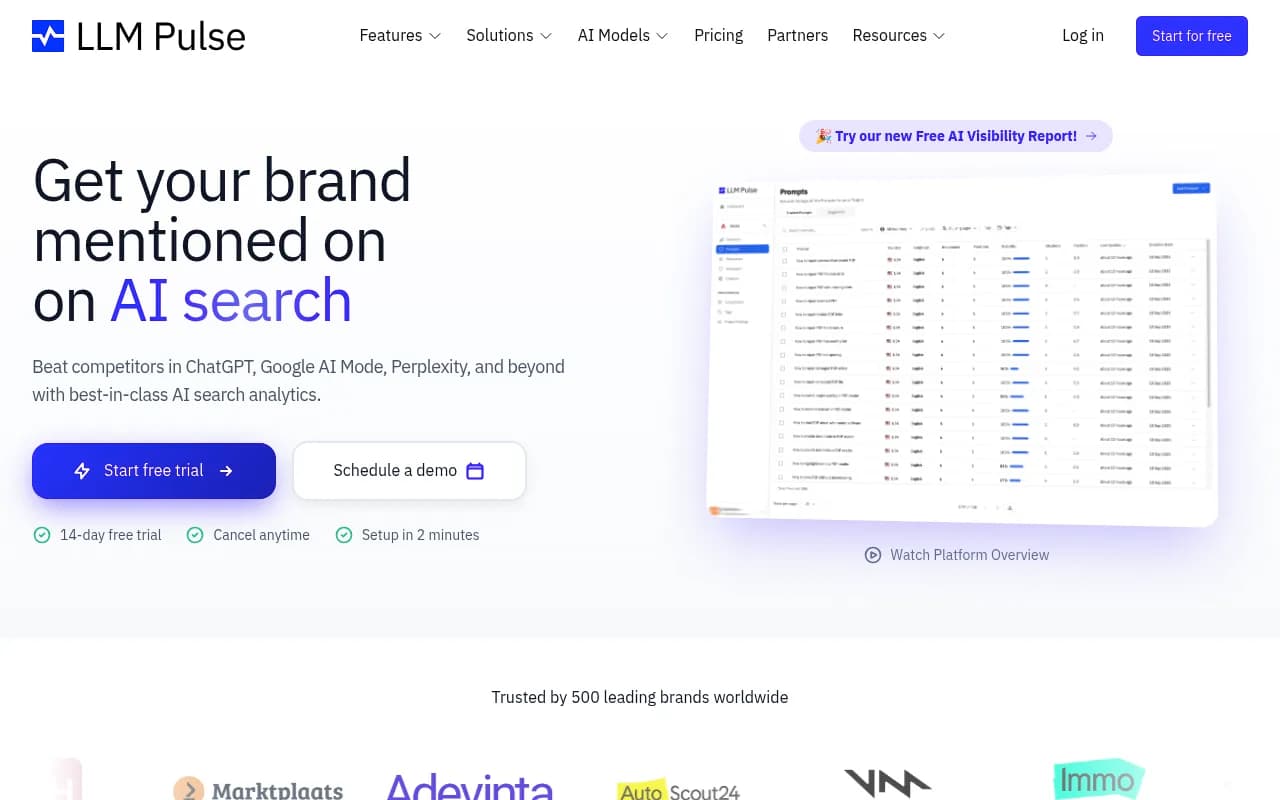
A few independent operators have built what amount to unofficial ad libraries by running large batches of prompts daily and logging every sponsored card that shows up. The ChatGPT Ad Library (chatgptadlibrary.com) catalogs thousands of brands by vertical, by creative, and by the trigger prompt that surfaced the ad. LLM Pulse launched a similar free archive in August 2026, explicitly describing it as "a sample, not a census" and "observed data, collected independently" rather than anything sourced from OpenAI.
Both tools are useful for one specific job: seeing which competitors are running ads and what their creative says. Headline, description, price point, landing page domain, the prompts that trigger them. That's a legitimate read on a competitor's positioning and messaging strategy, the same kind of audit you'd run on a rival's Google Ads copy. Neither tool claims to tell you how much that competitor is spending, and both are upfront that missing from the archive isn't proof of absence; it just means their sampling hasn't caught that advertiser yet.
Frequency and intensity signals
What you can measure with decent confidence is how often ads show up at all, in aggregate, across your prompt set. Promptwatch's own tracking of citation-enabled ChatGPT Search responses found ads in 0% of responses before May 27, 2026, climbing past 30% by July 1, with the most recent 7-day average sitting at 32.4%. That tells you the slot itself is becoming more common, which is useful macro context, but it says nothing about who's winning any specific slot for any specific prompt. Promptwatch's recommendation for anyone doing this kind of tracking is to run checks across multiple days rather than a single session, since daily rates have swung as high as 43.9% and as low as single digits depending on the day.

If you're already using Promptwatch to monitor your brand's AI visibility, the same prompt set you track for citations can double as a lightweight ad-presence sample: every time you pull a response, note whether a sponsored card appeared and who it belonged to. It's manual work layered on top of a tool built for something else, but it's a reasonable stopgap until a dedicated competitor-ad feature exists in this category.
The sampling problem, quantified
One of the more useful pieces of first-party research here comes from a GrowByData test that ran 44 buyer-intent and competitor-comparison prompts roughly once a day in both ChatGPT and Google AI Mode for a full month. Out of 1,317 ChatGPT searches, only 66 produced a sponsored placement, about 5 ads per 100 searches. Google AI Mode, run against the identical prompt set, produced almost double that density. Their blunt conclusion: a routine of a few dozen runs a month catches maybe a couple of ads. If you want a number you'd actually trust, you need sustained daily sampling over weeks, and even then you're measuring a share of what your sample saw, not the whole auction. That caveat matters. Any "competitor X has Y% share of voice" claim built on a thin prompt set is basically noise dressed up as data.
General competitive intelligence tools (adjacent, not direct)
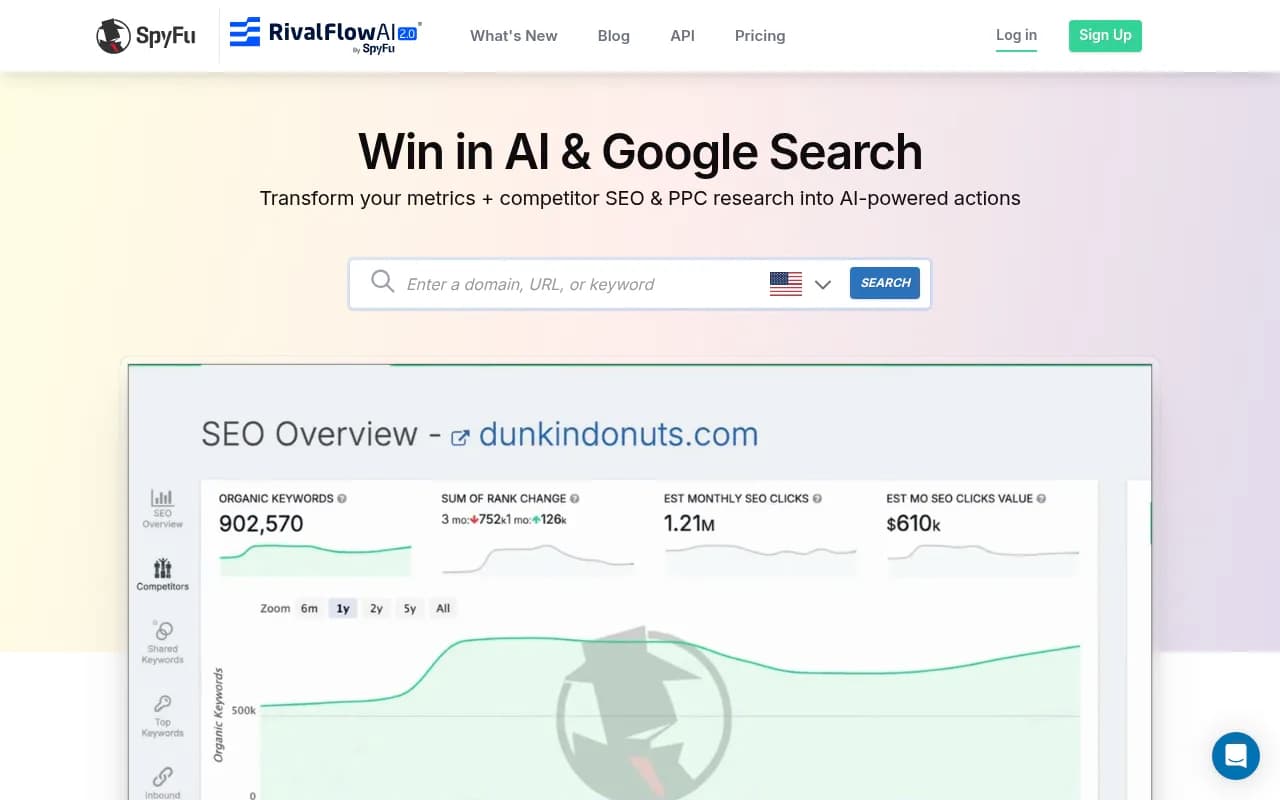
Tools built for broader competitive and ad intelligence, like Similarweb for traffic and digital strategy benchmarking or SpyFu for PPC keyword overlap, don't track ChatGPT ads specifically, but they're worth keeping in your stack if you're trying to triangulate a competitor's overall paid media posture. If a competitor's organic Google spend drops while their ChatGPT presence picks up in your manual sampling, that's a pattern worth a note, even if you can't put a dollar figure on it.
What's still a genuine black box
No auction insights, period
Unlike Google Ads, there's no report inside or outside ChatGPT that shows impression share, average position, or overlap rate against named competitors. GrowByData's own framing is the cleanest summary available: ChatGPT has no Auction Insights-style competitor report at all. You cannot see position, you cannot see impression share, and you cannot see overlap rate, full stop.
Spend is explicitly out of scope, even for advertisers themselves
This is the part people underestimate. OpenAI's own ads help documentation states that advertisers receive only "aggregated, non-identifying information about how their ads perform, such as total views or clicks" for their own campaigns, and that spend insights can be delayed 7-8 hours. If an advertiser running their own campaign can't see real-time spend on their own money, there is zero realistic path for an outsider to infer a competitor's budget with any precision.
The regulatory deadline won't fix this
On August 31, 2026, the European Commission designated ChatGPT a Very Large Online Search Engine under the Digital Services Act, triggered by roughly 159 million average monthly EU users. That designation legally obligates OpenAI to publish a public Article 39 ad repository within four months, landing around January 2027. It sounds like the fix everyone's waiting for. It isn't, not fully. Article 39 requires seven fields: the ad content, who it ran for, who paid (if different), the run period, targeting criteria, a commercial-communication flag, and reach broken down by member state. Spend and budget are not on that list. Even a fully compliant repository will tell you a competitor ran an ad targeting German users in March, not how much they paid for it.
It's also worth tempering expectations based on how comparable platforms have performed under the same rule. X scores worst among DSA-bound platforms, missing ad content, payer identity, and targeting data, and was fined €120 million in December 2025 over DSA violations (under appeal). TikTok's Commercial Content Library misses 7 of 11 sub-requirements with a binding fix deadline of December 2026, though it does offer the only genuine researcher API among the group. Meta's Ad Library, often held up as the gold standard, also misses 7 of 11 requirements and relies on self-declared, unverified advertiser identity. The realistic forecast is that ChatGPT's eventual repository lands somewhere in that range: a lagged, broad-category archive, not a clean Meta Ad Library equivalent, and certainly not a spend tracker.
No public pricing benchmarks to back into an estimate
Even the "work backward from known pricing" approach, the trick PPC people sometimes use on Google by comparing Quality Scores, falls apart here. OpenAI hasn't published average CPM, CPC, CTR, or conversion benchmarks. The only official number is a recommended $3-5 maximum CPC bid ceiling for Clicks campaigns and a $25 daily minimum, neither of which is an average price you can multiply against observed volume. Press-reported launch-era CPMs (around $60 in early 2026, dropping toward $25 by April) are third-party estimates, not OpenAI figures, and they tell you nothing about any single competitor's actual spend. A Reddit discussion among PPC practitioners flagged this exact trap: the Quality-Score-ratio method people use to estimate Google competitor spend is already shaky on Google, and it's not transferable to ChatGPT at all, because OpenAI publishes none of the underlying inputs (no Quality Score, no impression share, no average position) that the method depends on.
Comparing what's available today
| Approach | What it shows | What it doesn't show | Effort required |
|---|---|---|---|
| ChatGPT Ad Library / LLM Pulse archive | Observed creative, advertiser name, trigger prompts | Spend, bids, CTR, conversions | Low, free to browse |
| Manual daily prompt sampling (GrowByData method) | Presence/absence of an advertiser across your sample | True share of voice across the whole auction | High, needs weeks of logging |
| Promptwatch ad-frequency tracking | How often the ad slot appears across citation-enabled responses | Which specific competitor won any given slot | Low if you're already tracking prompts |
| EU Article 39 repository (expected Jan 2027) | Ad content, targeting, reach by member state | Spend, budget, bids | None for you, but data will lag and may be incomplete |
| Quality-Score-style spend inference | Nothing reliable | Everything, there's no public Quality Score or impression share to anchor the math | Not recommended |
A realistic workflow if you need to act on this today
Build a prompt set the same way GrowByData did: take your best-performing Google Ads keywords, rephrase them as natural buyer questions, and add a handful of direct competitor-comparison prompts ("X vs Y", "best alternative to X"). Fix your session conditions, same geo, same account state, so you're not introducing noise from personalization. Run it daily for at least four weeks, log every result including the runs with no ad shown, and treat anything shorter than that as anecdotal.
Pair that sampling with your existing AI visibility tracking rather than building a separate process from scratch. If you're already monitoring citations and prompt volume with Promptwatch, add a column for "sponsored card present / advertiser" to the same dashboard you're using for organic citation tracking, since the two signals (who gets cited organically, who buys the ad slot) are more useful read together than apart.
And set expectations with whoever's asking for this data internally. The honest deliverable in 2026 is "here's who we've observed running ads, on what prompts, with what creative, over a four-week window," not "here's competitor X's monthly ChatGPT ad budget." Anyone promising the latter is selling you a guess dressed up as a metric. If your team wants a broader view of which platforms actually do offer defensible AI-visibility and competitive data, the directory at ai-rank-tools.com is a reasonable place to compare what's out there beyond this specific gap.
What would actually close the gap
The realistic path to real competitor spend visibility isn't a scraping trick, it's regulatory pressure plus OpenAI's own commercial incentive to look transparent as ad revenue scales. The January 2027 DSA deadline is the first hard date on record, and it will produce something. Based on how TikTok and Meta's equivalents turned out, expect a repository that's searchable by advertiser and shows creative, targeting, and reach by country, arriving months later than scheduled, with real gaps in coverage. Spend will not be in it. If you want spend-level data on ChatGPT ads with any real confidence, that's a question for 2028 at the earliest, and only if regulators decide reach disclosure wasn't enough.
Until then, the honest framing for anyone running competitive analysis on ChatGPT ad spend is simple: you can see who's showing up and what they're saying, you cannot see what they're paying, and no tool on the market today, free or paid, claims otherwise without a caveat attached.