Key takeaways
- Weekly is the floor for any local prompt that matters commercially. Daily snapshots are statistical noise, single prompts checked once a day don't give you enough answers to tell signal from randomness.
- Local AI results churn harder than organic. Research cited by Garrett Handley puts domain volatility in local AI Overview results around 85%, and Authoritas found roughly 70% of cited pages can turn over within 8 to 13 weeks.
- Cadence should vary by content type. Landing and doc pages hold their citations for months; local "near me" and product-style pages decay much faster and deserve a tighter check-in.
- Re-test immediately after a confirmed model update, not just on a calendar. Promptwatch's data shows ChatGPT's average citations per response dropped about 27% within a day of the GPT-5.3 rollout in March 2026, a pure platform change that would have looked like a content problem if you didn't know the date.
- Treat Microsoft Copilot differently. Its citation counts have swung from under 2 to nearly 17 per response in a matter of weeks, so judge it on monthly trends, never on a single pull.
Why local prompts behave differently from generic brand prompts
If you're used to tracking "best CRM software" style prompts, local prompts feel like a different animal, because they are. A national software prompt draws from a relatively stable set of review sites, G2 pages, and comparison articles. A local prompt like "best plumber in Austin" or "emergency dentist near downtown Denver" pulls from Yelp listings, Google Business Profiles, Reddit threads, and local directory pages that rotate constantly based on freshness, recent reviews, and proximity signals that change by the hour.
The numbers back this up. Whitespark's 2026 study of 540 manual local queries across six verticals (plumbers, lawyers, dentists, optometrists, medical clinics, real estate) in Houston, Phoenix, and Denver found AI Overviews showing up in an average 68% of local business queries. Local Falcon's larger 60,000-query study across 4,423 businesses in 20 countries landed on 40.2%, a wide range that itself tells you these numbers are a moving target depending on vertical and geography.
What happens underneath those AI Overviews is the real story. Joy Hawkins at Sterling Sky tracked AI local packs surfacing only 5,943 unique businesses compared to 18,330 for the legacy 3-pack on the same query set, roughly a third of the coverage. Fewer slots exist, and the slots that do exist change hands fast. Garrett Handley's analysis puts domain volatility in local AI Overview results at around 85%. Separately, Authoritas found AI Overview source volatility averaging 0.68 over an 8-week window and 0.73 over 13 weeks, meaning something like 70% of the cited pages can be different two to three months later. Interestingly, the generated answer text itself is far steadier (volatility of 0.18 to 0.21 in the same study), so the words Google shows a user barely move even while the sources underneath churn completely. That's worth sitting with for a second: you can "lose" your citation without the visible answer changing at all, which is exactly why checking only the rendered text isn't enough.
The sample size problem nobody talks about
Before picking a cadence, you need enough data per check for the result to mean anything. A visibility rate near 25% measured over 72 answers carries a 95% confidence interval of about ±10 percentage points. Over roughly 300 answers that tightens to about ±5. To responsibly claim visibility moved from 20% to 30%, you need something like 294 answers in each comparison period. Checking one prompt once a day gives you 7 answers a week. That resolves nothing, it's just noise dressed up as a trend line.
The fix is to multiply, not to check more often. Fifty prompts across six engines sampled once a day produces 2,100 answers a week, which is plenty for a sound week-over-week read, even though a day-over-day comparison at that same volume (roughly 300 answers in a single day) still isn't statistically solid. For local monitoring this means: don't try to catch day-to-day wobble on one "best coffee shop in Portland" prompt. Build a real prompt set across intents, neighborhoods, and personas, and compare weekly windows against each other.
A content-type-aware cadence
Not every page decays at the same rate, so a single blanket cadence wastes effort on stable content and misses decay on volatile content. Promptwatch tracked every page ChatGPT cited on a single day in July 2026 and followed them for 90 days. The pattern by content type:
| Content type | Still cited after 30 days | Still cited after 60 days | Notes |
|---|---|---|---|
| Landing pages | 78% | 69% | Slowest decay, check monthly |
| Documentation | 76% | 67% | Similarly stable |
| Comparisons | 72% | 63% | Moderate decay |
| Product/local pages | ~65% | 55% | Reaches 50% "half-life" around 74-77 days |
| Reviews/how-tos | ~65% | 55% | Similar curve to product pages |
| News | ~55% | 41% | A quarter never cited again after day 0 |
Local business pages behave closer to the "product page" row than the "landing page" row. That half-life of 74 to 77 days is a useful number: if you're only checking your city-level prompts once a quarter, you're finding out about a lost citation roughly at the point half your coverage is already gone.
A practical cadence by prompt tier
Putting the sample-size math and the decay data together, here's the cadence I'd actually run:
| Prompt tier | Example | Recommended cadence | Why |
|---|---|---|---|
| Tier 1: revenue-critical, high-intent | "emergency plumber [city]", flagship location pages | Daily, aggregated weekly | Crisis-sensitive; a wrong answer costs money by the hour |
| Tier 2: core local service prompts | "best [service] near [neighborhood]" | Weekly | Matches the sample-size math; catches most churn before the 60-day decay point |
| Tier 3: long-tail city/neighborhood variants | Suburb- and micro-neighborhood-level phrasings | Bi-weekly to monthly | Lower volume doesn't justify daily checks; sample on rotation |
| Event-triggered checks | Any tier, after a confirmed model update | Immediately | Platform changes, not content changes, can move visibility overnight |
Local Falcon's own pricing guidance lands in a similar place: it explicitly recommends running geo-grid scans weekly or bi-weekly "to get a good trend analysis." That's a vendor confirming the same floor independently.
Event-triggered re-testing: the part a calendar can't catch
Cadence based purely on the calendar misses the single biggest cause of sudden visibility swings: the AI platform itself changing. Promptwatch's data shows average citations per ChatGPT response dropped around 27%, from 6.4 sources per response the week before to 4.7-4.9 by late March, within a day of the GPT-5.3 rollout on March 4, 2026, with no recovery a month later. If you were mid-quarter in a "check every 30 days" routine, you'd have attributed that drop to your own content, when it was a platform-controlled variable that changed overnight.
The same logic applies to Microsoft Copilot, which swung from under 2 to nearly 17 citations per response within weeks according to Promptwatch's average-sources-per-response tracking. Judge Copilot on monthly trends, never a single pull, because a sudden jump or drop is more likely a retrieval change on Microsoft's side than anything you did.
Google's own core update cadence gives a rough baseline for how often "the ground moves" on the traditional search side too: Google recorded 32 announced ranking updates from 2022 to 2025 (averaging 8 a year), with core updates specifically landing about 3.3 times a year and typical rollouts taking a bit over two weeks. Google's own advice is to wait at least a full week after a core update finishes before drawing conclusions, a rule of thumb worth borrowing for AI-answer tracking too.
What this looks like in practice for a multi-location brand
For a brand with locations across several cities, a workable setup looks like this:
- Build roughly 50-150 location-specific prompts per market, covering both branded ("[brand] [city]") and unbranded, organic-intent phrasings ("best [service] in [city]"), since unbranded local prompts pull from a much wider, noisier source pool. Promptwatch's own domain-crowding data shows unbranded prompts cite 10+ domains 52.5% of the time, versus only 21.3% for branded prompts, so unbranded local prompts need wider sampling to be trustworthy.
- Run the full set across at least ChatGPT, Google AI Overviews/AI Mode, and Perplexity daily, roll it up to a weekly comparison, and treat Copilot as a monthly-trend-only engine.
- Run from (or spoof) each target city, not just nationally. SE Ranking's AI Mode research confirmed Google adjusts answers by user location even without explicit geographic terms in the query, so a single national check misses city-level variation entirely.
- Re-run everything within 24-48 hours of any confirmed major model update, regardless of where you are in the normal cadence.
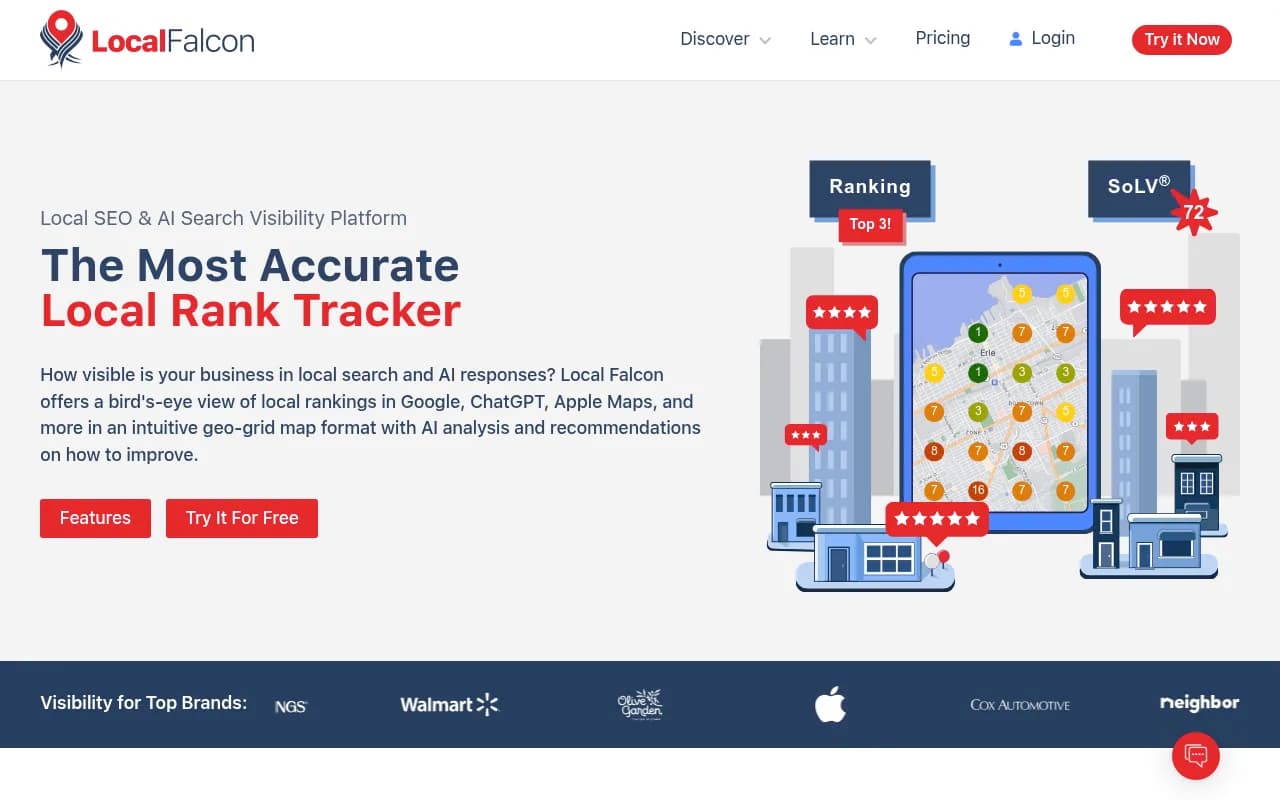
Tools in this space differ in how well they support that mix of frequency, geography, and engine coverage. Local Falcon is built specifically for geo-grid scanning and recommends weekly or bi-weekly runs as a minimum.
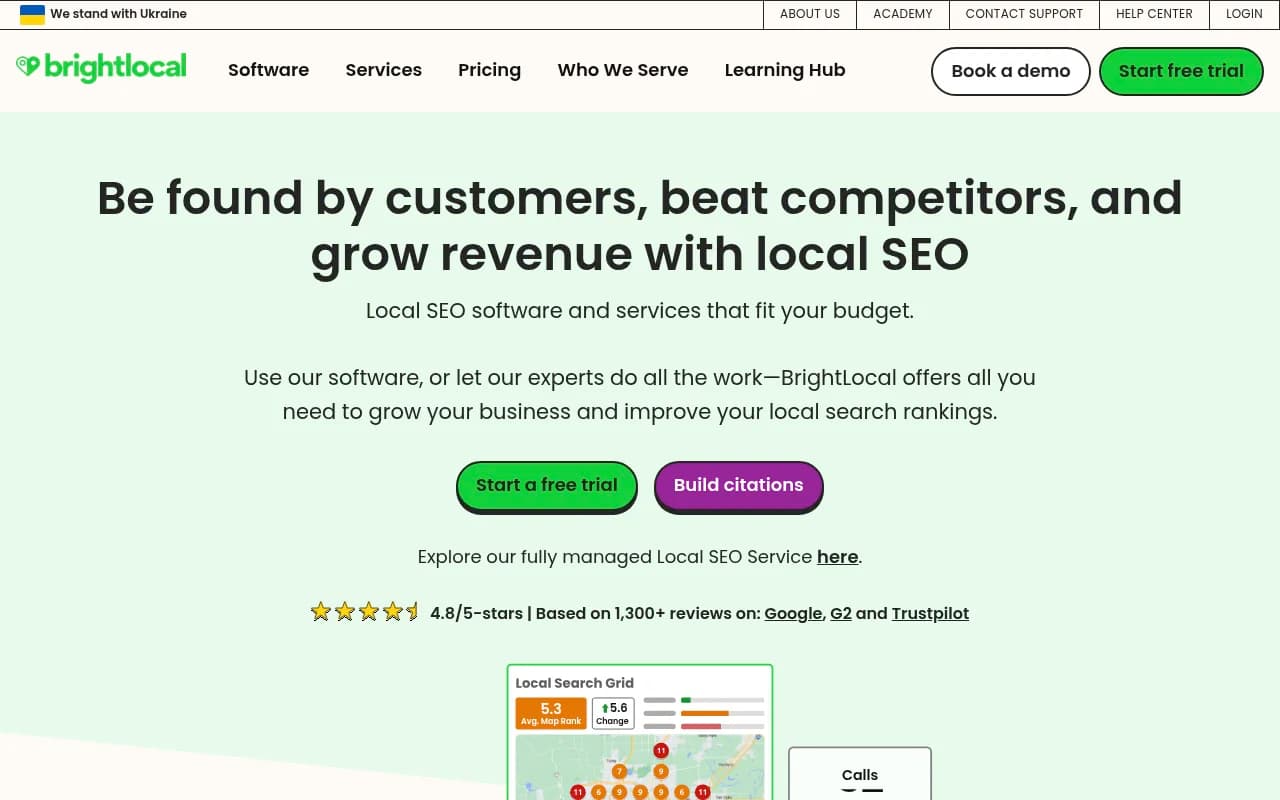
BrightLocal bundles an AI Overviews/ChatGPT/AI Mode tracker into its Track plan with up to 20 prompts per location, which works well for smaller multi-location footprints.
For brands that want city-level tracking combined with the ability to act on gaps rather than just monitor them, Promptwatch covers state, city, and country-level prompt tracking across all the major engines, plus crawler logs that show whether AI bots are even reaching your location pages in the first place, and content agents that can close the gap once you spot one.

Quick comparison
| Tool | Local/city-level tracking | Scan cadence support | Beyond monitoring |
|---|---|---|---|
| Local Falcon | Geo-grid, pin-level | Weekly/bi-weekly recommended | Rank visualization only |
| BrightLocal | Up to 20 prompts/location | Flexible, bundled with listings | Reviews, listings management |
| Synup | Multi-location AEO scoring | Scheduled | Listings/reviews bundled |
| Uberall | Location-level, 5 engines on higher tier | Scheduled | Multi-location workflows |
| Promptwatch | State/city/country-level, 12+ engines | Daily with weekly rollups | Content agents, crawler logs, CMS publishing |
Putting it together
If you only take one number away from this: weekly is the realistic floor for any local prompt tied to revenue, and the only thing that should ever override that calendar is a confirmed platform-level update, which deserves an immediate re-check regardless of where you are in the cycle. Quarterly local AI audits, which is still common practice at a lot of agencies, are checking in well past the point where half your citations have already turned over. If you want to see how these monitoring stacks compare in more depth, the GEO software directory at bestgeosoftware.com is worth a look.