Key takeaways
- ChatGPT's ad pilot hit roughly $100M in annualized revenue within two months of launch in February 2026, and ad-bearing responses now show up often enough that "who's advertising against my brand" is a real question, not a hypothetical one.
- Azoma is not an ads tracker. It's a competitive intelligence and share-of-voice tool built for agentic commerce, and it doesn't have a dedicated feature for monitoring ChatGPT ad placements.
- GetMint tracks ads at the Business tier and ties cited sources back to SKU-level product data, which is useful if you sell physical products and want to see who's bidding against your listings.
- Promptwatch includes Ads Radar (alongside ChatGPT Shopping tracking) starting on its Business plan, pairing ad visibility with crawler logs and citation data so you can see not just that a competitor's ad ran, but what page it pointed to and whether AI crawlers ever reached your own equivalent page.
- None of these three platforms give you a perfect, API-verified feed of every ad OpenAI serves. What you're really comparing is sampling methodology and what context each tool wraps around the ad sighting.
Why "tracking ChatGPT ads" is harder than it sounds
I want to get one thing out of the way before comparing vendors: there is no public ChatGPT Ads API that any of these three tools, or anyone else, can query directly. OpenAI doesn't publish a transparency feed of every sponsored placement the way Google's Ad Transparency Center does for search ads. So every "ChatGPT ad tracker" on the market is actually doing the same basic thing: running a large volume of prompts through the real ChatGPT interface, screenshotting or parsing the response, and flagging when a sponsored card or ad unit appears.
That matters because the accuracy question isn't really "which tool has better data access." It's "which tool samples enough prompts, across enough categories and geographies, with enough consistency, to give you a statistically meaningful read on ad frequency and who's showing up." A tool running 50 prompts a week is going to give you a much noisier picture than one running thousands.
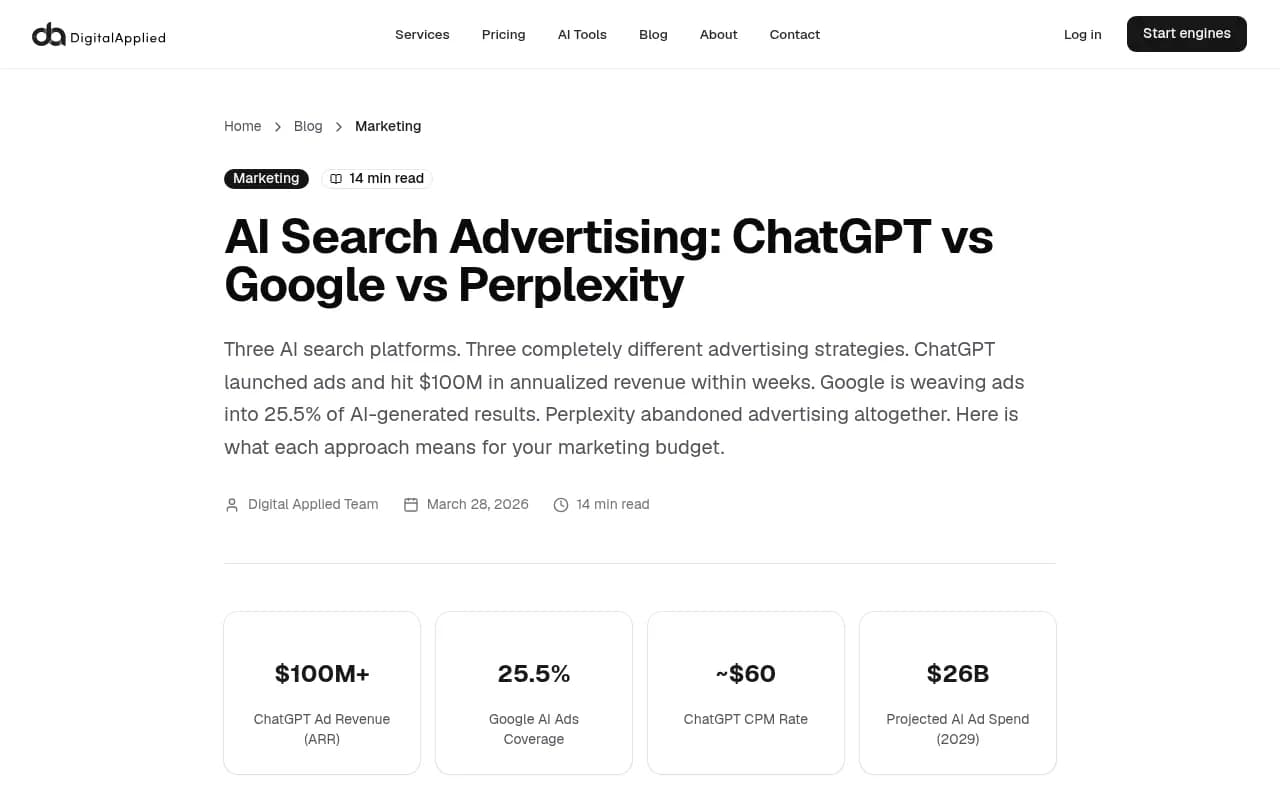
The scale of the opportunity is also bigger than most marketers assume. According to Digital Applied's 2026 analysis of AI search advertising, ChatGPT ads were already generating $100M in annualized revenue within two months of the February 2026 pilot launch, at roughly $60 CPM across 800M+ weekly users, and Google AI Mode now shows ads in about 25.5% of AI responses, up from just 5.17% in early 2025 (Digital Applied). Perplexity, by contrast, pulled out of advertising entirely in February 2026, citing user trust concerns. That split matters for a buying decision: if you only care about ChatGPT and Google AI Mode, ad tracking is worth paying for; if Perplexity is your main channel, it's a non-issue there for now.
Azoma: not actually an ads tracker
Let's deal with Azoma first, since it's the easiest to rule out. Azoma positions itself as a competitive intelligence and share-of-voice platform for agentic commerce, tracking how brands show up across AI shopping and recommendation flows. It's a reasonable tool if your question is "which competitors does ChatGPT recommend when someone asks for product suggestions in my category," but it does not have a dedicated feature for monitoring sponsored ad placements inside ChatGPT responses. If ad tracking is the specific job you're hiring a tool for, Azoma isn't built for that job, full stop. It may still be worth a look for broader agentic commerce visibility, but that's a different use case than what this guide is about.
GetMint: SKU-level ad monitoring, but only on the higher tier
GetMint is built for brands that sell products and want to see how those products show up in AI search, including ChatGPT's shopping surfaces. It pulls prompt volume data via DataForSEO and ties citations to SKU-level product detail, which is a genuinely useful angle if you're an e-commerce brand trying to understand whether AI engines are citing your product pages versus a competitor's.
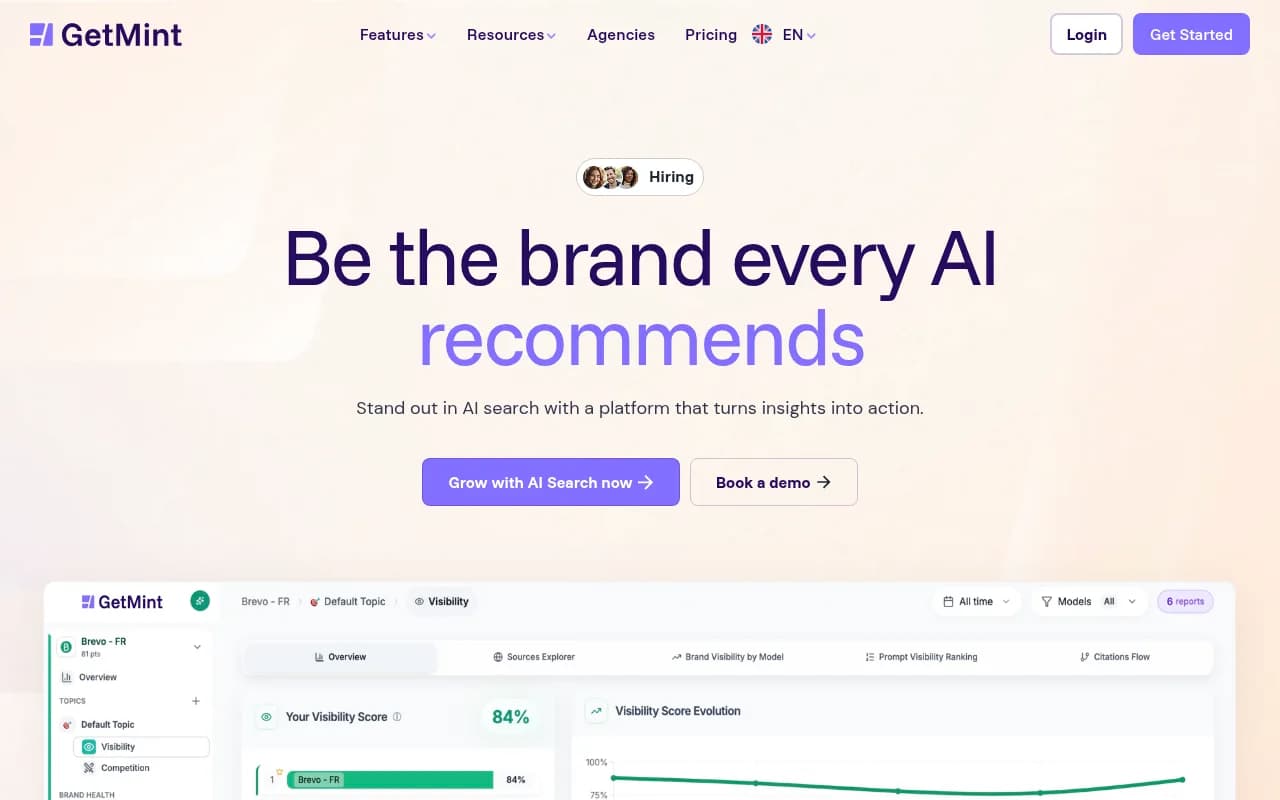
Where GetMint gets interesting for this comparison is its ad monitoring, which according to Promptwatch's own comparison data is available but gated to GetMint's higher-tier plan rather than included across the board. The entry Starter tier runs about $99/month (the vendor's pricing page now lists it closer to €74/month, with the $99 figure reflecting an earlier US pricing point) for roughly 50 prompts and around 3,000 responses tracked across two AI models, refreshed daily. That's a decent starting point for prompt and citation tracking, but if ad visibility is the actual reason you're buying, you need to check which tier unlocks it before you commit, because the sticker price on the entry plan doesn't include the feature you came for.
The SKU-level cited-sources detail is a real differentiator if your business is product-led. It's less useful if you're a SaaS company or a service business without product SKUs to tie citations back to.
Promptwatch: Ads Radar plus the context to act on it
Promptwatch approaches this from a different angle. Rather than treating ad tracking as a standalone widget, it's packaged as part of the Ads Radar feature alongside ChatGPT Shopping tracking, and it sits inside a broader stack that includes prompt volumes and difficulty scoring, query fan-out analysis, crawler logs, and citation trend data. According to Promptwatch's own 2026 platform comparison, it's currently the only platform in its benchmark set that scores full marks across AI ad tracking and the five other core capabilities it evaluates (prompt volumes, prompt difficulty, query fanouts, ChatGPT Shopping, and Reddit insights) combined (Promptwatch's GEO platform comparison).

The practical difference is this: when Promptwatch flags that a competitor's ad is showing up for one of your tracked prompts, you're not looking at an isolated data point. You can cross-reference it against your own citation trends for that same prompt, check whether AI crawlers have ever actually read the page you'd want cited, and see if there's a content gap explaining why the organic answer skipped you in favor of a paid placement. That's useful because an ad appearing isn't automatically a problem. Sometimes it means a competitor is buying visibility they haven't earned organically, which is exactly the kind of gap a content fix can close.
Ads Radar is available starting on Promptwatch's Business plan at $579/month, which also includes 350 prompts, 42,000 responses tracked, and 100M crawler log events. That's a meaningfully higher price than GetMint's entry tier, but it's also a different scope: you're paying for full-stack monitoring plus ad visibility, not ad visibility alone.
Side-by-side comparison
| Platform | ChatGPT ad tracking | How it's packaged | Entry price with ad tracking | Best fit |
|---|---|---|---|---|
| Promptwatch | Yes, via Ads Radar | Business plan, paired with ChatGPT Shopping, crawler logs, citation trends | $579/mo (Business) | Teams that want ad visibility tied to a content fix |
| GetMint | Yes, SKU-level | Higher tier only, not on Starter | Starter ~$99/mo (ad tracking gated above this) | E-commerce brands wanting ad vs. SKU citation comparison |
| Azoma | No dedicated feature | Competitive intelligence / SOV for agentic commerce | n/a | Agentic commerce share-of-voice, not ad monitoring |
What actually determines accuracy between these tools
Since none of them have privileged API access to OpenAI's ad serving logic, the real differences come down to a handful of concrete things worth asking any vendor before you buy:
- Sample volume: how many responses per month does the plan actually run against ChatGPT, and how many of those are the specific prompt categories where ads tend to appear (commercial, shopping, comparison intent)?
- Refresh cadence: daily refresh catches ad rotation and seasonal campaigns better than weekly snapshots.
- Real UI versus API parsing: ads render in the consumer-facing ChatGPT interface, not necessarily in API responses, so a tool needs to be sampling the actual interface rather than a backend endpoint that might not show sponsored content the same way.
- What you get alongside the sighting: an ad flag by itself tells you a competitor is spending money. An ad flag paired with citation and crawler data tells you whether they're also winning organically, which changes what you do next.
For context on how often ads are showing up at all, Digital Applied's analysis found Google AI Mode now displays ads in about a quarter of its AI responses, up fivefold from early 2025, while ChatGPT's pilot is still newer and growing fast. If you're trying to build a business case for paying for ad tracking at all, that growth curve is the number to bring to your budget conversation, not a vague sense that "ads are coming to AI search eventually." They're already here and the spend is projected to reach $26B by 2029, which is 13.6% of all search ad spend.
Which one should you actually pick
If ad tracking is your only requirement and you're not selling physical products, neither GetMint nor Azoma is the right fit, since Azoma doesn't do it and GetMint's SKU framing adds overhead you don't need. If you're an e-commerce brand and want ad visibility tied directly to product-level citation data, GetMint's higher tier is worth evaluating, just confirm pricing and which tier unlocks ads before signing anything.
If you want ad tracking as one input into a bigger decision, where you see an ad, check whether your own content is being crawled and cited for that same prompt, and then get an AEO content brief or automated draft to close the gap, Promptwatch's Business plan is built for that workflow specifically. It's a bigger spend than GetMint's entry tier, but you're buying the full loop from monitoring to fix, not just a flag that says "an ad ran here."
For a broader look at how these and other platforms stack up on cost per response and model coverage beyond just ads, the GEO software directory at bestgeosoftware.com is a reasonable place to keep comparing options as pricing and features shift through the rest of 2026.