Key takeaways
- AI search answers aren't static enough to eyeball. ChatGPT serves ads in roughly 20-32% of web-search responses depending on the week, and citation counts per answer can swing 27% overnight after a model update, so any organic-vs-paid comparison needs a real sample, not a screenshot.
- Treat organic AI visibility and paid AI placement as two separate experiments with two separate measurement systems, then join the data at the business-outcome level (traffic, leads, revenue), not at the "did we show up" level.
- You need roughly 300 answers per arm per week to detect a 10-point visibility swing with any confidence, and several times that to detect a 5-point move. Most teams under-sample badly and then draw conclusions from noise.
- Hold your prompt set, model versions, and geography constant for the duration of the test window, and log every platform-side change (new ad format, new ranking update) as a potential confounder, not as your result.
- Organic content compounds over weeks via citation decay curves, while paid placement stops the moment budget runs out, so the two arms need different measurement windows even inside the same experiment.
Why this is harder than a normal A/B test
A regular A/B test on your website is clean. You control the code, you control the traffic split, and the only thing that changes between variant A and variant B is the thing you changed. AI search is nothing like that.
When you're comparing "we earned a citation in ChatGPT organically" against "we bought a placement in ChatGPT Ads or ran a Google AI Max campaign," you're not controlling the environment at all. The model itself changes week to week. OpenAI's own rollout of GPT-5.3 on March 4, 2026 cut the average number of citations per ChatGPT response by about 27% almost overnight, from roughly 6.4 sources down to 4.7-4.9, and it never bounced back a month later. That's not something you caused. If you happened to be running an organic visibility test across that date, your numbers would have cratered for reasons that have nothing to do with your content (Promptwatch's citation drop data).
The ad side has its own volatility. Promptwatch's tracking of ChatGPT ad frequency over a 90-day window shows ads went from zero (before May 27, 2026) to north of 30% of ad-eligible responses by July, with a 7-day average as high as 32.4% in mid-August — a swing of more than 10 percentage points week over week (ChatGPT Ads Over Time). If you're testing paid placement performance and you don't know whether you measured it during a low-ad week or a high-ad week, you're not testing anything, you're just recording weather.
So the first rule of this framework: stop thinking of AI search as a stable surface you can split-test like a webpage. Think of it as a market that moves under you, and design the test to survive that movement.
Step 1: define what "win" actually means
Before touching any tool, decide what you're actually trying to learn. There are at least three different questions hiding inside "organic vs paid in AI search," and they need different setups:
- Visibility question — does paid placement get you seen more often than organic citation, for the same query set?
- Traffic/conversion question — which channel sends more qualified visitors and at what cost?
- Durability question — what happens to each channel's performance after you stop actively working on it?
Most teams jump straight to comparing visibility rates and skip questions 2 and 3, which is backwards. A high visibility rate that doesn't convert is a vanity metric. A content page that was cited two months ago and is still being cited today, at zero marginal cost, is a very different asset than an ad that stops the second the budget runs dry.
Step 2: pick your prompt set and lock it
This is the part teams get wrong most often. You can't just "check ChatGPT for our brand" a few times a week and call it data. Third-party measurement research (Cloro) puts hard numbers on this: a visibility rate near 25% measured over 72 answers carries a 95% confidence interval of plus or minus 10 points. Get to around 300 answers and that tightens to plus or minus 5 points. If you want to detect a real move from 20% to 30% visibility with standard statistical power, you need roughly 294 answers per measurement period. One prompt checked once a day gives you seven data points a week — nowhere close.
Translate that into a practical setup:
- Build a prompt set of 50-150 queries that represent real buyer intents, not 50 phrasings of the same intent (phrasing variants are repeated samples, not added coverage).
- Run each prompt once per engine per day, every day, for the full test window.
- Aggregate to weekly rates per engine. Never pool different engines into a single blended number — ChatGPT, Perplexity, Google AI Overviews and AI Mode each have distinct citation behavior and distinct noise profiles.
- Perplexity is the steadiest engine for this kind of test. It cites almost exactly 10 sources per response with the least day-to-day variance of any major engine, which means if your Perplexity numbers move, it's more likely your content than engine noise. ChatGPT cites around 5 sources per answer (though that number is itself unstable, see above), Google AI Overviews around 10, and Microsoft Copilot has swung from under 2 to nearly 17 sources per response within weeks — too volatile to lean on for a tight measurement window (Average Sources Per Response).
To actually run this cadence without hand-checking prompts, you need a monitoring layer. Promptwatch tracks prompt volumes, citation rates, and model-level shifts across ChatGPT, Gemini, Claude, Perplexity, Grok, and Google AI Overviews and AI Mode, which is the kind of infrastructure this experiment design assumes you have running in the background.

If you're comparing tools in this space before committing, the GEO software directory at bestgeosoftware.com lists the current field of AI visibility platforms side by side.
Step 3: separate the organic arm from the paid arm
The organic arm
You're testing whether a piece of content earns citations without paid intervention. Hold the content stable for the duration of the test (don't rewrite it mid-window, you'll corrupt the measurement). Pick content types deliberately: Promptwatch's citation-type breakdown shows product pages (22.4% of ChatGPT citations), landing pages (16.8%), and listicles (13.6%) dominate, with how-tos, docs, and comparisons trailing behind. If you're testing organic performance in a commercial category, product and landing pages are your fairest comparison point against a paid product listing (ChatGPT Citation Share by Content Type).
Also account for decay. Organic citations don't behave like a light switch — they ramp, peak, and fade on different schedules by content type. Landing pages and documentation still get cited at 78% and 76% of their peak rate after 30 days; comparisons fall from 72% to 63%; product pages, reviews, and how-tos all settle around 55% after 60 days. News content decays fastest — a quarter of news citations never recur after day zero, and half are gone within 36 days. If your test window is shorter than a content type's natural decay curve, you'll mistake normal fade for failure (ChatGPT Content Half-Life data).
If you're running classic SEO A/B tests on the content itself (headline variants, structure changes) before measuring AI citation impact, use proper web-testing hygiene: never cloak content differently to crawlers versus users, and if you redirect a test variant URL, use a 302 (temporary) redirect, not a 301, so AI crawlers and search engines keep indexing your original page. Platforms built specifically for SEO-style split testing, like SplitSignal and SearchPilot, handle this traffic-splitting logic for you.
The paid arm
You're testing two live ad systems right now: OpenAI's ChatGPT Ads and Google's AI Max for Search campaigns.
ChatGPT Ads moved to self-serve CPC bidding on May 5, 2026, with OpenAI recommending a starting max bid of $3-5 per click; reported real-world ranges run $3-6 for e-commerce, $8-18 for software, and $15-25 for finance and legal queries. You're only charged on a completed click, not an impression. ChatGPT now reaches 1.2 billion people weekly, and OpenAI has started piloting geo-based incrementality experiments with measurement partners Haus, Measured, and WorkMagic — worth watching if you want a methodology to borrow, since OpenAI itself admits "our work on incrementality is still in its early stages."
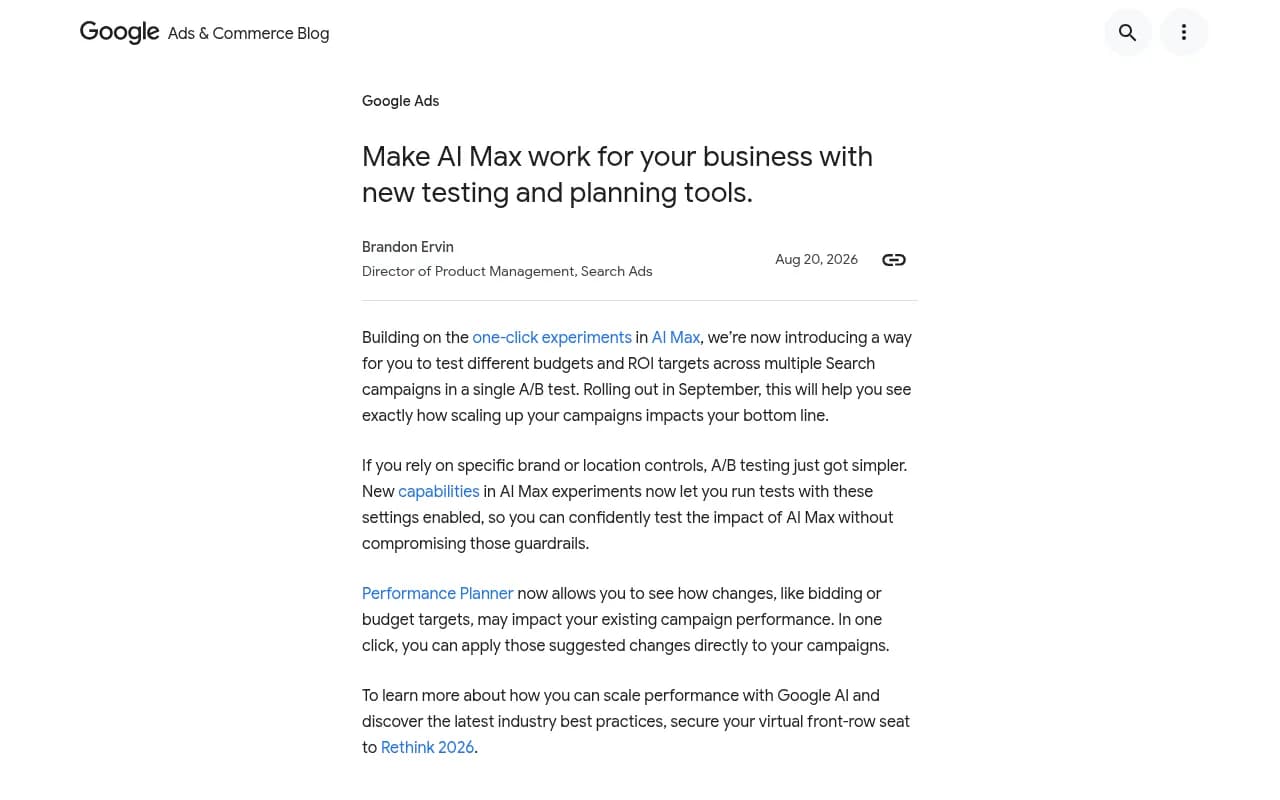
Google's AI Max, which moved out of beta in 2026, reports an average 7% lift in conversions or conversion value at similar CPA/ROAS when advertisers use the full feature set (search term matching, text customization, final URL expansion) versus search term matching alone. As of September 2026, Search campaigns using Dynamic Search Ads, automatically created assets, or campaign-level broad match get auto-upgraded to AI Max whether you asked for it or not, and Google has added one-click experiments that let you A/B test budgets and ROI targets across multiple campaigns in a single test. One caveat Google states directly: AI Max won't be effective if campaigns are limited by budget, so don't run a tight-budget paid arm and expect it to represent the channel's real ceiling.
Step 4: build the comparison table before you run anything
Decide your metrics up front so you're not retrofitting a narrative after the data comes in.
| Dimension | Organic arm | Paid arm |
|---|---|---|
| Primary metric | Citation rate per prompt per engine (weekly aggregate) | Impression/click rate at agreed bid range |
| Cost structure | Content production + optimization time | CPC or CPM, ongoing spend |
| Sample size needed | ~300 answers/week per engine for ±5pt confidence | Platform-reported, but cross-check with incrementality/holdout where possible |
| Decay behavior | Gradual, varies by content type (55-78% retained at 60 days) | Immediate stop when budget stops |
| Confounders to log | Model version changes, fanout behavior changes, domain authority shifts | Ad format changes, bid auction dynamics, category-level ad saturation |
| Best engine to test on | Perplexity (lowest variance) or Google AI Overviews | ChatGPT (self-serve CPC), Google Search (AI Max) |
Step 5: control for the confounders that will wreck your results
A few specific things changed in 2026 that any organic-vs-paid tester needs to log on a calendar, because they'll show up in your data whether you asked for them or not:
- Query fanout changes. ChatGPT's average fanout searches per response dropped from roughly 1.84 in early March 2026 to exactly 1.0 by April, and average query length shrank from about 117 characters to 53. If your organic content is written for long-tail phrasing and the model shifts to short, keyword-like fanout queries mid-test, your citation rate can move for reasons unrelated to content quality (ChatGPT Query Fanouts).
- Domain authority is a weak control variable. Mid-authority domains (DR 46-75) earned about 46% of all ChatGPT citations in August 2026, while the very top tier (DR 91-100) fell from roughly 7% to 3% share by mid-month. Don't assume a high-authority competitor automatically beats your organic test page — relevance is doing more work than raw domain rank right now (ChatGPT Citation Share by Domain Rank).
- Ad saturation by prompt type. Of ad-bearing ChatGPT responses, 73.3% come from generic, unbranded prompts rather than branded ones. If your paid arm is tested on branded queries, you're testing a much less crowded, less representative slice of the ad experience than most users actually see (ChatGPT Ads Over Time).
Step 6: run the test on a weekly cadence, not a daily one
Compare periods, not single days. A single answer, or even a single day's worth of answers, is an anecdote. The smallest sound measurement unit for a mid-sized prompt set is a week. Set up alerting on multi-day aggregates ( "visibility below 15% for 7 consecutive days" ) rather than reacting to any one day's blip, and batch any changes to your prompt set so you don't accidentally manufacture a fake trend by quietly swapping prompts mid-test.
For the organic side, Promptwatch's crawler logs (Agent Analytics) are useful here because they show you when AI crawlers actually visited your test pages and whether they hit errors, which helps you separate "we weren't cited because the model didn't see us" from "we weren't cited because the model saw us and chose someone else." That's a meaningfully different failure mode and it changes what you fix next.
Step 7: join the data at the business-outcome layer
This is the step most organic-vs-paid comparisons skip. Visibility rate and ad impression rate are inputs, not outcomes. The real comparison is: for every dollar and hour spent, how much qualified traffic and revenue did each channel produce, and how much of that is still running after you stop paying attention to it.
OpenAI's own named case studies from its October 2026 measurement expansion give a useful benchmark for the paid side: WeightWatchers' attributed CPA on ChatGPT Ads ran 15.3% lower than its blended paid-search benchmark (per DV Rockerbox), and 93% of Portland Leather's ChatGPT Ads visitors were new customers (per Triple Whale). Those are real incrementality numbers, not just impression counts, and they're the standard your organic measurement should be held to as well — not "did we get cited" but "did it bring someone new who converted."
For attribution tooling on the organic side, Promptwatch's visitor analytics track actual AI-referred traffic and conversions rather than stopping at citation counts, which is the piece most prompt trackers simply don't have.
A simple decision framework
- If your category has thin organic AI citation inventory (brand-specific prompts, for instance, see only 21.3% of ChatGPT responses citing 10+ domains versus 52.5% for generic prompts), paid placement is probably your faster lever short-term.
- If your content type has a long half-life (landing pages, documentation, comparisons), the organic arm likely wins on cost-per-citation over a 60-90 day window even if it starts slower.
- If you're testing a new product launch with no existing organic footprint, run paid first to generate immediate visibility, then layer organic content testing in parallel, measuring whether the paid exposure is lifting organic citation rates indirectly.
- Re-baseline your whole framework whenever a major model update ships (new GPT version, new Gemini release). Treat the before/after as two separate experiments, not one continuous line.
If you want to go deeper on tooling before you build this out, the rank-tracking options at ai-rank-tools.com and the broader software directory at surferstack.com are good starting points for comparing the monitoring and experimentation stack this framework assumes you have in place.