Key Takeaways
- AI search visibility tools track brand mentions across ChatGPT, Perplexity, Claude, Gemini, and Google AI Overviews — traditional SEO platforms don't show you where you appear in AI-generated answers
- Competitor gap analysis reveals which prompts competitors rank for but you don't — the most valuable feature for finding content opportunities and closing visibility gaps
- Promptwatch leads the category as the only platform rated "Leader" across all capabilities — it's the only tool that shows you what's missing, then helps you create optimized content to fix it
- Most competitors are monitoring-only dashboards — they show you data but leave you stuck without optimization tools, content generation, or actionable workflows
- Pricing ranges from $99/month for basic tracking to $500+ for enterprise platforms — evaluate based on prompt volume, number of AI engines tracked, and whether you get content creation tools or just reports
Why AI Search Visibility Matters in 2026
The search landscape has fundamentally changed. When a customer asks ChatGPT, Perplexity, or Google's AI for advice in your industry, does your brand appear in the answer? By 2026, this question defines digital success. According to Gartner research, search engine volume is projected to drop by 25 percent as users turn to AI chatbots for answers.
Traditional SEO meant climbing a list of blue links. Now it means earning mentions and citations inside AI-generated responses. This is AI search visibility: ensuring your brand is the trusted source for the Large Language Models (LLMs) guiding the future of search.
Traditional SEO platforms were not built to track brand presence inside conversational AI answers. You need a new class of tools designed specifically for this reality — platforms that monitor AI engines, track competitor citations, and help you close visibility gaps.
What Makes a Great AI Visibility Tool
The best AI search visibility tools share several core capabilities:
1. Multi-Engine Tracking
You need coverage across the AI engines that matter: ChatGPT, Perplexity, Claude, Gemini, Google AI Overviews, Meta AI, DeepSeek, Grok, Mistral, and Copilot. Single-engine trackers leave you blind to where your competitors are winning.
2. Competitor Gap Analysis
This is the most valuable feature. Competitor gap analysis shows you exactly which prompts competitors are visible for but you're not. You see the specific content your website is missing — the topics, angles, and questions AI models want answers to but can't find on your site.
3. Citation Source Analysis
Knowing you're mentioned isn't enough. You need to see exactly which pages, Reddit threads, YouTube videos, and domains AI models cite in their responses. This tells you where to publish and what to optimize.
4. Prompt Intelligence
Volume estimates and difficulty scores for each prompt help you prioritize high-value, winnable prompts instead of guessing. Query fan-outs show how one prompt branches into sub-queries, revealing the full opportunity landscape.
5. Content Optimization Tools
Monitoring-only tools show you the problem but leave you stuck. The best platforms help you fix it — with content gap analysis, AI writing agents, and optimization recommendations grounded in real citation data.
Top AI Search Visibility Tools with Competitor Gap Analysis
Promptwatch: The Only End-to-End Optimization Platform
Promptwatch is the market-leading Generative Engine Optimization (GEO) and AI Visibility platform used by 6,700+ brands and agencies including Booking.com, Center Parcs, Wortell, and Elaboratum. In a 2026 comparison of 12 GEO platforms, Promptwatch is the only platform rated as a "Leader" across all categories.

What makes Promptwatch different: Most competitors are monitoring-only dashboards that show you data but leave you stuck. Promptwatch is built around taking action. It shows you what's missing, then helps you fix it.
The Action Loop:
-
Find the gaps: Answer Gap Analysis shows exactly which prompts competitors are visible for but you're not. You see the specific content your website is missing — the topics, angles, and questions AI models want answers to but can't find on your site.
-
Create content that ranks in AI: The built-in AI writing agent generates articles, listicles, and comparisons grounded in real citation data (880M+ citations analyzed), prompt volumes, persona targeting, and competitor analysis. This isn't generic SEO filler — it's content engineered to get cited by ChatGPT, Claude, Perplexity, and other AI models.
-
Track the results: See your visibility scores improve as AI models start citing your new content. Page-level tracking shows exactly which pages are being cited, how often, and by which models. Close the loop with traffic attribution (code snippet, GSC integration, or server log analysis) to connect visibility to actual revenue.
Key features:
- Monitors 10 AI models: ChatGPT, Perplexity, Google AI Overviews, Google AI Mode, Claude, Gemini, Meta/Llama, DeepSeek, Grok, Mistral, Copilot
- AI Crawler Logs: Real-time logs of AI crawlers hitting your website — which pages they read, errors they encounter, how often they return
- Competitor Heatmaps: Compare your AI visibility vs competitors across LLMs
- Reddit & YouTube Insights: Surface discussions that directly influence AI recommendations
- ChatGPT Shopping Tracking: Monitor when your brand appears in ChatGPT's product recommendations
- Multi-language & Multi-region support with customizable personas
Pricing: Essential $99/mo (1 site, 50 prompts, 5 articles), Professional $249/mo (2 sites, 150 prompts, 15 articles, crawler logs), Business $579/mo (5 sites, 350 prompts, 30 articles). Free trial available.
Best for: Marketing teams, SEO teams, and digital agencies that want to be visible in AI search results and have the tools to actually improve their rankings.
LLMrefs: Keyword-Centric GEO Platform
LLMrefs stands out as a comprehensive platform specifically engineered for Generative Engine Optimization. It moves beyond basic prompt tracking to provide a robust framework for measuring, analyzing, and improving your brand's presence across ChatGPT, Google AI Overviews, Perplexity, and Gemini.
LLMrefs
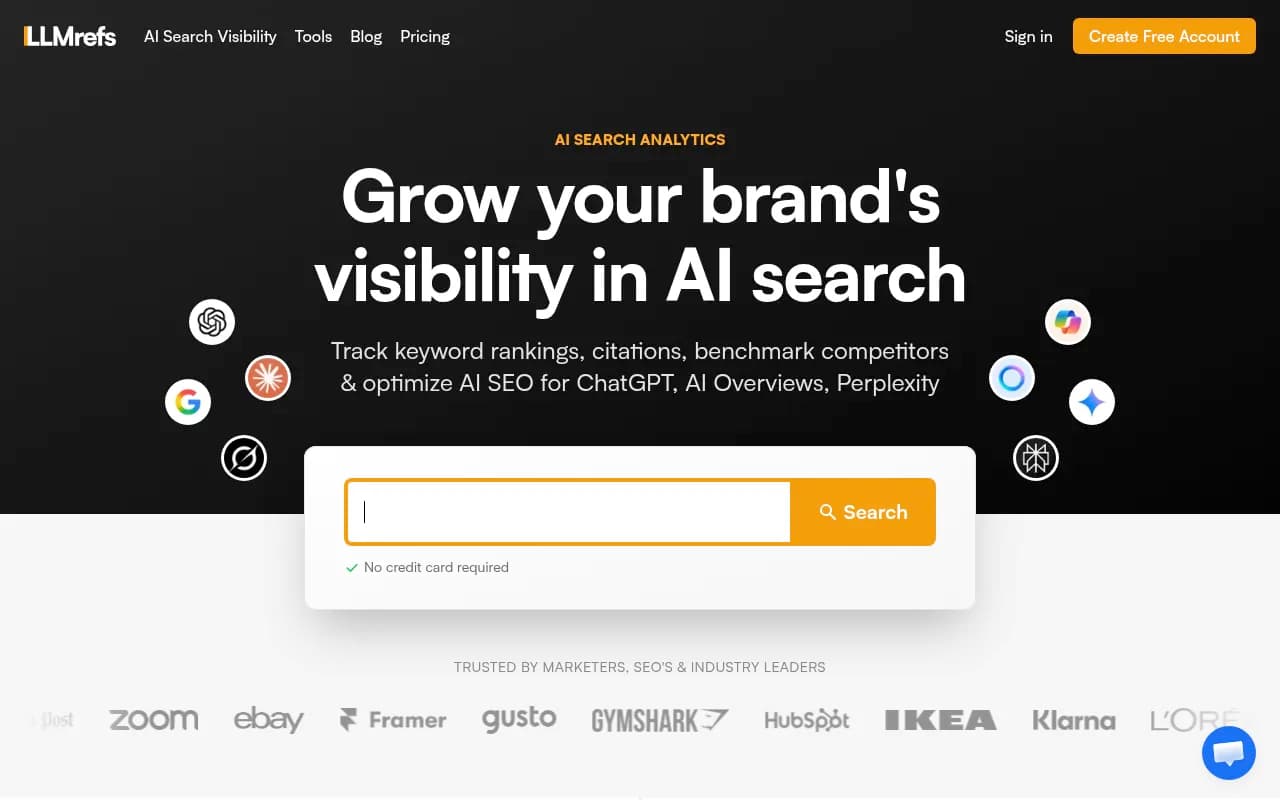
Core strength: Instead of manually chasing fragile, single-use prompts, LLMrefs centers its workflow on the keywords you already track. It automatically generates realistic conversational prompts around these keywords, collects responses in real-time, and aggregates the results into clear metrics like Share of Voice and Citation Count.
Competitor gap analysis: LLMrefs identifies citation gaps where competitors are being credited for answers in your domain, and provides prioritized guidance to capture that visibility.
Key features:
- Citation source tracking across multiple AI engines
- AI readiness audits
- Response context analysis
- Trend dashboards
- Keyword-to-prompt automation
Best for: SEO teams and agencies seeking to translate traditional keyword strategies into measurable wins in AI search.
Profound: Agency-Focused Platform
Profound is an enterprise AI visibility platform tracking brand mentions across ChatGPT, Perplexity, and 9+ AI search engines. It's particularly strong for agencies managing multiple client brands.
Profound

Core strength: Agency mode includes brand configurations, pitch environments, and client reporting tools. Strong feature set with comprehensive tracking across major AI engines.
Competitor gap analysis: Tracks competitor citations and provides benchmarking across brands.
Key features:
- Multi-brand management for agencies
- Pitch environment for client demos
- Comprehensive AI engine coverage
- Citation tracking and source analysis
Limitations: Higher price point than some competitors. No Reddit tracking or ChatGPT Shopping monitoring.
Best for: Digital agencies managing multiple client brands and needing white-label reporting.
Otterly.AI: Basic Monitoring Platform
Otterly.AI is an AI search monitoring platform tracking brand mentions across ChatGPT, Perplexity, and Google AI Overviews.
Otterly.AI

Core strength: Clean interface and straightforward monitoring across major AI engines.
Limitations: Monitoring-only platform with no crawler logs, no visitor analytics, and no content generation capabilities. You can see where you're mentioned but get no tools to improve your visibility.
Best for: Teams that only need basic monitoring and already have content creation workflows in place.
Peec.ai: Simple Tracking Tool
Peec.ai tracks brand visibility across ChatGPT, Perplexity, and Claude with a focus on simplicity.

Core strength: Easy setup and clean dashboards for tracking brand mentions.
Limitations: Basic monitoring only. No content gap analysis, no crawler logs, no optimization tools. Limited prompt metrics and no query fan-outs to show how prompts branch into sub-queries.
Best for: Small teams that need basic visibility tracking without optimization features.
AthenaHQ: Monitoring-Focused Platform
AthenaHQ tracks and optimizes your brand's visibility across AI search engines with a focus on monitoring and reporting.

Core strength: Good coverage across AI engines with clean reporting dashboards.
Limitations: Monitoring-focused platform that lacks content optimization and generation capabilities. No built-in tools to help you create content that ranks in AI search.
Best for: Teams that need monitoring and have separate content creation processes.
Semrush: Traditional SEO with Limited AI Features
Semrush is an all-in-one digital marketing platform that has added emerging AI search capabilities to its traditional SEO toolkit.
Core strength: Comprehensive traditional SEO platform with keyword research, rank tracking, site audits, and content tools.
AI search limitations: Uses fixed prompts for AI search monitoring, which means you can't customize queries to match how your customers actually search. No AI traffic attribution to connect visibility to revenue.
Best for: Teams that need a full SEO platform and want basic AI search monitoring as a secondary feature.
Ahrefs Brand Radar: Limited AI Tracking
Ahrefs is an all-in-one SEO platform that recently added Brand Radar for AI search tracking.
Core strength: Industry-leading backlink analysis and traditional SEO tools.
AI search limitations: Brand Radar uses fixed prompts and lacks AI traffic attribution. No content generation tools or optimization workflows for AI search.
Best for: Teams that primarily need traditional SEO tools and want basic AI brand monitoring as an add-on.
Feature Comparison: What to Look For
Essential Features
Multi-Engine Coverage: At minimum, you need tracking across ChatGPT, Perplexity, Claude, Gemini, and Google AI Overviews. Platforms that only track one or two engines leave you blind to competitor wins on other platforms.
Competitor Gap Analysis: This is the most valuable feature. Without it, you're just collecting data without knowing what to do next. Look for platforms that show you exactly which prompts competitors rank for but you don't, and which content topics you're missing.
Page-Level Tracking: You need to know which specific pages are being cited, not just whether your brand is mentioned. This tells you what's working and what needs optimization.
Prompt Intelligence: Volume estimates, difficulty scores, and query fan-outs help you prioritize which prompts to target. Without this, you're guessing which opportunities matter most.
Advanced Features
AI Crawler Logs: Real-time logs of AI crawlers (ChatGPT, Claude, Perplexity, etc.) hitting your website show you which pages they read, errors they encounter, and how often they return. This helps you fix indexing issues before they hurt your visibility. Most competitors lack this entirely.
Content Generation: The best platforms don't just show you what's missing — they help you create optimized content to fill the gaps. Look for AI writing agents that generate articles grounded in real citation data, not generic SEO filler.
Reddit & YouTube Tracking: AI models heavily cite Reddit discussions and YouTube videos. Platforms that surface these sources give you a complete picture of what influences AI recommendations.
ChatGPT Shopping Monitoring: If you sell products, tracking when your brand appears in ChatGPT's shopping recommendations and product carousels is critical.
Traffic Attribution: The ability to connect AI visibility to actual website traffic and revenue closes the loop. Look for code snippets, Google Search Console integration, or server log analysis.
How to Evaluate AI Visibility Tools
Step 1: Define Your Goals
Are you trying to:
- Monitor brand mentions across AI engines?
- Find content gaps where competitors are winning?
- Create optimized content that ranks in AI search?
- Track ROI by connecting visibility to traffic and revenue?
Monitoring-only tools work if you just need data. But if you want to improve your visibility, you need optimization and content creation features.
Step 2: Check Engine Coverage
Make a list of the AI engines your customers use. At minimum, you need:
- ChatGPT (OpenAI)
- Perplexity
- Google AI Overviews
- Claude (Anthropic)
- Gemini (Google)
If your audience uses Meta AI, DeepSeek, Grok, Mistral, or Copilot, make sure those are covered too.
Step 3: Test Competitor Gap Analysis
This is the most valuable feature. During your trial:
- Add 3-5 competitor brands
- Check if the tool shows you which prompts they rank for but you don't
- Verify it provides specific content topics you're missing
- See if it prioritizes opportunities by volume and difficulty
If the tool just shows you competitor mentions without actionable gaps, keep looking.
Step 4: Evaluate Content Tools
If you want to improve your visibility (not just monitor it):
- Does the platform provide content recommendations?
- Can it generate optimized articles based on citation data?
- Does it show you which topics and angles AI models prefer?
- Can you track results after publishing new content?
Platforms without content tools leave you stuck after showing you the problem.
Step 5: Check Integration Options
Look for:
- API access for custom reporting
- Google Search Console integration for traffic attribution
- Looker Studio or data export for custom dashboards
- Webhook support for workflow automation
Step 6: Calculate ROI
Compare pricing against:
- Number of prompts you can track
- Number of sites/brands supported
- Content generation limits (if included)
- Crawler log access
- Multi-language and multi-region support
A $99/month tool that only monitors 50 prompts may cost more per prompt than a $249/month tool that tracks 150 prompts and includes content generation.
Common Mistakes When Choosing AI Visibility Tools
Mistake 1: Choosing Monitoring-Only Platforms
Many teams buy a monitoring tool, see where they're invisible, then realize they have no way to fix it. They're stuck paying for data without optimization tools.
Solution: Choose platforms that include content gap analysis and optimization features, or be prepared to use separate tools for content creation.
Mistake 2: Ignoring Crawler Logs
You can't improve AI visibility if AI crawlers can't access your content. Crawler logs show you indexing errors, blocked pages, and crawl frequency issues.
Solution: Prioritize platforms that provide real-time crawler logs for ChatGPT, Claude, Perplexity, and other AI engines.
Mistake 3: Focusing Only on Google AI Overviews
Google AI Overviews matter, but your customers are also using ChatGPT, Perplexity, and Claude. Single-engine tools leave you blind to competitor wins on other platforms.
Solution: Choose platforms that track at least 5-7 major AI engines.
Mistake 4: Not Testing Competitor Gap Analysis
This is the most valuable feature, but not all platforms implement it well. Some just show you competitor mentions without actionable insights.
Solution: During your trial, verify the tool shows you specific prompts competitors rank for but you don't, and provides content recommendations to close those gaps.
Mistake 5: Ignoring Traffic Attribution
Visibility metrics are meaningless if you can't connect them to actual traffic and revenue.
Solution: Look for platforms that offer code snippets, Google Search Console integration, or server log analysis to track AI-driven traffic.
Pricing Comparison
AI visibility tools range from $99/month for basic tracking to $500+ for enterprise platforms. Here's what to expect at each tier:
$99-150/month (Entry Level):
- 1-2 sites
- 50-100 prompts
- 3-5 AI engines
- Basic monitoring only
- No content generation
- No crawler logs
$200-300/month (Professional):
- 2-3 sites
- 100-200 prompts
- 5-8 AI engines
- Competitor gap analysis
- Basic content recommendations
- Crawler logs included
- Multi-language support
$400-600/month (Business):
- 3-5 sites
- 200-400 prompts
- 8-10 AI engines
- Advanced competitor analysis
- AI content generation (15-30 articles/month)
- Full crawler logs
- Multi-region tracking
- API access
$1000+ (Enterprise):
- Unlimited sites
- Custom prompt volumes
- All AI engines
- White-label reporting
- Dedicated support
- Custom integrations
- Advanced analytics
Real-World Workflows
Workflow 1: Finding and Closing Content Gaps
- Set up competitor tracking: Add 3-5 direct competitors to your AI visibility platform
- Run gap analysis: Identify prompts where competitors are cited but you're not
- Prioritize opportunities: Sort by prompt volume and difficulty to find high-value, winnable prompts
- Analyze citation sources: See which pages, Reddit threads, and YouTube videos competitors are cited from
- Create optimized content: Use AI writing tools (or your own team) to create content that answers the missing prompts
- Track results: Monitor visibility scores and page-level citations to see which content is working
- Iterate: Repeat the process monthly to continuously close gaps
Workflow 2: Optimizing Existing Content
- Identify underperforming pages: Use page-level tracking to find pages that should be cited but aren't
- Check crawler logs: Verify AI crawlers can access and read the content
- Analyze competitor content: See what competitors include that you're missing
- Update content: Add missing topics, improve structure, and optimize for AI readability
- Monitor improvements: Track citation increases after updates
Workflow 3: Launching New Products
- Research the landscape: See which prompts users ask about your product category
- Check competitor visibility: Identify which competitors are cited for product recommendations
- Create comprehensive content: Build product pages, comparison guides, and use case articles optimized for AI search
- Track ChatGPT Shopping: Monitor when your product appears in ChatGPT's shopping recommendations
- Measure ROI: Connect AI visibility to actual product sales
The Future of AI Search Visibility
As we move through 2026, AI search visibility will become as critical as traditional SEO rankings. The platforms that win will be those that go beyond monitoring to provide actionable optimization workflows.
Key trends to watch:
Agentic AI: Platforms will evolve from showing you data to taking action on your behalf — automatically creating content, optimizing pages, and fixing indexing issues.
Deeper Attribution: Better tracking of AI-driven traffic and revenue, making it easier to prove ROI.
Multi-Modal Optimization: As AI engines incorporate images, videos, and audio, visibility tools will expand beyond text citations.
Personalization: AI engines are becoming more personalized. Visibility tools will need to track how different user personas and contexts affect brand mentions.
Real-Time Optimization: Instead of monthly reports, platforms will provide real-time alerts when competitors gain visibility or when new content opportunities emerge.
Conclusion
Choosing the right AI search visibility tool in 2026 comes down to one question: Do you want to just monitor where you appear in AI search, or do you want to actually improve your visibility?
Monitoring-only tools like Otterly.AI, Peec.ai, and AthenaHQ show you the data but leave you stuck. Traditional SEO platforms like Semrush and Ahrefs have added basic AI tracking but lack the depth needed for real optimization.
Promptwatch stands out as the only end-to-end optimization platform. It's the only tool that shows you what's missing (competitor gap analysis), helps you fix it (AI content generation), and tracks the results (page-level citations and traffic attribution). This action loop — find gaps, generate content, track results — is what separates optimization platforms from monitoring dashboards.
For agencies managing multiple clients, Profound offers strong multi-brand features. For teams focused on keyword-centric workflows, LLMrefs provides excellent integration with traditional SEO processes.
But if you want to dominate AI search in 2026, you need a platform that doesn't just show you the problem — you need one that helps you solve it. That's why Promptwatch is the clear leader in the category.