Key takeaways
- Tracking AI visibility across ChatGPT, Claude, and Perplexity requires purpose-built tools -- traditional SEO rank trackers don't cut it
- Most platforms only monitor (they show you data); fewer help you actually fix visibility gaps through content optimization and generation
- The most important features to look for: multi-engine tracking, prompt-level data, citation source analysis, and content gap identification
- Pricing ranges from free tiers to $500+/month for enterprise, with meaningful differences in what each tier actually covers
- Promptwatch is the only platform in 2026 rated as a leader across all evaluation categories, combining monitoring with content generation and traffic attribution
If you've noticed traffic from ChatGPT or Perplexity showing up in your analytics, you're already behind. Brands that are winning in AI search aren't waiting to see what happens -- they're actively tracking which prompts trigger mentions of their competitors, identifying where they're invisible, and publishing content specifically designed to get cited.
The problem is that the tools built for this job vary wildly. Some are genuinely useful. Others are dashboards that show you a number and leave you wondering what to do with it.
This guide breaks down the best platforms for monitoring your brand across multiple AI engines simultaneously, what separates the good ones from the mediocre, and how to pick the right one for your situation.
Why multi-engine tracking matters
ChatGPT, Claude, Perplexity, Gemini, and Grok don't all cite the same sources. They have different training data, different retrieval mechanisms, and different tendencies for which domains they trust. A brand that's consistently cited by Perplexity might be almost invisible in Claude's responses to the same question.
This matters because your customers use different tools. A B2B buyer researching software might use Perplexity for quick research and ChatGPT for deeper analysis. A consumer comparing products might ask Gemini. If you're only tracking one engine, you're seeing a fraction of the picture.
The other reason multi-engine tracking is worth the investment: each model's citation behavior gives you different signals. Perplexity is more likely to cite recent web content. ChatGPT tends to favor authoritative, well-structured pages. Understanding these patterns tells you what to create and where to publish.
What to look for in an AI visibility platform
Before getting into specific tools, it's worth being clear about what actually matters. The feature lists on most vendor websites look similar. The real differences show up in a few key areas.
Multi-engine coverage
The minimum bar in 2026 is tracking ChatGPT, Claude, Perplexity, and Google AI Overviews. Better platforms also cover Gemini, Grok, Copilot, DeepSeek, Meta AI, and Mistral. Check whether the tool runs real queries against these engines or just scrapes cached data -- the difference in accuracy is significant.
Prompt-level granularity
Knowing your brand appears in "AI search" is almost useless. You need to know which specific prompts trigger mentions, how often, in what position, and with what sentiment. Platforms that give you prompt-level data let you prioritize -- you can see which high-volume prompts your competitors own that you don't.
Citation and source analysis
When an AI model mentions your brand, what source is it citing? Your homepage? A Reddit thread? A third-party review? This tells you where to focus your optimization efforts. Some platforms surface this; many don't.
Content gap identification
The most valuable feature in any AI visibility platform is showing you what's missing. Which prompts are your competitors visible for that you're not? What content would close those gaps? This is where monitoring tools diverge from optimization platforms.
Traffic attribution
Can you connect AI visibility to actual website traffic and revenue? This requires either a tracking snippet, a Google Search Console integration, or server log analysis. Without it, you're optimizing for a metric that may or may not correlate with business outcomes.
The best AI visibility platforms in 2026
Promptwatch
Promptwatch is the most complete platform in this space. It monitors 10 AI engines (ChatGPT, Claude, Perplexity, Gemini, Grok, Google AI Overviews, Google AI Mode, Copilot, DeepSeek, and Mistral), but the monitoring is almost secondary to what comes after it.
The core workflow is built around a loop: find gaps, create content, track results. The Answer Gap Analysis shows you exactly which prompts competitors are visible for that you're not -- not just a list of keywords, but the specific questions AI models are answering where your brand is absent. From there, a built-in AI writing agent generates content grounded in real citation data (over 880 million citations analyzed) designed to get cited by these models, not just to rank in Google.
What separates it further: AI Crawler Logs show you in real time which pages ChatGPT, Claude, and Perplexity are actually crawling on your site, and whether they're encountering errors. Most competitors don't have this at all. Reddit and YouTube tracking surfaces the discussions that directly influence AI recommendations -- a channel that's often overlooked but genuinely affects what models cite.
Pricing runs from $99/month (Essential: 1 site, 50 prompts) to $579/month (Business: 5 sites, 350 prompts, 30 articles/month). A free trial is available without a credit card.

Profound
Profound is the strongest enterprise option outside of Promptwatch. It tracks 10+ AI engines and has processed 400M+ prompt insights. SOC 2 Type II compliance makes it viable for regulated industries where data security is non-negotiable. GA4 attribution is a genuine differentiator -- it connects AI visibility to actual traffic in a way that most platforms can't.
The main limitation is price. Profound sits at the higher end of the market, and some of its most useful features are gated behind enterprise tiers. It's a strong monitoring platform, but content optimization and generation aren't its core strengths.
Profound

Peec AI
Peec AI is purpose-built for multi-engine monitoring and covers ChatGPT, Claude, Perplexity, and Google AI Overviews. It's cleaner and more focused than some of the broader platforms, which makes it easier to get started with. The tradeoff is that it's primarily a monitoring tool -- it shows you where you stand but doesn't help you improve it.
Good choice for teams that want straightforward visibility data without the complexity of a full optimization platform.

Otterly.AI
Otterly.AI tracks brand mentions across ChatGPT, Perplexity, and Google AI Overviews. It's one of the more established names in this space and has a clean interface that marketing teams tend to find approachable. Like Peec AI, it sits firmly in the monitoring category -- you get data on where you appear, but the path from "I see the problem" to "I fixed the problem" requires other tools.
Otterly.AI

SE Visible (by SE Ranking)
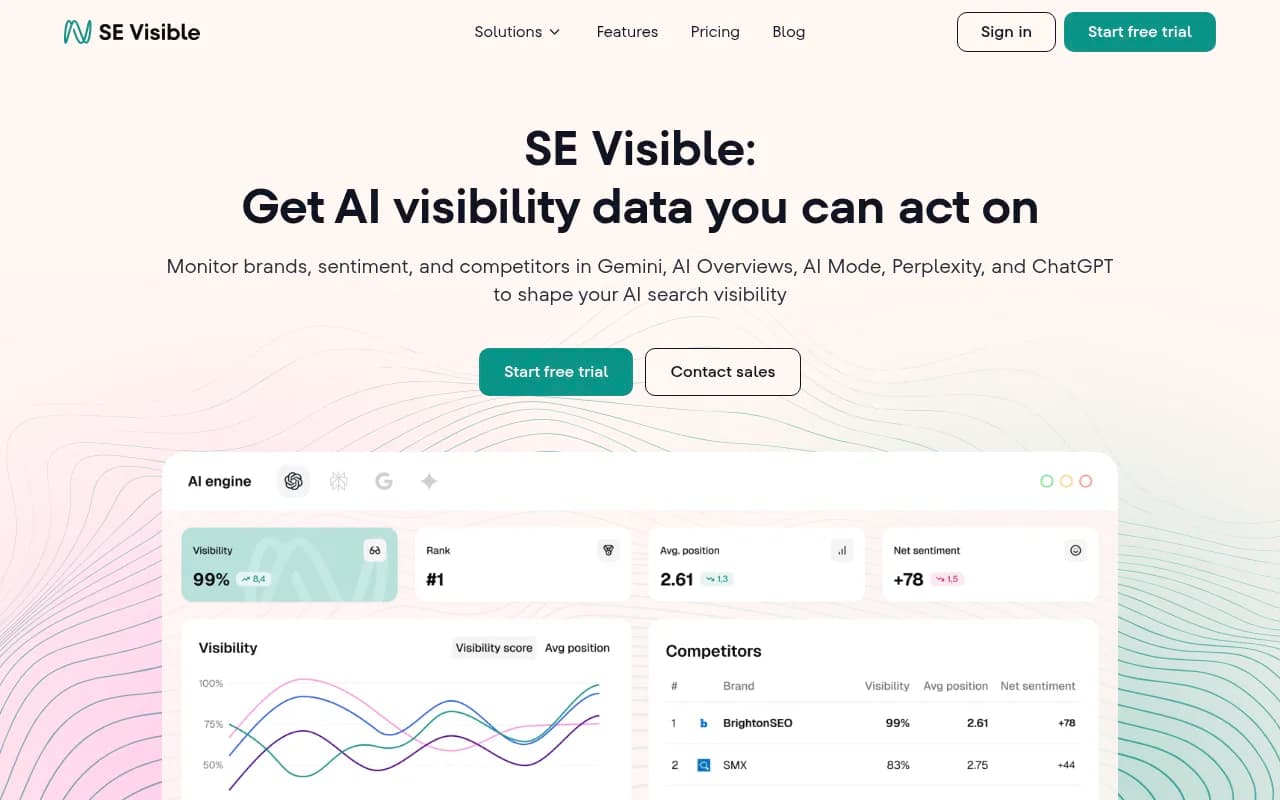
SE Ranking's AI visibility product covers brand mention tracking across AI engines and benefits from SE Ranking's existing infrastructure for traditional SEO. If your team already uses SE Ranking for rank tracking and site audits, the AI visibility layer integrates reasonably well into existing workflows.
The limitation is similar to other monitoring-focused tools: it shows you data but doesn't have the content optimization capabilities to act on it.
Scrunch AI
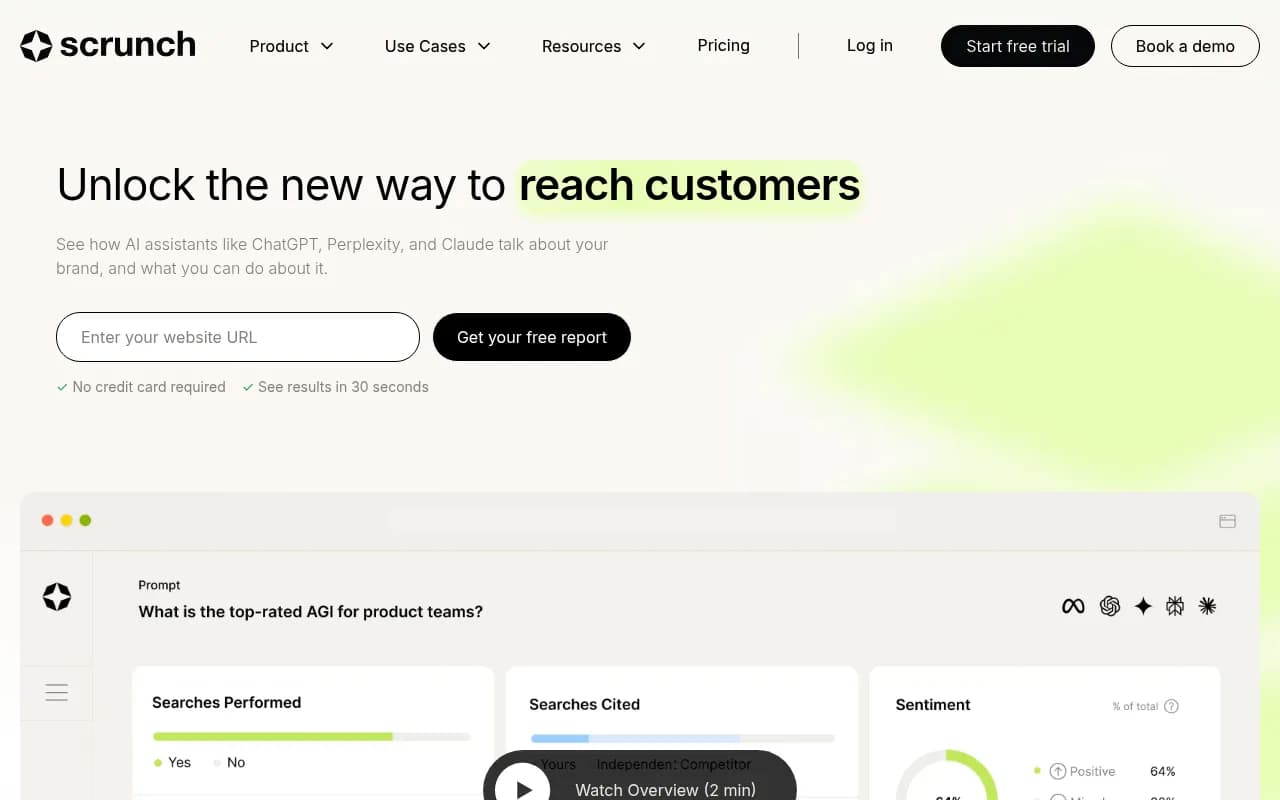
Scrunch AI focuses on AI search visibility tracking and has built a reasonable feature set for monitoring brand mentions across LLMs. It's positioned more toward mid-market teams and has a cleaner onboarding experience than some enterprise-focused competitors.
AthenaHQ
AthenaHQ is monitoring-focused and covers the major AI engines. It's been building out its feature set but still lacks content optimization and generation capabilities that would make it a full-cycle platform. Worth considering if you want a dedicated monitoring tool and plan to handle content creation separately.

LLM Pulse
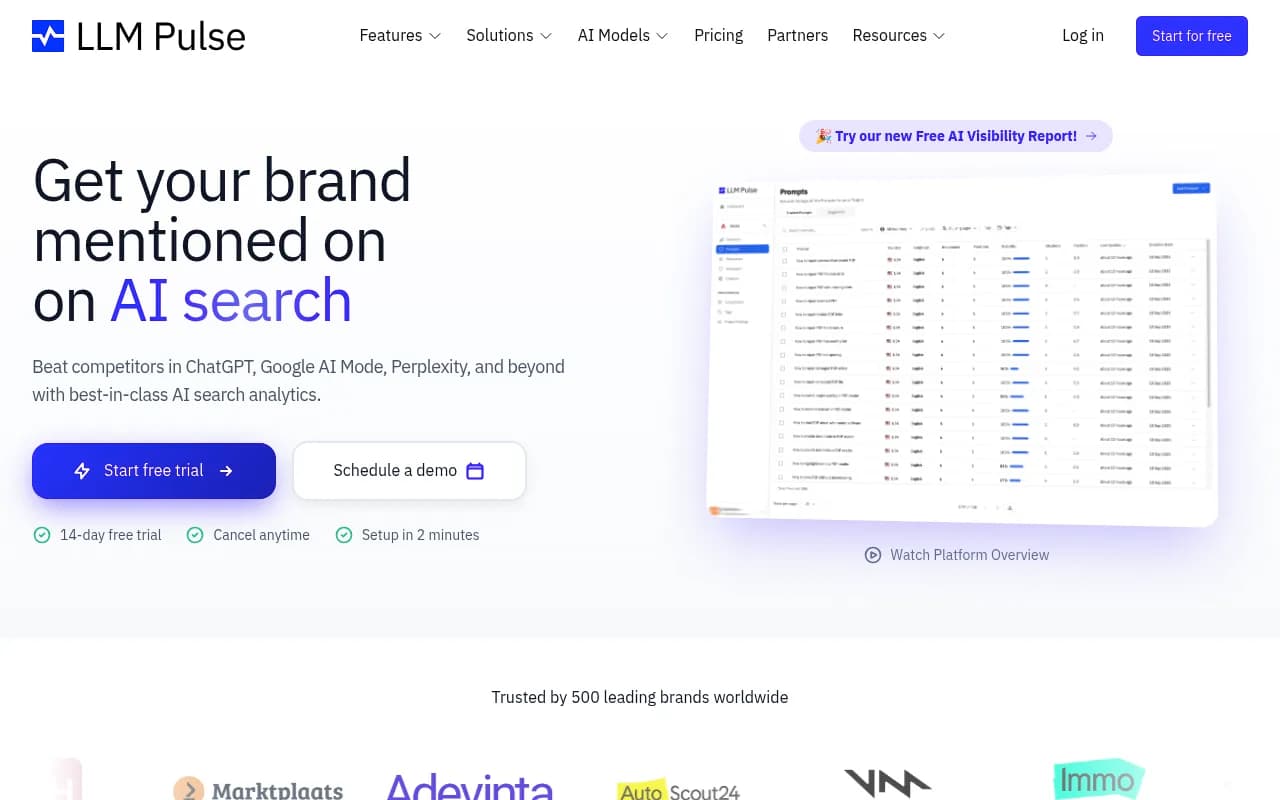
LLM Pulse tracks brand visibility across ChatGPT, Perplexity, and other AI search engines. It's a lighter-weight option that works well for smaller teams or brands just getting started with AI visibility tracking. Feature depth is more limited than the enterprise options, but the barrier to entry is lower.
How the platforms compare
| Platform | Engines tracked | Content generation | Citation analysis | Crawler logs | Reddit/YouTube tracking | Traffic attribution | Starting price |
|---|---|---|---|---|---|---|---|
| Promptwatch | 10 | Yes (built-in AI writer) | Yes (880M+ citations) | Yes | Yes | Yes (snippet/GSC/logs) | $99/mo |
| Profound | 10+ | No | Partial | No | No | Yes (GA4) | Enterprise |
| Peec AI | 4-5 | No | Basic | No | No | No | ~$49/mo |
| Otterly.AI | 3-4 | No | Basic | No | No | No | ~$49/mo |
| SE Visible | 4-5 | No | Basic | No | No | No | Bundled with SE Ranking |
| Scrunch AI | 5-6 | No | Partial | No | No | No | ~$99/mo |
| AthenaHQ | 5-6 | No | Partial | No | No | No | ~$149/mo |
| LLM Pulse | 3-4 | No | Basic | No | No | No | Free tier available |
The monitoring-only problem
This is worth dwelling on because it's the most common mistake teams make when evaluating these tools.
Most AI visibility platforms are dashboards. They run queries, record whether your brand appeared, and show you a score. That's useful for understanding your current state. It's not useful for improving it.
The question you should ask any vendor: "After I see that I'm invisible for a prompt my competitor owns, what does your platform help me do about it?" If the answer is "export the data and figure it out yourself," that's a monitoring tool. If the answer involves showing you what content is missing, helping you create it, and then tracking whether it worked, that's an optimization platform.
In the 2026 landscape, only a handful of platforms have crossed from monitoring into optimization. Promptwatch is the clearest example -- the Answer Gap Analysis, built-in content generation, and closed-loop traffic attribution form a complete workflow rather than a starting point.
How to choose the right platform for your situation
The right tool depends on where you are and what you need to do next.
If you're just starting out and want to understand your current AI visibility: LLM Pulse or Otterly.AI give you a low-friction way to see where you stand across the major engines. Expect to outgrow them quickly.
If you're a mid-market brand that wants to actively improve AI visibility: Promptwatch's Professional plan ($249/month) covers 2 sites, 150 prompts, 15 articles per month, and includes crawler logs and city-level tracking. The content generation capability is what makes this tier worth it -- you're not just seeing gaps, you're closing them.
If you're an agency managing multiple clients: Promptwatch's Business plan and agency/enterprise tiers are built for multi-site management. The Looker Studio integration and API make client reporting practical.
If you're in a regulated industry with strict data requirements: Profound's SOC 2 Type II compliance is a real consideration. It's more expensive and less feature-complete on the optimization side, but the compliance posture matters for some organizations.
If you're an enterprise brand with a large existing SEO stack: Look at how any AI visibility platform integrates with what you already have. Promptwatch's GSC integration and server log analysis connect AI visibility to existing analytics infrastructure without requiring a complete workflow change.
What good AI visibility tracking actually looks like in practice
Here's a concrete example of how this works when the tooling is right.
A SaaS company selling project management software notices that when users ask ChatGPT "what's the best project management tool for remote teams," their brand never appears -- but three competitors do. With a monitoring-only tool, that's where the insight ends.
With a full optimization platform, the next steps are visible: which pages on those competitors' sites are being cited, what topics those pages cover that yours don't, and what content you'd need to create to become a credible source for that prompt. The platform generates a draft article targeting that prompt, grounded in the citation patterns of content that's already working. You publish it, and over the following weeks, you track whether AI models start citing it.
That's the difference between knowing you have a problem and solving it.
Prompt intelligence: the underrated feature
One capability that doesn't get enough attention is prompt volume and difficulty scoring. Not all prompts are equal. Some are asked by thousands of users per month; others are niche queries with minimal traffic. Some prompts are dominated by a single authoritative source that's nearly impossible to displace; others have weak competition where a well-optimized page could break through quickly.
Platforms that give you this data let you prioritize intelligently. Instead of trying to become visible for every prompt in your category, you focus on high-volume, winnable prompts first. This is how teams with limited content budgets can still make meaningful progress.
Promptwatch includes prompt volume estimates and difficulty scores, plus query fan-outs that show how one prompt branches into related sub-queries. Most competitors don't have this level of detail.
A note on "free" AI visibility tools
There are free tools in this space -- some browser extensions, some basic dashboards. They're fine for a quick sanity check. They're not useful for ongoing optimization.
The core limitation is query volume. Running meaningful AI visibility tracking requires sending hundreds or thousands of queries to AI engines on a regular schedule. That costs money. Free tools either run very few queries (giving you an incomplete picture) or run queries infrequently (giving you stale data). For anything beyond initial curiosity, a paid platform is necessary.
Final thoughts
AI search visibility is no longer optional for brands that care about organic discovery. ChatGPT, Perplexity, and Claude are already influencing purchase decisions -- the question is whether your brand is part of those conversations or invisible in them.
The tools to track and improve this have matured significantly in 2026. The clearest dividing line is between platforms that show you data and platforms that help you act on it. If you're evaluating options, that's the question to anchor on: does this tool help me close the gap, or just measure it?