Key Takeaways
- AI visibility is now table stakes for B2B SaaS: 81% of B2B buyers choose vendors before talking to sales, and AI engines increasingly influence those decisions—monitoring where your brand appears in ChatGPT, Perplexity, Claude, and Google AI Overviews is no longer optional
- Most tools only monitor, few help you optimize: The majority of AI visibility platforms show you data but leave you stuck—look for tools that close the loop with content gap analysis, optimization workflows, and traffic attribution
- Action beats tracking: Platforms like Promptwatch stand out by combining visibility tracking with Answer Gap Analysis, AI content generation, and crawler logs—helping you find what's missing, create content that ranks, and measure results
- B2B SaaS needs differ from consumer brands: Enterprise teams require multi-region tracking, competitor benchmarking, API access, and the ability to connect AI visibility to pipeline—not just vanity metrics
- Budget wisely: Essential monitoring starts around $99/month, but enterprise-grade platforms with optimization capabilities range from $249-$579/month—prioritize tools that help you take action, not just collect data
Why AI Visibility Matters for B2B SaaS in 2026
Traditional SEO metrics no longer tell the full story. When a prospect asks ChatGPT "What's the best CRM for mid-market SaaS companies?" or Claude "Compare project management tools for remote teams," your brand either appears in that answer—or it doesn't.
The economics are stark: B2B SaaS CAC ratios increased 14% year-over-year while 81% of buyers now choose vendors before ever talking to sales. AI engines are increasingly the first touchpoint in that buyer journey. If you're invisible in AI search, you're invisible to prospects.
AI visibility tools track how your brand appears in AI-generated answers from ChatGPT, Perplexity, Claude, Google AI Overviews, Gemini, and similar platforms. They show where you're mentioned, where competitors outrank you, and which content gaps are costing you visibility.
But here's the problem: most tools stop at monitoring. They show you the data, then leave you to figure out what to do about it.
What B2B SaaS Teams Actually Need from AI Visibility Tools
Before evaluating specific platforms, understand what separates monitoring-only dashboards from optimization engines that drive results.
1. Multi-Engine Coverage That Reflects Your Buyers
Your prospects don't just use ChatGPT. They use Perplexity for research, Claude for analysis, Google AI Overviews during search, and Gemini for quick answers. A tool that only tracks one or two engines gives you an incomplete picture.
Look for platforms monitoring at least 8-10 AI models: OpenAI/ChatGPT, Perplexity, Google AI Overviews, Claude, Gemini, Meta AI, DeepSeek, Grok, Mistral, and Copilot.
2. Prompt Intelligence, Not Just Brand Mentions
Knowing your brand was mentioned 47 times this week is useless without context. Which prompts triggered those mentions? What's the search volume for each prompt? How difficult is it to rank for?
The best platforms provide prompt-level data: volume estimates, difficulty scores, and query fan-outs showing how one prompt branches into sub-queries. This lets you prioritize high-value, winnable prompts instead of guessing.
3. Competitor Benchmarking and Gap Analysis
You need to know not just where you appear, but where competitors are visible and you're not. Answer Gap Analysis shows exactly which prompts competitors rank for but you don't—revealing the specific content your website is missing.
This is where most monitoring tools fail. They show you your own visibility but provide no actionable path to improvement.
4. Citation and Source Analysis
AI models don't cite randomly. They reference specific pages, Reddit threads, YouTube videos, and domains. Understanding which sources AI engines trust—and why—is critical for optimization.
Look for tools that surface the exact pages being cited, the types of content that perform best, and channels most competitors ignore (like Reddit and YouTube discussions that directly influence AI recommendations).
5. AI Crawler Logs and Indexing Insights
AI engines crawl your website differently than Google. Real-time logs showing which pages ChatGPT, Claude, and Perplexity crawlers are reading—and which errors they're encountering—help you fix indexing issues before they cost you visibility.
Most competitors lack this capability entirely. It's a major differentiator for platforms serious about optimization, not just tracking.
6. Content Generation and Optimization Workflows
This is the action loop that separates leaders from laggards. After identifying gaps, can the platform help you create content that actually ranks in AI search?
The best tools include AI writing agents that generate articles, listicles, and comparisons grounded in real citation data, prompt volumes, persona targeting, and competitor analysis. This isn't generic SEO filler—it's content engineered to get cited by AI models.
7. Traffic Attribution and ROI Measurement
Visibility means nothing if you can't connect it to revenue. Look for platforms that help you track AI-driven traffic with code snippets, Google Search Console integration, or server log analysis. Close the loop by connecting visibility improvements to actual pipeline impact.
8. Multi-Language and Multi-Region Support
B2B SaaS companies operate globally. Your AI visibility tool should monitor responses in any language, from any country, with customizable personas that match how your actual customers prompt.
The AI Visibility Tools Worth Evaluating
Based on testing against real B2B SaaS workflows, here are the platforms that deliver on the criteria above—and where each fits best.
Promptwatch: Best for End-to-End Optimization
Promptwatch is the only platform rated as a "Leader" across all categories in a 2026 comparison of 12 GEO platforms. The core difference: it's built around taking action, not just showing data.

The platform closes the action loop:
- Find the gaps: Answer Gap Analysis shows exactly which prompts competitors are visible for but you're not, revealing the specific content your website is missing
- Create content that ranks: Built-in AI writing agent generates articles grounded in 880M+ citations analyzed, prompt volumes, and competitor data
- Track the results: Page-level tracking shows which pages are being cited, how often, and by which models—with traffic attribution connecting visibility to revenue
Key capabilities:
- Monitors 10 AI models including ChatGPT, Perplexity, Claude, Gemini, Google AI Overviews, Meta AI, DeepSeek, Grok, Mistral, and Copilot
- AI Crawler Logs showing real-time crawling activity, errors, and indexing issues
- Prompt Intelligence with volume estimates and difficulty scores
- Reddit and YouTube insights surfacing discussions that influence AI recommendations
- ChatGPT Shopping tracking for product recommendations
- Competitor heatmaps comparing visibility across LLMs
- Multi-language and multi-region monitoring
- Looker Studio integration and API access
Pricing: Essential $99/month (1 site, 50 prompts, 5 articles), Professional $249/month (2 sites, 150 prompts, 15 articles, crawler logs), Business $579/month (5 sites, 350 prompts, 30 articles). Free trial available.
Best for: Marketing and SEO teams at B2B SaaS companies that want to optimize AI visibility, not just monitor it.
Semrush AI Visibility Toolkit: Best for Teams Already Using Semrush
If you're already a Semrush customer, their AI Visibility Toolkit integrates AI search tracking into your existing SEO workflows. It monitors Google AI Overviews and provides basic visibility metrics.
The limitation: Semrush uses fixed prompts rather than custom queries, and lacks the content generation and optimization workflows needed to actually improve visibility. It's monitoring-focused.
Best for: Existing Semrush users who want basic AI visibility tracking alongside traditional SEO metrics.
Ahrefs Brand Radar: Best for Backlink-Focused Teams
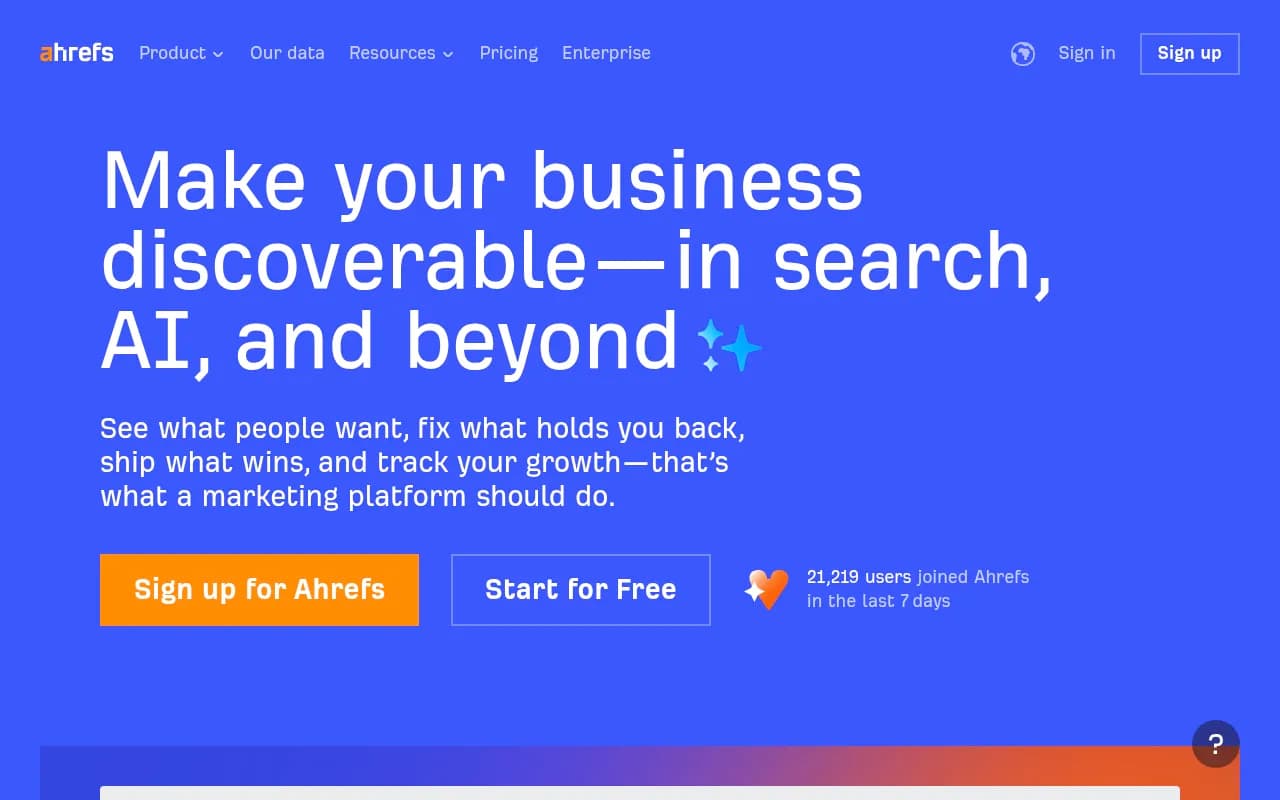
Ahrefs added Brand Radar to track brand mentions across AI search engines. Like Semrush, it uses fixed prompts and lacks AI traffic attribution or content optimization capabilities.
The platform excels at backlink analysis and traditional SEO, but AI visibility is a secondary feature rather than a core strength.
Best for: Teams heavily invested in Ahrefs who want basic AI mention tracking as an add-on.
Profound: Best for Analyst-Led Workflows
Profound

Profound targets enterprise teams with analyst-driven workflows. It provides raw data, APIs, and near real-time monitoring across 9+ AI engines.
The trade-off: you need internal analysts to interpret the data and build optimization strategies. Profound doesn't provide out-of-the-box recommendations or content generation.
Pricing starts higher than most competitors, reflecting its enterprise positioning.
Best for: Large enterprises with dedicated analyst teams who want raw data and API access.
Peec AI: Best for Entry-Level Tracking

Peec AI offers foundational AI visibility tracking with simple alerts and monitoring. It's easy to set up but lacks advanced analytics, content optimization, or execution workflows.
Best for: Small teams or agencies that want basic tracking without heavy setup, but don't need optimization capabilities.
Otterly.AI: Best for Budget-Conscious Monitoring
Otterly.AI

Otterly.AI provides affordable AI monitoring across ChatGPT, Perplexity, and Google AI Overviews. Like Peec, it's monitoring-only—no crawler logs, no visitor analytics, no content generation.
Best for: Freelancers and small teams that want low-cost mention tracking.
What About Traditional SEO Tools?
Platforms like Moz, SE Ranking, and Surfer SEO have added basic AI visibility features, but they remain SEO-first tools. AI search monitoring is an afterthought, not a core capability.
If your primary goal is traditional SEO and you want basic AI visibility as a bonus, these work. If you're serious about optimizing for AI search, you need a dedicated platform.
How to Choose the Right AI Visibility Tool for Your B2B SaaS Company
Start with Your Optimization Maturity
Just getting started? Begin with a platform that helps you understand the landscape and take action quickly. Promptwatch's Essential plan ($99/month) or Peec AI provide entry points.
Already tracking but not improving? You need optimization workflows, not more dashboards. Look for platforms with content gap analysis, AI content generation, and crawler logs. Promptwatch Professional ($249/month) or Profound fit here.
Enterprise scale with multiple brands/regions? You need API access, custom reporting, and advanced segmentation. Promptwatch Business ($579/month), Profound, or Semrush AIO are built for this.
Prioritize Action Over Data
Ask: "After I see this data, what do I do next?" If the answer is "export to a spreadsheet and figure it out," the tool isn't helping you optimize.
The best platforms show you what's missing, help you create content to fill gaps, and measure whether it worked.
Test the Integration Story
How does the tool fit into your existing stack? Does it export to Looker Studio? Integrate with Google Search Console? Provide API access for custom workflows?
Only 29% of enterprise apps are actually integrated. Don't add another silo.
Validate Multi-Engine Coverage
Your prospects use multiple AI engines. A tool that only tracks ChatGPT or Google AI Overviews gives you an incomplete picture. Verify the platform monitors at least 8-10 models.
Demand Proof of Citation Data
Ask how many citations the platform has analyzed. Promptwatch has processed over 1.1 billion citations, clicks, and prompts—data that powers its content recommendations. Platforms without this depth are guessing.
Common Mistakes B2B SaaS Teams Make with AI Visibility Tools
Mistake 1: Treating AI Visibility Like Traditional SEO
AI search doesn't work like Google. Ranking factors, content formats, and optimization tactics differ. Tools designed for traditional SEO often miss what actually drives AI citations.
Mistake 2: Focusing on Vanity Metrics
Total mentions or visibility scores mean nothing without context. What matters: which prompts drive buyer intent, where competitors outrank you, and whether visibility connects to pipeline.
Mistake 3: Buying Monitoring Without Optimization
Most teams buy a tool, see the data, then get stuck. "Now what?" Without content gap analysis, optimization workflows, and traffic attribution, you're just collecting data.
Mistake 4: Ignoring Crawler Logs
AI engines crawl your site differently than Google. If ChatGPT or Perplexity can't access your content, you'll never rank—no matter how good your content is. Crawler logs reveal these issues.
Mistake 5: Skipping Competitor Analysis
You can't optimize in a vacuum. Understanding where competitors are visible and you're not is the fastest path to improvement.
Building Your AI Visibility Stack in Stages
Don't try to implement everything at once. Build in stages:
Stage 1: Foundation (Month 1-2)
- Choose an AI visibility platform with optimization capabilities
- Set up tracking for your brand and top 3-5 competitors
- Identify your top 20 high-value prompts based on buyer intent
- Run initial Answer Gap Analysis to find content holes
Stage 2: Content Execution (Month 3-4)
- Create 5-10 pieces of AI-optimized content targeting identified gaps
- Implement crawler log monitoring to catch indexing issues
- Set up traffic attribution to measure AI-driven visits
Stage 3: Optimization Loop (Month 5-6)
- Analyze which content is getting cited and why
- Expand to 50+ tracked prompts based on performance data
- Add Reddit and YouTube monitoring to find discussion opportunities
- Integrate AI visibility metrics into executive reporting
Stage 4: Scale (Month 7+)
- Expand to multi-region and multi-language tracking
- Build custom dashboards via API or Looker Studio integration
- Automate content production based on gap analysis
- Connect AI visibility improvements to pipeline and revenue
The Future of AI Visibility for B2B SaaS
AI search is evolving rapidly. In 2026, we're seeing:
ChatGPT Shopping integration: AI engines now recommend products directly. B2B SaaS tools that appear in these recommendations see significant pipeline impact.
Multi-modal search: AI engines increasingly reference images, videos, and interactive content—not just text. Platforms tracking these formats will matter more.
Agentic workflows: AI agents that research, compare, and recommend vendors autonomously are emerging. Visibility in these agent workflows will become critical.
Personalized recommendations: AI engines tailor answers based on user context, company size, industry, and past behavior. Generic optimization won't work—you'll need persona-specific strategies.
The platforms investing in these capabilities now will lead in 2027 and beyond.
Taking Action: Your Next Steps
AI visibility isn't a "nice to have" for B2B SaaS companies anymore. It's a competitive requirement. The question isn't whether to invest, but which tools will actually help you improve.
Start here:
- Audit your current visibility: Use a free trial to see where your brand appears (or doesn't) in ChatGPT, Perplexity, and Claude
- Identify your top 10 buyer-intent prompts: What questions do prospects ask when evaluating solutions like yours?
- Run competitor analysis: Where are they visible that you're not?
- Choose a platform with optimization workflows: Monitoring alone won't move the needle
- Create your first 5 pieces of AI-optimized content: Target identified gaps with content engineered for AI citations
- Measure and iterate: Track which content gets cited, refine your approach, scale what works
The B2B SaaS companies winning in AI search aren't just tracking visibility—they're optimizing for it. Tools like Promptwatch that close the action loop (find gaps → create content → track results) deliver the outcomes that matter: more citations, more traffic, more pipeline.
The AI search revolution is here. Your prospects are already using these tools to evaluate vendors. The only question is whether they'll find you.