Key takeaways
- Sitecore acquired Scrunch in June 2026 (reportedly ~$225M), and reviewers say it's unclear whether Scrunch's self-serve pricing survives the enterprise bundling that follows. If you're not an enterprise Sitecore customer, that's a real roadmap risk.
- The best replacement depends on whether you need monitoring only, monitoring plus content execution, or a full end-to-end stack. Most Scrunch lookalikes stop at dashboards.
- Promptwatch is the strongest end-to-end alternative: prompt tracking with volumes and difficulty, AI crawler logs, Reddit and YouTube citation tracking, ChatGPT Shopping and Ads Radar, and automated content agents that publish to your CMS.
- Budget options exist: Otterly.AI starts at $29/mo and Peec AI at $95/mo, but both are monitoring-focused and lack crawler logs and content execution.
- Whatever you pick, prioritize platforms that can audit and optimize commercial pages, not just count mentions. ChatGPT cited product pages in 32.8% of classified citations in July 2026, nearly double their March share.
Why teams are leaving Scrunch in the first place
Scrunch built a real following. Founded in 2023 in Salt Lake City by Chris Andrew, it raised roughly $19M across a Mayfield-led seed and a Decibel-led Series A, and by mid-2025 counted 500+ brands including Lenovo, ADP, Akamai, and Crunchbase. Its prompt-level visibility monitoring was genuinely good, and the Agent Experience Platform (AXP) idea, serving AI-optimized pages to crawlers without touching your human-facing site, was one of the more original things anyone shipped in this category.
Then, on June 3, 2026, Sitecore announced it was acquiring Scrunch to fold its AI visibility insights into the Sitecore digital experience platform. Bloomberg pegged the deal at around $225 million; Sitecore didn't disclose terms. On paper it looks like a win for Scrunch's team and investors.
For Scrunch's customers, though, it raises an uncomfortable question. Sitecore is an enterprise DXP vendor. Its business model is bundle deals, long sales cycles, and six-figure contracts. Reviewers who looked at the acquisition closely flagged exactly this: whether Scrunch keeps selling its $250/mo self-serve Core plan, or whether it gradually gets absorbed into enterprise Sitecore packages, was "unsettled" as of their most recent review. Nobody knows yet. That uncertainty is why mid-market and SMB teams, the ones who can't wait a year to find out, are shopping.
There's a second reason, and it predates the acquisition. Scrunch was always strong on diagnosis and thin on execution. Even friendly roundups noted that its content generation "isn't shipped yet, and monitored prompts are configured, not sourced from real conversations." If you were going to switch anyway, 2026 is the year the market gives you better options.
What to look for when replacing Scrunch
Before the tool list, a quick reality check on what actually matters in a GEO platform this year, because the category has matured fast.
AI search is a scarce-inventory game. Promptwatch's data on average sources per response shows ChatGPT cites around 5 sources per web-search answer, versus roughly 10 for Google AI Overviews and Perplexity. Microsoft Copilot swings wildly, sometimes under 2, sometimes near 17. Five slots. That's the inventory you're fighting for, and it's why simply "being mentioned" is a weak metric. You want to know which of your pages get cited, why, and what to fix.
The citation mix is also shifting toward commercial content. In July 2026, product pages made up 32.8% of classified ChatGPT citations, nearly double their ~18% share in March. Listicles were the fastest-growing format. A GEO tool that only monitors brand mentions in blog-style prompts will miss where the actual buying decisions are happening.
So when you evaluate Scrunch alternatives, check for:
- Real prompt intelligence: search volumes, difficulty scores, and citations per prompt, not just a configured prompt list
- AI crawler logs: which of your pages ChatGPTBot, ClaudeBot, and friends actually read, and what errors they hit
- Citation analytics at page level, including offsite mentions (Reddit, YouTube, third-party pages without links)
- AI traffic attribution, so you can tie visibility to visits and conversions rather than mentions
- An execution layer: content gap analysis, briefs, and ideally automated publishing
Most tools on the market cover one or two of those. A handful cover all five.
The best GEO platforms to switch to
1. Promptwatch: the end-to-end replacement
If Scrunch's appeal was diagnosis plus action, Promptwatch is the closest thing to that vision, actually shipped. It's the platform we know best at this site, so factor that in, but the feature set stands on its own.

Promptwatch covers the full loop. Prompt tracking includes monthly volumes, difficulty scores, and citation rates, plus query fan-outs showing how AI expands a prompt into sub-queries. AI crawler logs show when bots hit your site, what they read, and whether they hit errors, which is the "why" behind visibility scores that most trackers skip entirely. Citation analytics break down which pages get cited, with Reddit and YouTube tracked as dedicated channels. Visitor analytics connect AI-driven traffic to conversions, so you're measuring revenue, not vibes.
Then the part most competitors don't have: Content Agents that plan, write, and publish GEO-optimized content straight to your CMS (Webflow, Framer, WordPress), either through a review inbox or fully automated. Unified Actions gives you a prioritized GEO to-do list, and Agent Chat lets you interrogate your own data conversationally.
The numbers behind it are substantial: over 4.5 billion citations, clicks, and prompts analyzed, 100M+ new data points per day, 1,840+ customers including Duolingo, Yelp, and Shutterstock, and a 4.7/5 G2 rating. Pricing runs from a free Explore tier to $95/mo Essential (1 site, 50 prompts, all LLM tracking, API access) up to $579/mo Business, with agency plans from $199/mo. That's a genuine self-serve path, which is exactly what Scrunch's future may not have.
Best for: teams that want monitoring, diagnostics, and automated execution in one platform, at prices that don't require an enterprise contract.
2. Profound: the enterprise monitoring heavyweight
If your Scrunch use case was purely "know how we show up across engines, at scale," Profound is probably the name you've already been quoted. It's the most common head-to-head with Scrunch in coverage of this space, and it wins on daily data, prompt volume data, and scaling into thousands of prompts for big organizations.
Profound

The pricing structure is where mid-market buyers should pay attention. The $99/mo Starter is ChatGPT-only, 50 prompts, one seat. Growth at $399/mo gets you 3 engines and 100 prompts. Full multi-engine coverage with API access sits behind a custom Enterprise tier that reviewers report often lands at $2,000+/mo. The Starter plan gets criticized as a funnel toward Growth, with the genuinely useful features gated above it.
Best for: large organizations that need deep, multi-engine visibility benchmarking and have the budget for custom pricing. Not a like-for-like Scrunch Core replacement.
3. Peec AI: analytics-focused and fairly priced
Peec AI earns its spot on transparency alone. Brand plans start at $95/mo (50 prompts, pick 3 of 6 engines, unlimited seats), Pro at $245/mo, Advanced at $495/mo, and its Enterprise tier has a published starting point ($499/mo) instead of a "contact sales" wall. Unlimited team seats at every tier is a real differentiator against Profound's per-seat approach.

The dashboards are clean: visibility, position, and sentiment across engines, with multi-country tracking at the Advanced tier and Looker Studio export. What you don't get is crawler logs, visitor analytics, or content execution. It's a monitoring tool, a good one, but it measures rather than fixes.
Best for: marketing teams that want solid analytics at transparent prices and are happy to handle content optimization elsewhere.
4. Otterly.AI: the budget entry point
At $29/mo for its Lite tier, Otterly is the cheapest credible way to start tracking AI visibility. Standard at $189/mo adds Agent Analytics, API/MCP access, and 100 prompts; Premium runs $489/mo.
Otterly.AI

The catch is à-la-carte engine coverage. Gemini and AI Mode add-ons cost $9–$149/mo depending on tier, and Claude runs $29–$439/mo. If you want broad engine coverage, the price climbs fast. And like Peec, there's no content generation or crawler log analysis to speak of. For a small team that just needs to know "are we showing up," it does the job.
Best for: solo marketers and small businesses validating whether AI search matters for them yet, before committing to a fuller stack.
5. AthenaHQ: citation pattern analysis
AthenaHQ takes a different analytical angle: it focuses on why content gets cited, not just whether. That's a genuinely interesting lens, and for teams trying to understand the mechanics of AI citations it can be valuable.

The barrier is the floor. Starter is $295/mo for 3,600 credits (one credit = one AI response), with API as a paid add-on, and there's no free trial. Enterprise reportedly starts around $2,000+/mo. For a small business, that entry price buys a lot of Promptwatch or Peec instead.
Best for: mid-market teams already convinced of GEO's value who want deeper citation-pattern insight and can absorb the credit-based pricing.
6. AirOps: content engineering for AI search
AirOps is worth a look if your Scrunch exit is really about the execution gap. It's an end-to-end content engineering platform: briefs, generation, and optimization workflows aimed at AI search visibility, with good CMS and workflow integrations.
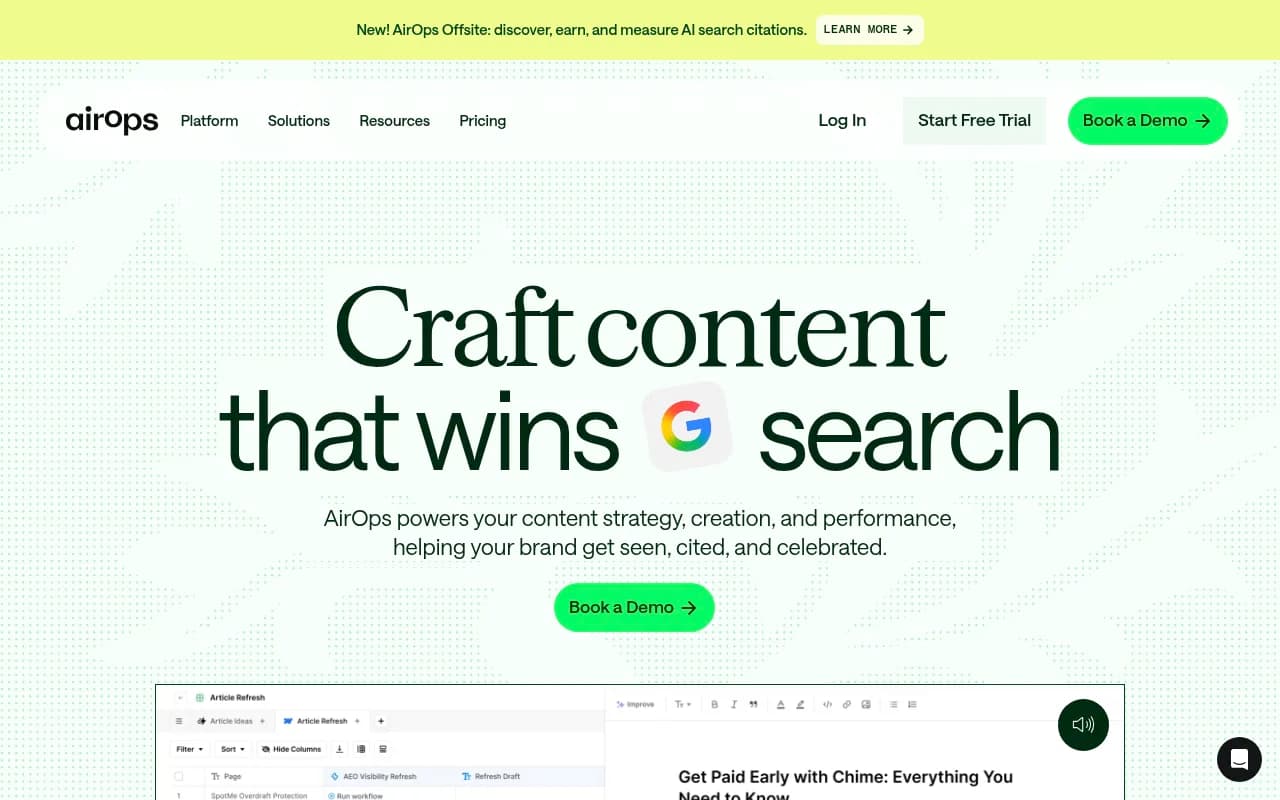
What it lacks is the visibility side. There's no citation dataset or crawler analytics grounding the content decisions in how AI actually behaves. It pairs well with a monitoring tool rather than replacing one.
Best for: content teams with an existing analytics stack who need production muscle for GEO-optimized content at volume.
Comparison table
| Platform | Entry pricing | Multi-engine coverage | Crawler logs | Content execution | Scrunch Core replacement fit |
|---|---|---|---|---|---|
| Promptwatch | $95/mo | All major engines, all plans | Yes | Yes (agents + CMS publishing) | Strong |
| Profound | $99/mo | Full coverage from Enterprise ($2k+/mo) | Limited | No | Weak for mid-market |
| Peec AI | $95/mo | 3 of 6 engines at Starter | No | No | Moderate |
| Otterly.AI | $29/mo | Add-ons required per engine | Partial (Agent Analytics) | No | Budget option only |
| AthenaHQ | $295/mo | Yes, credit-based | No | No | Moderate |
| AirOps | Custom | N/A (content platform) | No | Yes (strong) | Complements, not replaces |
| Scrunch (current) | $250/mo | 4 engines Core; 9 at Enterprise | Yes (Agent Traffic) | Partial (AXP) | Baseline |
How to choose without getting burned
A few things I'd tell anyone making this switch right now:
Audit your prompt set before you migrate. One legitimate criticism of Scrunch was that prompts were configured rather than sourced from real conversations. Moving platforms is a chance to fix that. Look at which prompts carry actual volume and buying intent, and use fan-out data to catch the sub-queries you weren't tracking. Prompt intelligence like Promptwatch's, with volumes and difficulty per prompt, makes this a one-afternoon job instead of guesswork.
Check the citation share math. Even the top-cited domain on ChatGPT holds under 4% of total citations, per Promptwatch's June 2026 citation share data. AI search citation share is a long tail, not a winner-take-all market, which means there's room for you even without a Fortune 500 brand budget. But it also means a tool that reports only domain-level mentions will mislead you about where you actually stand.
Watch where citations are moving. Reddit's share of ChatGPT citations dropped from roughly 4% to 0.5% on August 14, 2026, after an earlier slide through May and June. If your GEO strategy (or your tool's reporting) leans heavily on Reddit presence, that assumption needs a refresh. A platform with channel-level citation trend data will keep you from building on a shrinking foundation.
Don't buy monitoring when you need execution. The most repeated complaint across reviews of this whole category, Scrunch included, is that tools diagnose but don't fix. Content gap analysis, generated briefs, and automated publishing close the loop. If your team is small, that automation isn't a nice-to-have; it's the difference between a dashboard you check monthly and a program that compounds.
Ask about acquisition risk. Scrunch isn't the only consolidating vendor in this space, and the SEO-suite players bolting on AI tracking have their own lock-in dynamics. Before signing any annual deal, ask who owns the company, what happens to your tier if they're acquired, and whether there's a monthly option. No long-term contracts and transparent pricing aren't marketing niceties; they're your insurance policy against exactly the situation that pushed you off Scrunch.
Worth exploring
If you want to browse the full landscape, the GEO software directory at bestgeosoftware.com covers dozens of platforms with reviews and pricing, and our general software directory at surferstack.com has broader comparisons across SEO and content tools. And if you'd rather have a team run your AI search program end to end, 1001 SEO Media (the agency behind this site) offers GEO and AI search optimization alongside technical SEO and content production.
The short version: the Scrunch acquisition closed a chapter, not the book. The GEO market in 2026 is deeper, more competitive, and frankly cheaper at the mid-market level than it was a year ago. Pick the platform that matches where your traffic actually comes from, verify the pricing locks in, and don't settle for a tracker when you can have a system that fixes what it finds.