Summary
- Promptwatch is the only platform that closes the full loop: finds content gaps in AI search, generates optimized articles grounded in 880M+ citations, then tracks the results with page-level visibility scoring and traffic attribution
- Searchable offers basic content generation but lacks the citation intelligence and optimization depth that makes content actually rank in AI engines
- Junia AI and Outranking are strong SEO content tools but treat AI search as an afterthought -- no real-time LLM tracking, no prompt volume data, no Reddit/YouTube insights
- Most GEO platforms are monitoring-only dashboards that show you where you're invisible but leave you stuck on what to do next
- The platforms compared here represent the small subset that attempt to solve both problems: tracking AI visibility AND helping you create content that improves it
Why AI visibility tracking needs content generation
Tracking where your brand appears (or doesn't) in ChatGPT, Perplexity, Claude, and Google AI Overviews is step one. The hard part is fixing it. You can't just republish old blog posts and expect AI models to suddenly cite you. AI engines want specific content patterns: structured answers, cited sources, topical depth, and semantic clarity that traditional SEO content often lacks.
This is why the next generation of GEO platforms are adding built-in content writers. The workflow becomes: identify the prompts where competitors are visible but you're not, generate content optimized for those exact queries, publish it, then track whether AI models start citing the new pages. Without the content generation piece, you're stuck manually briefing writers or hiring agencies -- slow, expensive, and disconnected from the data.
But not all "AI content writers" are equal. Some platforms bolt on generic GPT wrappers that produce SEO filler. Others build content engines grounded in real citation data, prompt volumes, and competitor analysis. The difference shows up in results.
What makes a GEO content writer actually useful
A GEO platform's content generation is only valuable if it solves these problems:
- Gap identification: Which prompts are you missing? The tool should surface specific queries where competitors rank but you don't, then prioritize them by volume and difficulty.
- Citation intelligence: What content patterns do AI models reward? The best platforms analyze 100M+ citations to understand what gets cited vs ignored.
- Optimization for AI, not just Google: Traditional SEO content optimizes for keywords and backlinks. AI search content needs structured answers, authoritative sources, and semantic depth.
- Integration with tracking: Can you see which pages the AI models are actually citing after you publish? Page-level tracking ties content output to visibility outcomes.
- Workflow efficiency: Does the platform let you go from gap → draft → publish in one place, or do you export briefs and context-switch between tools?
Most platforms fail on at least three of these. Let's see how the four contenders stack up.
Promptwatch: the only platform built around the action loop
Promptwatch is the market leader in AI visibility tracking, used by 6,700+ brands including Booking.com, Center Parcs, and Wortell. What separates it from monitoring-only competitors (Otterly.AI, Peec.ai, AthenaHQ) is the action loop: find gaps, create content, track results.

How Promptwatch's content generation works
Answer Gap Analysis shows you exactly which prompts competitors are visible for but you're not. You see the specific topics, angles, and questions AI models want answers to but can't find on your site. This isn't guesswork -- it's based on tracking 10 AI engines (ChatGPT, Perplexity, Claude, Gemini, Google AI Overviews, Meta AI, DeepSeek, Grok, Mistral, Copilot) across thousands of prompts.
Once you identify a gap, the built-in AI writing agent generates articles, listicles, and comparison pages grounded in:
- 880M+ citations analyzed: The platform knows which content structures, sources, and semantic patterns AI models prefer
- Prompt volume estimates: Prioritize high-value queries instead of low-traffic edge cases
- Persona targeting: Generate content that matches how your actual customers prompt AI engines
- Competitor analysis: See what your competitors published to earn citations, then create better versions
This isn't generic SEO filler. The content is engineered to get cited by ChatGPT, Claude, Perplexity, and other AI models. After publishing, page-level tracking shows exactly which pages are being cited, how often, and by which models. Close the loop with traffic attribution (code snippet, GSC integration, or server log analysis) to connect visibility to actual revenue.
What else Promptwatch offers
- AI Crawler Logs: Real-time logs of ChatGPT, Claude, Perplexity crawlers hitting your site -- which pages they read, errors they encounter, how often they return. Fix indexing issues before they hurt visibility.
- Prompt Intelligence: Volume estimates and difficulty scores for each prompt, plus query fan-outs that show how one prompt branches into sub-queries.
- Citation & Source Analysis: See exactly which pages, Reddit threads, YouTube videos, and domains AI models cite. Know where to publish and what to optimize.
- Reddit & YouTube Insights: Surface discussions that directly influence AI recommendations -- a channel most competitors ignore entirely.
- ChatGPT Shopping Tracking: Monitor when your brand appears in ChatGPT's product recommendations and shopping carousels.
- Competitor Heatmaps: Compare your AI visibility vs competitors across LLMs. See who's winning for each prompt and why.
Pricing
- Essential: $99/mo (1 site, 50 prompts, 5 articles)
- Professional: $249/mo (2 sites, 150 prompts, 15 articles, crawler logs, state/city tracking)
- Business: $579/mo (5 sites, 350 prompts, 30 articles)
- Agency/Enterprise: custom pricing
Free trial available. Annual billing discounts.
Why Promptwatch wins
Promptwatchis the only platform that treats content generation as part of an optimization system, not a bolt-on feature. You're not just generating articles -- you're identifying specific visibility gaps, creating content engineered to close them, then measuring whether it worked. Most competitors stop at step one (monitoring) or step two (generic content generation). Promptwatch is the only one that closes the loop.
Searchable: basic content generation without the intelligence layer
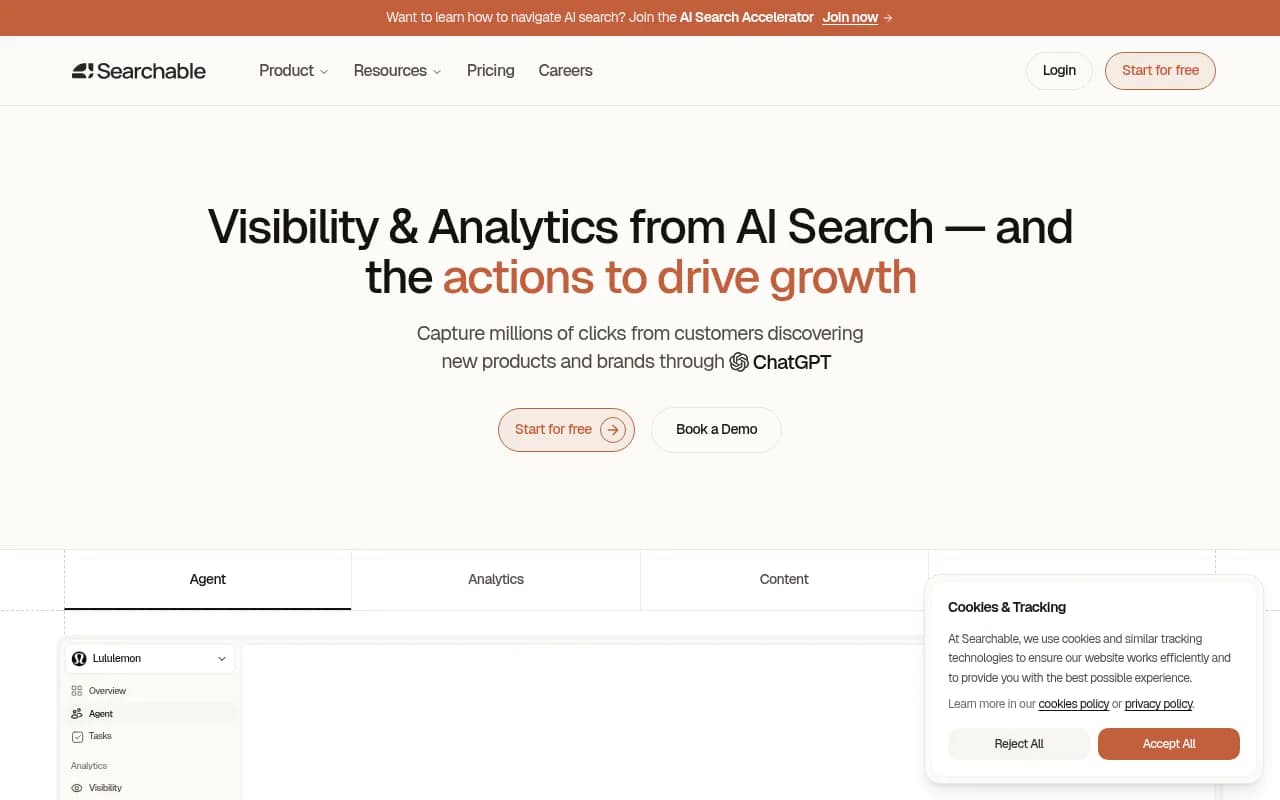
Searchable positions itself as an "AI Search Visibility Platform with Built-In Content Generation." It tracks brand mentions across ChatGPT, Perplexity, and Google AI Overviews, then offers a content writer to help you respond to gaps.
What Searchable does well
- Clean interface for tracking AI visibility across three major engines
- Content generation integrated into the dashboard -- no need to export briefs
- Basic prompt tracking and competitor benchmarking
Where Searchable falls short
The content writer is a generic GPT wrapper. It doesn't analyze citation patterns, prompt volumes, or competitor content strategies. You tell it what to write, it writes it, but there's no intelligence layer guiding what content will actually improve your AI visibility.
Searchable also lacks:
- AI crawler logs: No visibility into whether ChatGPT, Claude, or Perplexity are even discovering your content
- Reddit/YouTube tracking: Misses a major source of AI citation influence
- Page-level tracking: You can't see which specific pages AI models are citing after you publish
- Traffic attribution: No way to connect AI visibility improvements to actual revenue
Searchable is fine if you want a simple dashboard and basic content generation. But if you're serious about optimizing for AI search, you'll hit its limits quickly.
Junia AI: SEO content tool with shallow AI search features
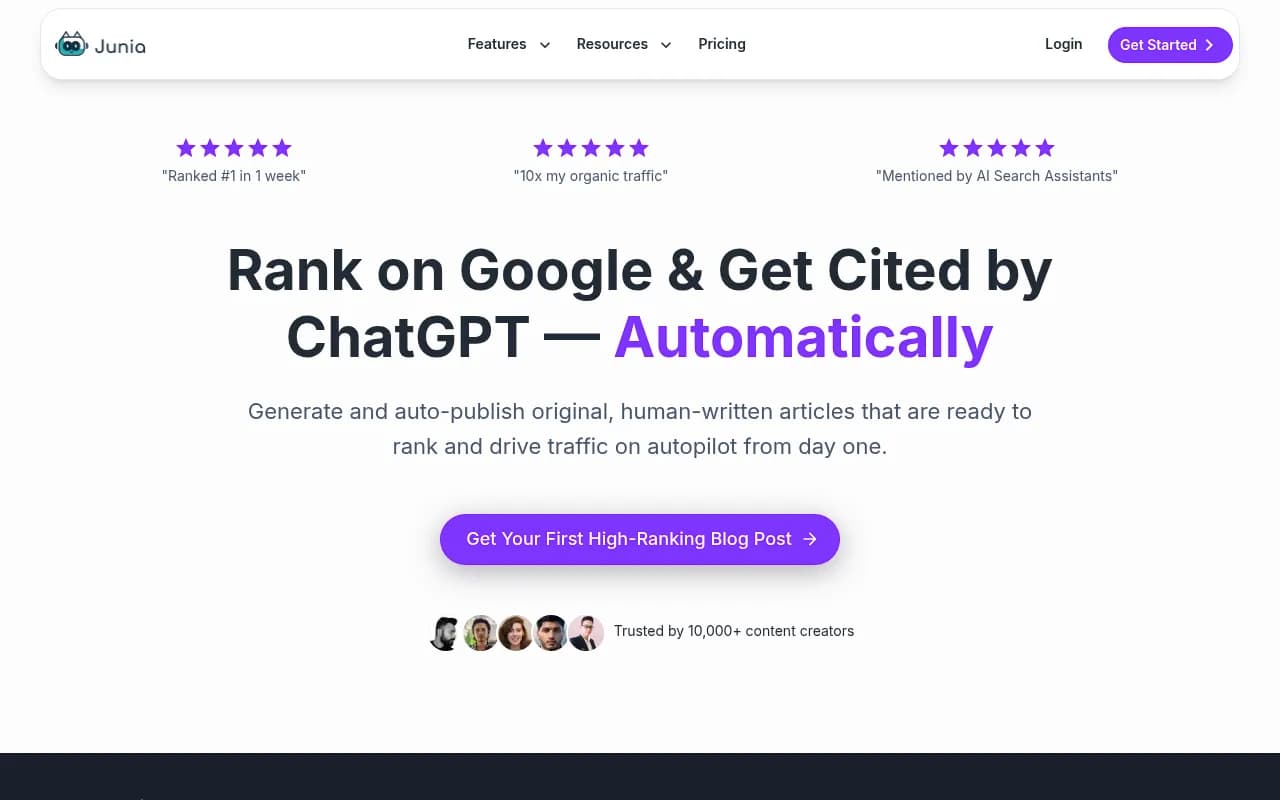
Junia AI is a well-regarded SEO content platform that generates factual, well-researched articles optimized for Google. It recently added "AI search optimization" features, but they're clearly an afterthought.
What Junia does well
- Strong traditional SEO content generation with keyword optimization, competitor analysis, and SERP research
- Bulk content workflows for scaling output
- Integration with WordPress and other CMSs
Where Junia falls short for GEO
Junia treats AI search as a checkbox feature, not a core competency. It doesn't track real-time LLM responses, doesn't analyze citation patterns, and doesn't offer prompt volume data. The "AI optimization" is mostly guesswork based on traditional SEO signals.
Junia also lacks:
- Real-time AI visibility tracking: No monitoring of ChatGPT, Perplexity, Claude, or other AI engines
- Citation intelligence: Doesn't analyze what content patterns AI models actually reward
- Prompt research: No data on which queries are high-volume or winnable
- Competitor AI benchmarking: Can't see where competitors are visible in AI search
If your primary goal is ranking in Google and AI search is a secondary concern, Junia is solid. But if AI visibility is a priority, you need a platform built for it.
Outranking: another SEO tool with bolted-on AI features
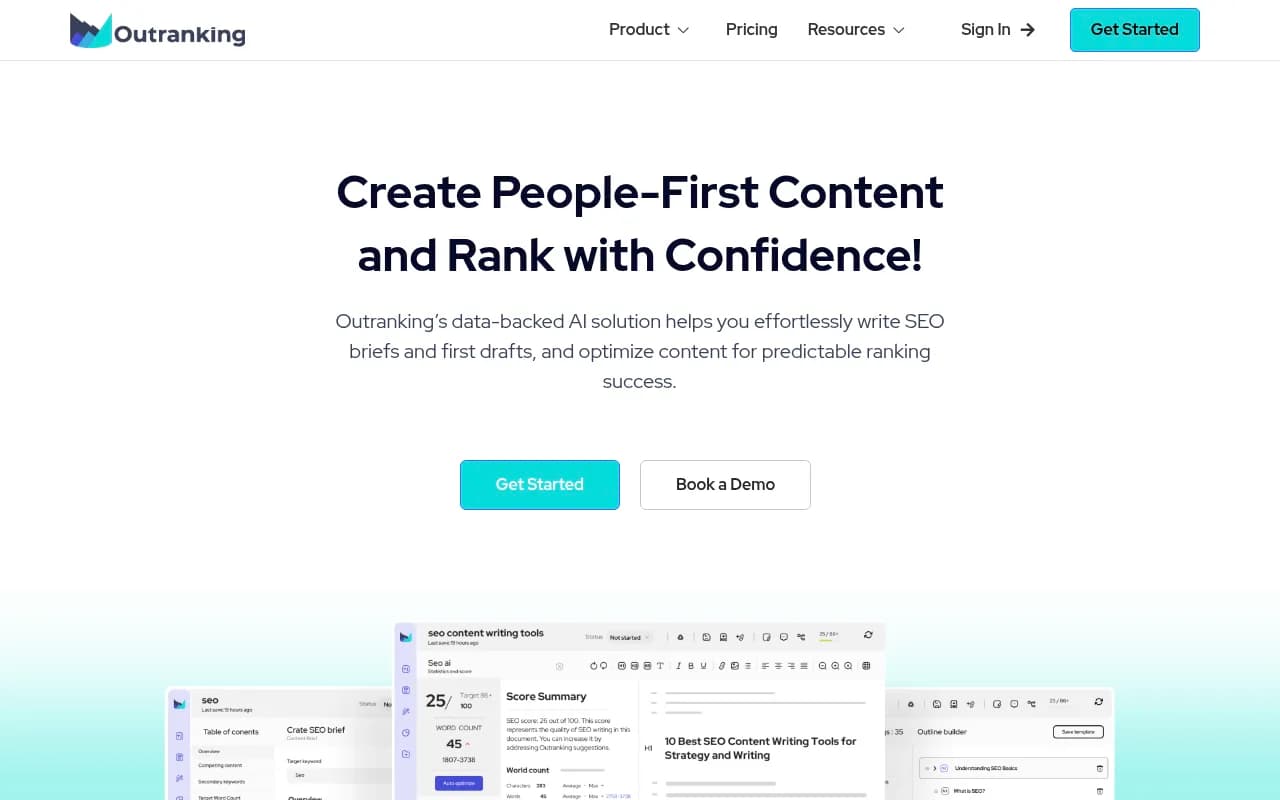
Outranking is similar to Junia -- a capable SEO content platform that recently added "AI search optimization" without rebuilding the core product around it.
What Outranking does well
- Comprehensive SEO content workflows from research to optimization
- Strong competitor analysis and SERP intelligence
- Content briefs that guide writers toward ranking outcomes
Where Outranking falls short for GEO
Like Junia, Outranking's AI search features are shallow. It doesn't track real-time LLM responses, doesn't analyze citation data at scale, and doesn't offer the prompt intelligence or gap analysis that make GEO platforms useful.
Outranking also lacks:
- AI engine monitoring: No tracking of ChatGPT, Perplexity, Claude, or other AI search platforms
- Citation pattern analysis: Doesn't study what content structures AI models prefer
- Reddit/YouTube insights: Misses key sources of AI citation influence
- AI crawler logs: No visibility into whether AI engines are discovering your content
Outranking is a good choice if you're optimizing for Google first and want basic AI search awareness. But for serious GEO work, it's not enough.
Comparison table: Promptwatch vs Searchable vs Junia vs Outranking
| Feature | Promptwatch | Searchable | Junia AI | Outranking |
|---|---|---|---|---|
| AI engines tracked | 10 (ChatGPT, Perplexity, Claude, Gemini, Google AI Overviews, Meta AI, DeepSeek, Grok, Mistral, Copilot) | 3 (ChatGPT, Perplexity, Google AI Overviews) | 0 (no real-time tracking) | 0 (no real-time tracking) |
| Content generation | Yes, grounded in 880M+ citations | Yes, generic GPT wrapper | Yes, SEO-focused | Yes, SEO-focused |
| Answer Gap Analysis | Yes | Basic | No | No |
| Prompt volume data | Yes | No | No | No |
| Citation intelligence | Yes (880M+ citations analyzed) | No | No | No |
| AI crawler logs | Yes | No | No | No |
| Reddit/YouTube tracking | Yes | No | No | No |
| Page-level tracking | Yes | No | No | No |
| Traffic attribution | Yes (code snippet, GSC, server logs) | No | No | No |
| Competitor benchmarking | Yes (heatmaps across LLMs) | Basic | Traditional SEO only | Traditional SEO only |
| ChatGPT Shopping tracking | Yes | No | No | No |
| Starting price | $99/mo | ~$200/mo | ~$20/mo | ~$79/mo |
| Best for | Brands serious about AI visibility | Simple monitoring + basic content | Traditional SEO with AI awareness | Traditional SEO with AI awareness |
Other GEO platforms without built-in content generation
Most GEO platforms are monitoring-only tools. They show you where you're visible (or invisible) in AI search but don't help you create content to fix it. Here's a quick overview:
- Otterly.AI: Basic monitoring across ChatGPT, Perplexity, and Google AI Overviews. No content generation, no gap analysis, no optimization workflows.
Otterly.AI

- Peec.ai: Entry-level tracking with alerts. No content generation, no citation intelligence, no crawler logs.

- AthenaHQ: Narrative tone monitoring focused on brand sentiment. No content generation, no prompt research.

- Profound: Enterprise analytics platform with deep data but no content generation. Built for analyst-driven workflows, not execution.
Profound

- Semrush AI Visibility Toolkit: Traditional SEO platform with basic AI search monitoring bolted on. Limited LLM coverage, no content generation optimized for AI.
These platforms are fine if you have a content team that can act on the data. But if you want an end-to-end solution that identifies gaps AND helps you close them, you need a platform with built-in content generation.
How to choose the right platform
Choose Promptwatch if:
- You want the full optimization loop: gap analysis → content generation → tracking → attribution
- AI visibility is a strategic priority, not a side project
- You need citation intelligence, prompt volumes, and competitor benchmarking to guide content decisions
- You want to track AI crawler behavior and fix indexing issues
- You need Reddit/YouTube insights and ChatGPT Shopping tracking
Choose Searchable if:
- You want a simple dashboard with basic content generation
- You're okay with a generic GPT wrapper instead of citation-grounded content
- You don't need advanced features like crawler logs or page-level tracking
Choose Junia or Outranking if:
- Your primary goal is ranking in Google, and AI search is secondary
- You want strong traditional SEO workflows with basic AI awareness
- You're willing to manually monitor AI visibility using other tools
Skip all of them if:
- You're looking for a monitoring-only dashboard (use Otterly.AI, Peec.ai, or AthenaHQ instead)
- You don't care about AI search visibility yet (stick with traditional SEO tools)
The future of GEO platforms: optimization, not just monitoring
The GEO category is splitting into two camps: monitoring dashboards and optimization platforms. Monitoring tools show you data. Optimization platforms help you act on it.
Promptwatchis leading the optimization camp. Its Answer Gap Analysis, citation-grounded content generation, and page-level tracking represent the direction the category is heading. Searchable is trying to follow but lacks the intelligence layer. Junia and Outranking are hedging their bets, adding shallow AI features to traditional SEO platforms.
The platforms that win will be the ones that close the loop: identify gaps, generate optimized content, track results, and connect visibility to revenue. Right now, Promptwatch is the only one doing all four.
If you're serious about AI search visibility in 2026, start with Promptwatch. If you want a simpler (but less powerful) option, try Searchable. If AI search is secondary to traditional SEO, Junia or Outranking will work. But don't waste time on monitoring-only tools that leave you stuck on what to do next.