Key takeaways
- Peec AI is a solid monitoring tool, but it stops at showing you the data -- it doesn't help you act on it
- Most alternatives (Otterly.AI, LLMrefs, AthenaHQ) have the same problem: great dashboards, no optimization path
- The tools worth switching to in 2026 are the ones that close the loop: find gaps, generate content, track results
- Promptwatch is the only platform rated "Leader" across all GEO categories in a 2026 comparison of 12 platforms -- and the only one with built-in AI content generation grounded in real citation data
- If budget is the main concern, there are cheaper monitoring-only options, but you'll still need a separate content strategy to actually move the needle
AI search has changed the math on visibility. You can rank #1 on Google and still be completely absent from ChatGPT's answer to the same question. According to Similarweb's 2025 Generative AI Report, AI platforms generated over 1.1 billion referral visits in June 2025 -- up 357% year-over-year. That's not a trend to watch. That's traffic you're either getting or missing right now.
Peec AI was one of the first tools to make AI visibility trackable for marketing teams. It monitors how your brand appears in ChatGPT, Perplexity, Claude, and Gemini, tracks prompt rankings and citations, and lets you benchmark against competitors. Pricing starts around €89/month. For a lot of teams, it's a perfectly reasonable starting point.
But "starting point" is the key phrase. The frustration I keep hearing from marketing leaders is some version of: "I can see I'm invisible. Now what?" Peec AI doesn't answer that question. Neither do most of its competitors.
This guide focuses on alternatives that actually do.

What Peec AI does well (and where it falls short)
To be fair: Peec AI does the monitoring job reasonably well. It uses UI scraping for more realistic results (rather than just hitting APIs), tracks prompts across major AI engines, and gives you a competitive view of who's showing up where.
The gaps show up when you try to move from insight to action:
- No content gap analysis that tells you which specific topics you're missing
- No built-in content generation to fix those gaps
- No AI crawler logs to understand how AI engines are actually reading your site
- No Reddit or YouTube tracking (both of which directly influence AI recommendations)
- No traffic attribution to connect AI visibility to actual revenue
- No query fan-outs showing how one prompt branches into sub-queries
If you're a small team that just wants a dashboard to check in on, Peec AI might be enough. If you're a marketing team with budget accountability, you need more.
The alternatives, ranked by how much they actually help you improve
1. Promptwatch -- the only platform that closes the full loop
Promptwatch is the tool I'd recommend first for any team serious about AI search visibility -- not just tracking it, but improving it.

The core difference is what Promptwatch calls the Action Loop: find gaps, create content, track results. Most tools stop at step one. Promptwatch runs all three.
The Answer Gap Analysis shows you exactly which prompts your competitors are visible for that you're not -- not as a vague "you're missing coverage here" observation, but as a specific list of topics, questions, and angles that AI models want to answer but can't find on your site. That's genuinely useful.
Then there's the built-in AI writing agent. It generates articles, listicles, and comparisons grounded in real citation data (880M+ citations analyzed), prompt volumes, persona targeting, and competitor analysis. This isn't generic content -- it's content engineered to get cited by ChatGPT, Claude, Perplexity, and other models.
A few other things that stand out:
- AI Crawler Logs show you in real time which pages ChatGPT, Claude, and Perplexity are actually reading, how often they return, and what errors they hit. Most competitors don't have this at all.
- Prompt Intelligence gives you volume estimates and difficulty scores for each prompt, plus query fan-outs showing how one prompt branches into sub-queries. You can prioritize high-value, winnable prompts instead of guessing.
- Reddit and YouTube tracking surfaces discussions that directly influence AI recommendations -- a channel most tools ignore entirely.
- ChatGPT Shopping Tracking monitors when your brand appears in ChatGPT's product recommendations and shopping carousels.
- Traffic attribution (via code snippet, GSC integration, or server log analysis) connects AI visibility to actual revenue.
It monitors 10 AI models: ChatGPT, Perplexity, Google AI Overviews, Google AI Mode, Claude, Gemini, Meta/Llama, DeepSeek, Grok, Mistral, and Copilot.
Pricing: Essential at $99/mo (1 site, 50 prompts, 5 articles), Professional at $249/mo (2 sites, 150 prompts, 15 articles, crawler logs), Business at $579/mo (5 sites, 350 prompts, 30 articles). Free trial available.
In a 2026 comparison of 12 GEO platforms, Promptwatch was the only one rated "Leader" across all categories. The reason is simple: it's the only platform built around optimization, not just observation.
2. Profound -- strong enterprise monitoring, limited optimization
Profound

Profound has a genuinely strong feature set for enterprise teams. It tracks brand mentions across 9+ AI search engines, offers solid competitive benchmarking, and has good data depth. The UI is clean and the reporting is thorough.
Where it falls short relative to Promptwatch: no built-in content generation, no Reddit/YouTube tracking, no ChatGPT Shopping monitoring, and the price point is higher. It's a monitoring tool that does monitoring very well -- but if you want to act on what you find, you're on your own.
Worth considering if you're at a large enterprise that already has a content team and just needs the data layer.
3. Otterly.AI -- clean monitoring for focused teams
Otterly.AI

Otterly.AI is one of the cleaner monitoring tools in this space. It tracks brand mentions across ChatGPT, Perplexity, and Google AI Overviews, and the interface is genuinely easy to use. For teams that want a simple, focused dashboard without a lot of complexity, it works.
The limitations are real though: no crawler logs, no visitor analytics, no content generation, no Reddit tracking. It's monitoring-only, and it knows it. If that's all you need, it's a reasonable choice. If you need to actually move your visibility scores, you'll hit the ceiling fast.
4. AthenaHQ -- monitoring with a sentiment angle

AthenaHQ takes a slightly different approach, focusing on sentiment-led brand control in AI search. It's useful for understanding not just whether you appear in AI answers, but how you appear -- positive, negative, neutral, accurate, inaccurate.
That's a legitimate use case, especially for larger brands managing reputation. But like most tools in this space, AthenaHQ is monitoring-focused. There's no content optimization path built in, no content generation, and no traffic attribution. It's a good complement to an optimization platform, not a replacement for one.
5. LLMrefs -- citation tracking done well
LLMrefs
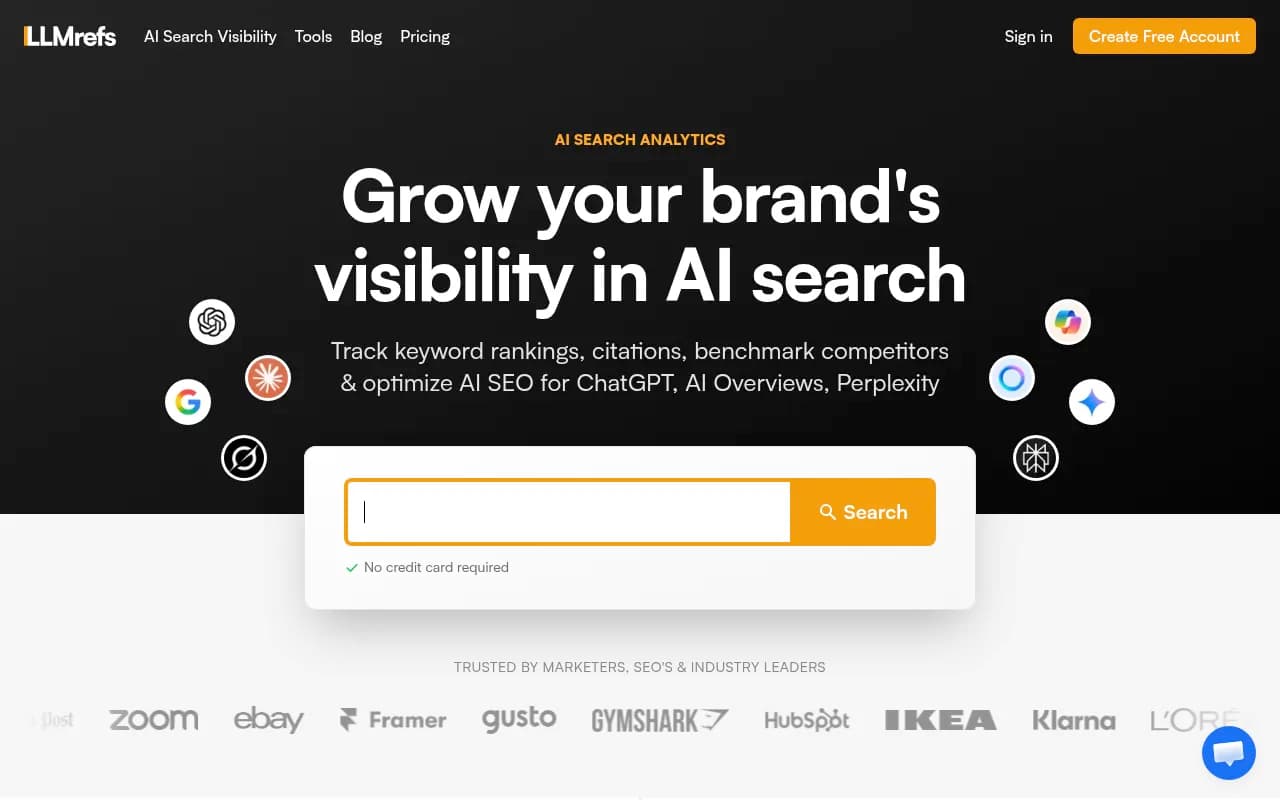
LLMrefs specializes in tracking which sources AI models actually cite -- which pages, domains, Reddit threads, and YouTube videos appear in AI responses. If you want to understand the citation landscape and identify where to publish or what to optimize, it's a useful data source.
The limitation is scope: it's a citation tracker, not a full GEO platform. You get good data on what's being cited, but no tools to help you become one of those cited sources. Useful as a research layer, less useful as a primary platform.
6. Scrunch AI -- enterprise-scale monitoring

Scrunch AI is built for enterprise-wide AI monitoring at scale. It handles large prompt sets, multiple brands, and complex organizational structures well. If you're a large enterprise with multiple product lines and need to monitor AI visibility across all of them, Scrunch is worth evaluating.
The trade-off: it's primarily a monitoring platform. No content generation, no Reddit tracking, no ChatGPT Shopping. And the price point reflects the enterprise positioning. For most mid-market teams, it's more platform than they need.
7. SE Ranking -- AI visibility inside a full SEO suite
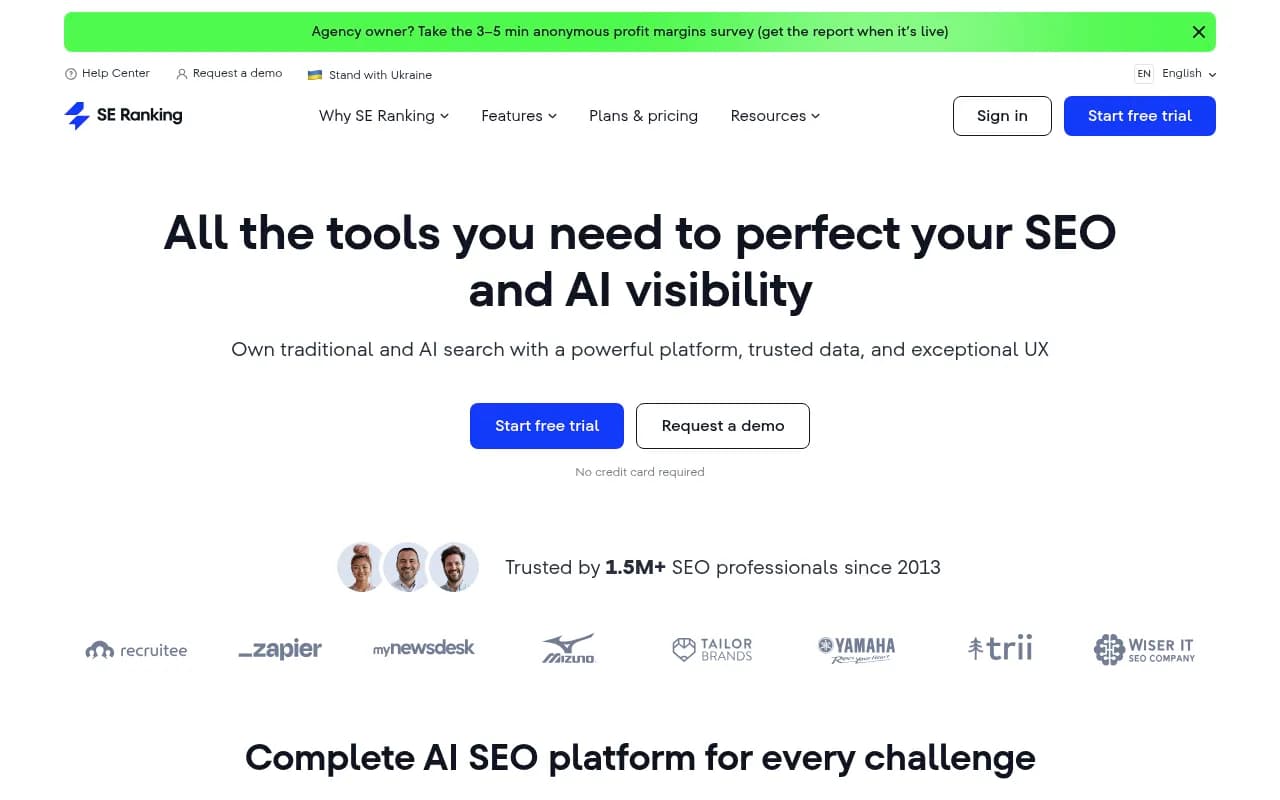
SE Ranking is interesting because it's not a pure-play GEO tool -- it's a full SEO platform that has added AI visibility tracking. If your team is already using SE Ranking for traditional SEO and wants to add AI monitoring without adopting a new platform, that's a reasonable path.
The AI visibility features are solid but not deep. You won't get the citation analysis, crawler logs, or content generation that a dedicated GEO platform offers. But if consolidation matters more than depth, it's a legitimate option.
8. Semrush -- broad coverage, shallow AI depth
Semrush has added AI search tracking to its platform, but the implementation has real limitations. It uses fixed prompts rather than letting you define your own, which means you're tracking the prompts Semrush thinks matter rather than the ones your customers actually use. There's no AI traffic attribution either.
That said, if you're already paying for Semrush and want a basic sense of your AI visibility without adding another tool, it's a starting point. Just don't expect it to replace a dedicated GEO platform.
Feature comparison table
| Tool | AI monitoring | Content generation | Crawler logs | Reddit/YouTube tracking | Traffic attribution | ChatGPT Shopping | Starting price |
|---|---|---|---|---|---|---|---|
| Promptwatch | 10 models | Yes (built-in) | Yes | Yes | Yes | Yes | $99/mo |
| Profound | 9+ models | No | No | No | Limited | No | Higher |
| Otterly.AI | 3 models | No | No | No | No | No | Lower |
| AthenaHQ | Multiple | No | No | No | No | No | Mid |
| LLMrefs | Multiple | No | No | No | No | No | Lower |
| Scrunch AI | Multiple | No | No | No | No | No | Enterprise |
| SE Ranking | Limited | No | No | No | No | No | Mid |
| Semrush | Limited (fixed) | No | No | No | No | No | $130+/mo |
| Peec AI | Multiple | No | No | No | No | No | ~€89/mo |
How to choose the right alternative
The honest answer depends on what you're actually trying to accomplish.
If you want to improve your AI visibility (not just measure it), Promptwatch is the clear choice. It's the only platform that takes you from "here's where you're invisible" to "here's the content that will fix it" to "here's proof it worked." The Action Loop isn't a marketing concept -- it's a literal workflow built into the platform.
If you're at a large enterprise and need monitoring at scale, Profound or Scrunch AI are worth evaluating. You'll need a separate content strategy, but the data layer is solid.
If budget is tight and you just need basic monitoring, Otterly.AI or LLMrefs give you a starting point at lower price points. Just be clear-eyed that you're buying a dashboard, not a solution.
If you're already using SE Ranking or Semrush, their AI tracking features are worth turning on as a baseline -- but don't mistake them for a GEO strategy.
The question worth asking before you choose
Before picking any tool, ask: "What happens after I see the data?"
Most platforms in this space will show you a visibility score, a list of prompts where competitors outrank you, and maybe a chart of how things have changed over time. That's useful context. But context doesn't move the needle.
The teams that are actually winning in AI search right now aren't just monitoring -- they're publishing content specifically engineered to get cited by AI models, tracking which pages get picked up, and iterating based on what works. That requires a platform built around the full cycle, not just the first step.
That's the real gap Peec AI leaves open, and it's the gap worth filling when you switch.