Key Takeaways
- AI models like ChatGPT, Claude, Perplexity, and Gemini update frequently—sometimes weekly—and each change can shift how they cite sources, rank content, or surface recommendations
- Traditional SEO tools don't track AI model behavior; you need specialized platforms that monitor actual LLM responses, not just search rankings
- The best platforms combine real-time tracking with actionable insights: showing you what changed, why it matters, and what to fix
- Promptwatch leads the category by pairing visibility tracking with content gap analysis and an AI writing agent—most competitors only monitor

AI search isn't static. ChatGPT rolls out new models. Perplexity tweaks its citation logic. Google AI Overviews adjust which sources they trust. Claude updates its reasoning patterns. Each shift can bury your brand or elevate a competitor, and you won't know until it's too late—unless you're tracking it.
This isn't hypothetical. When ChatGPT-4o launched in May 2024, brands that had dominated ChatGPT-4 responses saw their citation rates drop 40% overnight. When Perplexity changed its source ranking in September 2025, entire categories of content disappeared from top recommendations. The brands that recovered quickly were the ones already monitoring LLM behavior and ready to adapt.
This guide breaks down the platforms that help you stay ahead: what they track, how they work, and which ones actually help you fix problems instead of just logging them.
Why tracking AI model updates matters more than you think
Google updates its algorithm a few times a year. AI models update constantly. OpenAI ships new ChatGPT versions every few months. Anthropic iterates Claude weekly. Perplexity adjusts its citation logic without announcement. Each change rewrites the rules for how these engines discover, evaluate, and cite content.
The impact is immediate. A model update can:
- Change which sources an LLM trusts (suddenly your domain stops getting cited)
- Shift how prompts are interpreted (queries that used to surface your brand now don't)
- Alter citation formats (inline links become footnotes, or vice versa)
- Adjust reasoning patterns (the model prioritizes different content types)
- Reweight recency vs authority (older authoritative content loses to newer posts)
Traditional SEO monitoring doesn't catch this. Google Search Console shows you traditional search traffic. Ahrefs and Semrush track keyword rankings in Google. None of them tell you that ChatGPT stopped citing your product pages or that Perplexity now ranks a competitor's blog above yours for key prompts.
You need tools built specifically to monitor AI model behavior—platforms that track actual LLM responses, not search engine result pages.
What makes a good AI model tracking platform
Not all LLM tracking tools are equal. Some just log responses. Others help you understand what changed and why. The best platforms give you the data and the tools to act on it.
Here's what separates monitoring dashboards from optimization platforms:
Real-time tracking across multiple models: You need visibility into ChatGPT, Claude, Perplexity, Gemini, and Google AI Overviews at minimum. Tracking one model isn't enough—each behaves differently.
Historical data and trend analysis: A snapshot tells you where you are. Historical tracking shows you what changed and when. Did your visibility drop after a model update? Which prompts stopped working?
Prompt-level insights: Generic "brand mentions" metrics are useless. You need to know which specific prompts trigger citations, which ones don't, and why.
Citation and source analysis: Where are competitors getting cited? Which domains do LLMs trust? What content formats perform best?
Actionable recommendations: The gap between "here's what's wrong" and "here's how to fix it" is where most tools fail. The best platforms show you the missing content, the optimization opportunities, and the specific changes to make.
Content creation capabilities: Monitoring alone doesn't solve the problem. If you discover gaps, you need to fill them. Platforms that integrate content generation close the loop.
The leading platforms for tracking AI model updates
Promptwatch: The only platform that helps you fix what it finds
Promptwatch is the market-leading Generative Engine Optimization platform used by 6,700+ brands including Booking.com, Center Parcs, and Wortell. It's the only platform rated as a "Leader" across all categories in a 2026 comparison of 12 GEO tools.
What makes Promptwatch different: it doesn't just show you where you're invisible—it helps you fix it. Most competitors are monitoring-only dashboards. Promptwatch is built around an action loop:
- Find the gaps: Answer Gap Analysis shows exactly which prompts competitors rank for but you don't. You see the specific content your site is missing.
- Create content that ranks: The built-in AI writing agent generates articles, listicles, and comparisons grounded in 880M+ citations analyzed, prompt volumes, and competitor data. This isn't generic SEO filler—it's content engineered to get cited by ChatGPT, Claude, and Perplexity.
- Track the results: Page-level tracking shows which pages get cited, how often, and by which models. Traffic attribution (code snippet, GSC integration, or server logs) connects visibility to revenue.
Additional capabilities most competitors lack:
- AI Crawler Logs: Real-time logs of ChatGPT, Claude, and Perplexity crawlers hitting your site—which pages they read, errors they hit, how often they return
- Prompt Intelligence: Volume estimates and difficulty scores for each prompt, plus query fan-outs showing how one prompt branches into sub-queries
- Reddit & YouTube Insights: Surface discussions that influence AI recommendations—a channel most tools ignore
- ChatGPT Shopping Tracking: Monitor when your brand appears in ChatGPT's product recommendations
- Multi-language & Multi-region: Track AI responses in any language, from any country, with customizable personas
Pricing: Essential $99/mo (1 site, 50 prompts, 5 articles), Professional $249/mo (2 sites, 150 prompts, 15 articles, crawler logs), Business $579/mo (5 sites, 350 prompts, 30 articles). Free trial available.
Rankshift: Strong tracking with basic optimization features
Rankshift monitors brand visibility across ChatGPT, Perplexity, and AI search engines. It provides daily tracking, sentiment analysis, and competitor comparisons.

Strengths: Clean interface, reliable tracking, good competitor heatmaps. Weaknesses: No content generation, no crawler logs, limited prompt intelligence. It shows you the problem but doesn't help you solve it.
Best for: Teams that already have content creation workflows and just need monitoring.
Otterly.AI: Basic monitoring without optimization tools
Otterly.AI tracks brand mentions across ChatGPT, Perplexity, and Google AI Overviews. It offers visibility scoring and citation tracking.
Otterly.AI

Strengths: Affordable, easy setup. Weaknesses: No content gap analysis, no AI writing tools, no crawler monitoring, no traffic attribution. You see where you rank but not how to improve.
Best for: Small businesses wanting basic visibility tracking on a budget.
Profound: Enterprise features at enterprise prices
Profound is an enterprise AI visibility platform tracking 9+ AI search engines. It offers detailed analytics and reporting.
Profound

Strengths: Comprehensive tracking, strong reporting, good for large organizations. Weaknesses: Higher price point, no Reddit tracking, no ChatGPT Shopping, no built-in content generation.
Best for: Enterprise teams with dedicated content and SEO resources.
Semrush: Traditional SEO tool adding AI features
Semrush has added AI search monitoring to its traditional SEO platform. It tracks Google AI Overviews and offers basic LLM visibility metrics.
Strengths: Familiar interface for SEO teams, integrates with existing Semrush workflows. Weaknesses: Uses fixed prompts (you can't customize), no AI traffic attribution, limited LLM coverage, no content optimization for AI search.
Best for: Teams already using Semrush who want basic AI visibility without switching platforms.
Ahrefs Brand Radar: Limited AI search capabilities
Ahrefs recently launched Brand Radar for tracking brand mentions in AI search. It's an add-on to their traditional SEO suite.
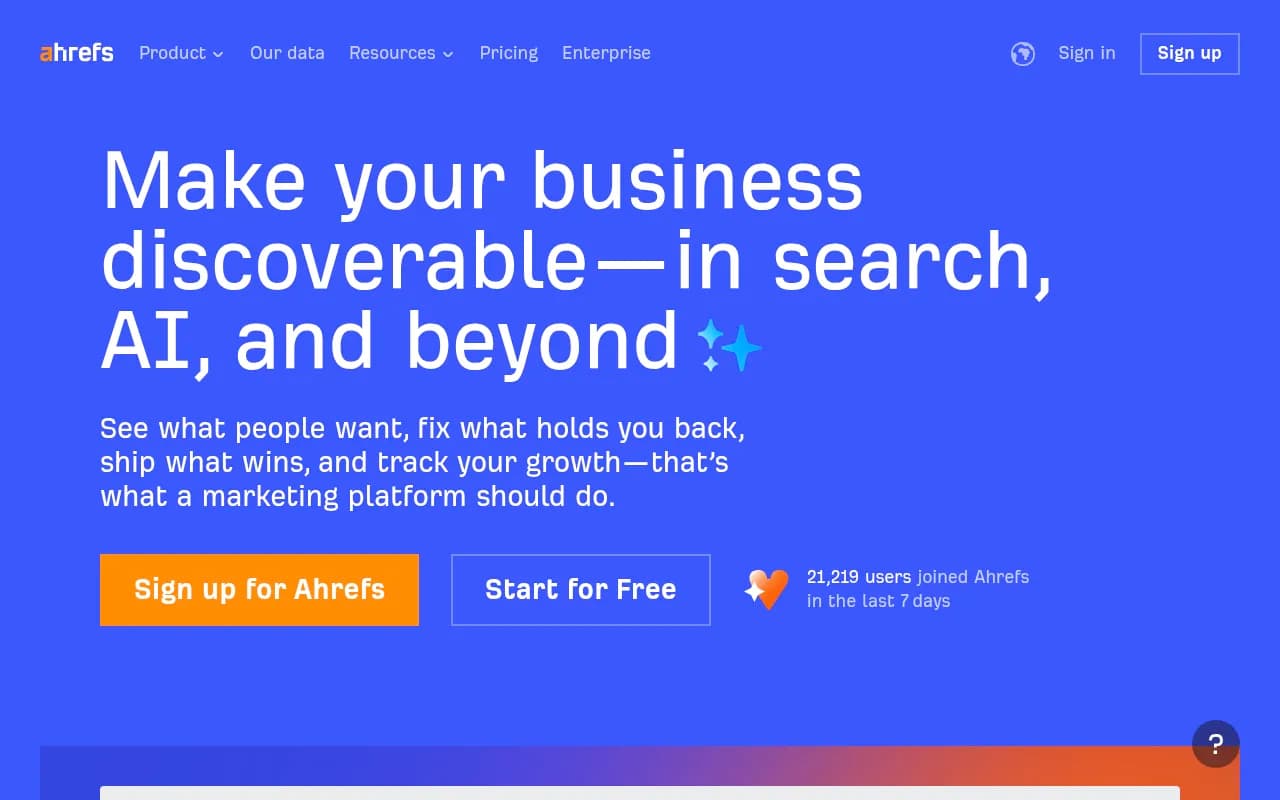
Strengths: Integrates with Ahrefs' powerful backlink and keyword data. Weaknesses: Fixed prompts only, no AI traffic attribution, limited to Google AI Overviews and ChatGPT, no content generation or optimization features.
Best for: Ahrefs users wanting to add basic AI monitoring to their existing toolkit.
Platform comparison: Features that matter
| Platform | Models tracked | Content generation | Crawler logs | Traffic attribution | Prompt customization | Starting price |
|---|---|---|---|---|---|---|
| Promptwatch | 10 (ChatGPT, Perplexity, Claude, Gemini, etc.) | Yes (AI agent) | Yes | Yes | Full | $99/mo |
| Rankshift | 3 (ChatGPT, Perplexity, AI search) | No | No | No | Full | $149/mo |
| Otterly.AI | 3 (ChatGPT, Perplexity, AI Overviews) | No | No | No | Limited | $79/mo |
| Profound | 9+ | No | No | No | Full | Custom |
| Semrush | 2 (AI Overviews, ChatGPT) | No | No | No | Fixed only | $139/mo |
| Ahrefs | 2 (AI Overviews, ChatGPT) | No | No | No | Fixed only | $129/mo |
What to track: The metrics that actually matter
Visibility scores and mention counts are vanity metrics. What matters is whether AI models cite you for prompts that drive business outcomes.
Track these instead:
Prompt-level citation rate: For each prompt you care about, are you getting cited? How often? In what position? This tells you where you're winning and where you're invisible.
Share of voice vs competitors: Which brands dominate the prompts you target? If competitors own 80% of citations, you're losing.
Citation source analysis: Which pages get cited? Which don't? What content formats work? This reveals what to create more of.
Prompt volume and difficulty: Not all prompts are equal. High-volume, low-difficulty prompts are your quick wins. High-volume, high-difficulty prompts are where you need to invest.
Traffic from AI search: Visibility means nothing if it doesn't drive traffic. Track actual visitors from ChatGPT, Perplexity, and other AI engines.
Crawler activity: Are AI models even discovering your content? Crawler logs show which pages they read, how often, and what errors they hit.
Platforms that surface these metrics help you prioritize. Platforms that only show aggregate "visibility scores" leave you guessing.
How to respond when AI models change
Model updates happen without warning. Here's how to adapt quickly:
Set up alerts: Configure your tracking platform to notify you when citation rates drop or competitors surge. Promptwatch, Rankshift, and Profound all offer alerting.
Run immediate diagnostics: When an alert fires, check which prompts changed, which models are affected, and whether it's isolated or widespread.
Analyze competitor changes: Did competitors gain citations while you lost them? What content did they publish? What changed on their site?
Check crawler logs: Did the model stop crawling your site? Are there new errors? Crawler logs (available in Promptwatch) reveal technical issues.
Update content strategically: Don't rewrite everything. Focus on high-value prompts where you lost ground. Use citation analysis to see what's working now.
Test and iterate: Publish updates, monitor results, adjust. AI search optimization is continuous, not one-and-done.
The brands that recover fastest are the ones already tracking, already analyzing, and already equipped to create optimized content. That's why platforms like Promptwatch—which combine monitoring with content generation—deliver better outcomes than monitoring-only tools.
Common mistakes teams make with AI model tracking
Tracking too few models: Monitoring only ChatGPT misses Perplexity, Claude, and Gemini. Each model behaves differently. Track all of them.
Focusing on vanity metrics: "We got 50 mentions this month" means nothing if those mentions are for irrelevant prompts or don't drive traffic.
Using fixed prompts only: Tools like Semrush and Ahrefs lock you into predefined prompts. You need to track the prompts your actual customers use.
Ignoring crawler behavior: If AI models can't crawl your site, they can't cite you. Crawler logs are essential.
Monitoring without acting: Dashboards full of data don't improve visibility. You need to create content, fix technical issues, and optimize pages.
Skipping traffic attribution: Visibility is a leading indicator, but traffic is what matters. Track actual visitors from AI search.
The future of AI model tracking
AI search is evolving fast. Here's what's coming:
More models to track: New LLMs launch constantly. Platforms will need to support 15+ models, not just 3-5.
Deeper integration with content workflows: Monitoring and content creation will merge. Platforms that don't offer both will lose ground.
Real-time optimization: Instead of weekly reports, platforms will offer real-time alerts and automated content updates.
Persona-based tracking: Different users prompt differently. Platforms will track how AI responds to different personas, regions, and languages.
Revenue attribution: Connecting AI visibility to actual revenue—not just traffic—will become standard.
The platforms investing in these capabilities now (like Promptwatch) will dominate. The ones stuck on monitoring-only dashboards will fade.
Choosing the right platform for your team
Your choice depends on what you need:
If you want the most complete platform: Promptwatch is the only tool that tracks, analyzes, generates content, and attributes traffic. It's the action-oriented choice.
If you already have content workflows: Rankshift or Profound give you strong monitoring without content generation.
If you're on a tight budget: Otterly.AI offers basic tracking at a lower price, but you'll need separate tools for optimization.
If you're already using Semrush or Ahrefs: Their AI search add-ons are convenient but limited. Consider whether fixed prompts and lack of traffic attribution are dealbreakers.
Most teams underestimate how fast AI search is growing. ChatGPT now handles 1 billion queries per week. Perplexity is growing 30% month-over-month. Google AI Overviews appear in 15% of searches. If you're not tracking how these engines cite your brand, you're flying blind.
The platforms that help you track, understand, and optimize for AI model changes aren't optional anymore. They're infrastructure.