Summary
- Prompt tracking tools monitor how your brand appears in AI-generated answers across ChatGPT, Perplexity, Claude, Gemini, and other LLMs—revealing which queries trigger mentions, citations, or recommendations of your business
- Most platforms are monitoring-only dashboards that show you data but leave you stuck—Promptwatch stands out by closing the loop with Answer Gap Analysis, AI content generation, and page-level tracking that connects visibility to revenue
- Essential features include multi-engine coverage, prompt volume estimates, citation tracking, and competitor analysis—but the real differentiator is whether a tool helps you take action or just shows you charts
- Pricing ranges from $99/month to enterprise contracts—your choice depends on whether you need basic monitoring or a full optimization platform that generates content and tracks results
ChatGPT hit 800 million weekly users in early 2026. Perplexity processes millions of queries daily. Google's AI Overviews appear in nearly half of all searches. Your potential customers are asking AI engines questions right now—and if your brand isn't part of the answer, you're invisible.
Traditional SEO tools measure blue link rankings. Prompt tracking tools reveal something more fundamental: which questions people ask AI models, how often those prompts appear, and whether your brand gets cited in the response. This is the new battleground for visibility.
Some estimates suggest AI search could drive one-third of B2B organic traffic within three years. Companies that understand this shift early will capture market share while competitors remain invisible in AI conversations. This guide compares 17 prompt tracking platforms so you can pick the one that fits your needs.
What prompt tracking tools actually do
Prompt tracking platforms monitor how your brand appears in responses generated by large language models. Unlike rank trackers that focus on search engine results pages, these tools analyze:
- Brand mentions: When AI models directly recommend your product or service in their answers
- Citation frequency: How often your content sources AI-generated responses across different engines
- Prompt volumes: Estimated query counts for each prompt—so you know which questions matter most
- Sentiment analysis: Whether AI describes your brand positively, negatively, or neutrally
- Share of voice: Your mention frequency compared to competitors for the same prompts
- Content gaps: Questions where competitors appear but you don't—the exact topics you need to cover
The best platforms go beyond monitoring. They show you what's missing, then help you fix it.
Why this matters more than traditional SEO
People don't just search differently in AI engines—they trust the answers more. When ChatGPT recommends a tool or Perplexity cites your article, users treat that as authoritative. There's no list of ten blue links to compare. The AI made the choice for them.
This changes everything:
- Zero-click answers: Users get what they need without visiting your site. Your brand either appears in the answer or it doesn't exist.
- Conversational queries: People ask full questions instead of typing keywords. "What's the best CRM for small teams under $100/month?" not "cheap CRM."
- Citation-based ranking: AI models prioritize sources they've indexed and trust. Getting cited once increases your odds of future citations.
- Competitor displacement: If a competitor appears in AI answers for your target prompts, they're stealing mindshare before users ever see your site.
Traditional SEO still works for Google. But if you're not tracking AI visibility, you're flying blind in the fastest-growing search channel.
The action loop: monitoring vs optimization
Most prompt tracking tools stop at step one. They show you charts of brand mentions, citation counts, and competitor comparisons. Then they leave you to figure out what to do about it.
A real optimization platform closes the loop:
- Find the gaps: See exactly which prompts competitors rank for but you don't. Identify the specific content your website is missing—the topics, angles, and questions AI models want answers to but can't find on your site.
- Create content that ranks in AI: Generate articles, listicles, and comparisons grounded in real citation data, prompt volumes, and competitor analysis. This isn't generic SEO filler—it's content engineered to get cited by ChatGPT, Claude, and Perplexity.
- Track the results: Watch your visibility scores improve as AI models start citing your new content. See page-level tracking that shows exactly which pages are being cited, how often, and by which models. Connect visibility to actual traffic and revenue.
This cycle—find gaps, generate content, track results—is what separates optimization platforms from monitoring dashboards. Most competitors stop at step one.
Top prompt tracking tools compared
Promptwatch: the only platform built for action
Promptwatch is the market-leading Generative Engine Optimization platform used by 6,700+ brands including Booking.com, Center Parcs, and Wortell. It's the only tool rated as a "Leader" across all categories in a 2026 comparison of 12 GEO platforms.

What makes it different: Promptwatch doesn't just show you where you're invisible—it helps you fix it. The platform combines monitoring with Answer Gap Analysis that reveals exactly which prompts competitors rank for but you don't, then uses an AI writing agent to generate content grounded in 880M+ citations analyzed. You see the gaps, create content that fills them, then track results with page-level visibility and traffic attribution.
Core capabilities:
- Monitors 10 AI models: ChatGPT, Perplexity, Google AI Overviews, Claude, Gemini, Meta AI, DeepSeek, Grok, Mistral, Copilot
- AI Crawler Logs: real-time logs of AI crawlers hitting your site—which pages they read, errors they encounter, how often they return
- Prompt Intelligence: volume estimates and difficulty scores for each prompt, plus query fan-outs showing how one prompt branches into sub-queries
- Citation & Source Analysis: see exactly which pages, Reddit threads, YouTube videos, and domains AI models cite
- Reddit & YouTube Insights: surface discussions that directly influence AI recommendations
- ChatGPT Shopping Tracking: monitor when your brand appears in product recommendations
- Competitor Heatmaps: compare your AI visibility vs competitors across LLMs
- Multi-language & Multi-region: monitor AI responses in any language, from any country
Pricing: Essential $99/mo (1 site, 50 prompts, 5 articles), Professional $249/mo (2 sites, 150 prompts, 15 articles, crawler logs), Business $579/mo (5 sites, 350 prompts, 30 articles). Free trial available.
Best for: Marketing teams and agencies that want to track visibility AND improve it—not just stare at dashboards.
Otterly.AI: affordable monitoring
Otterly.AI

Otterly.AI positions itself as a straightforward AI search monitoring tool tracking brand mentions across ChatGPT, Perplexity, and Google AI Overviews. It runs your defined prompts and reports back on visibility.
What it does well: clean interface, reasonable pricing, basic tracking across major engines. If you just want to know whether your brand appears in AI answers, it handles that.
What's missing: no crawler logs, no visitor analytics, no content generation, no Answer Gap Analysis. You see the data but you're on your own for fixing problems. Reddit and YouTube tracking are absent. No ChatGPT Shopping monitoring.
Pricing: starts around $99/mo for basic plans.
Best for: small teams that need basic visibility monitoring without optimization features.
Peec AI: smart suggestions

Peec AI tracks brand visibility across ChatGPT, Perplexity, and Claude with a focus on actionable suggestions. The platform analyzes where you appear and offers recommendations for improvement.
Strengths: the suggestion engine is useful if you're new to GEO and need guidance on what to fix. Multi-engine coverage is solid.
Weaknesses: suggestions are generic compared to platforms that show you exact content gaps with competitor analysis. No built-in content generation. Limited crawler monitoring.
Pricing: mid-tier pricing around $200-300/mo depending on features.
Best for: teams that want monitoring plus basic optimization guidance.
ZipTie: deep analysis and reporting
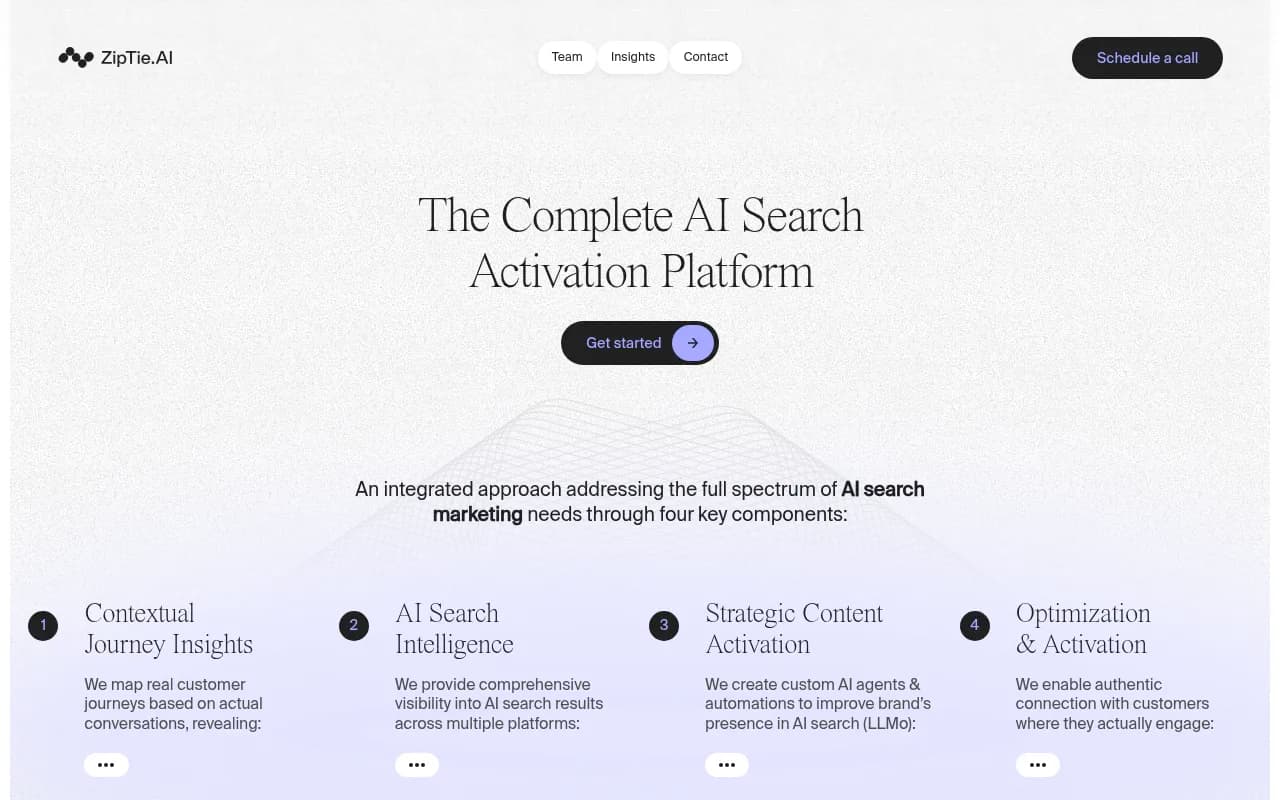
ZipTie focuses on in-depth analysis and reporting for AI visibility tracking. It provides detailed breakdowns of brand mentions, citation patterns, and competitor performance.
What stands out: the reporting is thorough. If you need to present AI visibility data to executives or clients, ZipTie generates polished reports.
What's lacking: heavy on analysis, light on action. No content generation tools. No Answer Gap Analysis showing exactly what content you're missing. The platform tells you what happened but doesn't help you change it.
Pricing: enterprise-focused, custom quotes.
Best for: agencies that need detailed reporting for clients but handle content creation separately.
Similarweb: side-by-side SEO and GEO tracking
Similarweb added AI search tracking to its existing digital intelligence platform. You can monitor traditional SEO metrics alongside AI visibility in one dashboard.
Advantages: if you're already using Similarweb for competitive analysis, adding GEO tracking is convenient. The platform excels at market intelligence.
Disadvantages: AI tracking feels like an add-on rather than a core feature. Limited optimization tools. No content generation. Expensive for teams that only need GEO capabilities.
Pricing: enterprise pricing, typically $5,000+/year.
Best for: large organizations already invested in Similarweb that want to add AI visibility monitoring.
Semrush: for existing Semrush users
Semrush added AI search tracking to its all-in-one SEO platform. You can monitor brand mentions in AI engines alongside traditional rank tracking.
Pros: if you're already paying for Semrush, adding GEO tracking is straightforward. The interface is familiar.
Cons: uses fixed prompts instead of custom queries. No crawler logs. No traffic attribution connecting AI visibility to actual revenue. The AI tracking feels bolted on rather than integrated. No Answer Gap Analysis or content generation.
Pricing: starts at $139.95/mo but AI tracking requires higher-tier plans.
Best for: existing Semrush customers who want basic AI monitoring without switching platforms.
Ahrefs Brand Radar: streamlined focus
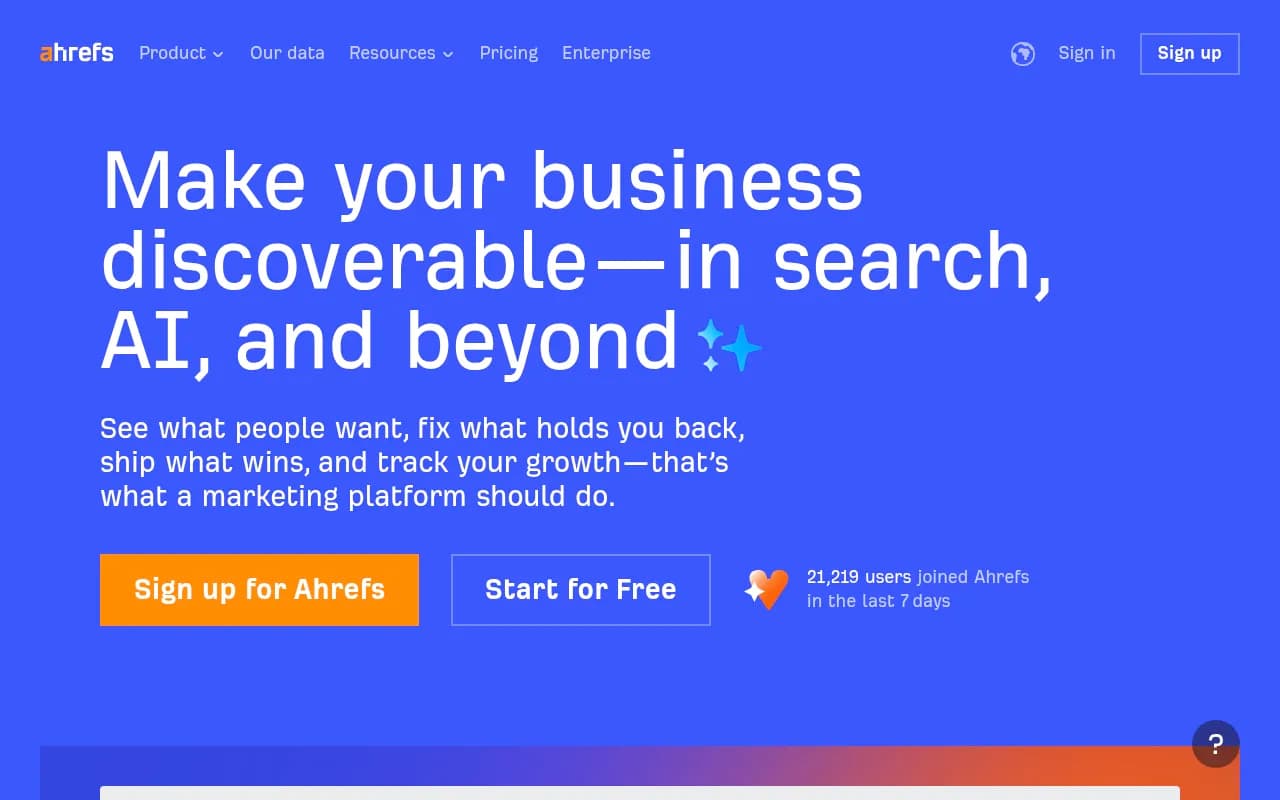
Ahrefs' Brand Radar offers a focused approach to monitoring brand performance across major AI engines. It's designed for teams that want simplicity.
Strengths: clean interface, reliable data, integration with Ahrefs' existing SEO tools.
Weaknesses: uses fixed prompts like Semrush. No custom query tracking. No AI traffic attribution. No content optimization or generation features. Limited to monitoring—no action tools.
Pricing: included with Ahrefs subscriptions starting at $129/mo.
Best for: Ahrefs users who want to add basic AI visibility tracking.
Comparison table: key features
| Tool | AI engines tracked | Custom prompts | Content generation | Crawler logs | Traffic attribution | Starting price |
|---|---|---|---|---|---|---|
| Promptwatch | 10 | Yes | Yes | Yes | Yes | $99/mo |
| Otterly.AI | 3 | Yes | No | No | No | $99/mo |
| Peec AI | 3 | Yes | No | No | No | $200/mo |
| ZipTie | Multiple | Yes | No | No | No | Custom |
| Similarweb | Multiple | Limited | No | No | No | $5,000+/yr |
| Semrush | Multiple | No (fixed) | No | No | No | $139.95/mo |
| Ahrefs | Multiple | No (fixed) | No | No | No | $129/mo |
What to look for in a prompt tracking tool
Multi-engine coverage
Your tool should track at least ChatGPT, Perplexity, and Google AI Overviews. Better platforms add Claude, Gemini, Meta AI, and others. Each engine has different citation patterns—monitoring just one gives you an incomplete picture.
Custom prompt tracking
Fixed prompts are useless. You need to define queries that match how your actual customers search. "Best CRM for small teams" matters more than a generic "CRM software" prompt.
Prompt volume estimates
Knowing a prompt exists isn't enough. You need volume estimates showing how many people actually ask that question. Prioritize high-volume, winnable prompts instead of guessing.
Answer Gap Analysis
The best tools show you exactly which prompts competitors rank for but you don't. This reveals the specific content your website is missing—the topics, angles, and questions AI models want answers to but can't find on your site.
Citation and source tracking
See which pages, domains, Reddit threads, and YouTube videos AI models cite in their responses. This tells you where to publish and what to optimize.
Content generation
Monitoring-only tools leave you stuck. Platforms with built-in AI writing agents generate articles, listicles, and comparisons grounded in real citation data and competitor analysis. This is content engineered to get cited by AI models.
Crawler logs
Real-time logs of AI crawlers (ChatGPT, Claude, Perplexity) hitting your website show which pages they read, errors they encounter, and how often they return. Fix indexing issues before they hurt visibility.
Traffic attribution
Connect AI visibility to actual revenue. The best platforms offer code snippets, Google Search Console integration, or server log analysis to track traffic from AI engines.
Reddit and YouTube insights
AI models cite Reddit discussions and YouTube videos constantly. Tools that surface these sources give you channels most competitors ignore entirely.
ChatGPT Shopping tracking
If you sell products, monitor when your brand appears in ChatGPT's shopping recommendations and carousels. This is a direct revenue channel.
Pricing considerations
Prompt tracking tools range from $99/month to enterprise contracts exceeding $10,000/year. Here's how to think about cost:
Budget tier ($99-200/mo): Basic monitoring across 3-5 AI engines. Custom prompts. Limited optimization features. Good for small teams testing GEO.
Mid-tier ($200-500/mo): More engines, crawler logs, deeper analytics. Some platforms add content suggestions. Better for growing businesses.
Premium ($500-1,000/mo): Full optimization platforms with Answer Gap Analysis, content generation, traffic attribution, and advanced tracking. Best for marketing teams serious about AI visibility.
Enterprise (custom pricing): White-label options, API access, dedicated support, unlimited sites and prompts. For agencies and large organizations.
The real question: are you paying for monitoring or optimization? Monitoring-only tools show you charts. Optimization platforms help you fix the problems those charts reveal.
How to choose the right tool
Start by asking what you actually need:
Just want to know if your brand appears in AI answers? Basic monitoring tools like Otterly.AI or Peec AI work fine. You'll see visibility data without paying for features you won't use.
Need to improve AI visibility but don't know where to start? Look for platforms with Answer Gap Analysis and content suggestions. Promptwatch shows you exactly what content you're missing and generates articles to fill those gaps.
Already have a content team and just need data? ZipTie or Similarweb provide deep analysis and reporting without built-in content generation.
Using Semrush or Ahrefs for traditional SEO? Their AI tracking add-ons are convenient if you're already paying for those platforms—but they're monitoring-only with fixed prompts.
Want to connect AI visibility to revenue? You need traffic attribution. Most platforms don't offer this. Promptwatch includes code snippets, GSC integration, and server log analysis to track actual traffic from AI engines.
Selling products online? ChatGPT Shopping tracking is essential. Monitor when your brand appears in product recommendations and shopping carousels.
Common mistakes to avoid
Tracking vanity metrics
Brand mention counts mean nothing if those mentions don't drive traffic or revenue. Focus on prompts with volume, citation sources that matter, and tracking that connects visibility to business outcomes.
Ignoring crawler logs
If AI crawlers can't access your content, you'll never rank in AI answers. Real-time crawler logs show indexing issues before they hurt visibility. Most platforms skip this entirely.
Monitoring without action
Dashboards full of charts don't improve visibility. The platforms that matter show you what's missing, then help you fix it with content generation and optimization tools.
Fixed prompts
Generic prompts like "best software" don't match how your customers actually search. Custom queries that reflect real user intent are the only ones worth tracking.
Single-engine focus
ChatGPT is huge, but people use Perplexity, Claude, Gemini, and Google AI Overviews too. Each engine has different citation patterns. Monitor multiple engines or you're missing the full picture.
Getting started with prompt tracking
-
Define your target prompts: List 20-50 questions your customers ask AI engines. Be specific. "Best project management tool for remote teams under 10 people" beats "project management software."
-
Pick a platform: Start with a free trial. Promptwatch offers trials that include Answer Gap Analysis and content generation—not just monitoring.
-
Run your first audit: See where you appear, where competitors beat you, and which prompts have the highest volume.
-
Identify content gaps: Use Answer Gap Analysis to find exactly what content you're missing. Prioritize high-volume prompts where you're invisible but competitors appear.
-
Create optimized content: Generate articles, listicles, and comparisons grounded in citation data. Publish them on your site.
-
Track results: Monitor visibility scores, citation frequency, and traffic from AI engines. Adjust your content strategy based on what works.
-
Iterate: AI search is evolving fast. Review your prompts monthly, update content quarterly, and stay ahead of competitors.
The future of AI search visibility
AI search is growing faster than traditional search ever did. ChatGPT reached 800 million weekly users in two years. Google's AI Overviews appear in nearly half of all searches. Perplexity processes millions of queries daily.
Brands that optimize for AI visibility now will dominate their categories. Those that ignore it will watch competitors steal mindshare in the fastest-growing search channel.
Prompt tracking tools are the foundation. But monitoring alone isn't enough. You need platforms that show you what's missing, help you create content that ranks, and connect visibility to revenue.
The companies winning in AI search aren't just tracking prompts—they're closing the loop from gaps to content to results. That's the difference between dashboards and optimization platforms.
Start tracking your AI visibility today. Then fix the gaps before your competitors do.