Key Takeaways
- MarketMuse is built for enterprise teams focused on topical authority and content strategy at scale — best for large content libraries and planning-heavy workflows
- Clearscope offers the most intuitive content optimization experience with real-time scoring and seamless editor integrations — ideal for teams prioritizing workflow efficiency
- Frase delivers the best value with AI-powered content briefs, research automation, and built-in writing tools — perfect for small teams and agencies on a budget
- All three platforms help you create content that ranks in traditional search, but none are designed to track or optimize for AI search engines like ChatGPT, Perplexity, or Google AI Overviews
- For AI search visibility (citations in LLM responses), you'll need a dedicated GEO platform like Promptwatch that shows content gaps, tracks AI citations, and helps you optimize for how AI models discover and recommend brands
What Content Intelligence Platforms Actually Do
Content intelligence platforms analyze top-ranking content across search engines to help you create articles, guides, and landing pages that rank. They pull data from Google's SERPs, identify patterns in what's ranking, and give you actionable recommendations: which topics to cover, which keywords to include, how long your content should be, and what structure works best.
The goal is simple: write content that matches search intent and outranks competitors. These tools don't write for you (though many now include AI writing features) — they guide your strategy and optimize your drafts.
In 2026, the market has consolidated around three leaders: MarketMuse, Clearscope, and Frase. Each takes a different approach to the same problem.
MarketMuse: Strategy-First Platform for Enterprise Teams
MarketMuse is the most strategy-heavy platform in this comparison. It's built for teams managing large content libraries who need to understand topical coverage, identify content gaps, and build authority across entire subject areas — not just individual keywords.
What MarketMuse Does Best
Topic modeling and authority scoring. MarketMuse uses AI to map your entire content library against your competitors and identify where you're strong, where you're weak, and which topics you need to cover to build topical authority. This isn't keyword-level analysis — it's understanding the full semantic landscape of your niche.
Content planning at scale. The platform's Content Brief feature generates outlines based on what's ranking, but it also shows you which topics are worth investing in based on difficulty, opportunity, and your current authority. You can prioritize content production based on strategic value, not just search volume.
Content inventory analysis. MarketMuse audits your existing content and tells you which pages need refreshing, which are underperforming, and which topics have gaps. This is critical for enterprise teams with hundreds or thousands of published pages.
Where MarketMuse Falls Short
Steep learning curve. MarketMuse is not intuitive. The interface is dense, the metrics are complex, and it takes weeks to fully understand how to use the platform effectively. Small teams or solo marketers will struggle.
High price point. MarketMuse starts at $149/month for the Standard plan (limited features), but most teams need the Team plan at $399/month or higher. Enterprise pricing runs into the thousands. This is a significant investment.
No AI search optimization. MarketMuse is built entirely around traditional Google search. It doesn't track or optimize for AI search engines like ChatGPT, Perplexity, Claude, or Google AI Overviews — a growing blind spot as AI search adoption accelerates.
Who Should Use MarketMuse
MarketMuse is best for:
- Enterprise content teams managing 500+ articles
- Brands building topical authority in competitive niches
- Teams with dedicated content strategists who can invest time learning the platform
- Organizations that need content inventory management and refresh workflows
If you're a small team, solo marketer, or agency working with multiple clients, MarketMuse is likely overkill.
Clearscope: The Cleanest Content Optimization Workflow
Clearscope is the most user-friendly platform in this comparison. It strips away the complexity and focuses on one thing: helping you optimize individual pieces of content to rank in Google. The interface is clean, the recommendations are clear, and the workflow is fast.

What Clearscope Does Best
Real-time content grading. Clearscope's editor gives you a live content grade (0-100) as you write. Add a recommended term, watch your score go up. Remove something important, watch it drop. This instant feedback loop makes optimization intuitive — no guesswork, no confusion.
Seamless integrations. Clearscope integrates directly with Google Docs and WordPress, so you can optimize content without leaving your writing environment. The Google Docs add-on is particularly smooth — it sits in the sidebar and updates your score in real-time as you type.
Clean, focused recommendations. Clearscope doesn't overwhelm you with data. It shows you the terms you need to include, the questions you should answer, and the readability level you should target. That's it. No topic clusters, no authority scores, no strategic planning — just optimization.
Where Clearscope Falls Short
No strategic planning features. Clearscope is built for optimizing individual articles, not planning content strategies. It won't help you identify content gaps, prioritize topics, or build topical authority. You need to know what you're writing about before you open Clearscope.
Limited content intelligence. Clearscope's analysis is shallower than MarketMuse. It tells you which terms to include but doesn't explain why, doesn't show competitor content structures, and doesn't provide depth recommendations beyond word count.
No AI search visibility. Like MarketMuse, Clearscope is entirely focused on traditional Google search. It doesn't track or optimize for AI search engines, which means you're missing a growing channel where your audience is discovering brands and products.
Who Should Use Clearscope
Clearscope is best for:
- Content teams that already have a strategy and just need optimization
- Writers and editors who want a simple, fast workflow
- Teams using Google Docs or WordPress as their primary writing environment
- Brands prioritizing user experience and clean interfaces over deep analytics
If you need strategic planning, content gap analysis, or topical authority building, Clearscope won't cut it.
Frase: Best Value for AI-Powered Content Briefs
Frase is the most affordable platform in this comparison and the most AI-forward. It combines content research, brief generation, and AI writing into a single workflow. You can go from keyword to published article faster with Frase than with any other tool.
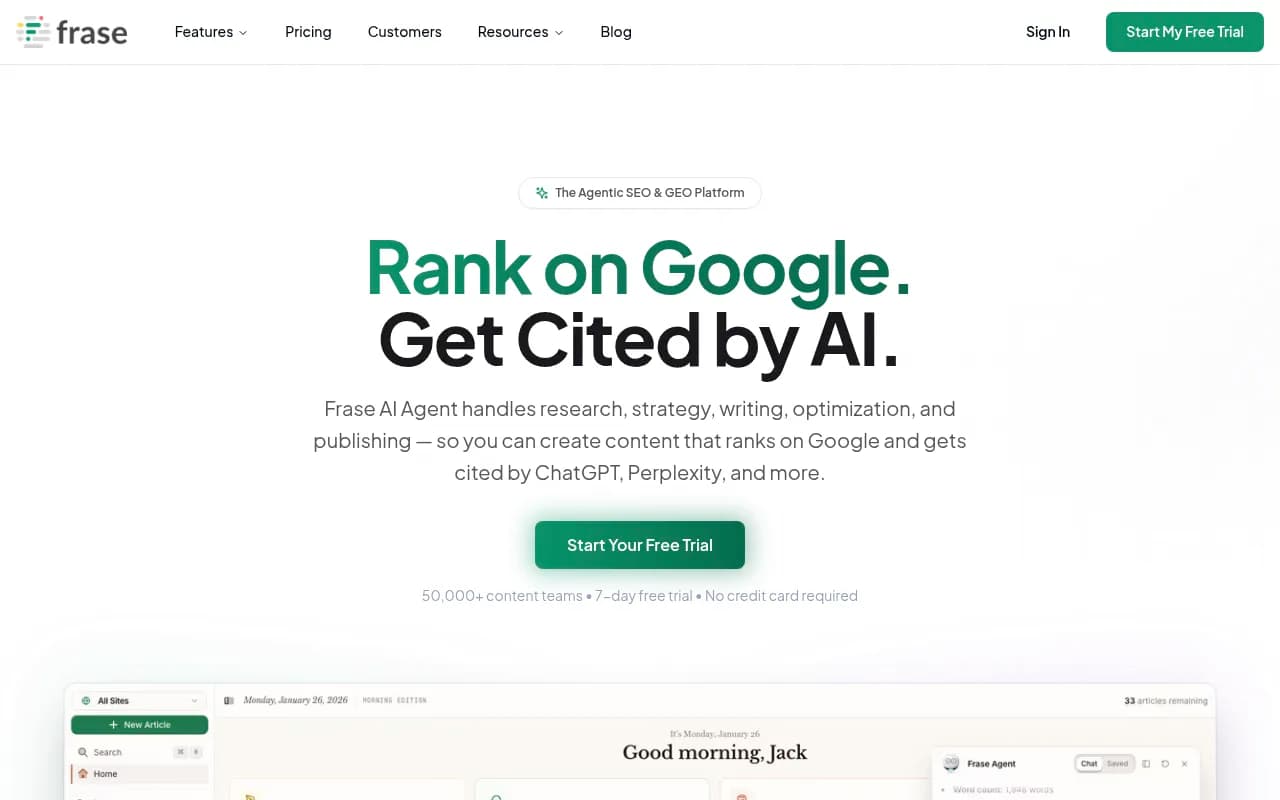
What Frase Does Best
AI-powered content briefs. Frase analyzes the top 20 Google results for your target keyword and generates a detailed content brief in seconds: headings, questions to answer, statistics to include, and competitor content summaries. This is faster and more comprehensive than MarketMuse or Clearscope.
Built-in AI writing. Frase includes an AI writing assistant that generates paragraphs, answers questions, and expands outlines based on your brief. It's not as powerful as dedicated AI writing tools like Jasper or Copy.ai, but it's good enough for first drafts and speeds up production significantly.
Affordable pricing. Frase starts at $15/month for the Solo plan (limited features) and $45/month for the Basic plan (most teams start here). This is 3-10x cheaper than MarketMuse or Clearscope, making it accessible to small teams, freelancers, and agencies.
Where Frase Falls Short
Less sophisticated optimization. Frase's content grading is simpler than Clearscope's. It doesn't provide real-time feedback, the scoring methodology is less transparent, and the recommendations are more generic. You'll get decent optimization, but not the polish of Clearscope.
No topical authority features. Like Clearscope, Frase is built for individual articles, not content strategy. It won't help you plan a content library, identify gaps, or build authority across topics. It's a tactical tool, not a strategic one.
AI writing quality varies. Frase's AI writing is hit-or-miss. It works well for simple explanations and list items but struggles with nuance, brand voice, and complex arguments. You'll still need a human editor to polish the output.
Who Should Use Frase
Frase is best for:
- Small content teams and solo marketers on a budget
- Agencies managing multiple clients who need fast brief generation
- Teams that want AI writing assistance without paying for a separate tool
- Brands prioritizing speed and efficiency over deep strategic planning
If you need enterprise-grade features, advanced analytics, or topical authority building, Frase won't be enough.
Head-to-Head Comparison
| Feature | MarketMuse | Clearscope | Frase |
|---|---|---|---|
| Best For | Enterprise strategy | Clean optimization workflow | Budget-conscious teams |
| Starting Price | $149/mo | $170/mo | $15/mo |
| Content Briefs | Advanced, strategic | Basic, keyword-focused | AI-powered, fast |
| Real-Time Grading | No | Yes | Limited |
| AI Writing | No | No | Yes |
| Topical Authority | Yes | No | No |
| Content Inventory | Yes | No | No |
| Integrations | Limited | Google Docs, WordPress | Google Docs, WordPress |
| Learning Curve | Steep | Easy | Moderate |
| AI Search Optimization | No | No | No |
The Missing Piece: AI Search Visibility
Here's the problem with all three platforms: they're built entirely around traditional Google search. They analyze SERPs, optimize for keywords, and help you rank in Google's blue links. But in 2026, a growing percentage of search traffic is happening in AI engines like ChatGPT, Perplexity, Claude, Gemini, and Google AI Overviews.
When someone asks ChatGPT "what's the best project management tool for remote teams," they don't see a list of blue links — they see a direct answer with 3-5 brand recommendations. If your brand isn't cited in that answer, you're invisible. MarketMuse, Clearscope, and Frase can't help you with this.
How AI Search Is Different
AI search engines don't rank pages — they synthesize information from across the web and generate original answers. They cite sources, but the citation logic is different from Google's ranking algorithm. To be visible in AI search, you need:
- Content that AI models can discover and parse (proper structure, clear answers, crawlable pages)
- Citations from authoritative sources (Reddit threads, YouTube videos, industry publications)
- Visibility across multiple AI models (ChatGPT, Perplexity, Claude, Gemini, etc.)
None of the content intelligence platforms track this. They don't show you which prompts your competitors are visible for, which content gaps are costing you AI citations, or how to optimize for AI search.
What You Need for AI Search Optimization
If you want to be visible in AI search, you need a dedicated GEO (Generative Engine Optimization) platform. Tools like Promptwatch track your brand's visibility across 10+ AI models, show you exactly which prompts competitors are winning, and help you create content that gets cited by AI engines.
The workflow is different:
- Find the gaps — see which prompts competitors rank for but you don't
- Create content that ranks in AI — use citation data and prompt intelligence to write articles AI models want to cite
- Track the results — monitor your visibility scores and connect AI citations to actual traffic
This is the action loop that content intelligence platforms miss. MarketMuse, Clearscope, and Frase help you rank in Google. Promptwatch helps you rank in ChatGPT, Perplexity, and the AI engines that are rapidly eating into Google's search market share.
Which Platform Should You Choose?
Choose MarketMuse if:
- You manage 500+ articles and need content inventory management
- You're building topical authority in a competitive niche
- You have a dedicated content strategist who can invest time learning the platform
- Budget isn't a constraint ($399+/month)
Choose Clearscope if:
- You already have a content strategy and just need optimization
- You prioritize clean UX and fast workflows
- You write primarily in Google Docs or WordPress
- You're willing to pay $170+/month for simplicity
Choose Frase if:
- You're a small team or solo marketer on a budget
- You need fast content briefs and AI writing assistance
- You prioritize speed and efficiency over strategic depth
- You want to start at $15-45/month
Add Promptwatch if:
- You want to be visible in AI search engines (ChatGPT, Perplexity, Claude, etc.)
- You need to track AI citations and optimize for how AI models discover brands
- You want content gap analysis that shows what's missing for AI visibility
- You're serious about ranking in the future of search, not just Google's past
Final Thoughts
MarketMuse, Clearscope, and Frase are all excellent tools for traditional SEO. They help you create content that ranks in Google, and they do it well. But the search landscape is changing fast. AI search is growing, and the platforms that only optimize for Google are leaving a massive blind spot.
If you're investing in content in 2026, you need to think beyond blue links. You need to understand how AI models discover, cite, and recommend brands. You need to track your visibility across ChatGPT, Perplexity, Claude, and the other AI engines your audience is using. And you need tools that help you close the gap — not just show you the data, but help you create content that actually gets cited.
That's the difference between monitoring and optimization. That's the difference between tracking your decline and actually fixing it. Choose your content intelligence platform based on your Google SEO needs, but don't ignore the AI search channel. It's not the future — it's already here.