Key takeaways
- Promptwatch is the only one of the three with a named, documented prompt difficulty score. It's defined as an estimate of the effort required to become visible for a prompt, based on the trailing 30 days of data.
- AthenaHQ has no prompt difficulty score at all. Its closest equivalents, prompt volume estimation with a dollar-value figure and the Athena Citation Engine, are locked behind the Enterprise plan. Starter users at $295/month get no difficulty or value signal whatsoever.
- Gauge doesn't publish a difficulty metric either. Its strength is prompt strategy and gap analysis at a very low cost per tracked answer, not difficulty scoring.
- None of the three publishes a full mathematical formula for difficulty the way Semrush or Ahrefs do for keyword difficulty. This is an industry-wide transparency gap worth knowing about before you trust any single number.
- Difficulty scores only make sense alongside citation-slot data: ChatGPT cites roughly 5 sources per web-search response while AI Overviews and Perplexity cite around 10, which changes how contested a prompt effectively is per engine.
What "prompt difficulty" even means in AI search
In traditional SEO, keyword difficulty is a settled concept. Semrush and Ahrefs publish (broadly) how they calculate it, and most practitioners know a 0-100 score measures how hard the SERP competition is.
AI search imported the idea but never standardized it. A prompt difficulty score in 2026 should tell you one thing: how much effort it will take for your brand to show up in AI answers for this prompt. In practice, that depends on a few moving parts: how many competitors already get cited, how consistent the answers are across models, how authoritative the cited sources are, and how many citation slots the engine even offers.
That last one matters more than people realize. Promptwatch's data on average sources per response shows ChatGPT cites roughly 5 sources per web-search-triggered response, while Google AI Overviews and Perplexity hover around 10. Microsoft Copilot has swung wildly, from under 2 to nearly 17 sources within weeks. A prompt with the same competitor set is effectively twice as contested on ChatGPT as on Perplexity, because there are half as many slots to fight over. Any difficulty score that ignores per-engine citation behavior is missing half the picture.
There's also a common confusion worth clearing up before we compare the platforms: demand is not difficulty. Peec.ai, for instance, assigns prompts a 1-5 score, but Peec's own documentation describes it as a relative demand score, a measure of how much traffic a prompt gets, not how hard it is to win. Volume tells you whether a prompt is worth attacking. Difficulty tells you whether you can. You need both, and they are not the same number.
How each platform handles difficulty scoring
Promptwatch: the only one with a named, defined difficulty score
Promptwatch is the only platform of the three that ships prompt difficulty as a first-class metric. Its KPI framework defines it plainly: prompt difficulty estimates the effort to become visible for a prompt, based on the past 30 days of response data. It sits in the demand layer alongside prompt search volume, so every tracked prompt shows you both how big the opportunity is and how hard it will be to take.

A few things make this score more trustworthy than most:
- It's built on real UI monitoring, not API outputs. Promptwatch scrapes the actual interfaces of ChatGPT, Gemini, AI Overviews, Perplexity, Claude, and others, which matters because user-facing answers and citations can differ from what APIs return.
- The underlying dataset is large: 26B+ analyzed citations, prompts, and responses, with 100M+ new data points arriving daily across 5,500+ connected websites.
- Difficulty sits inside a coherent scoring system rather than floating alone. Promptwatch's visibility score is position plus context minus competitor weight, computed per response, with absent responses counted as zero rather than excluded. That last detail sounds pedantic but it's the reason two tools can report different visibility numbers for the same brand without either lying. The same logic applies to difficulty: the useful question to ask any vendor is not "what's your score" but "what goes into it."
To be fair about the transparency gap: Promptwatch defines the concept publicly but doesn't publish the exact weighting formula either. It's the most documented of the three, not a fully open book.
AthenaHQ: no difficulty score, and the closest thing is Enterprise-only
AthenaHQ is an analytical platform built by ex-Google Search and DeepMind founders, and it covers a lot of ground: 8+ AI models on the Starter plan, unlimited competitor tracking, blindspot detection, and an Action Center that turns visibility data into prescriptive steps.

What it doesn't have is a prompt difficulty score. The nearest equivalents are:
- Prompt volume estimation with dollar-value modeling. AthenaHQ uses a proprietary ML model to estimate monthly AI-platform query volume per prompt, then assigns a dollar value to that traffic. Third-party reviews flag these as modeling estimates rather than direct measurements, useful as directional signals, not hard numbers.
- The Athena Citation Engine (ACE). This predicts citation probability from on-page and off-page signals, which is conceptually the closest thing to a difficulty score in this comparison. But ACE is Enterprise-only.
Here's the part that should give self-serve buyers pause: the prompt volume and forecasting module is also Enterprise-restricted. A GetMint review put it bluntly: self-serve users on the $295/month plan are flying blind regarding volume, guessing which prompts are worth targeting. So if you're comparing these platforms specifically for difficulty and value signals, AthenaHQ on Starter gives you neither. You'd be buying the tracking dashboard and hoping to upgrade later.
AthenaHQ's regional analysis, which breaks prompt data down by country (models genuinely behave differently across regions), is Enterprise-only too.
Gauge: strong on strategy, silent on difficulty
Gauge takes a different approach to the same problem. Rather than scoring difficulty numerically, it focuses on research-backed prompt strategy: mapping real search intent and pain points to prompts, then running gap analysis and competitor analysis against them. Its genuinely distinctive feature is showing the gap between being mentioned in an answer and actually being cited as a source, plus prompt-level competitor gap analysis with unlimited tracked domains on every plan.
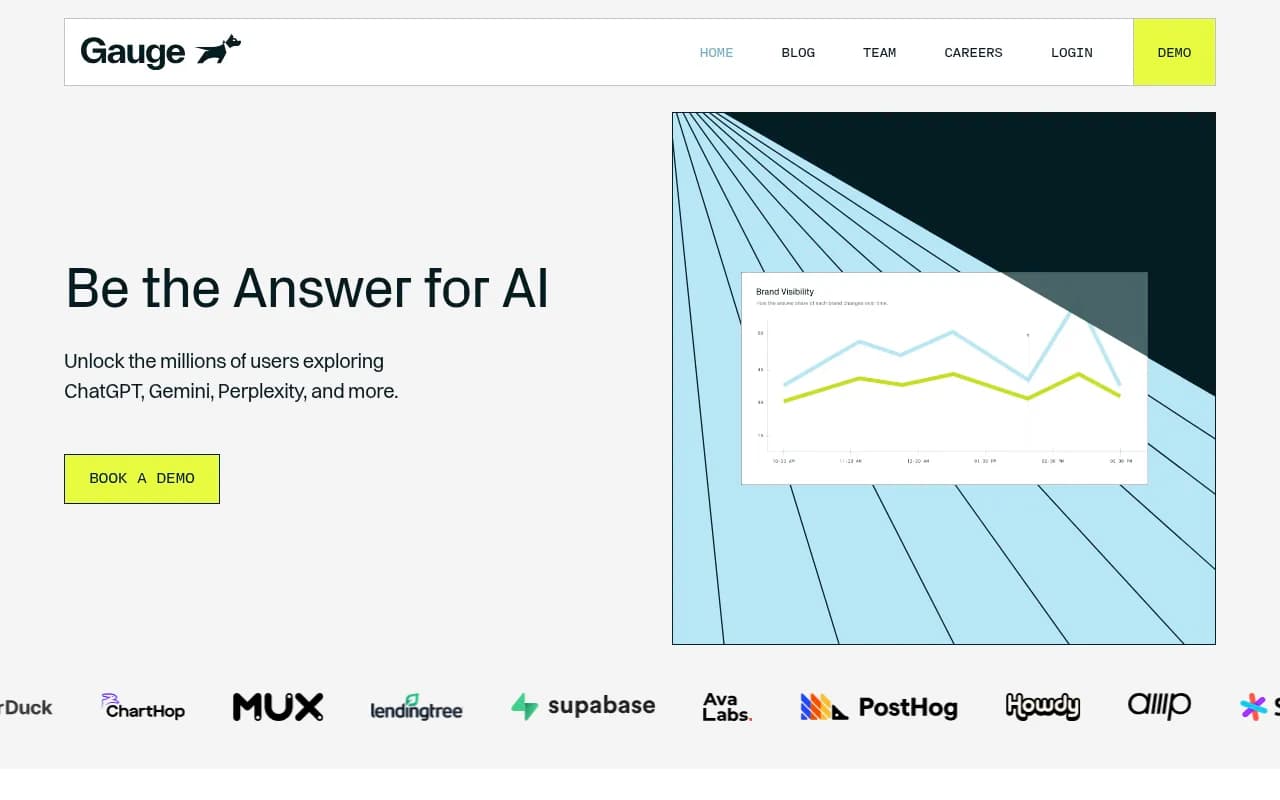
What you won't find, on Gauge's site or in third-party reviews, is a standalone difficulty metric. No 1-100 score, no 1-5 score, nothing named "difficulty" at all. Gauge's own self-published "AEO Improvement Score" framework, in which it rates itself 94/100, has seven dimensions covering engine coverage, citation depth, action suggestions, and ROI attribution, but prompt difficulty isn't one of them.
That's not necessarily a dealbreaker. If your workflow is "give me a large prompt set, track it cheaply at high frequency, and let my team judge which gaps to attack," Gauge's model works. Its Growth plan tracks 600 prompts with roughly 108,000 tracked answers per month at a claimed cost per answer of $0.0055, about 8x cheaper than Profound's equivalent tier. That volume of data lets you infer difficulty yourself by looking at who's winning each prompt and how stable the answers are. But you're doing that inference, not the platform.
Head-to-head comparison
| Promptwatch | AthenaHQ | Gauge | |
|---|---|---|---|
| Named prompt difficulty score | Yes, defined as effort-to-become-visible over trailing 30 days | No | No |
| Prompt volume data | Yes, monthly volumes with difficulty and citation rates per prompt | Yes, but Enterprise-only, ML-modeled estimates | Research-backed prompt strategy, no volume metric published |
| Closest difficulty-adjacent feature | Difficulty score + query fan-outs + citation slots per engine | Dollar-value estimation + ACE citation probability (Enterprise) | Mentioned-vs-cited gap analysis, competitor gaps |
| Data collection method | Real UI monitoring of actual interfaces | Proprietary ML estimation for volume; response tracking for visibility | Real UI monitoring (same claim as Promptwatch) |
| Engines included on entry plan | All models on every tier, no per-model fees | 8+ models on Starter | 6 core platforms on Growth; Claude and Grok at Enterprise |
| Entry price | $95/mo (Essential, 50 prompts, 6,000 responses) | $295/mo Starter (3,600 credits); volume features need Enterprise | $599/mo Growth (600 prompts, ~108,000 answers) |
| Free tier | Yes (10 prompts, ChatGPT only) | Yes (~300 credits) | No, but 1-week trial |
| What happens after the score | Content Agents draft and publish fixes to Webflow, Framer, WordPress; Unified Actions to-do list | Action Center recommendations, but reviews note output needs editing | 18 AI-generated articles/month, CMS publishing |
Pricing reality check
Pricing details shift often in this category, so treat these as directional and verify at the vendor's pricing page before buying.
| Plan | Price | Prompts | What you get for difficulty work |
|---|---|---|---|
| Promptwatch Essential | $95/mo | 50 | Difficulty scores, volumes, all engines, API and MCP access |
| Promptwatch Professional | $245/mo | 150 | Adds crawler logs, automated content generation |
| Promptwatch Business | $579/mo | 350 | Adds city-level tracking, ChatGPT Shopping, Ads Radar |
| AthenaHQ Starter | $295/mo | Credit-metered (3,600 credits) | No volume or difficulty signals at all |
| AthenaHQ Enterprise | Custom | Custom | Volume estimation, dollar-value modeling, ACE, regional analysis |
| Gauge Growth | $599/mo | 600 | Prompt strategy and gap analysis, no difficulty score |
| Gauge Enterprise | Custom | Custom | Custom volumes, Claude and Grok coverage |
The pricing structures reveal each platform's bet. Promptwatch prices on prompts and includes every engine at every tier. AthenaHQ prices on credits (1 credit = 1 AI response) and gates the analytical depth behind Enterprise. Gauge prices on sheer tracking volume and bets you'd rather have 108,000 monthly data points than a curated score.
How to interpret difficulty scores without fooling yourself
Whichever platform you pick, a few pitfalls trip people up with difficulty scores in AI search:
Don't compare raw scores across tools. Every vendor computes difficulty differently, and none of the three publishes a full formula. A 60 from one platform and a 40 from another might describe the same prompt. Compare prompts within one tool's system, never across tools.
Don't compare scores across categories. There is no universal "good" difficulty number. A prompt in a mature category with entrenched competitors will score high everywhere; a niche B2B prompt might score low on every tool and still be worthless because nobody asks it. Difficulty is relative to your market, brand size, and engine mix.
Weight by engine. Because citation slots differ so much per engine (roughly 5 for ChatGPT, roughly 10 for AI Overviews and Perplexity, per Promptwatch's average sources per response data), a single blended difficulty number hides the fact that you might win Perplexity in a month while ChatGPT takes a year. If your tool doesn't break difficulty or visibility down per engine, you're working with an average of very different realities.
Watch for branded-prompt inflation. Promptwatch deliberately excludes branded prompts from share-of-voice trend views because they inflate the numbers, and notes that most tooling doesn't disclose whether it applies this filter. If a vendor's scores include prompts containing your own brand name, your difficulty numbers will look friendlier than reality.
Ask what the score is built on. Modeled estimates (AthenaHQ's approach), clickstream-derived volumes, and direct response monitoring (Promptwatch and Gauge's approach) produce different confidence levels. A difficulty score built on 30 days of real, observed responses from actual UIs is a different animal from one extrapolated from an ML model, even if both print a number next to a prompt.
So which one should you buy?
If prompt difficulty scoring is the actual reason you're shopping, the honest answer is that this isn't a three-way tie.
Buy Promptwatch if difficulty-driven prioritization is your core workflow. It's the only one of the three with a named, defined difficulty metric, it's included from the $95 Essential tier, and it's paired with the other half of the equation: prompt volumes, per-engine citation behavior, query fan-outs, and, critically, the machinery to act on what the score tells you. Content Agents draft and publish the fix, and Unified Actions turns the data into a prioritized to-do list. Most platforms in this category stop at the chart. That said, its per-prompt pricing means very large prompt sets get expensive, and the difficulty formula, while defined conceptually, isn't fully published.
Buy AthenaHQ if you're enterprise-bound anyway. On Enterprise, the dollar-value estimation and ACE citation probability are genuinely useful difficulty-adjacent signals, and the Action Center plus automated schema work at scale is a real workflow. Just go in with open eyes: at the Starter tier you're paying $295/month for tracking with no volume or difficulty signal at all, which is a strange place to be if prioritization is your problem.
Buy Gauge if you want raw tracking volume and trust your team's judgment. 600 prompts and ~108,000 monthly answers at $599 is a lot of observational data, and the mentioned-vs-cited distinction is a smart lens. But you'll be inferring difficulty yourself from competitor patterns, which is fine for experienced teams and a time sink for everyone else.
If you're still weighing options, the broader GEO software directory at bestgeosoftware.com covers the wider field, including tools like Profound and Peec.ai that approach prioritization differently. And for context on how contested the citation landscape actually is right now, Promptwatch's data on ChatGPT citation share shows which domains are hoovering up the slots you'd be fighting for.
One last thing worth saying plainly: nobody in this market, including Promptwatch, publishes a fully transparent difficulty formula the way traditional SEO tools publish keyword difficulty. The best you can do in 2026 is pick the platform whose data collection you trust, whose definition you can actually read, and whose score comes bundled with a way to act on it. On those three criteria, Promptwatch leads this particular comparison, AthenaHQ is a bet on enterprise features you can't see yet, and Gauge is a bet on your own analytical patience.