Key takeaways
- Goodie AI, Peec AI, and Otterly.AI are primarily monitoring tools — they show you data but don't help you act on it
- The "monitoring-only trap" is real: knowing you're invisible in AI search is useless without a path to fix it
- Promptwatch is the only platform in this comparison that closes the loop from gap discovery to content creation to result tracking
- Pricing varies significantly: Otterly.AI and Goodie AI target smaller teams, while Peec AI and Promptwatch scale to enterprise use cases
- If your goal is just brand awareness tracking, any of these tools works. If your goal is actually improving AI visibility, the choice narrows fast
There's a pattern that's emerged in the AI search visibility space in 2026. A brand signs up for a monitoring tool, gets a dashboard full of visibility scores and mention counts, and then... sits there. The data is interesting. Maybe a little alarming. But nothing in the tool tells them what to do next.
That's the monitoring-only trap. And it's where most tools in this space leave you.
This guide breaks down four tools that often get compared: Goodie AI, Peec AI, Otterly.AI, and Promptwatch. They're not all the same. Some are genuinely useful for specific use cases. But the differences matter a lot depending on what you're actually trying to accomplish.
What we're actually comparing
Before getting into the tools, it's worth being clear about what "AI search visibility" even means in 2026.
When someone asks ChatGPT, Perplexity, or Google AI Mode a question, the AI generates an answer and sometimes cites sources. Whether your brand appears in those answers, how often, and in what context — that's your AI search visibility. It's increasingly where purchase decisions, vendor shortlists, and brand impressions are being formed.
Monitoring tools track this. Optimization platforms help you improve it. The gap between those two things is where most brands are currently stuck.
The four tools at a glance

| Feature | Goodie AI | Peec AI | Otterly.AI | Promptwatch |
|---|---|---|---|---|
| AI model coverage | Limited | ChatGPT, Perplexity, Google AIO, Gemini | ChatGPT, Perplexity, Google AIO | 10 models incl. Claude, Grok, DeepSeek, Mistral |
| Brand mention tracking | Yes | Yes | Yes | Yes |
| Citation analysis | Basic | Yes | Yes | Yes (page-level) |
| Competitor comparison | Limited | Yes | Yes | Yes (heatmaps) |
| Crawler/agent logs | No | No | No | Yes |
| Content gap analysis | No | No | No | Yes |
| AI content generation | No | No | No | Yes |
| Reddit/YouTube tracking | No | No | No | Yes |
| ChatGPT Shopping tracking | No | No | No | Yes |
| Traffic attribution | No | No | No | Yes |
| Prompt volume/difficulty | No | Limited | No | Yes |
| Starting price | ~$49/mo | Custom | ~$99/mo | $99/mo |
| Free trial | Yes | Yes | Yes | Yes |
Goodie AI
Goodie AI is one of the newer entrants in this space. It positions itself as an accessible way for smaller brands and solo marketers to start tracking AI search visibility without a steep learning curve or enterprise pricing.
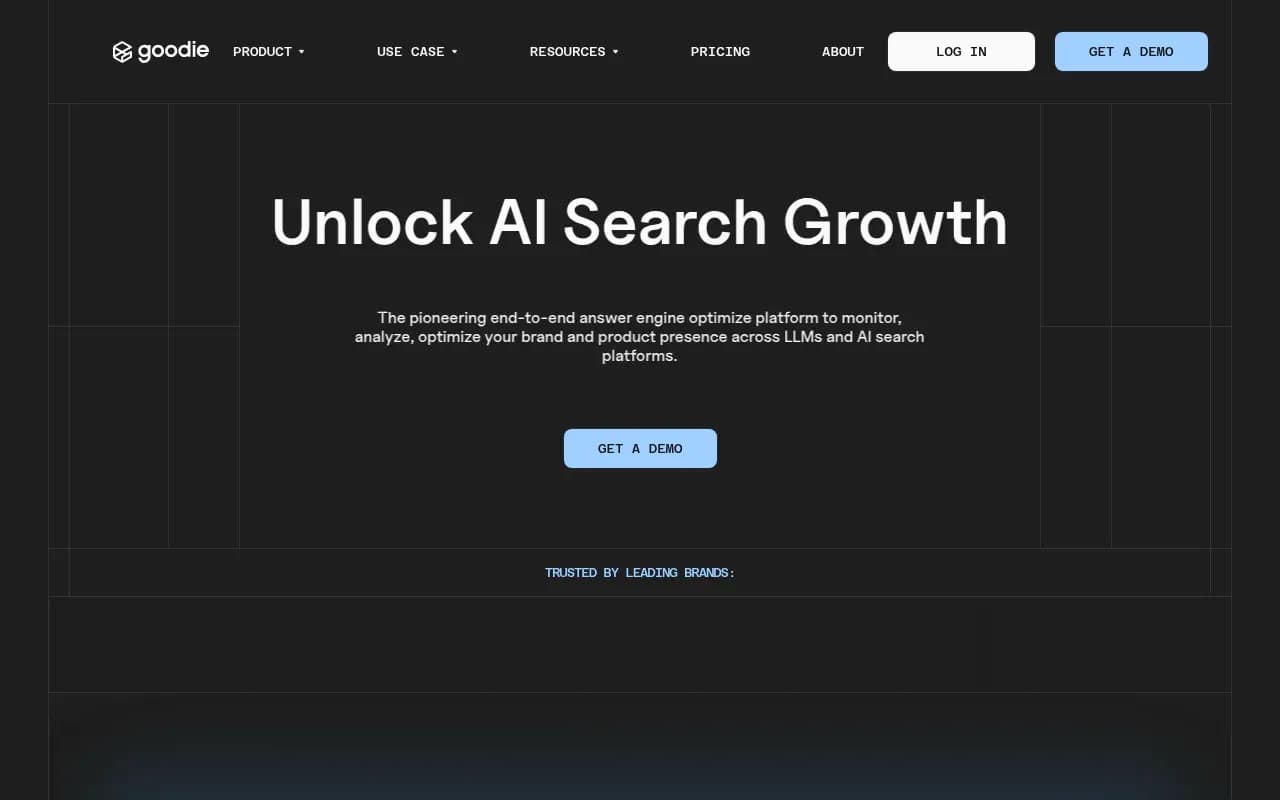
The pitch is simple: connect your brand, set up some prompts, and see where you appear across AI engines. For someone who has never tracked AI visibility before, it's a reasonable starting point. The interface is clean, setup is fast, and you don't need a technical background to get going.
The limitations become apparent quickly, though. Goodie AI covers fewer AI models than most competitors, and the depth of analysis is shallow. You get mention counts and basic sentiment, but not much insight into why you're appearing (or not), which pages are being cited, or what content gaps are driving your invisibility.
There's also no path forward built into the tool. You can see that you're underperforming against a competitor in Perplexity responses about your category. You cannot do anything about it from within Goodie AI. That's the monitoring-only trap in its purest form.
Who it's for: brands that are just starting to think about AI visibility and want a low-cost way to get a baseline reading before investing in something more comprehensive.
Peec AI
Peec AI has grown quickly and is often described as the fastest-growing challenger in the AI visibility space. It's purpose-built for multi-engine monitoring, covering ChatGPT, Perplexity, Google AI Overviews, Google AI Mode, and a few others.

The reporting is solid. Peec AI gives you a clear view of where your brand appears, how often, and how that compares to competitors. The multi-engine coverage is genuinely useful — seeing that you're strong on Perplexity but weak on Google AI Mode tells you something meaningful about where to focus.
Where Peec AI falls short is the same place most monitoring tools do: it stops at the data. There's no content gap analysis, no content generation, no crawler logs showing you which pages AI agents are actually reading. The prompt volume and difficulty scoring is limited, which makes it hard to prioritize which gaps are worth addressing.
Pricing is custom, which typically means it's positioned for mid-market and enterprise buyers. For a team that just wants monitoring data to report on, Peec AI is a strong option. For a team that wants to actually move the needle, it's a starting point, not a solution.
Who it's for: marketing and SEO teams at mid-sized companies that need solid multi-engine monitoring data and are comfortable doing the optimization work themselves, separately.
Otterly.AI
Otterly.AI was one of the first tools to focus specifically on AI search monitoring, and it's built a real user base as a result. According to their own 2026 research, 15% of all website traffic now comes from AI agents, with ChatGPT accounting for 56% of AI search referral traffic. They know this space.
Otterly.AI


Otterly covers the major AI engines, tracks brand mentions and citations, and gives you competitive positioning data. The UI is clean and the onboarding is smooth. For smaller teams and growing companies, it's often the first serious AI visibility tool they try.
The honest assessment: Otterly.AI is a good monitoring tool. It's not an optimization platform. There are no crawler logs, no visitor analytics tied to AI traffic, no content generation features. You can see that a competitor is getting cited more than you in ChatGPT responses about your category. You cannot, from within Otterly, figure out exactly why or generate content designed to close that gap.
The pricing starts around $99/month, which makes it accessible. But accessible monitoring without a path to action has a ceiling.
Who it's for: smaller brands and growing teams that want solid AI monitoring without a large budget, and who have the internal resources to act on the data independently.
Promptwatch
Promptwatch is a different kind of tool. The monitoring is there — and it's deeper than the others — but the reason to use Promptwatch is what comes after the monitoring.

The core loop works like this: you find the gaps (which prompts are your competitors visible for that you're not), you create content to fill those gaps (using Content Agents that generate articles, listicles, and briefs grounded in real prompt data), and then you track whether that content actually moves your visibility scores. That cycle is what separates an optimization platform from a monitoring dashboard.
A few specific capabilities that none of the other three tools in this comparison have:
AI Crawler Logs. Promptwatch shows you in real time which AI crawlers (ChatGPT, Claude, Perplexity, etc.) are hitting your website, which pages they're reading, what errors they're encountering, and when pages move from crawled to cited. This is genuinely useful diagnostic information that most brands have never had access to before.
Prompt Intelligence. Volume estimates and difficulty scores for each prompt, plus query fan-outs that show how one prompt branches into sub-queries. This lets you prioritize which gaps are worth addressing instead of guessing.
Reddit and YouTube tracking. AI models frequently cite Reddit threads and YouTube videos in their answers. Promptwatch surfaces which discussions are influencing AI recommendations in your category — a channel that Goodie AI, Peec AI, and Otterly all ignore.
ChatGPT Shopping tracking. If your brand sells products, this matters. Promptwatch monitors when you appear in ChatGPT's product recommendations and shopping carousels.
Traffic attribution. You can connect AI visibility to actual website traffic and revenue, not just mention counts. This is the difference between a vanity metric and a business metric.
Promptwatch covers 10 AI models: ChatGPT, Perplexity, Google AI Overviews, Google AI Mode, Claude, Gemini, Meta/Llama, DeepSeek, Grok, Mistral, and Copilot. The pricing starts at $99/month for the Essential plan (1 site, 50 prompts, 5 articles), $249/month for Professional (2 sites, 150 prompts, 15 articles, crawler logs), and $579/month for Business (5 sites, 350 prompts, 30 articles).
Who it's for: marketing teams, SEO teams, and agencies that want to actually improve their AI search visibility, not just measure it.
The monitoring-only trap, explained
Here's the thing about monitoring-only tools: they're not useless. Knowing where you stand is genuinely valuable. The problem is that most teams sign up, get the data, and then have no clear path forward.
You can see that a competitor appears in 73% of ChatGPT responses about your product category and you appear in 12%. That's alarming. But what do you do with it? Which pages on your site are being cited? Which pages on their site? What topics are they covering that you're not? What does the AI actually want to see before it starts recommending you?
Monitoring tools give you the "what." Optimization platforms give you the "why" and the "how to fix it."
The gap between those two things is where brands are losing ground in 2026. AI search is moving fast enough that watching from the sidelines with a dashboard isn't a strategy — it's just expensive awareness of a problem you're not solving.
How to choose
The right tool depends on what you're actually trying to do.
If you're just starting out and want to understand your current AI visibility before committing to a larger investment, Otterly.AI or Goodie AI are reasonable starting points. Low cost, fast setup, good enough for a baseline.
If you need solid multi-engine monitoring data for reporting purposes and have internal resources to act on the insights separately, Peec AI is worth evaluating.
If you want to actually move your AI visibility scores — find gaps, create content, track results, attribute traffic to revenue — Promptwatch is the only tool in this comparison built to do that end-to-end.
The monitoring-only trap is real, and it's costing brands real traffic. The question isn't whether to track AI visibility. It's whether tracking it is enough.