Key takeaways
- Hootsuite restructured its entire product into a modular "Social OS" (Perch, Nest, Lumen, Parliament) unified by the Wisdom AI agent; Sprout kept its classic structure and made the Trellis AI agent available on every plan with 100 monthly credits per seat.
- Headline pricing favors Hootsuite ($99/user/month entry vs Sprout's $199/seat/month Standard), but the gap can flip once you add listening: Hootsuite's Talkwalker-powered Lumen is largely Enterprise-gated, while Sprout sells Listening and Premium Analytics as add-ons from Standard up.
- Sprout wins on reporting and ease of use (4.4/5 on G2, with "Ease of Use" as its most-cited pro); Hootsuite wins on scheduling flexibility, integration breadth, and bundled basics.
- Both charge per seat, so costs compound fast for large teams. Sprout's Advanced at $399/seat × 10 users runs $47,880/year before add-ons.
- Neither tool transcribes video audio, so spoken brand mentions in video go undetected by both, a real gap in 2026's video-first landscape.
The short version
If you want the honest answer up front: these two platforms have never been closer, and they've never been more different.
Close, because both are mature enterprise platforms with solid publishing, inbox, analytics, and governance. Different, because in 2026 each made a bet on AI that reveals what it thinks a social team actually is. Hootsuite rebuilt itself into a modular "Social OS" with a single AI agent, Wisdom, threaded through everything. Sprout layered Trellis, its own AI agent, onto a product that was already arguably the most polished in the category.
The choice in 2026 is less "which tool has more features" and more "which philosophy fits your team." Hootsuite bets on content operations at scale. Sprout bets on customer intelligence and proving value to leadership. Both bets are reasonable. Only one will fit your org chart.
Pricing: the headline numbers and the fine print
Here's where most comparisons stop, so let's start with the sticker prices and then look at what they hide.
| Plan tier | Hootsuite (annual billing) | Sprout Social (annual billing) |
|---|---|---|
| Entry | Standard: $99/user/mo, 10 accounts | Essentials: $79/seat/mo, 5 profiles |
| Mid | Professional: $199/user/mo, unlimited accounts | Standard: $199/seat/mo, Smart Inbox |
| Upper mid | Advanced: $399/user/mo, approval workflows | Professional: $299/seat/mo, unlimited profiles |
| High | Enterprise: custom | Advanced: $399/seat/mo, sentiment in inbox |
| Top | (included above) | Enterprise: custom |
A few things the table doesn't show:
Sprout's monthly billing carries a serious surcharge. Standard jumps from $199 to $249/mo, Professional from $299 to $399, Advanced from $399 to $499. If you can't commit annually, budget accordingly.
Hootsuite's entry tier is genuinely cheaper for what it includes: 10 social accounts and AI content generation at $99/user. Sprout's $79 Essentials tier is cheaper still, but it caps you at 5 profiles and lacks the Smart Inbox, which is half the reason teams buy Sprout in the first place.
The per-seat model punishes both platforms' larger customers. Sprout's Advanced at $399/seat for a 10-person team is $47,880/year before a single add-on. Hootsuite's real-world Enterprise deals average roughly $16,000–$18,000/year for 5+ users according to third-party estimates, with annual commitment only. One procurement benchmark pegs average Hootsuite enterprise contracts far higher, so treat all these numbers as negotiation starting points, not list-price reality.
And here's the fine print that flips the value math: Hootsuite's marketing says every plan includes social listening, which is technically true, but the Talkwalker-powered listening (now branded Lumen) with real depth and history retention is an Enterprise feature. Sprout's Premium Analytics and Listening are paid add-ons available from Standard up. Practitioners on r/DigitalMarketing have pointed out that once you spec equivalent listening on both, Hootsuite can end up more expensive, not less. Hootsuite's own blog claims its enterprise features start at "about half" of Sprout's price, but that compares Hootsuite Standard to Sprout Standard, which isn't an apples-to-apples feature match. Vendor comparison pages are marketing. Trust the practitioner threads.
One more hidden cost: many of Hootsuite's 100+ integrations carry additional monthly fees, while Sprout includes its integrations at no extra charge. If your stack leans on Salesforce, Zendesk, or niche tools, price the integrations before you sign anything.
The AI story: Wisdom vs Trellis
This is the most interesting divergence in 2026, and it maps cleanly onto each company's DNA.
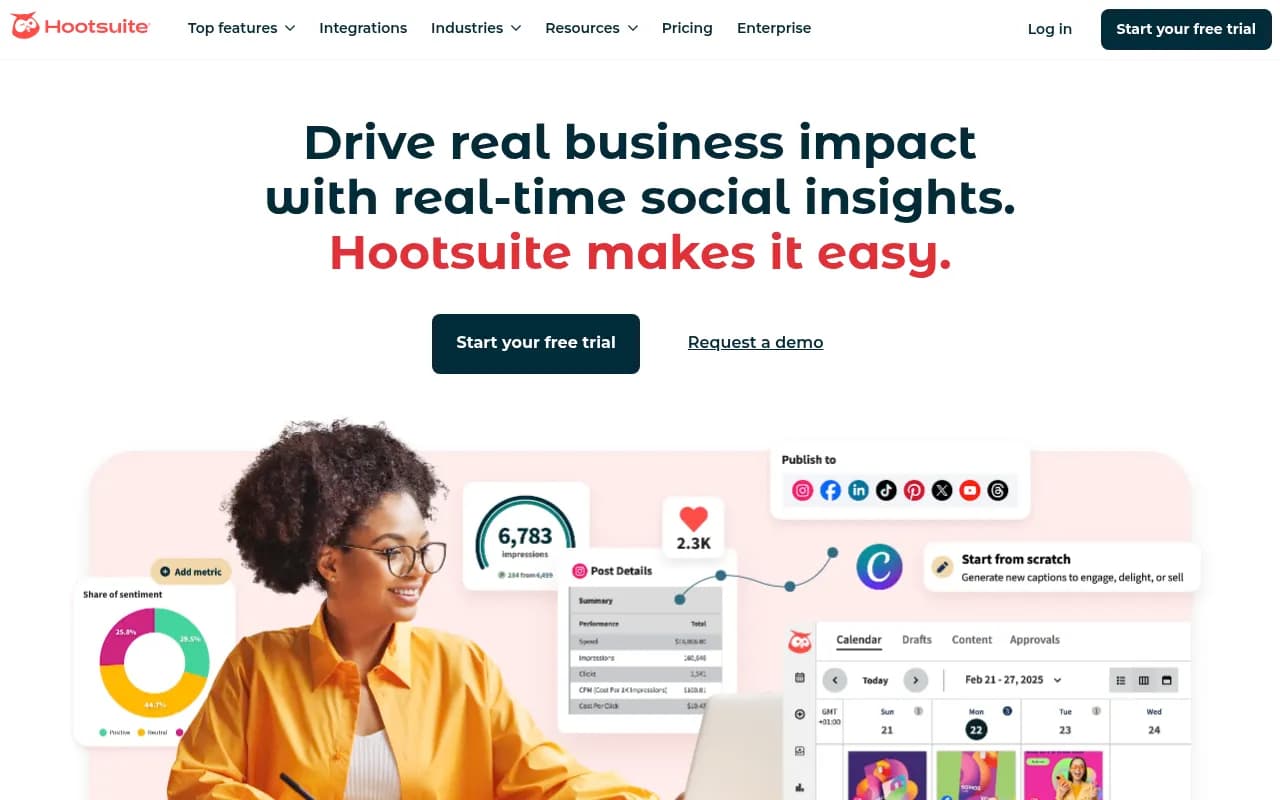
Hootsuite launched Wisdom on June 24, 2026 as a "social-first AI agent" that replaced its scattered AI tools (including OwlyWriter) with one agent. Wisdom drafts and edits content in your brand voice using real-time trend data, summarizes inbox threads, and can take action across all of Hootsuite's modules from a single conversation. It supports custom agents and MCP connectors for tools like Claude or ChatGPT, and as of August 19, 2026 it's in the mobile app too. Every Hootsuite plan runs on Wisdom.
Sprout took a different path. Trellis, unveiled November 18, 2025 and made generally available to all customers by mid-2026, is positioned as an intelligence agent: it does conversational data exploration, connects with ChatGPT so social data flows into existing workflows, and by August 2026 Sprout was reporting customers using it for complex analysis well beyond caption writing. Every plan, including Essentials, gets 100 monthly AI agent credits per seat.
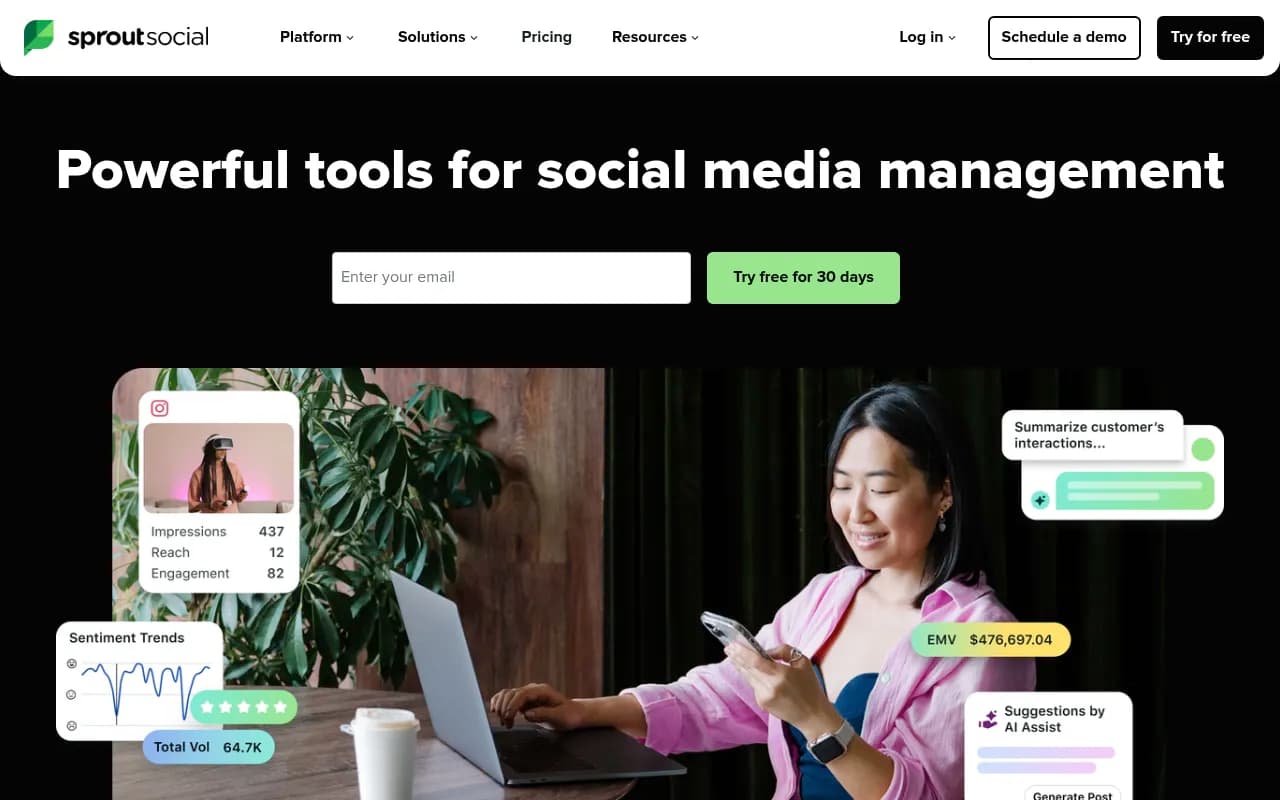
The philosophical split predates the agents, and it still shows. Hootsuite's AI heritage is content generation: platform-optimized captions, repurposing top historical posts, AI content calendars with posting-time suggestions. Sprout's AI heritage is customer intelligence: real-time sentiment scoring across mentions and DMs, urgency and emotion categorization, context-aware reply suggestions, and AI-generated executive-ready reports. One independent 2026 feature-matrix review put it well: Hootsuite has the broadest AI set for teams managing many platforms at scale; Sprout has the deepest customer intelligence for brands focused on engagement and reputation.
There's also tier-gating to watch. Sprout splits its AI Assist features: "Enhance Post" needs Professional or higher, while "Enhance Reply" and inbox sentiment scoring need Advanced. Hootsuite's Wisdom is on every plan, but the modules it acts on are not.
Publishing, inbox, and day-to-day workflow
Small things that matter daily:
Hootsuite requires posts to be scheduled at least five minutes in the future. Sprout allows instant publishing. If your workflow involves reactive, time-sensitive posting (news, sports, live events), this alone might decide the comparison.
Sprout's Smart Inbox remains the best unified inbox in the category, and it's the feature reviewers mention most. Message tagging, keyword and location monitoring, and (on Advanced) Message Spike Alerts make it genuinely good for care-heavy teams. Hootsuite's Nest module covers the same ground with automated inbox replies and auto-routed messages, and it's solid, but the practitioner consensus is that Sprout's inbox feels more considered.
On scheduling and calendar flexibility, the consensus flips. G2 reviewers consistently name scheduling as Hootsuite's top strength, and the Professional tier's trend forecasting (up to 90 days ahead) is a real planning aid. Hootsuite's trial accounts have daily posting caps and no bulk scheduling, so evaluate on a paid pilot if bulk operations matter to you.
Neither platform natively transcribes video content. Both rely on captions, hashtags, and (in Hootsuite's case) image recognition. In a year where every platform is pushing video-first, spoken brand mentions inside videos go undetected by both tools. If video listening matters to your brand, you'll need a dedicated solution regardless of which you pick.
Analytics and reporting
This is Sprout's clearest win. G2's own comparison summary notes that while both platforms offer robust analytics, Sprout is "often preferred for its social measurement and reporting features," and community feedback agrees: reporting is strong out of the box, exports are leadership-friendly, and dashboards are easy to hand to an executive without a walkthrough.
Hootsuite's analytics are customizable and perfectly serviceable, and the Warwick Business School switch story (they moved from Sprout to Hootsuite over reporting limitations) shows the gap isn't universal. But if the person buying the tool has to present results to a board every quarter, Sprout's reports will save real hours.
The catch, again, is the add-on wall: Sprout's Premium Analytics is a separate purchase from Standard up. The beautiful leadership-ready reports may cost extra depending on what you negotiate.
Listening and consumer intelligence
Hootsuite acquired Talkwalker in April 2024, and the payoff is coverage: 150+ million sources including forums, review sites, and TV networks, with 13-month listening history retention at Enterprise (vs 7 days on Standard). That breadth is Hootsuite's structural advantage, and Lumen is a genuinely enterprise-grade listening product.
Sprout's counterpunch is the G2 2026 Winter Reports, where it was named the #1 Social Listening Product and picked up 40 top rankings overall including Social Customer Service. Sprout's listening is sold as a premium add-on, and its acquisition of Tagger Media (now Sprout Social Influencer Marketing, a separate product covering 10M+ social profiles) covers the influencer intelligence angle without requiring a Sprout plan at all.
If deep listening is your primary use case, get quotes for both with listening fully spec'd. This is exactly the scenario where the price comparison inverts.
Governance, security, and the enterprise checklist
Both platforms clear the enterprise bar, with different textures:
| Capability | Hootsuite | Sprout Social |
|---|---|---|
| SSO | Enterprise plan | Enterprise plan (assisted setup) |
| Approval workflows | Advanced plan up | Available on higher tiers |
| Compliance tools | Custom solutions at Enterprise | Standard governance features |
| Listening history | 13 months (Enterprise) | Varies by add-on |
| Onboarding | Standard enterprise onboarding | White-glove at Enterprise |
Hootsuite leans harder on regulated industries: audit trails, compliance controls, and its Amplify employee advocacy module at Enterprise. Sprout's enterprise pitch is more about service quality: white-glove onboarding, dedicated SSO setup, priority support. Neither is wrong. If you're a bank, Hootsuite's compliance story will resonate more. If you're a consumer brand with a large care operation, Sprout's will.
What users actually say
The G2 numbers are nearly a tie: Hootsuite at 4.3/5 from 7,439 reviews, Sprout at 4.4/5 from 6,875. The sub-scores tell a sharper story. Ease of Use: Sprout 8.8 vs Hootsuite 8.6. Ease of Setup: both 8.7. Meets Requirements: identical at 8.5.
The review text is more revealing. Sprout's top pro is "Ease of Use" (1,818 mentions), and its top cons are "Missing Features" (707) and "Limited Features" (526), which mostly traces back to the add-on pricing model. Hootsuite's top pros are scheduling-related, and its top cons are "Limited Features" (320) and "Expensive" (317). Read together: people find Sprout nicer to use and Hootsuite cheaper to start, and both charge for the good stuff.
The question nobody's asking yet: does your social content show up in AI answers?
Here's something neither vendor's comparison page will tell you, and it matters for enterprise social teams in 2026. The content you publish and monitor through these tools doesn't just live on social platforms anymore. AI search engines cite social content constantly, and the patterns are not obvious.
Per Promptwatch's data on social media citations by AI model, Reddit dominates social citations across AI models at a 3.36% average share, with YouTube close behind at 2.94%, while LinkedIn sits far lower at 0.74%. ChatGPT is a Reddit specialist: 5.19% of its citations point there, more than 20x its next social source. X never exceeds 0.25% on any engine. So if your enterprise social strategy is heavily weighted toward X because it's easy to manage in a dashboard, the AI-search payoff may be minimal.
LinkedIn has its own quirks. Promptwatch's LinkedIn citation analysis (May 17 to June 16, 2026) found Pulse articles take 37.67% of all LinkedIn citations across AI engines and ordinary feed posts take 32.19%, while company pages sit at 13.35%. But ChatGPT treats LinkedIn as a company directory (company pages 23.84%, homepage 22.55%, Pulse articles only 8.77%), while Google's AI Mode and AI Overviews heavily favor Pulse articles. The practical takeaway: if employee advocacy content is part of your Hootsuite Amplify or Sprout strategy, long-form LinkedIn articles earn citations in Google's AI surfaces, while your company page matters more for ChatGPT.
If you want to measure whether your social output is actually influencing what AI engines say about your brand, tools like Promptwatch can track brand visibility and citations across ChatGPT, Gemini, Perplexity, and Google's AI surfaces, which pairs well with either platform's own analytics.

How to decide
| Your situation | Better fit | Why |
|---|---|---|
| Small team (1–3 people), one brand | Hootsuite Professional | Sprout's per-seat pricing doesn't pay back at this size |
| Care-heavy team, support-driven brand | Sprout Advanced | Smart Inbox, sentiment, reply AI, helpdesk integrations |
| Regulated industry, compliance needs | Hootsuite Enterprise | Audit trails, compliance tooling, Amplify |
| Board-facing reporting burden | Sprout | Best out-of-box reports in the category |
| Deep listening is the core use case | Hootsuite Enterprise (Lumen) | Talkwalker's 150M+ source coverage |
| Many platforms, content-ops at scale | Hootsuite | Broadest scheduling and integration set |
| Budget-constrained enterprise | Negotiate both | Real Enterprise pricing is custom on both |
If neither feels right
Worth knowing before you sign a contract: the market between "cheap scheduler" and "enterprise suite" has real options. Buffer covers straightforward scheduling at a fraction of the cost for teams that don't need the governance layer, Vista Social and Statusbrew undercut both on price for growing teams, and Sprinklr competes at the very top end if you're managing customer experience across dozens of channels, not just social. You can browse the full range of social media management tools, with reviews and comparisons, in the software tools directory at surferstack.com.
The verdict
There's no longer a universal answer to "Hootsuite or Sprout," and any comparison page (including the vendors' own, which are exactly as biased as you'd expect) claiming otherwise is selling something. Hootsuite in 2026 is the stronger bet for content operations, multi-platform scale, and regulated industries, especially if you can negotiate Enterprise pricing that includes Lumen. Sprout is the stronger bet for teams whose center of gravity is customer engagement, internal adoption, and reporting that leadership actually reads, provided you budget for the add-ons that make it shine.
Run both trials with your real content, your real inbox volume, and your real approval chain. The five-minute scheduling rule, the Smart Inbox, or a single missing integration will make the decision for you faster than any feature matrix can.