Summary
- AI search visibility reveals unmet demand: Founders track which prompts competitors rank for but they don't -- exposing gaps in their product that real users are already asking about
- Validation happens before development: Teams use prompt volumes, citation patterns, and Reddit discussions to prioritize features based on actual user intent, not guesswork
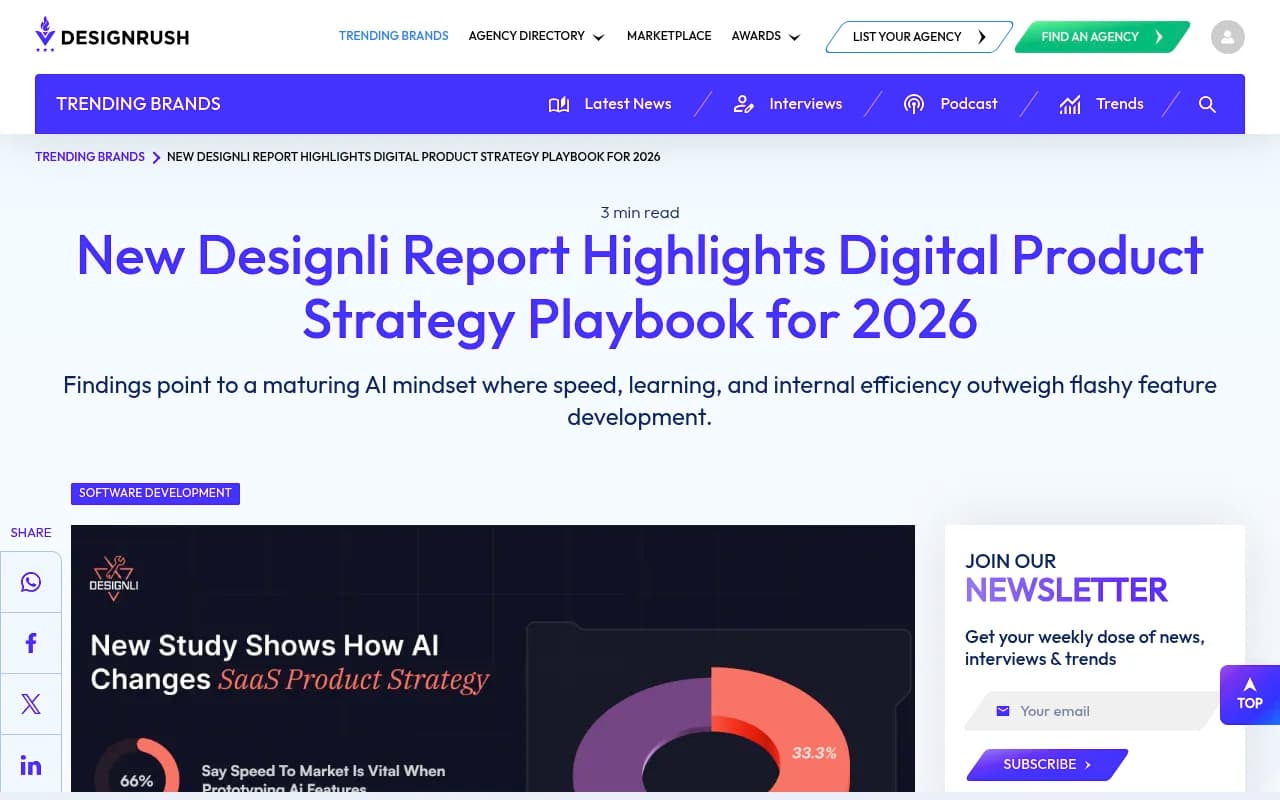
- Speed to market beats perfection: 66.7% of founders now optimize for rapid prototyping, using AI visibility data to validate ideas in weeks instead of months
- Non-technical founders close the gap: AI tools democratize product validation -- you don't need a technical co-founder to understand what users want anymore
- Distribution moats start early: Startups that build AI visibility before product-market fit create a discovery advantage competitors can't replicate later
The old playbook is broken
You build a feature. You ship it. You wait. Maybe someone uses it. Maybe they don't. You have no idea if the problem was real until after you've burned weeks of runway.
That's how most SaaS teams validated product-market fit in 2024. Build first, learn later. Hope the market shows up.
In 2026, the smartest founders flipped the script. They validate demand before writing code by tracking what people ask AI search engines. If users are prompting ChatGPT, Perplexity, or Claude about a problem you could solve -- and your competitors aren't showing up in the answers -- that's a signal. A concrete, measurable signal that demand exists and the market is underserved.
This isn't theoretical. According to recent research from Designli, 55.6% of SaaS founders now actively adjust their roadmaps based on AI trends. They're not guessing which features to build. They're reading the prompts.
Why AI search visibility is a better validation signal than surveys
Surveys lie. Not intentionally -- people just don't know what they want until they need it. You ask "Would you use a feature that does X?" and they say yes because it sounds reasonable. Then you build it and crickets.
AI search visibility shows you what people actually ask when they have a problem right now. These aren't hypothetical feature requests. These are real queries from people actively looking for solutions.
Here's what makes AI search different:
Intent is explicit. When someone prompts "How do I automate billing for usage-based SaaS?" they're not browsing. They have a problem today. If your product solves that and you're not showing up in ChatGPT's answer, you're invisible to that buyer.
Volume is measurable. Tools like Promptwatch track prompt volumes and difficulty scores. You can see how many people are asking a specific question and how hard it is to rank for. That's validation data you can actually use.

Competitors reveal gaps. Answer Gap Analysis shows which prompts your competitors rank for but you don't. Each gap is a feature opportunity. If five competitors are cited for "multi-currency invoicing" and you're not, that's a roadmap item backed by real demand.
Reddit and YouTube surface unfiltered needs. AI models cite Reddit threads and YouTube videos heavily. These platforms capture unfiltered user frustration -- the exact problems people complain about when existing solutions fail. Tracking these citations tells you what features users desperately want but can't find.
One founder I talked to put it this way: "We used to spend $10K on user interviews and still guess wrong. Now we track which prompts drive citations to competitor docs and build those features first. We haven't missed in six months."
How technical vs non-technical founders approach AI visibility differently
Technical founders and non-technical founders see AI adoption through completely different lenses. Understanding this split matters because it changes how you validate.
According to Clutch's 2026 survey, technical founders focus on operational automation first. They want AI to handle QA, billing workflows, and internal tooling. They're optimizing for efficiency before they think about user-facing features. That makes sense -- they can ship faster if AI removes bottlenecks.
Non-technical founders, on the other hand, lean on AI to close knowledge gaps. They use AI visibility tools to understand what features matter without needing to interpret raw data or build custom dashboards. The tools do the analysis. They just act on it.
This creates an interesting dynamic: non-technical founders often move faster on feature validation because they're not bogged down in implementation details. They see a prompt gap, validate it's real, and decide to build. Technical founders sometimes overthink it -- "How would we architect this? What's the technical debt?" -- before they've confirmed anyone actually wants it.
The lesson: use AI visibility to validate first, architect later. If the demand isn't there, the technical elegance doesn't matter.
The validation loop: find gaps, validate demand, prototype fast
Here's the loop that's working in 2026:
1. Find the gaps
Start with Answer Gap Analysis. Tools like Promptwatch show you which prompts competitors rank for but you don't. Each gap represents a feature or content angle your product is missing.
Example: You're building a project management SaaS. Your competitor ranks for "How do I track billable hours across multiple clients in real time?" but you don't. That's a gap. It tells you users want real-time billable hour tracking, and your product probably doesn't surface that capability clearly (or doesn't have it at all).
2. Validate the demand
Don't build yet. First, check:
- Prompt volume: How many people are asking this? If it's 50 prompts a month, maybe skip it. If it's 5,000, pay attention.
- Difficulty score: How hard is it to rank for this prompt? Low difficulty + high volume = easy win.
- Citation patterns: Which pages, Reddit threads, or YouTube videos are AI models citing? Read them. What specific pain points do they mention?
- Query fan-outs: Does this prompt branch into sub-queries? If "billable hours" fans out into "invoicing", "time tracking", and "client reporting", you're looking at a feature cluster, not a one-off.
This step takes a few hours, not weeks. You're not running a full market study. You're confirming the signal is real.
3. Prototype fast
Now build the minimum version that would get you cited. Not the full feature. Just enough to answer the prompt.
Designli's research found that 66.7% of founders prioritize rapid prototyping as their primary validation method. Speed matters more than polish at this stage. If you can ship a basic version in two weeks and start tracking whether AI models cite it, you've validated faster than any competitor running traditional user research.
Use AI tools to accelerate this. The same platforms tracking your visibility often include content generation features. Promptwatch's AI writing agent, for example, generates articles and feature docs grounded in real citation data. You're not writing blind -- you're creating content that's already optimized for the prompts you're targeting.
4. Track the results
Once you ship, monitor:
- Citation growth: Are AI models starting to cite your new feature page or docs?
- Visibility score changes: Is your overall AI search visibility improving?
- Traffic attribution: Are you seeing actual visitors from AI search? Use code snippets, Google Search Console integration, or server log analysis to connect visibility to traffic.
If citations go up but traffic doesn't, your content might be getting cited but not driving clicks. That's a conversion problem, not a demand problem. Optimize the content or the CTA.
If neither citations nor traffic move, the feature might not solve the problem users actually have. Revisit the prompt. Maybe you misread the intent.
Real example: How one SaaS validated a $50K feature in three weeks
A B2B SaaS founder (healthcare vertical) was debating whether to build a HIPAA-compliant audit log feature. Engineering estimated six weeks of dev time. The founder wasn't sure if anyone actually cared.
Instead of building, they:
- Ran Answer Gap Analysis and found competitors ranking for "HIPAA audit log requirements for SaaS" with 2,300 monthly prompt volume
- Checked Reddit citations -- found 14 threads where healthcare admins complained existing tools didn't surface audit logs clearly
- Wrote a detailed feature doc explaining how their (not-yet-built) audit log would work, optimized for the top 10 prompts
- Published it and tracked citations for two weeks
Result: ChatGPT and Perplexity started citing the doc within 10 days. Traffic spiked. Three enterprise leads mentioned the audit log feature in sales calls -- they'd found it via AI search.
The founder greenlit the build. The feature shipped five weeks later and became a top-three sales driver within two months.
Total validation cost: ~$500 in tools and a few days of writing. Compare that to building a $50K feature on a hunch.
Why startups need distribution moats before product-market fit
Most founders think distribution comes after product-market fit. You build the product, find the fit, then figure out how to get it in front of people.
That's backwards in 2026.
AI search visibility is a distribution moat you can build before you have product-market fit. If you're visible in ChatGPT, Perplexity, and Claude for the problems your product will solve, you're already in front of buyers when they're actively searching for solutions. By the time competitors catch up, you've accumulated months of citation history, backlinks, and trust signals that are hard to replicate.
This is especially true for startups. You don't have brand recognition. You don't have a massive content library. You don't have years of SEO equity. But you can rank in AI search faster than established players because AI models prioritize recency, specificity, and relevance over domain authority.
A startup that publishes 20 hyper-targeted articles answering the exact prompts their ICP asks will outrank a legacy SaaS with 500 generic blog posts. AI search rewards precision, not volume.
Start building that moat now. Track the prompts. Write the content. Get cited. When you finally ship the product, the distribution is already there.
Comparison: AI visibility tools for SaaS founders
| Tool | Best for | Key feature | Pricing |
|---|---|---|---|
| Promptwatch | End-to-end validation | Answer Gap Analysis + AI content generation | From $99/mo |
| Peec AI | Basic monitoring | Simple tracking across ChatGPT and Perplexity | From $79/mo |
| Otterly.AI | Monitoring only | Multi-LLM tracking, no optimization tools | From $99/mo |
| AthenaHQ | Brand tracking | Visibility monitoring, limited content features | Custom pricing |
| Profound | Enterprise teams | 9+ AI engines, high price point | From $499/mo |

Otterly.AI


Profound

The table above shows the landscape. Most tools stop at monitoring -- they show you where you're invisible but don't help you fix it. Promptwatch is the only platform that closes the loop: it shows you the gaps, helps you create content to fill them, and tracks whether it's working.
What founders are building with AI visibility data
Here's what's actually getting built in 2026 based on AI search insights:
Workflow automation features. 44.4% of founders identified operational automation as AI's highest immediate business impact. They're building features that automate billing, QA, and internal workflows because that's what users are prompting about.
Real-time collaboration tools. Prompts around "real-time" anything (editing, syncing, notifications) are spiking. Founders are prioritizing real-time features over async ones.
Multi-currency and multi-language support. Global SaaS prompts are growing. If you're not tracking international queries, you're missing a huge validation signal.
Compliance and security features. HIPAA, GDPR, SOC 2 -- these aren't just checkboxes anymore. Users are actively searching for SaaS tools that surface compliance features clearly. If your product has it but your docs don't explain it, you're invisible.
Integrations with AI tools. Users want SaaS products that integrate with ChatGPT, Claude, and other AI assistants. If your product has an API but no AI integration docs, you're leaving citations on the table.
The pattern: founders are building features users are already asking AI about, not features they think users might want.
How to start tracking AI visibility today
You don't need a massive budget or a technical co-founder to start validating with AI search visibility. Here's the step-by-step:
-
Pick a tracking tool. Promptwatch is the most complete option for SaaS founders because it combines monitoring, gap analysis, and content generation. If you just want basic tracking, Peec AI or Otterly.AI work.
-
Add your competitors. Most tools let you track 3-5 competitors. Add the ones your ICP compares you to. You'll see which prompts they rank for and you don't.
-
Review the gaps weekly. Set a recurring calendar block. Every Monday, look at the Answer Gap Analysis. Pick 2-3 high-volume, low-difficulty prompts where competitors rank but you don't.
-
Write content to fill the gaps. Use the AI writing agent (if your tool has one) or write it yourself. Aim for 1,500+ words, answer the prompt directly, and embed screenshots or examples. Publish on your blog or docs site.
-
Track citations and traffic. After two weeks, check if AI models are citing your new content. Use Google Search Console or your analytics tool to see if traffic is increasing. If yes, keep going. If no, revisit the content -- you might have missed the intent.
-
Prioritize features based on citation velocity. If a prompt is driving citations and traffic fast, that's a feature worth building. If it's slow, maybe it's not as urgent as you thought.
This loop takes 2-3 hours a week. That's less time than most founders spend in status meetings.
Why this works when traditional validation fails
Traditional validation methods -- surveys, user interviews, beta programs -- all suffer from the same problem: they rely on people accurately predicting their own future behavior. "Would you pay for this?" is a useless question because people don't know until they're actually in the buying moment.
AI search visibility bypasses that. You're not asking hypothetical questions. You're observing real behavior. When someone prompts "How do I automate invoicing for my SaaS?" they're not imagining a future need. They have the need right now. They're actively searching for a solution.
That's why this works. You're validating based on revealed preference, not stated preference. And revealed preference is the only kind that matters.
The future: AI visibility as a core product metric
In 2026, the smartest SaaS teams treat AI visibility as a core product metric, not a marketing afterthought. They track it alongside MRR, churn, and activation rate. Why? Because AI visibility is a leading indicator of demand.
If your visibility score is climbing for prompts related to a feature you haven't built yet, that's a signal. If it's flat or declining for prompts related to your core product, that's a warning. The market is moving and you're not keeping up.
This shift is already happening. Founders who ignore it will spend 2027 wondering why their competitors are growing faster despite having worse products. The answer: their competitors are visible in AI search and they're not.
Start tracking today. The prompts are already there. The demand is already there. You just have to show up in the answers.