Key Takeaways
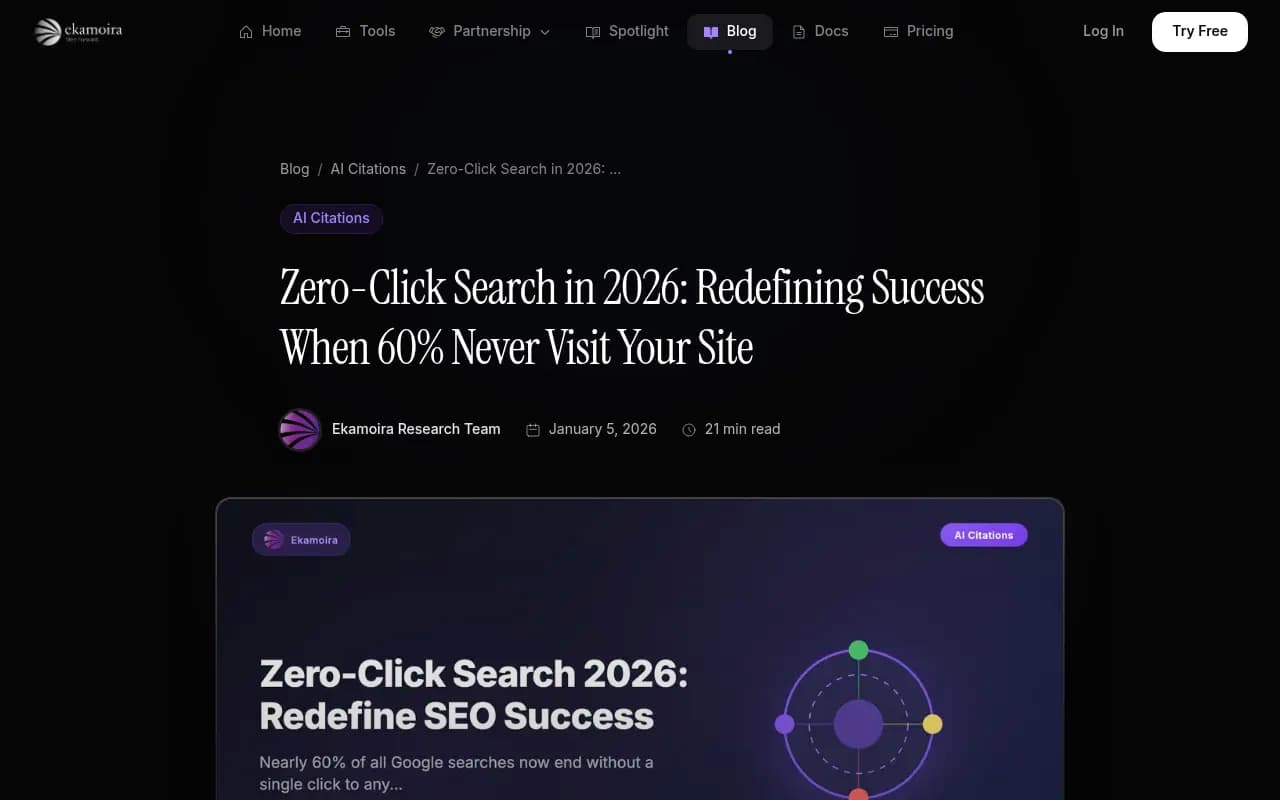
- 60% of searches end without clicks — AI Overviews, featured snippets, and answer engines deliver information directly in results, making traditional CTR metrics obsolete
- Citation tracking replaces click tracking — Monitor how often AI models like ChatGPT, Perplexity, and Claude cite your brand, content, or domain in their responses
- Visibility metrics matter more than rankings — Track Share of Voice, citation frequency, and brand mention sentiment across AI platforms
- AI traffic converts 4.4x better — Despite lower volume, visitors from AI search engines show significantly higher intent and conversion rates
- New measurement tools are essential — Platforms like Promptwatch provide the tracking infrastructure traditional SEO tools weren't built for
If there are no keyword rankings or click-through rates, how do you know if your AI search optimization is working?
This is the question keeping search marketers up at night in 2026. The fundamental metrics that powered SEO for two decades — rankings, impressions, CTR, organic traffic — completely miss what happens when your brand appears in AI-generated answers.
According to Semrush's 2025 zero-click study, 58.5% of US searches and 59.7% of EU searches now end without a single click to any website. Google's AI Overviews reach 2 billion monthly users across 200+ countries. ChatGPT, Perplexity, Claude, and Gemini answer millions of queries daily without generating any traditional analytics data.
The good news? A new measurement framework has emerged. This guide shows you exactly how to track AI search impact using visibility metrics, citation analysis, and attribution methods that work when there are no clicks to count.
Why Traditional SEO Metrics Fail for AI Search
Classic SEO measurement was built around a simple funnel: keywords → rankings → impressions → clicks → conversions. Every stage was trackable in Google Search Console or your analytics platform.
AI search breaks this model completely:
No keyword rankings exist — AI models don't have position 1-10. Your brand either appears in the response or it doesn't. There's no "ranking #3 for best project management software" when ChatGPT synthesizes an answer from 50 sources.
No impressions data — ChatGPT, Claude, Perplexity, and other AI platforms don't provide impression counts. You can't see how many times your content was considered, only whether it was cited in the final output.
No click-through rates — When AI answers the question directly, users never click through. Even when sources are cited, click rates are dramatically lower than traditional search.
No Google Search Console — AI platforms don't integrate with GSC or provide query-level performance data. You're flying blind with traditional tools.
According to research from The HOTH, even Google's own AI Overviews now appear for queries that drive significant traffic, yet traditional rank tracking tools completely miss these placements. A brand could be cited in AI Overviews thousands of times per day with zero visibility in their SEO dashboard.
The New AI Search Measurement Framework
Measuring AI search impact requires a completely different approach. Instead of tracking clicks, you track visibility, citations, and influence.
Here's the framework that leading brands use in 2026:
1. Citation Tracking
What it measures: How often AI models cite your brand, domain, or content when answering relevant queries.
Why it matters: Citations are the AI equivalent of rankings. If ChatGPT recommends your product in 8 out of 10 relevant prompts, you're winning — even if no one clicks.
How to track it:
- Monitor specific prompts related to your category (e.g., "best CRM for small business")
- Track whether your brand appears in responses from ChatGPT, Claude, Perplexity, Gemini, and other models
- Measure citation frequency, position (first mentioned vs. buried), and context (positive vs. neutral vs. negative)
- Calculate your citation rate: (prompts where you're cited / total relevant prompts) × 100
Tools like Promptwatch automate this by running thousands of prompts daily across 10+ AI models and tracking exactly when and how your brand appears. The platform's 880M+ citation database shows which content types and topics drive the most AI visibility.

2. Share of Voice in AI Responses
What it measures: Your brand's visibility compared to competitors across AI platforms.
Why it matters: Even if you're cited, you need to know if you're mentioned first, third, or tenth. Share of Voice shows your relative position in the AI-powered conversation.
How to track it:
- Identify your top 5-10 competitors
- Track the same set of category prompts for all brands
- Calculate: (your citations / total citations for all tracked brands) × 100
- Monitor trends over time — is your share growing or shrinking?
Example: If you're cited in 40 responses, Competitor A in 35, and Competitor B in 25, your Share of Voice is 40%. If that number was 30% last month, you're gaining ground.
This metric directly parallels traditional SEO's visibility metrics but applies to AI search. According to AirOps research, brands that track Share of Voice can identify exactly which competitors are winning specific prompt categories and reverse-engineer their content strategy.
3. Zero-Click Visibility Rate
What it measures: How often your brand appears in AI answers when users don't click any result.
Why it matters: This captures pure influence — awareness and authority built without driving traffic.
How to track it:
- Monitor prompts that typically generate zero-click answers (definitions, comparisons, how-to queries)
- Track citation frequency specifically for these query types
- Measure brand mention sentiment and context
According to ClickRank AI research, Zero-Click Visibility Rate is the single best predictor of brand authority in AI search. Brands with high zero-click visibility see downstream effects: higher conversion rates when users do visit, stronger brand recall, and better performance in traditional search.
4. AI Crawler Activity
What it measures: How often AI models' web crawlers visit your site and which pages they read.
Why it matters: AI models need to discover and understand your content before they can cite it. Crawler logs show whether you're even in the game.
How to track it:
- Monitor server logs for known AI crawler user agents (GPTBot, ClaudeBot, PerplexityBot, etc.)
- Track crawl frequency, pages accessed, and errors encountered
- Identify which content AI models prioritize
Promptwatch's AI Crawler Logs feature provides real-time visibility into exactly which pages ChatGPT, Claude, and Perplexity are reading, how often they return, and any indexing issues they encounter. This is critical infrastructure that most monitoring-only tools completely lack.
5. Prompt Volume and Difficulty Scoring
What it measures: How many people are asking specific prompts and how hard it is to get cited for them.
Why it matters: Not all prompts are created equal. You need to prioritize high-volume, winnable opportunities.
How to track it:
- Estimate search volume for key prompts in your category
- Analyze citation difficulty based on competitor presence and content quality requirements
- Calculate ROI potential: (volume × conversion value) / difficulty score
This is the AI equivalent of keyword difficulty scoring in traditional SEO. Platforms that provide prompt intelligence help you focus on queries where you can actually win, rather than chasing impossible targets.
6. Content Gap Analysis
What it measures: Which prompts competitors rank for but you don't.
Why it matters: Shows exactly what content you're missing — the topics, angles, and questions AI models want answers to but can't find on your site.
How to track it:
- Compare your citation profile to competitors
- Identify prompts where they appear but you don't
- Analyze the content they have that you lack
- Prioritize gaps based on prompt volume and business relevance
This is where monitoring platforms diverge from optimization platforms. Tools like Otterly.AI and Peec.ai show you the gaps but leave you stuck. Promptwatch's Answer Gap Analysis not only identifies missing content but also includes an AI writing agent that generates articles, listicles, and comparisons specifically engineered to get cited — grounded in real citation data, prompt volumes, and competitor analysis.
Otterly.AI


Connecting AI Visibility to Business Outcomes
The hardest question for any marketer: how do I prove ROI when there are no clicks?
Here's how leading brands connect AI search visibility to revenue:
Method 1: AI Traffic Attribution
Even though most AI searches don't generate clicks, some do. When users click a cited source in Perplexity or ChatGPT, you need to track it.
Implementation options:
- UTM parameters: Some AI platforms append referrer data. Track
utm_source=chatgptorutm_source=perplexityin your analytics - JavaScript snippet: Install tracking code that identifies AI referrers and logs them separately
- Server log analysis: Parse server logs for AI platform user agents and referrer strings
- Google Search Console integration: Track AI Overview impressions and clicks in GSC
According to Semrush research, AI search traffic converts 4.4x better than traditional organic search. Even small volumes of AI-driven traffic can significantly impact revenue.
Promptwatch provides multiple attribution methods — code snippet, GSC integration, and server log analysis — to connect visibility improvements to actual traffic and revenue. This closes the loop: find gaps → create content → track citations → measure traffic → prove ROI.
Method 2: Brand Lift Studies
When users never click, measure awareness instead.
How it works:
- Survey target audiences before and after AI visibility campaigns
- Measure brand awareness, consideration, and preference
- Correlate changes with citation rate improvements
Example: A B2B SaaS company increased ChatGPT citations by 300% over 6 months. Brand awareness surveys showed a 45% lift in unaided recall among their target persona, directly correlating with citation growth.
Method 3: Assisted Conversions
AI search often starts the journey, even if it doesn't close it.
Tracking approach:
- Use multi-touch attribution to identify users who encountered your brand in AI search before converting
- Track "AI-assisted conversions" as a separate segment
- Measure time-to-conversion and deal size for AI-assisted vs. non-assisted leads
Many brands find that AI search acts as top-of-funnel awareness, with conversions happening days or weeks later through other channels.
Method 4: Competitive Benchmarking
If you can't measure absolute ROI yet, measure relative performance.
What to track:
- Your citation rate vs. competitors over time
- Share of Voice trends in your category
- Prompt coverage — what percentage of relevant prompts cite you vs. competitors
If your Share of Voice is growing while competitors' is shrinking, you're winning — even before you can tie it directly to revenue.
Essential Tools for AI Search Measurement
You can't measure what you can't see. Here are the tools that make AI search tracking possible:
Comprehensive AI Visibility Platforms
These platforms monitor multiple AI models and provide the full measurement stack:
Promptwatch — The only platform rated as a "Leader" across all GEO categories in 2026 comparisons. Tracks 10 AI models (ChatGPT, Perplexity, Claude, Gemini, Google AI Overviews, Meta AI, DeepSeek, Grok, Mistral, Copilot). Differentiator: goes beyond monitoring with Answer Gap Analysis, built-in AI content generation, crawler logs, and traffic attribution. Pricing from $99/mo.
Profound

Profound — Enterprise platform tracking 9+ AI engines with strong feature set. Higher price point than Promptwatch, lacks Reddit tracking and ChatGPT Shopping monitoring.

AthenaHQ — Monitoring-focused platform with good coverage but limited optimization capabilities. No content generation or gap analysis features.
Specialized Monitoring Tools
Otterly.AI
Otterly.AI — Basic monitoring across ChatGPT, Perplexity, and Google AI Overviews. Monitoring-only approach with no crawler logs, visitor analytics, or content optimization.

Rankshift — Simple tracking across major AI platforms. Good for basic visibility monitoring but lacks advanced features.
Traditional SEO Tools Adding AI Features
Semrush — Added AI Overview tracking to their traditional SEO platform. Uses fixed prompts rather than custom tracking. Good for brands already using Semrush who want basic AI visibility data alongside traditional metrics.
Ahrefs Brand Radar — Basic AI search monitoring with fixed prompts and no traffic attribution. Better suited for traditional SEO with light AI tracking.
Building Your AI Search Measurement Dashboard
Here's how to structure your reporting:
Weekly Metrics
- Citation count by AI model
- Share of Voice vs. top 3 competitors
- New prompts where you're cited
- Crawler activity and errors
Monthly Metrics
- Citation rate trends
- Zero-click visibility rate
- Content gap analysis — new opportunities identified
- AI-driven traffic and conversions
Quarterly Metrics
- Share of Voice trends across all tracked prompts
- Competitive positioning changes
- ROI analysis — AI visibility investment vs. attributed revenue
- Brand lift study results (if applicable)
Dashboard Tools
Most AI visibility platforms provide built-in dashboards. For custom reporting:
- Looker Studio integration — Promptwatch and other platforms offer Looker Studio connectors for custom dashboards
- API access — Pull data programmatically for integration with existing BI tools
- CSV exports — Basic option for manual reporting
Common Measurement Challenges and Solutions
Challenge: "I don't know which prompts to track"
Solution: Start with your existing keyword research. Convert informational keywords into natural language prompts. Use tools with prompt discovery features to identify what people are actually asking AI models.
Example: If you rank for "best CRM software," track prompts like:
- "What's the best CRM for small businesses?"
- "Compare Salesforce vs HubSpot vs Pipedrive"
- "Which CRM integrates with Gmail?"
Challenge: "AI responses are inconsistent — results vary every time"
Solution: Track at scale. Run each prompt multiple times per day across different models. Look for patterns and trends rather than individual results. Platforms like Promptwatch run thousands of prompts daily to provide statistically significant data.
Challenge: "I can't connect AI visibility to revenue yet"
Solution: Start with leading indicators:
- Track citation rate growth
- Monitor Share of Voice vs. competitors
- Measure AI crawler activity increases
- Survey brand awareness in target segments
As AI traffic grows, implement attribution tracking to close the loop.
Challenge: "My CEO wants to see ROI but we're just starting"
Solution: Frame it as defensive and offensive:
Defensive: "60% of searches now end without clicks. If we're not visible in AI search, we're invisible to the majority of potential customers."
Offensive: "AI search traffic converts 4.4x better than traditional search. Early movers are capturing disproportionate market share."
Show competitive benchmarking — if competitors are gaining Share of Voice while you're not tracking it, you're losing ground.
The Action Loop: From Measurement to Optimization
Measurement without action is just data collection. Here's the optimization cycle that turns visibility metrics into business results:
Step 1: Find the gaps — Use Answer Gap Analysis to identify prompts where competitors are cited but you're not. See exactly which content your website is missing.
Step 2: Create content that ranks in AI — Generate articles, listicles, and comparisons grounded in citation data, prompt volumes, and competitor analysis. This isn't generic SEO filler — it's content engineered to get cited by AI models.
Step 3: Track the results — Monitor citation rate improvements, Share of Voice gains, and crawler activity increases. Connect visibility to traffic and revenue through attribution.
Step 4: Iterate — Double down on what works. Identify which content types, topics, and formats drive the most citations. Repeat.
This is the fundamental difference between monitoring platforms and optimization platforms. Most competitors (Otterly.AI, Peec.ai, AthenaHQ, Search Party) stop at step one. Promptwatch is built around the full cycle — it shows you what's missing, helps you create content that fixes it, then tracks the results.
Getting Started: Your First 30 Days
Week 1: Baseline Measurement
- Set up tracking for 20-50 core prompts in your category
- Identify top 3-5 competitors to benchmark against
- Run initial citation audit — where do you appear today?
- Check AI crawler logs — are AI models even visiting your site?
Week 2: Gap Analysis
- Compare your citation profile to competitors
- Identify top 10 prompts where competitors appear but you don't
- Analyze the content they have that you lack
- Prioritize based on prompt volume and business relevance
Week 3: Content Creation
- Create or optimize content targeting your top gaps
- Ensure AI crawlers can access and understand it (clean HTML, clear structure, no JavaScript rendering issues)
- Submit updated pages to AI models where possible
Week 4: Results Tracking
- Monitor citation rate changes for optimized content
- Track crawler activity increases
- Measure Share of Voice movement
- Document early wins to build momentum
The Future of AI Search Measurement
As AI search matures, measurement will evolve:
More granular attribution — AI platforms will provide better referrer data, making traffic attribution more accurate.
Intent signal tracking — Platforms will track not just citations but user engagement signals within AI responses (follow-up questions, refinements, etc.).
Conversion tracking — As AI models add commerce features (like ChatGPT Shopping), direct conversion measurement will become possible.
Unified dashboards — Traditional SEO and AI search metrics will converge into single visibility dashboards.
Brands that build measurement infrastructure now will have years of historical data and optimization learnings when these capabilities arrive.
Conclusion
Measuring AI search impact without click-through rates isn't just possible — it's essential. The 60% of searches that end without clicks represent the majority of your potential audience. If you're not tracking citations, Share of Voice, and AI visibility, you're flying blind.
The measurement framework is clear:
- Track citations across all major AI models
- Monitor Share of Voice vs. competitors
- Analyze content gaps to identify opportunities
- Measure crawler activity to ensure discoverability
- Connect visibility to outcomes through attribution and brand lift
The tools exist. The methodology is proven. The only question is whether you'll start measuring before or after your competitors capture the AI search market share.
Get started with platforms like Promptwatch that provide the full measurement and optimization stack. Track your baseline, identify gaps, create content that gets cited, and prove ROI. The brands winning in AI search in 2026 aren't guessing — they're measuring, optimizing, and iterating based on real visibility data.