Key takeaways
- Brandlight's terms give you a 30-day export window after termination before your Customer Content may be deleted. Everything you plan to keep has to leave the platform inside that window.
- No GEO platform on the market can import a competitor's historical citation or visibility trend data. Migration always means starting a new trend line, so the goal is continuity of insight, not continuity of data.
- The proven workaround is running your old and new platforms in parallel for 30-60 days so the two trend lines overlap and can be cross-referenced.
- AI search baselines shift constantly on the engine side (Reddit's citation share in ChatGPT fell roughly 40% in a single month in mid-2026), which is exactly why longitudinal data is worth protecting during a switch.
- Before signing anything new, get export terms, historical data depth, and API access in writing. Several platforms gate these behind enterprise tiers.
Why teams outgrow Brandlight in the first place
Let's be fair to Brandlight before we talk about leaving it. It's a serious enterprise platform. Fortune 500 brands like Volkswagen, LG, TD Bank, and Estée Lauder use it, it holds a 4.8/5 rating on G2 across nearly 200 reviews, and it raised a $30M Series A. The dashboards get consistent praise for being organized and the insights clear.
So why leave? A few recurring reasons come up:
- Cost. Brandlight doesn't publish pricing, and third-party estimates put enterprise contracts in the $4K-$15K/month range once you add brands, regions, and modules. There's no free trial either; you typically start with a paid three-month pilot.
- Speed to value. G2 reviewers report an average of two months just to implement, and seven months to see ROI. That's a long runway if your needs have changed.
- Monitoring depth vs. execution. Brandlight is fundamentally a visibility and intelligence platform. Teams that want the platform to also help fix the gaps, through content generation, CMS publishing, or crawler-level diagnostics, often end up shopping for a fuller stack.
- Learning curve. The most common critique in G2 reviews is that the feature breadth makes onboarding slow for new team members.
If any of those sound like your situation, the rest of this guide is for you.
The data problem: what actually happens when you terminate
This is the part most teams discover too late, so read it twice.
Brandlight's Terms of Use (Section 4.3.3, last updated April 2026) state that Brandlight will make Customer Content available for export for thirty days after the effective date of termination, in a reasonable standard format, after which Brandlight may delete it.
Two things worth noting about that clause:
- "Customer Content" is defined broadly. It covers prompts, inputs, outputs, files, and other information submitted through the products. So your prompt library, tracked responses, and reports should all fall under it, but confirm the export format covers what you need before your termination date, not after.
- There is no publicly documented migration path, data-import tool, or white-glove offboarding process from Brandlight. I searched, and the 30-day export clause in the ToS is the only formal commitment that surfaces. That's an evidence gap you should close by requesting written export and offboarding terms from Brandlight directly before you commit to a switch.
Also worth knowing: unpaid fees through the termination date become immediately due, and support is ticket-based during U.S. business hours. Plan your export work inside those windows.
Why your historical data is worth fighting for
You might be tempted to think, "It's just visibility data, the new tool will collect fresh numbers." That undersells what longitudinal data does in AI search.
AI search is far less winner-take-all than Google. Per Promptwatch's ChatGPT citation share data, even the single most-cited domain on ChatGPT holds under 4% of citations. Nobody dominates. That means snapshots are noisy and slow to move, and the only reliable proof that your GEO program is working is a trend line over months.
The engine side is also moving under your feet constantly:
- Reddit's share of ChatGPT Search citations fell from 6.11% in May 2026 to 3.71% in June 2026, a drop of roughly 40% in one month, per Promptwatch's June 2026 citation share report. If your "before" data was collected in May and your "after" data in July, you might read an engine-side shift as your own performance change.
- ChatGPT's query fan-out behavior changed dramatically in early 2026: average searches per response fell from around 2.15 in December to roughly 1.0 by April, and average fanout query length shrank by more than half, per Promptwatch's query fanout data. Retrieval itself is non-stationary.
- Citation counts per response vary a lot by engine and shift with model updates. ChatGPT cites around 5 sources per answer, Google AI Overviews around 10, and Microsoft Copilot has swung from under 2 sources to nearly 17 within weeks, per Promptwatch's average sources per response data.
The point: when you compare "before Brandlight" and "after new platform" numbers, you're comparing two different measurement methodologies collected during two different engine-behavior regimes. Your exported historical data is the only thing that lets you sanity-check that comparison. Lose it, and you're flying blind for a quarter.
The uncomfortable truth: nobody can import your history
Here's what nobody's sales team will tell you upfront: no GEO platform can ingest a competitor's historical citation and visibility trend data. There's no standard format for it, and the underlying response data was collected with different methodologies, different sampling, and different engine versions.
Retention policies across the market make this worse. A quick comparison of what platforms offer on historical depth:
| Platform | Historical data | Notes |
|---|---|---|
| Brandlight | 30-day export window post-termination | ToS Section 4.3.3; deletion may follow |
| Profound | 2 months on Lite/Standard tiers; all-time on Enterprise | API and SSO also gated to Enterprise |
| Goodie AI | 3 months on lower tiers | No data export until Team tier, no API until Enterprise |
| Ahrefs | 6 months (Lite) to unlimited (Enterprise) | AI tracking bundled into the SEO suite |
| Peec AI | From signup date only | No retroactive backfill at any tier |
| Promptwatch | Continuous from your signup | Crawler logs, citations, and visitor analytics accumulate from day one |
So the realistic goal of a migration is not "port the data." It's "preserve the data for reference, and build a new baseline fast."
The migration plan, step by step
Step 1: Audit what you have before giving notice
Don't terminate anything yet. First, inventory what exists inside Brandlight:
- Your full prompt library, grouped by topic, persona, and region
- Competitor set and share-of-voice configurations
- Historical visibility and citation reports, ideally monthly snapshots
- Any custom dashboards or report templates
- User list and seat assignments (useful for negotiating the new contract)
Export-friendly formats matter here. Ask Brandlight support specifically what "reasonable standard format" means in practice: CSV, XLSX, PDF, or something else. Get it in writing.
Step 2: Export everything inside the 30-day window
Once termination is effective, the clock runs. My advice: don't wait for day 25. Do the full export in week one, verify it opens and parses correctly in week two, and re-export anything that looks broken well before day 30.
Store the exports somewhere durable: a shared drive, a warehouse, anywhere that isn't tied to either vendor. Two copies minimum. This is boring advice that has saved people's jobs.
Step 3: Choose the replacement with data continuity in mind
When evaluating candidates, ask three questions that sales decks tend to gloss over:
- How far back does historical data go on the tier I'm actually buying, not the enterprise tier?
- Is data export (CSV, API) included on that tier, or gated upward?
- Is there an API or MCP access so I can pull data out on my own schedule next time?
A few platforms worth shortlisting, depending on your situation:
Promptwatch is the one I'd point most teams at, because it goes beyond monitoring into execution: crawler logs that show when AI systems visit your pages and what they read, citation analytics including Reddit and YouTube, visitor analytics that tie AI traffic to conversions, and Content Agents that plan, write, and publish GEO-optimized content straight to your CMS. When you're rebuilding a baseline from zero, the crawler logs help a lot, because they explain the "why" behind your visibility scores instead of leaving you guessing. Pricing starts at $95/month with API and MCP access included, and there's a 7-day trial on the Essential tier.

Profound is the closest enterprise peer to Brandlight, with strong monitoring across up to 9-10 engines. Just know that all-time historical data, API, and SSO sit behind the Enterprise tier, and real enterprise contracts reportedly run $2,000+/month.
Profound

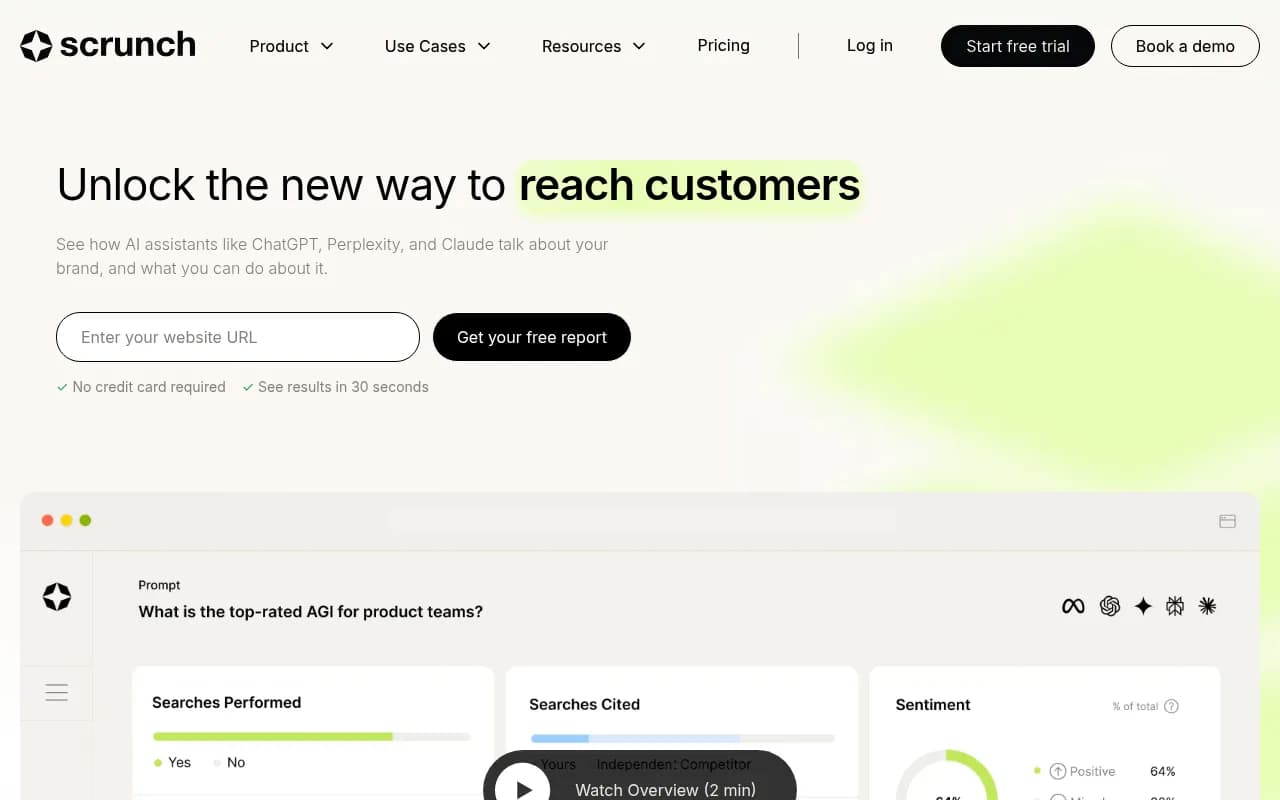
ScrunchAI (acquired by Sitecore in 2026) covers the major engines with a solid agency program, but API and SSO are enterprise-only.
AthenaHQ offers unlimited topics and competitor tracking from its Starter tier, with API as a paid add-on and full API plus SSO at Enterprise.

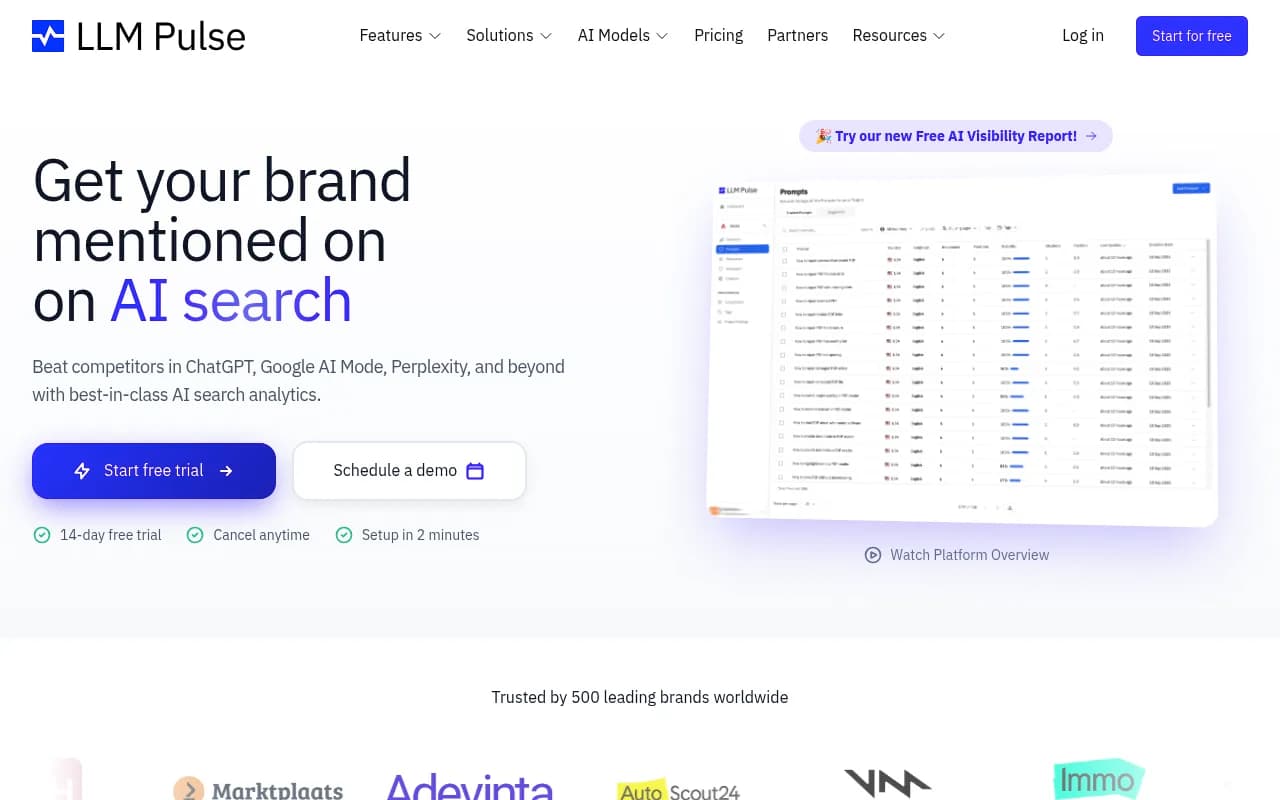
LLM Pulse is the budget-conscious option, with REST API, CSV export, and integrations included at lower tiers than most competitors.
For a broader view of the category, the GEO software directory at bestgeosoftware.com keeps a maintained list, and ai-rank-tools.com covers the rank-tracking side specifically.
Step 4: Rebuild your prompt library
Your prompt library will not port automatically. Plan for manual reconstruction, and treat it as an opportunity rather than a chore.
Pull the prompt list from your Brandlight export and rebuild it in the new platform, but prune as you go. Prompts you added 18 months ago that no longer map to how customers actually ask questions are dead weight. If your new platform offers prompt intelligence features like monthly volumes and difficulty scores, use them to prioritize: keep the prompts with real volume, retire the vanity ones.
One practical tip: preserve your Brandlight prompt wording exactly where possible, even if the new platform supports richer configurations. Changing the prompt text at the same time as changing the tool makes it impossible to tell whether a visibility delta came from the platform or the phrasing.
Step 5: Run both platforms in parallel
This is the single most important step in the whole guide.
If your Brandlight contract allows it, keep it live for 30-60 days after the new platform starts collecting data. You're not using two tools indefinitely; you're building an overlap window where both platforms measure the same prompts over the same period.
During the overlap:
- Compare visibility scores for identical prompts weekly. They won't match, and that's fine. What you're establishing is the offset: "Brandlight reads us about X points higher/lower than the new tool on the same prompt set."
- Document the offset per engine. ChatGPT offsets will differ from AI Overviews offsets because the platforms sample differently.
- Watch for divergence over time. If the offset is stable, your new baseline is trustworthy. If it swings wildly, one of the platforms is sampling inconsistently, and you want to know that now, not in a board presentation.
If budget makes a full parallel run impossible, even a two-week overlap gives you something. And if the contract is already terminated, your exported Brandlight data becomes the reference: chart the last 90 days of Brandlight numbers next to the first 90 days of new-platform numbers and annotate the methodology break clearly.
Step 6: Cut over and set the new baseline
Once the overlap window closes, declare a formal new baseline date. Communicate it to stakeholders with the offset documentation from step 5 attached, so nobody compares new-platform numbers against old Brandlight reports without the conversion context.
Then actually use the new platform's advantages. If you moved to a full-stack GEO tool, this is when crawler logs, content gap analysis, and automated content workflows start earning their keep. A migration that ends with the same monitoring you had before, just rebranded, wasted everyone's time.
Common pitfalls
Terminating before exporting. The 30-day window starts at termination. Export first, or at minimum confirm export access and formats before you give notice.
Comparing raw numbers across platforms. A 42% visibility score in Brandlight and a 38% score in your new tool are probably the same reality measured differently. Always compare trends, not absolutes.
Buying a tier without checking data depth. The Profound two-month history cap on lower tiers and Goodie AI's export gating are documented examples of platforms that look cheaper until you read the fine print.
Migrating during an engine-side shakeup. If ChatGPT just shipped a model update that changed citation behavior (the GPT-5.3 rollout in March 2026 cut average citations per response across models, for example), your overlap window will be noisy. Not always avoidable, but at least be aware of it when interpreting results.
Forgetting the humans. Brandlight reviewers mention a real learning curve. Whatever you pick, budget onboarding time, and get written confirmation of what onboarding support is included.
Migration checklist
- Inventory prompts, competitors, reports, and dashboards inside Brandlight
- Request written export format and offboarding terms from Brandlight
- Give termination notice only after export path is confirmed
- Export everything within the first week of the 30-day window; verify and back up
- Shortlist new platforms; confirm historical depth, export, and API access on your actual tier
- Rebuild the prompt library, preserving original wording
- Run both platforms in parallel for 30-60 days; document per-engine offsets
- Declare a new baseline date and circulate the offset documentation
- Retire the old tool and archive the exported data somewhere durable
The bottom line
Migrating off Brandlight without losing historical data is possible, but only if you're precise about what "losing" means. The raw trend data can be exported and archived inside the 30-day window. The measurement continuity cannot be ported to any new platform, so it has to be rebuilt through a parallel run. Do both, and you'll come out of the migration with a documented, defensible baseline. Skip either, and you'll spend the next two quarters explaining why the numbers moved.