Key Takeaways
- Each AI platform works differently: ChatGPT relies primarily on training data, Perplexity performs real-time web searches with heavy citations, and Claude prioritizes depth and authority. Understanding these differences is critical to optimization.
- Universal principles exist: Despite their differences, all three platforms reward clear structure, direct answers, authoritative content, and proper technical implementation. You don't need separate pages—you need smarter content architecture.
- Authority matters most for Claude: Brand authority correlates 0.430 with Claude citations vs 0.320 for ChatGPT and 0.180 for Gemini. Building topical authority is your Claude optimization strategy.
- Freshness is critical for Perplexity: Content decay begins within 2-3 days of publication on Perplexity. Regular updates and new content are essential for maintaining visibility.
- Technical implementation unlocks visibility: Structured data, clean HTML, accessible transcripts, and crawlable content are non-negotiable. AI models can't cite what they can't parse.
Understanding the Architectural Differences
Most marketers make the same mistake: they assume all AI search engines work the same way. They don't.
Each platform has a fundamentally different architecture that determines how it discovers, processes, and cites content. Optimizing for all three simultaneously requires understanding these differences—not ignoring them.
ChatGPT: Training Data + Optional Search
ChatGPT primarily generates answers from patterns learned during training on massive datasets. It mentions brands roughly 3x more often than it formally cites them because most responses come from training data without web retrieval.
When ChatGPT does use web search (via "Browse with Bing"), it becomes more like Perplexity. But most ChatGPT interactions don't trigger web retrieval—they pull from the model's training cutoff.
What this means for optimization: Your content needs to be part of OpenAI's training data to appear in most ChatGPT responses. This happens through:
- High-authority domains that OpenAI includes in training datasets
- Content published before the model's training cutoff
- Partnerships or licensing agreements (like OpenAI's deals with publishers)
For newer content or smaller brands, the path to ChatGPT visibility is through triggering web search mode—which happens when users ask for recent information or when ChatGPT determines it needs fresh data.
Perplexity: Real-Time Search Engine
Perplexity performs real-time web searches for every query. It crawls, indexes, and cites sources actively—more like Google than ChatGPT.
According to research on Perplexity's citation patterns, content decay begins within 2-3 days of publication. This platform rewards freshness aggressively.
What this means for optimization: Perplexity is the most "traditional SEO-like" of the three platforms. It responds to:
- Fresh content published regularly
- Strong backlink profiles and domain authority
- Clear, structured answers that match query intent
- Reddit threads and community discussions (Perplexity heavily indexes Reddit)
Claude: Depth and Authority
Claude shows the strongest correlation between brand authority and citation rates. From a dataset of 1,528 company reports (Jan 9-21, 2026), Claude's brand authority correlation was 0.430 compared to 0.320 for ChatGPT and 0.180 for Gemini.
Claude users spend an average of 19 minutes per session—nearly 4x the organic search average. These are deep research sessions, not quick lookups.
What this means for optimization: Claude rewards comprehensive, authoritative content that demonstrates expertise. Surface-level answers don't cut it. You need:
- Long-form content that covers topics thoroughly
- Clear demonstration of expertise and credentials
- Detailed explanations with supporting evidence
- Consistent topical authority across your domain
The Universal Optimization Framework
Despite their architectural differences, all three platforms respond to the same core content principles. You don't need separate pages—you need content that satisfies all three systems simultaneously.
1. Structure for Machine Parsing and Human Skimming
AI models parse content the same way humans skim articles: they look for clear structure, headings, and direct answers.
Implementation checklist:
- Use descriptive H2 and H3 headings that contain target keywords
- Lead with direct answers in the first 100 words
- Break content into scannable sections with clear topic boundaries
- Use bullet points and numbered lists for multi-part answers
- Include a table of contents for long-form content
- Add FAQ sections that directly answer common questions
When you structure content this way, ChatGPT can extract training patterns, Perplexity can cite specific sections, and Claude can understand the depth of your coverage.
2. Lead with Clear, Direct Answers
All three platforms prioritize content that answers questions directly. Burying your answer after 500 words of introduction kills your citation chances.
The answer-first framework:
- First paragraph: Direct answer to the main question
- Second section: Context and why the answer matters
- Remaining content: Supporting details, examples, edge cases
This structure works because:
- ChatGPT can extract the core answer for training data
- Perplexity can cite your direct answer in search results
- Claude can verify your answer is comprehensive by reading the supporting sections
3. Demonstrate Expertise, Authority, and Trust
All three platforms evaluate content quality, though they weigh different signals.
Universal authority signals:
- Author credentials and bylines with expertise indicators
- Citations to authoritative sources (research papers, official documentation, industry reports)
- Original data, case studies, or proprietary research
- Consistent publishing on related topics (topical authority)
- Technical accuracy and attention to detail
Claude weighs these signals most heavily, but ChatGPT and Perplexity also factor them into content selection and citation decisions.
4. Optimize Technical Implementation
AI models can't cite content they can't parse. Technical optimization is non-negotiable.
Critical technical requirements:
- Clean HTML: Avoid excessive JavaScript, iframes, or dynamic content that blocks crawlers
- Structured data: Implement Schema.org markup (Article, FAQPage, HowTo, Product)
- Accessible text: Don't hide content behind JavaScript or require user interaction to reveal it
- Fast load times: AI crawlers have timeout limits just like search engines
- Mobile-friendly: All three platforms prioritize mobile-optimized content
5. Handle Multimedia Content Correctly
AI models can't watch videos or listen to audio—they need text representations.
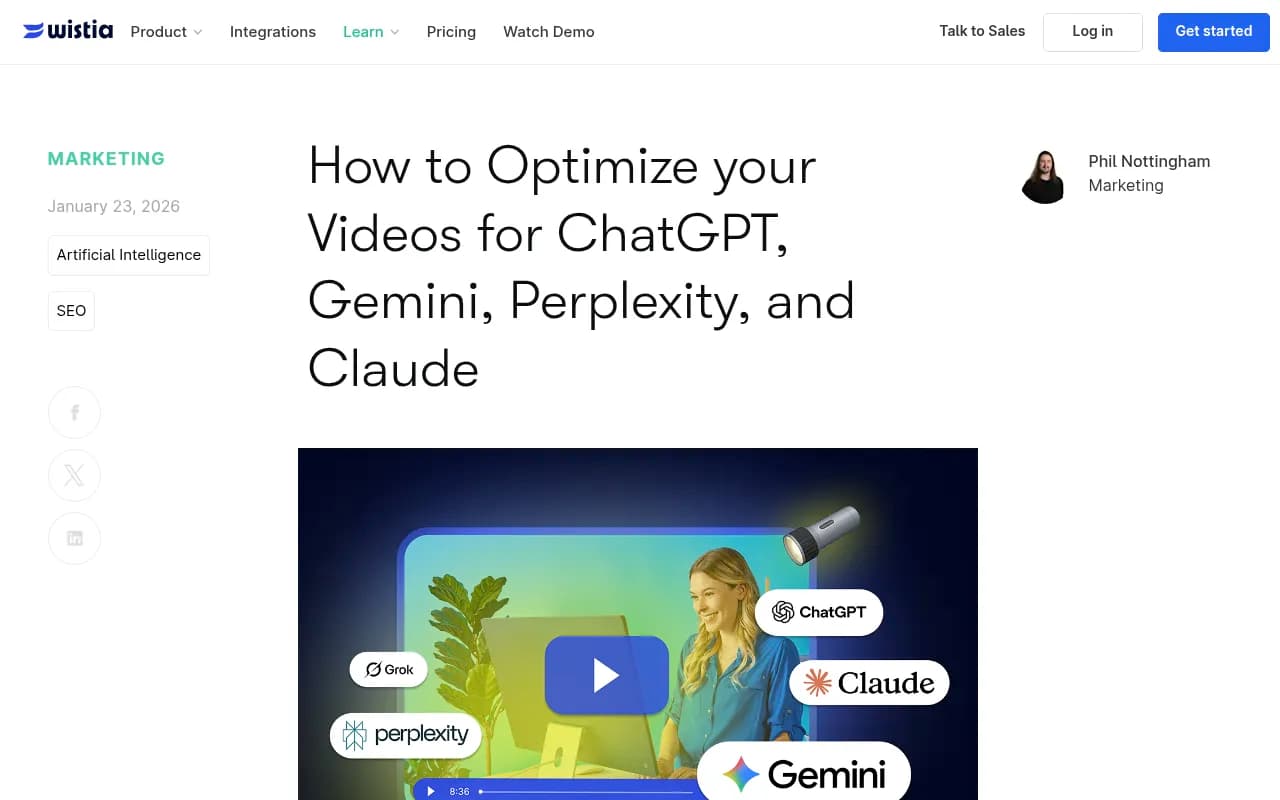
According to Wistia's research, LLMs interact with video content through:
- Reading video transcripts
- Analyzing metadata (titles, descriptions)
- Sharing links when factors indicate relevance
Video optimization checklist:
- Provide full transcripts as plain HTML text (not hidden in iframes or JavaScript)
- Write detailed video descriptions that explain what's covered
- Use descriptive titles with target keywords
- Consider tools like Wistia's LLM-friendly embeds that include transcripts in the embed code
The same principle applies to images, infographics, and podcasts: provide text alternatives that AI models can parse.
Platform-Specific Optimization Tactics
While universal principles form your foundation, each platform responds to specific tactics that amplify your visibility.
ChatGPT-Specific Tactics
1. Optimize for Bing search triggers
ChatGPT uses Bing when it needs fresh information. Bing SEO best practices apply:
- Strong social signals (shares, engagement)
- Clear, descriptive meta titles and descriptions
- Bing Webmaster Tools submission and monitoring
2. Build long-term authority
Since ChatGPT relies on training data, your goal is to become part of future training datasets:
- Publish on high-authority domains
- Earn backlinks from sites likely to be included in training data
- Create evergreen content that remains relevant across training cycles
3. Target conversational query patterns
ChatGPT users ask questions conversationally. Optimize for:
- Natural language questions ("How do I..." "What's the best way to...")
- Multi-turn conversations (anticipate follow-up questions)
- Comparison queries ("X vs Y" "Alternatives to Z")
Perplexity-Specific Tactics
1. Publish fresh content consistently
Content decay begins within 2-3 days on Perplexity. Combat this with:
- Regular publishing schedule (daily or weekly)
- Content updates with timestamps
- News-style coverage of industry developments
2. Leverage Reddit and community discussions
Perplexity heavily indexes Reddit. Strategies:
- Monitor relevant subreddits for questions your content answers
- Participate authentically in discussions (don't spam)
- Create content that addresses common Reddit questions
- Link to your comprehensive guides when genuinely helpful
3. Optimize for citation-friendly formats
Perplexity cites sources prominently. Make your content citation-worthy:
- Include statistics and data points that Perplexity can cite
- Use clear section headings that Perplexity can reference
- Provide unique insights or original research
- Format content for easy extraction (lists, tables, callout boxes)
Claude-Specific Tactics
1. Build topical authority clusters
Claude's 0.430 brand authority correlation means domain-wide expertise matters:
- Create content clusters around core topics
- Interlink related articles to demonstrate depth
- Cover topics from multiple angles (beginner guides, advanced tactics, case studies)
- Establish yourself as the definitive resource on specific subjects
2. Write comprehensive, long-form content
Claude users spend 19 minutes per session—they're doing deep research:
- Aim for 2,500+ words on pillar topics
- Include multiple perspectives and edge cases
- Provide detailed explanations with supporting evidence
- Add examples, case studies, and real-world applications
3. Demonstrate expertise explicitly
Claude evaluates authority signals carefully:
- Include author bios with credentials
- Cite authoritative sources and research
- Show your work (explain reasoning, not just conclusions)
- Update content regularly to maintain accuracy
Content Formats That Work Across All Three Platforms
Certain content formats naturally satisfy all three platforms' requirements.
Comprehensive Guides
Why they work:
- ChatGPT: Rich training data with multiple angles covered
- Perplexity: Citation-worthy sections for specific questions
- Claude: Depth and authority demonstration
Structure template:
- Executive summary with key takeaways
- Detailed sections with H2/H3 headings
- Examples and case studies
- FAQ section
- Resources and further reading
Comparison Articles
Why they work:
- ChatGPT: Common query pattern ("X vs Y")
- Perplexity: Clear structure for citing specific comparisons
- Claude: Demonstrates expertise through nuanced analysis
Structure template:
- Quick comparison table upfront
- Overview of each option
- Head-to-head feature comparison
- Use case recommendations
- Final verdict with reasoning
How-To Tutorials
Why they work:
- ChatGPT: Procedural content trains well
- Perplexity: Step-by-step format is citation-friendly
- Claude: Detailed instructions demonstrate expertise
Structure template:
- What you'll accomplish (outcome)
- Prerequisites and requirements
- Numbered steps with explanations
- Screenshots or examples
- Troubleshooting common issues
Data-Driven Reports
Why they work:
- ChatGPT: Original data becomes training material
- Perplexity: Statistics are highly citable
- Claude: Research demonstrates authority
Structure template:
- Key findings summary
- Methodology explanation
- Detailed results with charts/tables
- Analysis and implications
- Recommendations based on data
Measuring Success Across Platforms
You can't optimize what you don't measure. Track your visibility across all three platforms to understand what's working.
Metrics to monitor:
- Citation frequency: How often each platform cites your content
- Prompt coverage: Which queries trigger your content
- Position in responses: Are you cited first, second, or buried?
- Traffic attribution: Which platforms drive actual visitors
- Conversion rates: Do AI visitors convert differently?
Tools like Promptwatch can help you track visibility across ChatGPT, Claude, Perplexity, and other AI search engines, showing exactly which prompts you're ranking for and where gaps exist in your coverage.

Common Mistakes to Avoid
Mistake 1: Creating Separate Pages for Each Platform
This is unnecessary and counterproductive. It:
- Dilutes your domain authority across duplicate content
- Creates maintenance nightmares (updating three versions)
- Confuses users who find multiple similar pages
- Wastes crawl budget
Solution: Create one comprehensive page that satisfies all three platforms' requirements using the universal framework above.
Mistake 2: Optimizing Only for ChatGPT
ChatGPT has 78% market share today, but Perplexity is growing at 15% and Claude users convert at higher rates. Ignoring the other platforms leaves money on the table.
Solution: Use the platform-specific tactics above to amplify your universal optimization foundation.
Mistake 3: Treating AI Optimization Like Traditional SEO
AI search engines don't use PageRank algorithms or traditional ranking factors. They evaluate content quality, relevance, and authority differently.
Solution: Focus on content quality and structure first, technical optimization second, and traditional SEO signals third.
Mistake 4: Neglecting Technical Implementation
Even perfect content fails if AI models can't parse it. JavaScript-heavy sites, iframes, and dynamic content block AI crawlers.
Solution: Audit your site's technical implementation. Ensure transcripts, structured data, and core content are accessible as plain HTML.
Mistake 5: Ignoring Content Freshness
Perplexity's 2-3 day content decay means stale content loses visibility fast. Even ChatGPT and Claude prefer recent, updated content.
Solution: Implement a content update schedule. Refresh existing articles, add new sections, and update statistics regularly.
The Action Loop: Find Gaps, Create Content, Track Results
The most effective optimization strategy follows a continuous improvement cycle:
1. Find the gaps: Identify which prompts your competitors rank for but you don't. Understand what content is missing from your site.
2. Create optimized content: Use the universal framework and platform-specific tactics to create content that ranks across all three platforms.
3. Track the results: Monitor your citation rates, prompt coverage, and traffic attribution to see what's working.
4. Iterate and improve: Double down on what works, fix what doesn't, and continuously expand your coverage.
This cycle—find gaps, generate content, track results—transforms AI optimization from guesswork into a systematic process.
Conclusion
Optimizing for Claude, ChatGPT, and Perplexity simultaneously is not only possible—it's the most efficient approach. Creating separate pages for each platform wastes resources and dilutes your authority.
The key is understanding that while these platforms have different architectures, they all reward the same core principles:
- Clear structure and direct answers
- Demonstrated expertise and authority
- Proper technical implementation
- Fresh, comprehensive content
Build your foundation on these universal principles, then amplify with platform-specific tactics. Measure your results, identify gaps, and continuously improve.
The brands winning in AI search aren't creating three versions of every page—they're creating one exceptional version that satisfies all three platforms at once.