
Key takeaways
- Promptwatch Data (Sep 28 to Oct 4, 2026) shows product pages are the most cited content type in ChatGPT at 22.4% of citations. Landing pages add 16.8%, so pages that describe what you sell make up about 39% of all citations.
- Product pages lead for commercial prompts (26.0%), informational prompts (19.1%) and branded prompts (23.3%). Almost half of branded citations go to product and landing pages combined.
- Ranking in ChatGPT means being named or cited inside an answer. There is no position ten to climb to, so the goal is a higher share of answers.
- A citable product page has complete facts, plain-language answers near the top, comparison-ready specs, an FAQ, and a crawlable URL. The template below walks through each block.
- Crawl access gets you eligible, not trusted. Check OAI-SearchBot access first, then measure a fixed prompt set on a schedule.
What the 22.4% figure actually says
The number comes from Promptwatch Data's report on ChatGPT citation share by content type, covering Sep 28 to Oct 4, 2026. Each figure is a share of all ChatGPT citations that have a classified content type. A page cited in several responses counts once per citation.
Here are the all-prompt numbers worth remembering:
| Content type | Share of ChatGPT citations |
|---|---|
| Product pages | 22.4% |
| Landing pages | 16.8% |
| Listicles | 13.6% |
| How-to guides | 8.7% |
| Documentation | 7.5% |
| General articles | 6.1% |
| Comparisons | 5.9% |
| News | 5.7% |
| FAQ pages | 3.3% |
| Reviews | 1.7% |
Two things stand out to me. First, the thing most content teams spend their budgets on, the blog post, is not the top citation type. Pages that describe what a company sells beat every editorial format individually. Second, reviews are only 1.7%. Everyone says "get reviews" and that is still sensible advice, but the volume of citations going to review pages is small.
One caveat. This is a one-week snapshot. Citation mixes move, and Promptwatch's own ChatGPT content half-life report shows durability differs by type: landing pages and docs stayed cited longest, while news lost half its pages within 36 days. That favors product pages as a stable asset. A third-party sample from SaaStorm, covering 22,875 citations in one client's category, found how-to guides at 25%, product pages 22% and listicles 13%. It is a single category, so I treat it as a reminder that your category may skew differently from the all-prompt average.
What ranking in ChatGPT means for a product page
ChatGPT has no ten blue links. As Profound's practitioner guide puts it, you get one answer with a handful of brands inside it. BenorMedia draws the useful line between two outcomes: a mention, where ChatGPT names your product in the answer text, and a citation, where it links your page as a source.
For a product page, the citation is the job. When someone asks "best CRM for small businesses", ChatGPT searches the web, pulls pages, and quotes the ones that state facts clearly. If your product page says "flexible pricing for teams of all sizes" and a competitor's says "$29 per user per month, up to 10 users, includes email sync and a free 14-day trial", the second page is the one that can be quoted.
Step zero: make sure ChatGPT can read the page
No rewrite matters if the crawler cannot fetch the page. Kinect's guide says pages become eligible when OAI-SearchBot can crawl them and the host or CDN allows OpenAI's published search crawler IP addresses. It also notes that OpenAI does not guarantee placement, and that crawler access creates eligibility, not authority. Read OpenAI's publisher FAQ before you edit robots.txt.
A quick checklist:
- robots.txt does not disallow OAI-SearchBot on product URLs
- Your CDN or firewall is not blocking OpenAI's search crawler IPs
- The product page renders its key facts in HTML, not only after heavy client-side JavaScript
- The page is in your sitemap and returns a 200 status
If you want to see whether AI bots actually reach these pages, IP-verified crawler logs answer that directly. Promptwatch shows which AI crawlers hit which pages and where they hit errors, and the Robots.txt Generator for AI is a free place to sanity-check your rules.

For sites that rely on JavaScript rendering, prerendering services can help crawlers see the content.
The product page rewrite template
The report's own recommendations are the backbone here: keep specs, prices and positioning complete and factual because ChatGPT quotes them directly, and make product pages easy to compare. I turned that into seven blocks. Not every page needs all seven, but most thin product pages are missing at least four.
Block 1: the one-sentence definition
Open with a plain statement of what the product is, who it is for, and what it does. No slogan.
Before:
Unlock the future of customer relationships.
After:
Acme CRM is a customer relationship management tool for teams of 2 to 50 people. It tracks contacts, deals and email conversations in one place, and starts at $29 per user per month.
This is the sentence most likely to be lifted into an answer. Write it so it still makes sense with no surrounding context.
Block 2: a facts table
Put the quotable specifics in a table near the top. Pricing, plans, limits, integrations, supported platforms, free trial length, compliance certifications.
| Field | Example value |
|---|---|
| Price | $29 per user per month, billed annually |
| Free trial | 14 days, no card |
| Team size | 2 to 50 users |
| Integrations | Gmail, Outlook, Slack, Zapier |
| Data hosting | EU or US region |
| Support | Email and chat, 24 hours on weekdays |
If you hide pricing behind "contact sales", you give ChatGPT nothing to quote and it will happily quote a competitor's number instead. If you genuinely cannot publish prices, publish ranges, plan names and what is included at each level.
Block 3: who it is for, and who it is not for
Commercial prompts are phrased as fit questions: "best X for small agencies", "X for healthcare teams". State your best-fit customers explicitly, and add a short line on who should look elsewhere. That honesty reads as evidence, and it gives ChatGPT a clean passage for a recommendation that includes a caveat.
Block 4: feature-to-outcome pairs
Swap vague benefit copy for pairs of a feature and a concrete result.
- Shared inbox: every email from a contact appears on their record, so handoffs do not lose context
- Pipeline view: deals show stage, owner and last activity, with stalled deals flagged after 14 days
Keep each pair self-contained. Passages get extracted, not whole pages.
Block 5: comparison-ready positioning
The data shows comparisons rising to 7.9% of citations on commercial prompts, up from 5.9% overall. You do not need a separate attack page on every competitor, but the product page should make comparison easy: a short "how it differs" section naming the category alternatives and the real tradeoffs, with a link to a fuller comparison page. Also get included in the roundups ChatGPT already cites for your category, since listicles are 15.0% of commercial citations.
Block 6: proof you can check
Add named customers, numbers with dates, certifications, and links to sources. AdvisorRankings calls out structure, statistics and third-party presence as the real differentiators, and I agree. A claim with a named source is easier to trust than an adjective.
Block 7: a short FAQ in plain language
FAQ pages are 3.3% of all citations but 4.8% of branded ones. Answer the questions people actually ask: pricing, cancellation, data security, migration, integrations. Lead each answer with the answer itself in the first sentence, then explain.
Tailor the page to the prompt intent
The report splits citations by prompt type, and the mix changes enough to matter.
| Prompt type | Example | Top cited types |
|---|---|---|
| Commercial | "best CRM for small businesses" | Product pages 26.0%, landing pages 20.6%, listicles 15.0%, comparisons 7.9% |
| Informational | "how does a CRM work" | Product pages 19.1%, landing pages 13.9%, listicles 13.6%, how-to guides 10.7% |
| Branded | "is HubSpot good for startups" | Product pages 23.3%, landing pages 22.8%, reviews 5.6%, FAQ 4.8% |
The practical read: for commercial prompts, you need product pages and comparisons. For informational ones, add guides and public docs, because documentation took 8.5% there. For branded prompts, your own site, FAQ and reviews carry the answer, and social posts (3.0%) and press releases (2.1%) show up more than usual. Plan content per intent rather than writing one page and hoping.
A worked rewrite, start to finish
Say you run a scheduling tool and the product page currently reads like this:
Scheduling made simple. Our powerful platform helps teams work smarter. Book a demo today.
A rewritten version, following the blocks:
Slotly is a scheduling tool for sales and support teams of 5 to 200 people. It lets prospects book meetings directly from an email link, routes them to the right rep, and syncs with Google Calendar and Outlook. Plans start at $12 per user per month.
Best for: inbound sales teams with round-robin routing needs. Not ideal for: solo freelancers who only need a booking link, where a free calendar tool is enough.
Then a facts table, three feature-outcome pairs, a short section on how it differs from the two best-known alternatives, two named customer results with dates, and a five-question FAQ. It is longer than the original, but every sentence is something a model can lift.
A few things I would resist: stuffing the page with keywords, copying competitor wording, and adding schema markup as a magic fix. Structured data helps machines parse a page, but it does not replace having specific facts to parse.
Measure it, or you are guessing
ChatGPT answers change by prompt, user and run, so one manual test proves nothing. A workable routine:
- Pick 20 to 50 prompts across commercial, informational and branded intent. Use real questions from sales calls, support tickets and Search Console.
- Record the baseline: how often you are mentioned, how often your product page is cited, and which competitors appear alongside you.
- Ship the rewrite on a handful of pages first, not all at once.
- Re-run the same prompts weekly and compare.
- Check crawler logs and AI-referred visits to confirm the pages are being read and clicked.
A spreadsheet works for a dozen prompts. Past that, a platform is less painful. Promptwatch tracks prompts in the real ChatGPT interface and shows which of your pages get cited and where they land in the source list. Its Page Tracker and citation views tie that back to specific URLs, and the content gap analysis shows prompts where competitors get cited and you do not. For agencies running this across clients, there are agency plans. Pricing is on promptwatch.com/pricing, and the free AI visibility report gives a quick baseline with no login.
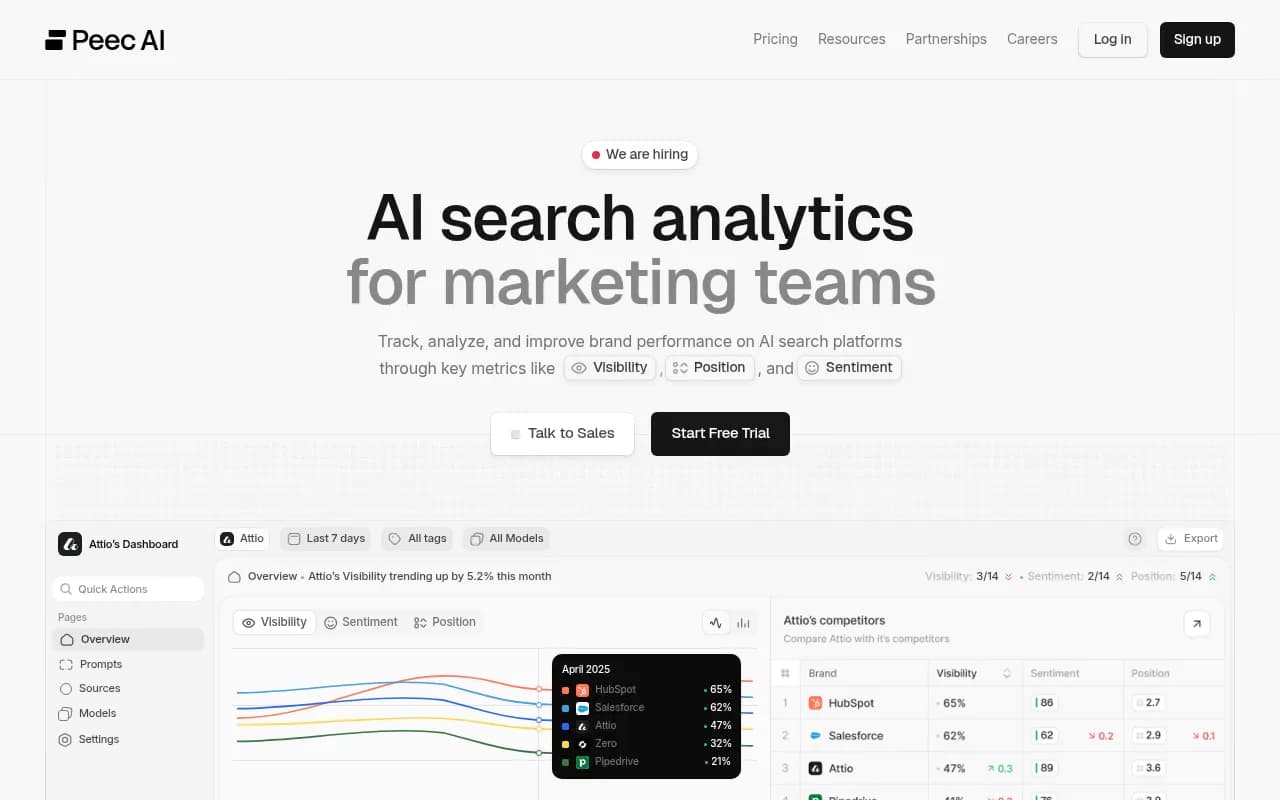
Other options in this space include Profound, Peec AI and Otterly.AI, which are mostly monitoring-focused. Compare them side by side before paying for one.
Profound

Otterly.AI

If you want to browse more, the GEO software directory lists tools by category.
Common mistakes
- Treating the product page as a conversion-only asset. It is also your main citation surface now.
- Hiding the facts. Prices, limits and specs behind a form or a demo call mean nothing to quote.
- Rewriting without checking crawl access. A perfect page that OAI-SearchBot cannot fetch is invisible.
- Changing fifty pages and measuring nothing. You will not know which edit mattered.
- Ignoring the rest of the ecosystem. Listicles, comparisons, docs and reviews all carry weight, so a great product page alone will not win every prompt.
What I would do this week
Pick your three highest-revenue product pages. Run the crawl checklist. Rewrite each with the seven blocks. Record a baseline on 20 prompts first so you can tell whether it worked. Then recheck in two to four weeks. The 22.4% figure says where ChatGPT looks first, and it is usually at the page that says plainly what you sell.
FAQ
Do product pages really get cited more than blog posts in ChatGPT?
In Promptwatch Data for Sep 28 to Oct 4, 2026, product pages were the single most cited type at 22.4%. Editorial formats combined (listicles, how-tos, comparisons, reviews and others) reach 43%, so blog-style content still matters in total. No single editorial type beats product pages.
Is there a way to guarantee ChatGPT cites my page?
No. OpenAI does not guarantee placement. You can improve eligibility through crawl access and improve your odds with clear, checkable content.
How often should I update product pages?
When prices, plans or specs change, update immediately, because stale facts get quoted as current. The half-life data suggests landing pages and docs stay cited for months, so a well-kept product page is a durable asset compared with news.
Should I publish a comparison page for every competitor?
Start with the two or three alternatives that appear most often next to you in answers. Keep the comparisons factual, including where a competitor is a better fit.