Key Takeaways
- DeepSeek uses Retrieval-Augmented Generation (RAG) and open-source LLMs to synthesize answers from indexed content, prioritizing semantic clarity and structural quality over traditional SEO signals
- Brand mentions in DeepSeek appear in AI-generated answer blocks ahead of organic results, making visibility tracking critical for brands targeting developers, researchers, and international audiences
- Enterprise-grade tracking platforms like Promptwatch, Peec AI, and LLM Pulse offer multi-model monitoring, citation analysis, and content gap identification to optimize DeepSeek visibility
- Effective DeepSeek optimization requires structured content with clear FAQs, technical documentation, and semantic markup that LLMs can parse and cite confidently
- Tracking should cover prompt-level visibility, source-type analysis, sentiment scoring, and competitor benchmarking across DeepSeek's V2 and Coder models
Understanding DeepSeek's AI Search Architecture
DeepSeek represents a new category of AI search engine that blends traditional retrieval with generative synthesis. Unlike Google's keyword-driven ranking or ChatGPT's conversational interface, DeepSeek combines a research-focused query parser with open-source large language models (DeepSeek-V2 and DeepSeek-Coder) to generate factual, citation-backed responses.
When a user submits a query, DeepSeek's architecture executes a multi-stage process:
Query parsing and intent modeling interprets user queries using embeddings and semantic parsing, even when phrasing is vague or implicit. The system determines whether the user seeks factual information, technical documentation, product comparisons, or brand recommendations.
Retrieval-Augmented Generation (RAG) fetches relevant documents from DeepSeek's indexed corpus, which includes multilingual sources, developer platforms like GitHub, and high-authority domains. This retrieval step grounds the LLM's response in real-world content rather than relying solely on training data.
Contextual synthesis uses transformer-based summarization to paraphrase and combine the most relevant inputs into a coherent answer. Citations are not always surfaced explicitly, which makes tracking brand mentions more complex than monitoring traditional search results.
Ranking and inclusion logic prioritizes topical relevance, semantic clarity, and structural quality. DeepSeek favors content with clear FAQs, concise summaries, and clean markup. Domain authority plays a role but is not the sole signal -- newer sites with well-structured technical content can outrank established brands.
Output assembly presents a hybrid format: an LLM-generated answer block followed by traditional search links. Brand mentions often appear within the synthesized answer without requiring user interaction, making top-of-response visibility critical.
Why DeepSeek Citations Matter for Brand Visibility
DeepSeek's user base is predominantly Chinese but growing internationally, particularly among developers, researchers, and technical audiences. Its open-source models (DeepSeek-V2 and DeepSeek-Coder) are deployed across platforms like Hugging Face, making its citation logic influential beyond its own search interface.
Zero-click searches now account for 58% of US queries according to recent data, with AI-generated answers from ChatGPT, Gemini, and Google AI Overviews playing a central role. DeepSeek follows this pattern -- if your brand is not cited in the synthesized answer block, your visibility drops even if you rank in the traditional link results below.
For brands targeting technical audiences, developer tools, SaaS platforms, or international markets, DeepSeek citations represent a new visibility channel. Unlike traditional SEO where rankings correlate with traffic, AI search visibility depends on whether the LLM chooses to mention your brand in its response. This makes tracking and optimization fundamentally different.
How DeepSeek Decides Which Brands to Cite
DeepSeek's citation logic differs from traditional search ranking. Instead of backlink profiles or keyword density, the system evaluates:
Semantic relevance measures how closely your content matches the query's intent using embeddings and contextual understanding. Content that directly answers the question in clear, structured language ranks higher than keyword-stuffed pages.
Structural clarity prioritizes content with headings, lists, FAQs, and concise summaries that LLMs can parse easily. Technical documentation, comparison tables, and step-by-step guides perform well because they provide clear, extractable information.
Domain authority and trust signals still matter but are weighted differently than in traditional SEO. DeepSeek considers citation frequency in its training data, domain age, HTTPS implementation, and consistency across multiple sources.
Freshness and recency influence citations for time-sensitive queries. Content updated in 2026 with current statistics, product versions, and industry trends receives priority over outdated material.
Multi-source validation means DeepSeek cross-references information across multiple documents before citing a brand. If your claim appears in only one source, it is less likely to be included in the synthesized answer.
Setting Up DeepSeek Brand Monitoring
Tracking DeepSeek citations requires specialized tools that query AI models programmatically and analyze response patterns. Traditional SEO rank trackers cannot monitor AI-generated answers because they only capture organic link positions.
Choosing a DeepSeek Tracking Platform
Enterprise-grade AI visibility platforms offer DeepSeek monitoring alongside ChatGPT, Perplexity, Claude, and other LLMs. Key evaluation criteria include:
Model coverage should include DeepSeek-V2 and DeepSeek-Coder alongside other major LLMs. Platforms that only track ChatGPT and Perplexity miss DeepSeek's unique citation patterns.
Prompt library scale determines how many queries you can monitor. Enterprise teams typically need 150-350 prompts to cover product categories, competitor comparisons, and brand-specific queries.
Citation and sentiment analysis identifies not just whether your brand is mentioned but how it is positioned relative to competitors. Sentiment scoring reveals whether mentions are positive, neutral, or negative.
Source-type breakdown shows whether citations come from your website, Reddit threads, YouTube videos, or third-party reviews. This helps prioritize optimization efforts.
Multi-region and multi-language support matters for brands targeting international markets. DeepSeek's user base spans multiple countries and languages.

Promptwatch tracks DeepSeek alongside 9 other AI models, offering citation analysis, content gap identification, and AI-generated content creation. The platform processes over 1.1 billion citations and provides page-level tracking to show exactly which pages are being cited.

Peec AI offers prompt-level visibility tracking with source-type citation analysis and multi-country monitoring starting at €89 per month. The platform includes unlimited seats and export-ready reporting.
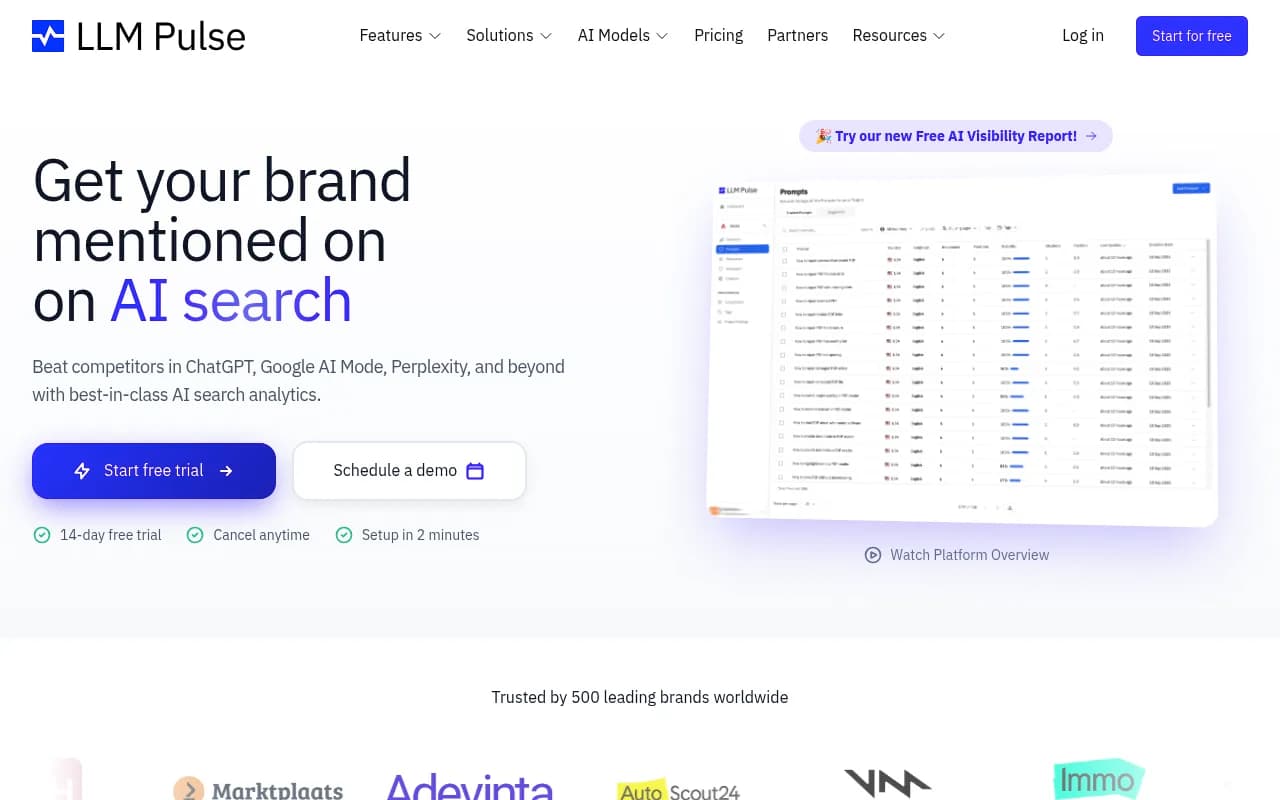
LLM Pulse provides DeepSeek-specific tracking with mention monitoring, visibility analytics, and competitor benchmarking. The platform is trusted by 500+ brands for multi-model AI visibility tracking.
Configuring Your Tracking Setup
Once you have selected a platform, configure your monitoring with these steps:
1. Define your prompt library by identifying queries where your brand should appear. Start with:
- Product category queries ("best project management tools")
- Competitor comparison queries ("Asana vs Monday.com")
- Brand-specific queries ("[YourBrand] features")
- Problem-solution queries ("how to automate workflows")
2. Set up competitor tracking to benchmark your visibility against 3-5 direct competitors. Monitor the same prompts for each competitor to identify gaps.
3. Configure geographic and language settings to match your target markets. DeepSeek's responses vary by region and language.
4. Enable citation source tracking to see whether mentions come from your website, third-party reviews, or social platforms.
5. Set up automated reporting to receive weekly or monthly visibility summaries showing citation trends, sentiment changes, and competitor movements.
Analyzing DeepSeek Citation Data
Raw citation counts provide limited insight. Effective analysis requires understanding citation context, source quality, and competitive positioning.
Citation Frequency and Position
Track how often your brand appears in DeepSeek responses and where it is positioned within the answer. Mentions in the first paragraph or opening sentence receive more visibility than citations buried in longer responses.
Position tracking should measure:
- Top-of-response mentions (first 100 words)
- Mid-response mentions (100-300 words)
- Bottom-of-response mentions (300+ words)
- Link-only mentions (cited in traditional results but not in AI answer)
Sentiment and Recommendation Context
Sentiment analysis reveals how DeepSeek frames your brand. Positive mentions include phrases like "leading solution," "highly recommended," or "best for." Neutral mentions state facts without endorsement. Negative mentions highlight limitations or competitor advantages.
Recommendation context matters more than raw sentiment. A neutral mention in a "top 5 tools" list is more valuable than a positive mention in a paragraph about industry challenges.
Source Attribution Analysis
Identify which sources DeepSeek cites when mentioning your brand:
- Your website (product pages, documentation, blog posts)
- Third-party reviews (G2, Capterra, TrustRadius)
- Reddit discussions (product recommendations, troubleshooting threads)
- YouTube videos (tutorials, comparisons, reviews)
- News articles (press releases, industry coverage)
Source diversity indicates brand authority. If DeepSeek only cites your website, it may not trust your claims. Citations from multiple independent sources signal credibility.
Competitor Benchmarking
Compare your citation frequency, position, and sentiment against competitors for the same prompts. Identify:
- Prompts where competitors dominate (you are not mentioned)
- Prompts where you rank second or third (optimization opportunities)
- Prompts where you lead (defend these positions)
Competitor heatmaps visualize this data, showing which brands win for each prompt category.
Optimizing Content for DeepSeek Citations
Tracking reveals gaps. Optimization closes them. DeepSeek favors content that is semantically clear, structurally organized, and factually grounded.
Structural Optimization
Reformat existing content to match DeepSeek's parsing preferences:
Add FAQ sections that directly answer common questions. Use schema markup to help LLMs identify question-answer pairs.
Create comparison tables for product features, pricing, and use cases. Structured data is easier for LLMs to extract and cite.
Use descriptive headings that summarize section content. Avoid clever or vague headings that require context to understand.
Write concise summaries at the top of long articles. DeepSeek often pulls from introductory paragraphs when synthesizing answers.
Break up dense paragraphs into shorter blocks with clear topic sentences. LLMs struggle to parse walls of text.
Semantic Optimization
Align content with how users phrase queries:
Match natural language patterns by writing in conversational tone. Avoid jargon unless targeting technical audiences.
Answer questions explicitly rather than implying answers. State "Product X is best for Y" instead of "Many users choose Product X for Y."
Provide specific examples and concrete details. Vague claims like "industry-leading performance" are less likely to be cited than "processes 10,000 requests per second."
Update statistics and dates to reflect 2026. DeepSeek prioritizes fresh content for time-sensitive queries.
Citation-Worthy Content Formats
Certain content types receive more citations than others:
Technical documentation ranks highly for developer-focused queries. Clear API references, code examples, and troubleshooting guides are frequently cited.
Comparison guides that objectively evaluate multiple solutions perform well. Include feature matrices, pricing breakdowns, and use case recommendations.
Case studies and examples provide concrete evidence that LLMs can reference when answering "how to" queries.
Listicles and roundups ("10 best tools for X") are citation magnets if they include specific details about each option.
Original research and data gives DeepSeek unique information to cite. Surveys, benchmarks, and industry reports are high-value content types.
Content Gap Analysis
Identify prompts where competitors are cited but you are not. These represent content gaps -- topics, angles, or questions your website does not address.
Platforms like Promptwatch offer Answer Gap Analysis that shows exactly which prompts competitors are visible for and what content your site is missing. This data-driven approach prioritizes content creation based on actual AI visibility opportunities rather than guesswork.
Leveraging AI Content Generation for DeepSeek Visibility
Manually creating content for hundreds of prompts is not scalable. AI-powered content generation tools can produce citation-optimized articles grounded in real visibility data.
AI Writing Agents for Citation-Optimized Content
Modern AI writing platforms analyze citation patterns across millions of LLM responses to understand what content gets cited. They generate articles, listicles, and comparisons that match the structural and semantic patterns DeepSeek favors.
Key capabilities include:
- Prompt volume and difficulty scoring to prioritize high-value, winnable queries
- Competitor analysis to identify content gaps and positioning opportunities
- Citation data integration to ground content in real-world visibility patterns
- Multi-model optimization to create content that ranks across DeepSeek, ChatGPT, Perplexity, and other LLMs
Promptwatch's built-in AI writing agent generates content based on 880M+ analyzed citations, targeting specific prompts with persona-aware angles and competitor-informed positioning. This is not generic SEO filler -- it is content engineered to get cited by AI models.
Quality Control and Human Review
AI-generated content requires human oversight to ensure accuracy, brand voice, and strategic alignment. Establish a review process that:
- Verifies factual claims and statistics
- Adjusts tone and messaging to match brand guidelines
- Adds unique insights or examples that AI cannot generate
- Optimizes for both AI citations and human readers
Tracking DeepSeek Crawler Activity
Understanding how DeepSeek's crawlers interact with your website helps identify indexing issues and optimization opportunities.
AI Crawler Log Analysis
AI crawler logs show real-time data on which pages DeepSeek's bots access, how often they return, and what errors they encounter. This visibility is critical for diagnosing why certain pages are not being cited.
Key metrics include:
- Crawl frequency (how often DeepSeek revisits your site)
- Page coverage (which pages are being indexed)
- Error rates (404s, timeouts, blocked resources)
- Crawl depth (how many clicks from homepage to reach content)
Platforms like Promptwatch provide AI crawler logs that track ChatGPT, Claude, Perplexity, and DeepSeek bots. Most competitors lack this capability entirely, leaving brands blind to indexing issues.
Fixing Crawler Access Issues
Common problems that prevent DeepSeek from citing your content:
- Robots.txt blocking AI crawlers
- JavaScript-heavy pages that crawlers cannot render
- Slow page load times causing timeouts
- Thin or duplicate content that LLMs skip
- Missing structured data that helps crawlers understand page context
Monitoring DeepSeek Shopping and Product Recommendations
DeepSeek's integration with e-commerce platforms means product recommendations influence purchase decisions. Tracking when your products appear in shopping-related queries is critical for retail and SaaS brands.
Product Mention Tracking
Monitor queries like:
- "Best [product category] to buy in 2026"
- "[Product A] vs [Product B] comparison"
- "Where to buy [product type]"
- "[Product] reviews and ratings"
Track whether your products are mentioned, how they are positioned relative to competitors, and what attributes DeepSeek highlights (price, features, reviews).
Shopping Carousel Visibility
Some AI search engines display product carousels with images, prices, and direct purchase links. DeepSeek's shopping features are evolving, and early visibility in these carousels can drive significant traffic.
Promptwatch offers ChatGPT Shopping tracking, which monitors product recommendations and shopping carousels. Similar capabilities are emerging for DeepSeek as its e-commerce features expand.
Integrating DeepSeek Visibility with Traffic Attribution
Tracking citations is only half the equation. Connecting AI visibility to actual website traffic and revenue closes the loop.
Traffic Attribution Methods
Code snippet tracking embeds a JavaScript snippet on your site to identify visitors arriving from AI search engines. This method captures referral data even when traditional analytics miss it.
Google Search Console integration provides limited visibility into AI-driven traffic but can show query patterns and click-through rates.
Server log analysis parses raw server logs to identify AI crawler activity and visitor sessions originating from AI platforms.
Promptwatch offers all three methods, allowing brands to connect visibility scores to traffic and revenue. This attribution proves ROI and justifies continued investment in AI search optimization.
Multi-Model Tracking Strategy
DeepSeek is one of 10+ AI models shaping search behavior. A comprehensive visibility strategy tracks:
- ChatGPT (largest user base, shopping features)
- Perplexity (research-focused, citation-heavy)
- Claude (long-form content, technical queries)
- Gemini (Google integration, multimodal)
- Google AI Overviews (traditional search integration)
- Copilot (Microsoft ecosystem, enterprise users)
- Grok (X/Twitter integration, real-time data)
- Meta AI (Facebook/Instagram integration)
- Mistral (European market focus)
- DeepSeek (developer audience, open-source models)
Platforms that track multiple models reveal cross-platform visibility patterns. A brand might rank well in ChatGPT but poorly in DeepSeek, indicating content gaps or structural issues specific to DeepSeek's citation logic.
Advanced DeepSeek Optimization Tactics
Reddit and YouTube Optimization
DeepSeek frequently cites Reddit discussions and YouTube videos when answering product recommendation and troubleshooting queries. Brands that actively participate in these platforms gain indirect citations.
Reddit strategy:
- Participate authentically in relevant subreddits
- Answer questions with detailed, helpful responses
- Link to your documentation when relevant (avoid spam)
- Monitor threads where your brand is discussed
YouTube strategy:
- Create tutorial and comparison videos
- Optimize titles and descriptions for search queries
- Include timestamps and chapter markers for easy navigation
- Encourage comments and engagement to boost visibility
Promptwatch surfaces Reddit discussions and YouTube videos that influence AI recommendations, helping brands identify high-impact channels.
Prompt Intelligence and Query Fan-Outs
Understanding how one prompt branches into sub-queries helps prioritize content creation. Prompt intelligence tools provide:
- Volume estimates for each prompt
- Difficulty scores based on competition
- Query fan-outs showing related sub-queries
This data reveals which prompts are worth targeting and which are too competitive or low-volume to justify effort.
Multi-Language and Multi-Region Tracking
DeepSeek's international user base requires monitoring in multiple languages and regions. Responses vary significantly by geography and language, even for the same query.
Customizable personas that match how actual customers prompt (e.g., "enterprise IT buyer" vs "individual developer") improve tracking accuracy and content relevance.
Reporting and Stakeholder Communication
AI visibility data must be presented in formats that non-technical stakeholders understand.
Executive Dashboards
Create high-level dashboards showing:
- Overall visibility score (percentage of tracked prompts where brand is cited)
- Trend lines (visibility over time)
- Competitor comparison (your rank vs top 3 competitors)
- Traffic attribution (visitors and revenue from AI search)
Detailed Reporting
Provide granular reports for optimization teams:
- Prompt-level performance (citation frequency, position, sentiment)
- Content gap analysis (prompts where competitors win)
- Source attribution (which pages and external sources are cited)
- Optimization recommendations (specific content to create or update)
Looker Studio Integration and API Access
Enterprise teams often need to integrate AI visibility data with existing reporting infrastructure. Platforms like Promptwatch offer Looker Studio integration and API access for custom dashboards and automated workflows.
Choosing the Right DeepSeek Tracking Platform
Not all AI visibility tools are created equal. When evaluating platforms, consider:
Action-oriented vs monitoring-only: Does the platform just show you data, or does it help you fix visibility gaps with content generation and optimization tools?
DeepSeek-specific features: Does it track DeepSeek-V2 and DeepSeek-Coder specifically, or lump all models together?
Citation depth: Does it show just mention counts, or provide source attribution, sentiment, and position analysis?
Crawler visibility: Can you see how DeepSeek's bots interact with your site, or are you blind to indexing issues?
Content gap analysis: Does it identify exactly which prompts competitors win and what content you need to create?
Traffic attribution: Can you connect visibility to actual revenue, or is it just vanity metrics?
Promptwatch is the only platform rated as a "Leader" across all categories in a 2026 comparison of 12 GEO platforms. Unlike monitoring-only tools like Otterly.AI, Peec.ai, and AthenaHQ, Promptwatch closes the action loop: find gaps, generate content, track results.
Conclusion
DeepSeek represents a growing visibility channel for brands targeting developers, researchers, and international audiences. Its open-source models and research-focused interface make it distinct from ChatGPT and Perplexity, requiring specialized tracking and optimization strategies.
Effective DeepSeek visibility depends on structured content, semantic clarity, and multi-source validation. Tracking tools that provide citation analysis, content gap identification, and traffic attribution enable data-driven optimization.
As AI search continues to reshape how users discover brands, monitoring DeepSeek alongside ChatGPT, Perplexity, and other LLMs becomes essential for maintaining visibility in 2026 and beyond.