Key Takeaways
- AI search visibility is now a competitive battleground: 90% of brands appear in Google AI Mode responses, making tracking competitor mentions critical for market positioning
- Monitor across multiple AI engines: ChatGPT, Perplexity, Claude, Gemini, and Google AI Overviews each have different citation patterns and recommendation logic
- Track three core metrics: Share of recommendations (how often competitors appear vs you), citation sources (which pages/domains AI models reference), and sentiment (positive/negative/neutral mentions)
- Use specialized tracking tools: Traditional SEO tools don't capture AI search data -- platforms like Promptwatch, Profound, and Peec AI are purpose-built for multi-LLM monitoring
- Turn insights into action: The real value isn't just seeing where competitors rank -- it's identifying content gaps, understanding their citation strategy, and creating better content that AI models prefer to cite
AI search engines like ChatGPT, Perplexity, and Claude are fundamentally changing how customers discover brands. When someone asks "What's the best project management tool for remote teams?" or "Which CRM should I use for my startup?", AI models generate instant recommendations -- and your competitors might be getting mentioned while you're invisible.
Tracking competitor AI search strategy isn't optional anymore. It's the difference between being recommended by AI or being left out of the conversation entirely. Here's how to do it systematically in 2026.
Why Competitor AI Search Tracking Matters
Traditional SEO competitor analysis focuses on keyword rankings and backlinks. AI search is different. When a user asks ChatGPT for recommendations, the model doesn't return a list of blue links -- it synthesizes an answer and cites specific brands, products, or resources.
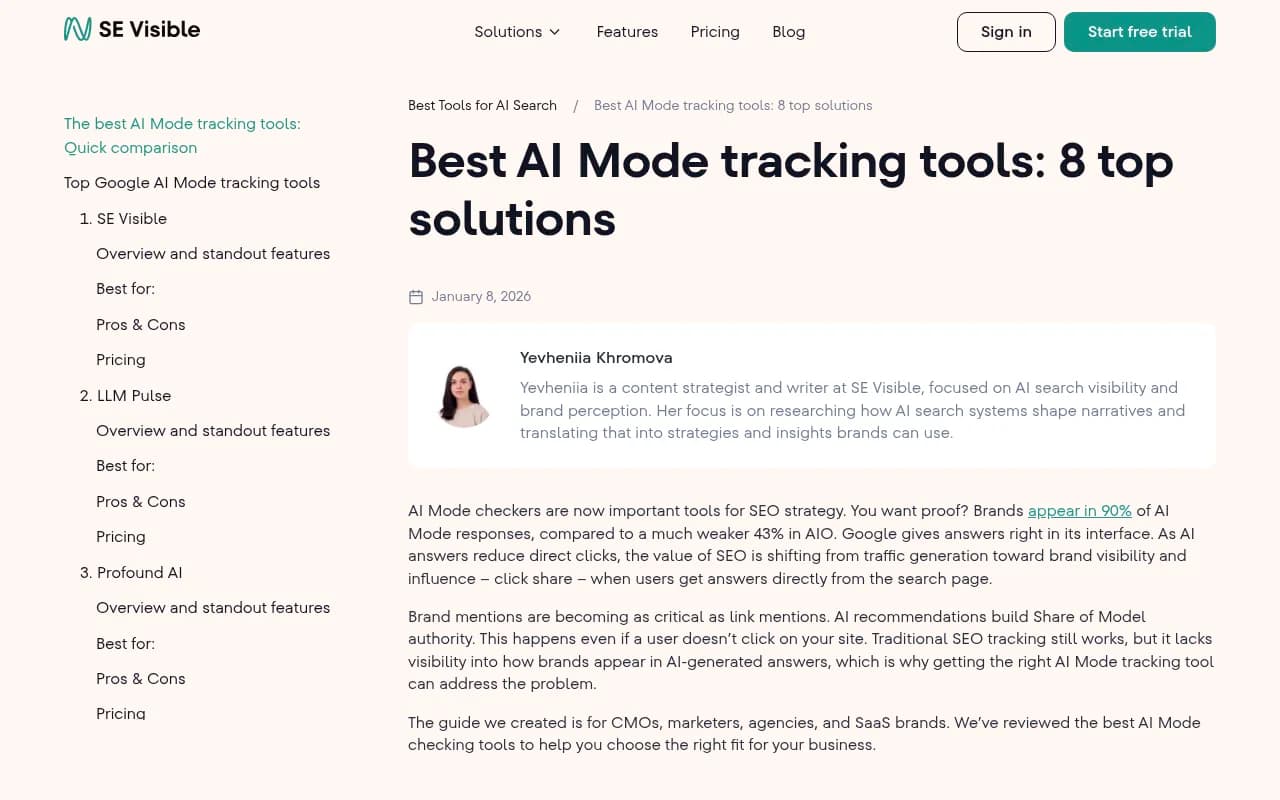
Research shows that brands appear in 90% of Google AI Mode responses, compared to just 43% in traditional AI Overviews. This creates a new competitive dynamic: share of recommendations. If competitors consistently get cited and you don't, you're losing mindshare even if users never click through to their websites.
AI search visibility drives three business outcomes:
- Brand awareness: Being mentioned by AI models builds authority and trust, even without direct traffic
- Consideration: Users who see your competitors recommended repeatedly are more likely to choose them
- Traffic and conversions: While AI answers reduce clicks, being cited still drives qualified visitors who want to learn more
The brands winning in AI search aren't guessing. They're systematically tracking what works, analyzing competitor strategies, and optimizing their content to get cited more often.
Understanding AI Search Competitive Dynamics
Before diving into tracking methods, it's important to understand how AI search competition differs from traditional SEO.
Citation vs Ranking
In traditional search, you compete for position 1-10 on a SERP. In AI search, you compete for citations -- mentions within AI-generated responses. A competitor might be cited three times in a single ChatGPT answer while you're not mentioned at all. That's a 100% share of voice loss.
Citations come from:
- Direct brand mentions: "Asana is a popular choice for remote teams"
- Product recommendations: "Consider tools like Notion, ClickUp, or Monday.com"
- Source attributions: Links to specific pages, articles, or resources the AI model references
Multi-Engine Fragmentation
Unlike Google's near-monopoly in traditional search, AI search is fragmented across multiple platforms:
- ChatGPT: 200M+ weekly active users, integrated shopping features
- Perplexity: Real-time web search with source citations
- Claude: Long-form reasoning and analysis
- Google AI Overviews: Integrated into traditional search results
- Gemini: Google's conversational AI with deep integration
- Meta AI: Embedded in Facebook, Instagram, WhatsApp
- Grok: X/Twitter's AI with real-time social data
- DeepSeek: Emerging Chinese AI model gaining traction
Each engine has different training data, citation logic, and recommendation patterns. A competitor might dominate ChatGPT but be invisible in Perplexity. You need to track across all major platforms to see the full picture.
Prompt Variation
The same question asked different ways produces different results. "Best CRM for startups" vs "What CRM should a 5-person startup use?" vs "Recommend a CRM under $50/month" might surface different competitors.
Effective tracking requires testing multiple prompt variations for each topic you care about -- not just one or two queries.
Step 1: Identify Your AI Search Competitors
Your AI search competitors might not be the same as your traditional SEO competitors. Start by mapping who actually gets mentioned when users ask questions related to your category.
Brainstorm Core Prompts
List 10-20 prompts your target customers would realistically ask AI models:
- Product category questions: "What's the best [category] for [use case]?"
- Comparison queries: "[Your product] vs [competitor] vs [competitor]"
- Problem-solving prompts: "How do I [solve problem]?"
- Buying intent queries: "Which [product] should I buy for [specific need]?"
For a project management tool, examples might include:
- "Best project management software for remote teams"
- "Asana vs Monday.com vs ClickUp"
- "How do I manage projects with a distributed team?"
- "What PM tool integrates with Slack and Google Drive?"
Run Manual Tests
Query each prompt across ChatGPT, Perplexity, Claude, and Google AI Overviews. Document:
- Which brands get mentioned
- How often each brand appears
- Position in the response (first mention, middle, end)
- Context (positive recommendation, neutral mention, comparison)
- Source citations (which pages/domains are referenced)
This manual exercise reveals your true competitive set in AI search. You might discover:
- Direct competitors you already track
- Indirect competitors solving the same problem differently
- Content publishers (blogs, review sites, YouTube channels) that influence AI recommendations
- Unexpected brands dominating specific prompt types
Analyze Competitor Content Strategy
For each competitor that appears frequently, audit their content:
- What topics do they cover that you don't?
- How do they structure content (listicles, comparisons, guides)?
- What format (blog posts, videos, case studies, documentation)?
- Where is content published (owned site, third-party platforms, Reddit, YouTube)?
- How do they use structured data, schema markup, or metadata?
Look for patterns. If a competitor consistently gets cited, they're doing something right -- and you can reverse-engineer their approach.
Step 2: Set Up Automated AI Search Monitoring
Manual testing gives you initial insights, but tracking competitor AI search strategy at scale requires automation. You need tools that continuously monitor AI engines and alert you to changes.
Choose the Right Tracking Platform
Several platforms specialize in AI search visibility tracking. Key capabilities to look for:
- Multi-LLM coverage: Tracks ChatGPT, Perplexity, Claude, Gemini, Google AI Overviews, and other major engines
- Competitor benchmarking: Compares your visibility vs competitors across prompts
- Prompt libraries: Pre-built or customizable prompt sets for your industry
- Citation analysis: Shows which sources AI models reference
- Trend tracking: Historical data to see visibility changes over time
- Alerting: Notifications when competitors gain or lose visibility
Tools like Promptwatch help you track competitor visibility across multiple AI engines and identify content gaps. The platform shows exactly which prompts competitors rank for but you don't -- then helps you create content to close those gaps with an AI writing agent trained on 880M+ citations.

Other platforms worth evaluating:
Profound offers enterprise-grade tracking across 9+ AI engines with strong automation features. It's built for large brands that need comprehensive visibility data and workflow integration.
Profound

Peec AI focuses on conversational AI visibility with simple dashboards and competitor benchmarks. Good for B2B and SaaS companies that want straightforward monitoring without complexity.

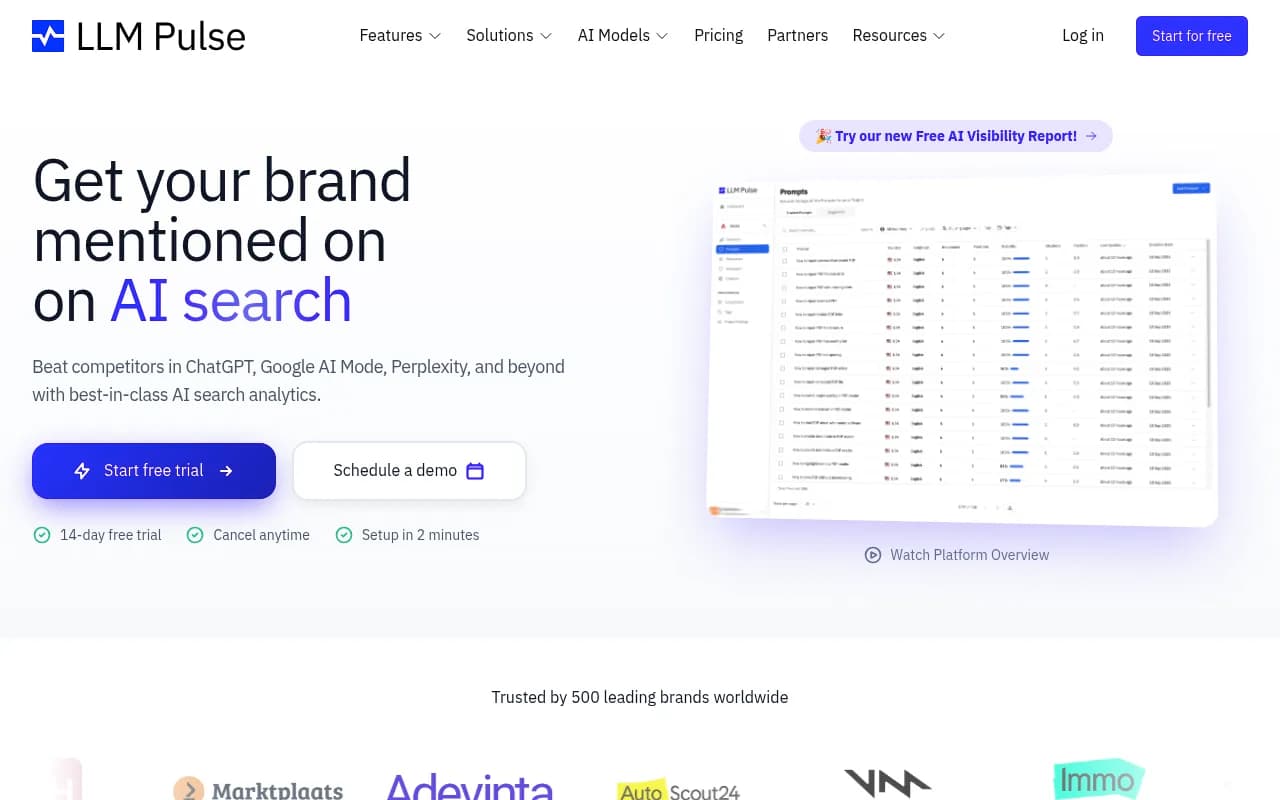
LLM Pulse specializes in brand recommendation tracking and sentiment analysis. It measures share of recommendations across LLMs and shows whether mentions are positive, neutral, or negative.
Configure Competitor Tracking
Once you've selected a platform, set up competitor monitoring:
- Add competitor domains: Input the websites of your top 5-10 competitors
- Define prompt sets: Create collections of prompts grouped by topic, use case, or buying stage
- Set tracking frequency: Daily for high-priority prompts, weekly for broader monitoring
- Configure alerts: Get notified when competitors gain visibility for important prompts or when your visibility drops
Most platforms let you organize prompts into categories like "product comparisons," "buying intent," "educational," or "problem-solving." This makes it easier to spot patterns in competitor strategy.
Track Key Metrics
Focus on metrics that reveal competitive positioning:
- Share of recommendations: What percentage of AI responses mention you vs competitors?
- Citation frequency: How many times does each brand appear across all tracked prompts?
- Position: Are competitors mentioned first, middle, or last in responses?
- Sentiment: Are mentions positive ("highly recommended"), neutral ("another option"), or negative ("lacks features")?
- Source diversity: How many unique sources (pages, domains) does each competitor get cited from?
- Prompt coverage: Which prompts do competitors appear for that you don't?
These metrics tell you not just who is winning in AI search, but where and why.
Step 3: Analyze Competitor Citation Sources
AI models don't invent recommendations from thin air. They cite sources -- web pages, Reddit threads, YouTube videos, documentation, reviews. Understanding where competitors get cited from reveals their content strategy.
Identify Citation Patterns
For each competitor, analyze:
- Owned content: Which pages on their website get cited most often?
- Third-party mentions: What external sites, blogs, or publications reference them?
- Reddit discussions: Which subreddits and threads mention the competitor?
- YouTube content: Are there reviews, tutorials, or comparisons featuring them?
- Review sites: Do they appear on G2, Capterra, Trustpilot, or industry-specific directories?
- Documentation and guides: Do they have comprehensive help docs, API references, or technical guides?
Tools like Promptwatch surface the exact sources AI models cite, so you can see which content types and platforms drive the most visibility.
Map Content Gaps
Compare competitor citation sources to your own content. Where are the gaps?
- Do competitors have detailed comparison pages ("[Product] vs [Competitor]") that you lack?
- Are they active on Reddit in relevant communities while you're not?
- Do they publish case studies, customer stories, or use case guides that get cited?
- Have they created glossaries, resource hubs, or educational content that establishes authority?
- Are they leveraging video content on YouTube that you're missing?
Every citation source a competitor has that you don't is an opportunity. If AI models cite their "Ultimate Guide to [Topic]" but you don't have equivalent content, that's a gap to fill.
Analyze Content Quality and Structure
Look at how competitors structure high-performing content:
- Depth: Are they writing 3,000-word comprehensive guides or 800-word surface-level posts?
- Formatting: Do they use clear headings, bullet points, tables, and visual elements?
- Data and examples: Are they backing claims with data, case studies, or specific examples?
- Freshness: Is content updated regularly with current information?
- Schema markup: Are they using structured data to help AI models parse content?
AI models favor content that's well-structured, comprehensive, and authoritative. If competitors consistently get cited, their content likely checks these boxes.
Step 4: Monitor Competitor AI Crawler Activity
AI models don't just read content once -- they continuously crawl websites to update their knowledge. Monitoring which pages AI crawlers visit on competitor sites reveals what content they prioritize.
Track AI Crawler Logs
Some platforms (like Promptwatch) provide real-time logs of AI crawlers hitting your website -- and potentially competitor sites if you have access to their analytics:
- ChatGPT crawler (GPTBot)
- Perplexity crawler (PerplexityBot)
- Claude crawler (ClaudeBot)
- Google AI crawlers (Google-Extended)
- Meta AI crawler (Meta-ExternalAgent)
Crawler logs show:
- Which pages get crawled most frequently
- When crawlers return (daily, weekly, monthly)
- Errors or issues preventing crawling
- Crawl depth (how many pages they index)
If competitors' key pages get crawled daily while yours are crawled weekly, AI models have fresher data on them. That's a competitive disadvantage.
Optimize for AI Crawlers
Based on competitor crawler patterns, optimize your own site:
- Ensure crawlability: Check robots.txt and meta tags to confirm AI crawlers aren't blocked
- Improve site speed: Faster sites get crawled more efficiently
- Update content regularly: Fresh content signals to crawlers that your site is active
- Fix errors: Broken links, 404s, or server errors hurt crawl efficiency
- Use XML sitemaps: Help crawlers discover all your important pages
The goal is to make it as easy as possible for AI models to discover, read, and cite your content -- just like your competitors do.
Step 5: Reverse-Engineer Competitor Prompt Strategy
Competitors don't just wait for AI models to mention them randomly. The best ones optimize content for specific prompts they know customers use.
Identify High-Value Prompts
Use AI search tracking tools to see which prompts drive the most visibility for competitors:
- Volume: Which prompts get asked most often?
- Intent: Which prompts indicate buying intent vs research?
- Difficulty: Which prompts are easier to rank for (fewer strong competitors)?
- Conversion potential: Which prompts lead to signups, demos, or purchases?
Platforms like Promptwatch provide prompt volume estimates and difficulty scores, plus query fan-outs that show how one prompt branches into related sub-queries. This helps you prioritize which prompts to target.
Analyze Competitor Prompt Coverage
For each high-value prompt, check:
- Do competitors have dedicated content targeting that prompt?
- How do they structure the content (format, length, angle)?
- What keywords and phrases do they use?
- Are they answering the prompt directly or tangentially?
If a competitor ranks for "Best [product] for [use case]" and you don't, look at their content. Do they have a dedicated page for that use case? A comparison guide? A case study? A video?
Create Better Content
The goal isn't to copy competitors -- it's to create better content that AI models prefer to cite.
Better means:
- More comprehensive: Cover the topic in greater depth
- More current: Include 2026 data, trends, and examples
- More specific: Address the exact question with actionable advice
- More credible: Back claims with data, expert quotes, or case studies
- Better structured: Use clear headings, lists, and formatting that AI models can parse easily
Some AI search platforms (like Promptwatch) include AI writing agents that generate content grounded in real citation data. Instead of guessing what AI models want, you create articles engineered to get cited based on analysis of 880M+ existing citations.
Step 6: Track Competitor Sentiment and Positioning
It's not enough to know that competitors get mentioned -- you need to understand how they're positioned.
Monitor Sentiment
AI models express sentiment in their recommendations:
- Positive: "Highly recommended," "industry leader," "best choice for"
- Neutral: "Another option," "also consider," "alternative to"
- Negative: "Lacks features," "limited support," "not ideal for"
Track sentiment over time. If a competitor's sentiment improves (more positive mentions), they're likely improving their content, product, or reputation. If it declines, they might be facing issues you can capitalize on.
Analyze Positioning
How do AI models position competitors relative to each other?
- Category leaders: Mentioned first, described as "top choice" or "industry standard"
- Specialists: Positioned for specific use cases ("best for small teams," "ideal for agencies")
- Alternatives: Presented as secondary options or budget choices
- Emerging players: Mentioned less frequently but gaining traction
Understanding positioning helps you identify opportunities. If competitors dominate the "enterprise" positioning but no one owns "best for startups," that's a niche you can target.
Track Competitive Comparisons
Monitor prompts that directly compare competitors:
- "[Competitor A] vs [Competitor B]"
- "Is [Competitor] better than [Your Brand]?"
- "[Competitor] alternatives"
These prompts reveal how AI models frame competitive dynamics. If a competitor consistently wins head-to-head comparisons, analyze why -- then create content that tells your story more effectively.
Step 7: Monitor Competitor Reddit and YouTube Strategy
AI models increasingly cite Reddit discussions and YouTube videos. Competitors active on these platforms gain visibility you might miss.
Track Reddit Mentions
Identify subreddits relevant to your category:
- r/SaaS, r/startups, r/entrepreneur for B2B software
- r/productivity, r/projectmanagement for productivity tools
- Industry-specific communities (r/marketing, r/sales, r/devops)
Monitor:
- Which competitors get mentioned in discussions
- What questions or problems trigger mentions
- Whether mentions are organic (users recommending) or promotional (competitor posting)
- Sentiment (positive, neutral, negative)
Some AI search platforms include Reddit tracking features that surface relevant threads automatically.
Analyze YouTube Presence
Search YouTube for:
- "[Competitor] review"
- "[Competitor] tutorial"
- "[Competitor] vs [other tools]"
- "Best [category] 2026"
Note:
- How many videos feature each competitor
- Video quality and production value
- Influencer or creator partnerships
- View counts and engagement (likes, comments)
If competitors have strong YouTube presence and you don't, that's a channel gap. AI models cite video content increasingly often, especially for how-to queries and product comparisons.
Step 8: Set Up Competitive Alerts and Reporting
Tracking competitor AI search strategy isn't a one-time project -- it's an ongoing process. Set up systems to stay informed.
Configure Alerts
Most AI search tracking platforms offer alerting:
- Competitor visibility spikes: Get notified when a competitor suddenly appears for important prompts
- Your visibility drops: Alert when you lose citations or ranking position
- New competitor mentions: Track when new players enter the competitive set
- Sentiment changes: Flag when competitor sentiment shifts (positive to negative or vice versa)
- Citation source changes: Monitor when competitors gain citations from new sources
Build Dashboards
Create dashboards that visualize competitive dynamics:
- Share of voice chart: Compare your citation frequency vs top 5 competitors
- Prompt coverage heatmap: Show which prompts each competitor ranks for
- Sentiment trends: Track positive/neutral/negative mentions over time
- Citation source breakdown: Compare owned vs third-party citations
- Engine-specific performance: See which AI platforms favor which competitors
Many platforms integrate with Looker Studio or offer API access for custom reporting.
Schedule Regular Reviews
Set a cadence for competitive analysis:
- Weekly: Quick check of key metrics and alerts
- Monthly: Deep dive into competitor content strategy and citation sources
- Quarterly: Strategic review of positioning, sentiment trends, and market shifts
Regular reviews ensure you catch competitive moves early and adjust your strategy accordingly.
Step 9: Turn Insights Into Action
Tracking competitor AI search strategy is only valuable if you act on insights. Here's how to close the loop.
Prioritize Content Gaps
Based on competitor analysis, create a prioritized list of content to create:
- High-impact prompts: Prompts with high volume and buying intent where competitors rank but you don't
- Low-hanging fruit: Prompts with lower difficulty where you can win quickly
- Strategic positioning: Content that establishes your unique positioning vs competitors
- Citation source gaps: Formats or platforms (Reddit, YouTube, comparison pages) where competitors have presence and you don't
Use a simple scoring system (impact × feasibility) to rank opportunities.
Create AI-Optimized Content
For each priority prompt, create content designed to get cited:
- Answer the prompt directly: Don't make AI models hunt for the answer
- Use clear structure: Headings, lists, and formatting that's easy to parse
- Include data and examples: Back claims with specifics
- Update regularly: Keep content current with 2026 information
- Add schema markup: Help AI models understand content structure
- Optimize for multiple engines: Different AI models have different preferences
Some platforms (like Promptwatch) generate AI-optimized content automatically based on citation data and competitor analysis. This accelerates content creation while ensuring it's engineered for AI visibility.
Measure Results
Track whether your actions improve AI search visibility:
- Citation frequency: Are you getting mentioned more often?
- Prompt coverage: Are you ranking for more prompts?
- Share of voice: Is your percentage of mentions increasing vs competitors?
- Position: Are you moving from third mention to first?
- Traffic: Is AI search visibility driving actual visitors? (Use tracking codes, Google Search Console integration, or server log analysis)
Close the loop by connecting visibility to business outcomes. If AI search visibility increases but doesn't drive traffic or conversions, adjust your strategy.
Advanced Tactics for Competitive AI Search Intelligence
Once you've mastered the basics, these advanced tactics provide deeper competitive insights.
Persona-Based Tracking
AI models tailor responses based on user context. Track competitor visibility across different personas:
- Job titles: "marketing manager" vs "CEO" vs "developer"
- Company size: "startup" vs "enterprise"
- Industry: "healthcare" vs "fintech" vs "ecommerce"
- Geography: US vs UK vs EU vs APAC
Competitors might dominate for one persona but be invisible to another. Persona-based tracking reveals these nuances.
Multi-Language Monitoring
If you operate globally, track competitor visibility in multiple languages:
- Spanish, French, German, Japanese, etc.
- Regional variations (US English vs UK English)
- Local competitors that don't appear in English results
AI models have different training data and citation patterns for each language. A competitor might be strong in English but weak in German -- an opportunity for you.
Query Fan-Out Analysis
One prompt often branches into related sub-queries. For example, "Best project management tool" might fan out to:
- "Best PM tool for remote teams"
- "Best PM tool for agencies"
- "Best PM tool under $20/month"
- "Best PM tool with Gantt charts"
Track competitor visibility across the entire fan-out. They might rank for the parent prompt but miss sub-queries -- or vice versa.
Competitive Content Velocity
Monitor how often competitors publish new content:
- Blog post frequency
- Product updates and release notes
- Case study and customer story cadence
- Video and multimedia content
Competitors publishing more frequently often gain AI search visibility faster. If they're out-publishing you 3:1, that's a strategic gap.
Citation Network Mapping
Map the network of sites that cite each competitor:
- Which domains link to them most often?
- Are there influencer or publisher relationships?
- Do they guest post on high-authority sites?
- Are they featured in industry roundups or "best of" lists?
Building similar citation networks for your brand improves AI search visibility over time.
Common Mistakes to Avoid
As you track competitor AI search strategy, avoid these pitfalls:
Tracking Too Many Competitors
Focus on your top 5-10 competitors. Tracking 20+ dilutes insights and makes it harder to act.
Ignoring Indirect Competitors
Don't just track direct product competitors. Monitor content publishers, review sites, and influencers that shape AI recommendations in your category.
Focusing Only on ChatGPT
ChatGPT is important, but Perplexity, Claude, Gemini, and Google AI Overviews each have different user bases and citation patterns. Track across all major engines.
Copying Instead of Innovating
Seeing what competitors do is valuable, but blindly copying their strategy won't differentiate you. Use insights to inform your unique approach.
Neglecting Measurement
Tracking visibility without connecting it to business outcomes (traffic, leads, revenue) makes it hard to justify investment. Always measure ROI.
Treating AI Search Like Traditional SEO
AI search requires different tactics. What works for Google rankings doesn't always work for ChatGPT citations. Adapt your strategy accordingly.
The Future of Competitive AI Search Intelligence
AI search is evolving rapidly. Here's what to watch in 2026 and beyond:
AI Shopping and Commerce
ChatGPT now includes shopping features that recommend products directly. Tracking competitor visibility in shopping carousels and product recommendations will become critical for ecommerce brands.
Real-Time Personalization
AI models are getting better at personalizing responses based on user history, preferences, and context. Competitive tracking will need to account for personalization factors.
Multi-Modal Search
AI search is expanding beyond text to include images, video, and voice. Tracking competitor visibility across these modalities will require new tools and methods.
AI Agent Ecosystems
As AI agents become more autonomous (booking travel, making purchases, managing workflows), tracking which brands agents prefer will matter more than traditional search rankings.
Regulatory Changes
Governments are beginning to regulate AI search and recommendation systems. Transparency requirements might make competitive intelligence easier -- or harder, depending on how regulations evolve.
Conclusion
Tracking your competitors' AI search strategy in 2026 isn't optional -- it's essential for staying competitive. AI models are now the first place customers go for recommendations, and if competitors consistently get cited while you don't, you're losing mindshare and market position.
The process is straightforward:
- Identify who your real AI search competitors are (not just traditional SEO rivals)
- Set up automated tracking across ChatGPT, Perplexity, Claude, Gemini, and other major AI engines
- Analyze citation sources to understand competitor content strategy
- Monitor AI crawler activity to see what content gets prioritized
- Reverse-engineer competitor prompt strategy and coverage
- Track sentiment and competitive positioning
- Monitor Reddit, YouTube, and other platforms AI models cite
- Set up alerts and dashboards for ongoing intelligence
- Turn insights into action by creating better, AI-optimized content
The brands winning in AI search aren't just monitoring -- they're using insights to create content that AI models prefer to cite. Tools like Promptwatch help you track competitor visibility, identify content gaps, and generate AI-optimized content based on real citation data from 880M+ analyzed citations.
Start tracking today. The longer you wait, the further ahead your competitors get.