Key Takeaways
- Voice search optimization targets spoken queries and featured snippets — it's about capturing position zero in traditional search engines through conversational keywords and direct answers
- AI search optimization (GEO) targets citations in LLM responses — it's about being mentioned and recommended by ChatGPT, Perplexity, Claude, and other AI models that synthesize information from multiple sources
- Voice is an input method; AI search is a discovery channel — voice queries can trigger AI-generated answers, but optimizing for one doesn't automatically optimize for the other
- Technical foundations overlap but diverge — both need fast sites and structured data, but AI search requires citation-worthy content architecture and crawler accessibility that voice search doesn't prioritize
- In 2026, you need both strategies — 30% of searches are voice-based, but AI models are increasingly the first stop for research, recommendations, and decision-making
The Fundamental Difference: Input vs. Discovery
The most important thing to understand is that voice search and AI search are solving different problems.
Voice search optimization is about adapting your content for how people speak rather than type. When someone asks their phone "What's the best pizza place near me?", they're using voice as an input method to query a traditional search engine. The goal is to rank in featured snippets (position zero) so that Google Assistant, Siri, or Alexa reads your answer aloud.
AI search optimization — also called Generative Engine Optimization (GEO) or Answer Engine Optimization (AEO) — is about being cited and recommended by large language models. When someone asks ChatGPT "What are the best project management tools for remote teams?", the AI synthesizes information from multiple sources and generates a response. Your goal is to be one of those sources.
Voice is an interface. AI search is a discovery layer.
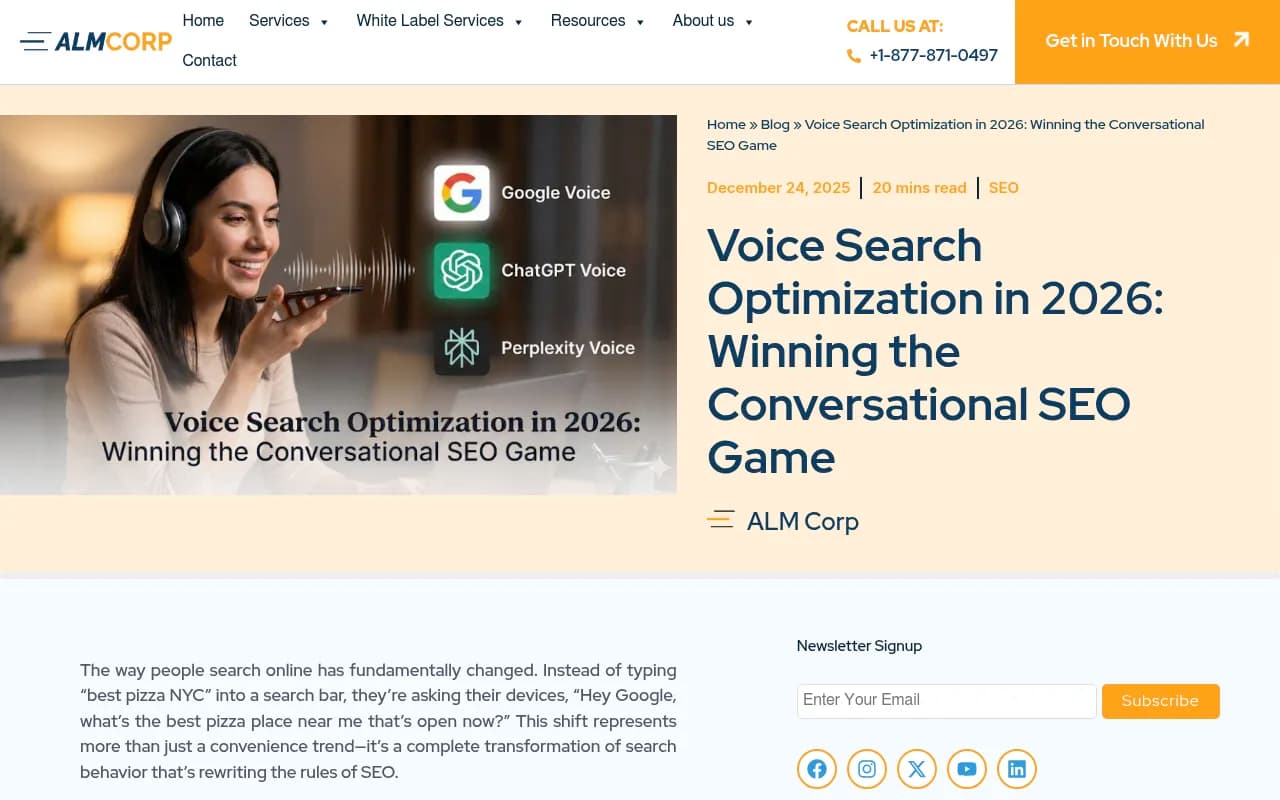
How Voice Search Works in 2026
Voice search has matured significantly. According to recent data, approximately 30% of all web browsing sessions now involve voice search, with 32% of consumers using voice daily for searches they would normally type.
The mechanics are straightforward:
- User speaks a query into a device (phone, smart speaker, car)
- Speech-to-text converts the audio to a text query
- The query is processed by a traditional search engine (Google, Bing)
- The search engine attempts to extract a direct answer from its index
- The answer is read aloud via text-to-speech
Key characteristics of voice queries:
- Conversational and natural — "What's the best pizza place near me?" vs. "best pizza NYC"
- Question-based — 70%+ of voice searches are phrased as questions (who, what, where, when, why, how)
- Longer tail — voice queries average 3-5 words longer than typed queries
- Local intent — 58% of consumers use voice search to find local business information
- Immediate need — voice searchers want fast, direct answers, not a list of links
What voice assistants prioritize:
- Featured snippets (position zero in Google)
- Local business listings (Google Business Profile)
- Structured data markup (FAQ schema, HowTo schema)
- Mobile-friendly, fast-loading pages
- Clear, concise answers in the first 150 characters
How AI Search Works in 2026
AI search represents a fundamental shift in how information is discovered and consumed. Instead of returning a ranked list of links, AI models like ChatGPT, Perplexity, Claude, Gemini, and Google AI Overviews synthesize information from multiple sources and generate a coherent response.
The AI search process:
- User asks a question or describes a need
- The LLM retrieves relevant information from its training data, real-time web access, or connected knowledge bases
- The model synthesizes information from multiple sources
- It generates a response that directly answers the question
- It may cite sources, provide recommendations, or suggest follow-up questions
Key characteristics of AI search queries:
- Research-oriented — users ask for comparisons, explanations, recommendations
- Multi-turn conversations — follow-up questions build on previous context
- Complex intent — "I need a CRM for a 50-person sales team that integrates with HubSpot and costs under $10k/year"
- Persona-aware — AI models tailor responses based on user context and preferences
- Citation-driven — users want to know where information comes from
What AI models prioritize:
- Authoritative, well-structured content
- Clear entity relationships and topical authority
- Crawlable, indexable pages (AI crawlers need access)
- Citation-worthy sources (original research, case studies, expert analysis)
- Comprehensive coverage of topics
- Structured data that helps models understand context
Technical Optimization: Where They Overlap and Diverge
Shared Technical Foundations
Both voice and AI search require solid technical SEO fundamentals:
Page speed and mobile-friendliness — Voice searches are predominantly mobile (27% of mobile users use voice search), and AI crawlers prioritize fast, accessible content. Core Web Vitals matter for both.
Structured data markup — Schema.org markup helps both traditional search engines and AI models understand your content. FAQ schema, HowTo schema, Product schema, and Organization schema are valuable for both channels.
HTTPS and security — Both voice assistants and AI crawlers require secure connections.
Clean site architecture — Clear navigation, logical URL structure, and proper internal linking help both discovery methods.
Where They Diverge
Voice search technical priorities:
- Featured snippet optimization — Format content to win position zero (concise paragraphs, bulleted lists, tables)
- Local SEO signals — Google Business Profile optimization, NAP consistency, local schema markup
- Mobile-first indexing — Voice queries happen on mobile devices, so mobile performance is critical
- Natural language processing — Content should match how people speak, not how they type
AI search technical priorities:
- AI crawler accessibility — Your robots.txt and server configuration must allow AI crawlers (GPTBot, PerplexityBot, ClaudeBot, etc.) to access your content
- Crawler log analysis — Monitor which pages AI crawlers are accessing, how often, and what errors they encounter. Tools like Promptwatch provide real-time AI crawler logs.
- Citation-worthy content architecture — Structure content so AI models can extract and attribute information (clear headings, author attribution, publication dates, sources)
- Entity optimization — Help AI models understand your brand, products, and expertise through consistent entity references and knowledge graph connections
- API and data feed access — Some AI platforms prefer structured data feeds over web scraping
Content Strategy: Answering vs. Being Cited
Voice Search Content Strategy
Voice search optimization is about providing direct, concise answers to specific questions.
Content formats that win voice search:
- FAQ pages — Answer common questions in 40-60 words per answer
- How-to guides — Step-by-step instructions with clear headings
- Local landing pages — Location-specific content with address, hours, services
- Listicles — "Top 10" or "Best 5" lists that can be read aloud
- Definition content — Clear, concise explanations of terms and concepts
Writing for voice search:
- Use conversational language and question-based headings
- Answer the question in the first 150 characters
- Write in second person ("you") to match spoken queries
- Include long-tail, conversational keywords
- Structure content for easy extraction (short paragraphs, bullet points)
Example voice-optimized content:
## What is the best time to post on Instagram in 2026?

The best time to post on Instagram in 2026 is between 9-11 AM and 7-9 PM on weekdays, when engagement rates are highest. However, optimal timing varies by industry and audience location.

**Best posting times by day:**
- Monday: 9 AM, 7 PM
- Tuesday: 10 AM, 8 PM
- Wednesday: 9 AM, 7 PM
This format allows a voice assistant to extract and read the core answer, with additional detail available if needed.
AI Search Content Strategy
AI search optimization is about being cited as an authoritative source across multiple queries and topics.
Content formats that win AI citations:
- Original research and data — AI models cite sources with unique insights
- Comprehensive guides — In-depth coverage of topics (2000+ words)
- Comparison articles — "X vs. Y" content that helps users make decisions
- Case studies — Real-world examples with measurable results
- Expert analysis — Opinion pieces backed by data and experience
- Tool directories and resource lists — Curated collections of solutions
Writing for AI search:
- Establish topical authority through comprehensive coverage
- Use clear entity references (brand names, product names, people)
- Cite your own sources and data
- Structure content with semantic headings (H2, H3) that reflect user intent
- Include author bios and credentials
- Update content regularly to maintain freshness
- Create content clusters around core topics
Example AI-optimized content structure:
# Complete Guide to Project Management Software for Remote Teams in 2026

## Key Takeaways
- [Summary of main points]

## What Makes Project Management Software Effective for Remote Teams?
[Comprehensive explanation with data]

## Top 10 Project Management Tools for Remote Teams
[Detailed comparison with features, pricing, use cases]

### 1. Tool Name
**Best for:** [Specific use case]
**Key features:** [List]
**Pricing:** [Details]
**Our analysis:** [Expert opinion backed by data]

## How to Choose the Right Project Management Tool
[Decision framework with criteria]

## Implementation Best Practices
[Actionable advice based on case studies]
This structure provides multiple citation opportunities — AI models can reference your comparison data, expert analysis, or implementation advice depending on the user's query.
Keyword Research: Questions vs. Topics
Voice Search Keyword Research
Voice search keyword research focuses on identifying question-based queries and conversational phrases.
Voice search keyword characteristics:
- Start with question words (who, what, where, when, why, how)
- Include natural language modifiers ("near me", "open now", "best for")
- Reflect spoken patterns ("How do I" vs. "How to")
- Often include location modifiers
- Typically longer than typed queries (7-10 words)
Tools for voice search keyword research:
- Answer the Public — visualizes question-based queries
- AlsoAsked — shows related questions people ask
- Google's "People Also Ask" — reveals common follow-up questions
- Google Search Console — filter for question-based queries driving traffic
Example voice search keyword cluster:
Core topic: "Coffee maker"
Voice search variations:
- "What is the best coffee maker for home use?"
- "How do I clean a coffee maker?"
- "What's the difference between drip and pour over coffee makers?"
- "Where can I buy a coffee maker near me?"
- "How much does a good coffee maker cost?"
AI Search Keyword Research
AI search keyword research focuses on identifying topics, entities, and intent patterns that AI models prioritize.
AI search keyword characteristics:
- Topic clusters rather than individual keywords
- Entity-focused (brand names, product categories, concepts)
- Intent-driven (research, comparison, recommendation)
- Multi-faceted (users ask complex, multi-part questions)
- Persona-aware (different audiences ask different questions)
Tools for AI search keyword research:
- Promptwatch — shows which prompts competitors are visible for, with volume estimates and difficulty scores. Identifies content gaps where you're not being cited.

- Answer Gap Analysis — reveals specific topics and angles AI models want but can't find on your site
- Competitor citation analysis — see which pages, domains, and content types AI models cite most frequently
- Prompt Intelligence — understand how one prompt branches into sub-queries (query fan-outs)
Example AI search topic cluster:
Core topic: "Project management software"
AI search variations:
- "Best project management software for remote teams in 2026"
- "Asana vs. Monday.com vs. ClickUp comparison"
- "How to choose project management software for a startup"
- "Project management tools with Slack integration"
- "Free project management software with Gantt charts"
- "What project management software does [Company X] use?"
The difference: voice search targets specific question phrases. AI search targets topical authority across an entire subject area.
Tracking and Measurement: Featured Snippets vs. Citations
Measuring Voice Search Success
Voice search performance is measured through traditional SEO metrics with a focus on featured snippets and local visibility.
Key voice search metrics:
- Featured snippet ownership — track which queries you own position zero for
- Local pack rankings — monitor your position in the local 3-pack
- Mobile traffic — voice searches are predominantly mobile
- Query-level traffic — track traffic from question-based keywords
- Bounce rate and time on page — voice searchers want quick answers
Tools for tracking voice search:
- Google Search Console — filter for question-based queries, track featured snippet performance
- SEMrush — featured snippet tracking and opportunity identification
- Ahrefs — SERP feature tracking including featured snippets

- BrightLocal — local SEO tracking for voice search visibility
Measuring AI Search Success
AI search performance requires new metrics focused on citations, visibility scores, and brand mentions across LLMs.
Key AI search metrics:
- Citation frequency — how often AI models mention or cite your brand/content
- Visibility score — your share of voice across tracked prompts
- Prompt coverage — number of prompts where you appear vs. competitors
- Source quality — which pages are being cited and how often
- Model-specific performance — visibility across ChatGPT, Perplexity, Claude, Gemini, etc.
- Traffic attribution — actual visitors coming from AI search interactions
Tools for tracking AI search:
-
Promptwatch — tracks brand visibility across 10 AI models (ChatGPT, Perplexity, Google AI Overviews, Claude, Gemini, Meta AI, DeepSeek, Grok, Mistral, Copilot). Provides page-level citation tracking, competitor heatmaps, and traffic attribution via code snippet, GSC integration, or server log analysis.
-
AI Crawler Logs — see which pages AI crawlers are accessing, how often, and what errors they encounter. Most competitors lack this capability entirely.
-
Answer Gap Analysis — identifies prompts where competitors are visible but you're not, showing exactly which content you need to create.
The critical difference: voice search tracking focuses on ranking positions. AI search tracking focuses on citation presence and recommendation frequency.
Local SEO: Voice's Advantage
Voice search has a significant advantage in local discovery. According to research, 58% of consumers use voice search to find local business information, and "near me" searches have grown exponentially.
Voice search local optimization:
- Google Business Profile — complete, accurate, and regularly updated
- NAP consistency — name, address, phone number consistent across all platforms
- Local schema markup — LocalBusiness schema with hours, services, reviews
- Location-specific content — pages for each location with unique content
- Review generation — positive reviews improve voice search visibility
- Local keywords — "[service] in [city]" and "[service] near me" variations
AI search local optimization:
AI models are less focused on local discovery in 2026, though this is evolving. ChatGPT, Claude, and Perplexity don't have real-time location awareness in the same way Google does.
However, AI models do cite local businesses when:
- They have strong online presence and authority
- They're mentioned in local directories, review sites, and news articles
- They have comprehensive, citation-worthy content about their services
- They appear in Reddit discussions and YouTube videos about local recommendations
For local businesses, voice search optimization remains the higher priority for immediate local discovery. AI search optimization builds long-term brand authority that influences recommendations.
Content Generation: Manual vs. AI-Assisted
Voice Search Content Creation
Voice search content is typically created manually with a focus on natural language and direct answers.
Voice search content workflow:
- Identify question-based keywords from research tools
- Write conversational answers in 40-60 words
- Structure content with clear headings and short paragraphs
- Optimize for featured snippet extraction
- Add FAQ schema markup
- Test on mobile devices
This process is relatively straightforward but time-consuming at scale.
AI Search Content Creation
AI search content benefits from AI-assisted creation, but requires human expertise for authority and citation-worthiness.
AI search content workflow:
- Use Answer Gap Analysis to identify content opportunities (prompts where competitors are cited but you're not)
- Generate content outlines based on citation data and competitor analysis
- Use AI writing agents to create drafts grounded in real citation data (880M+ citations analyzed)
- Add original research, expert analysis, and unique insights
- Structure for citation extraction (clear headings, entity references, source attribution)
- Monitor AI crawler logs to ensure content is being discovered
- Track citation performance and iterate
Tools like Promptwatch include AI writing agents that generate articles, listicles, and comparisons specifically engineered to get cited by AI models. This isn't generic SEO content — it's content built from prompt volumes, persona targeting, and competitor citation analysis.
The key difference: voice search content can be formulaic (answer the question, add schema, done). AI search content must demonstrate genuine expertise and provide unique value that AI models want to cite.
The Convergence: Voice Queries Triggering AI Answers
Here's where it gets interesting: voice and AI search are converging.
In 2026, when someone asks their phone a question, the answer may come from:
- A traditional search engine (Google, Bing)
- An AI model (ChatGPT, Perplexity, Google AI Overviews)
- A hybrid (Google AI Mode, Bing with Copilot)
Voice is increasingly becoming an input method for AI-generated answers, not just traditional search results.
Example scenario:
User asks: "What's the best project management tool for a remote team?"
Traditional voice search response: Google extracts a featured snippet from a blog post and reads it aloud.
AI-powered voice search response: Google AI Overviews or Perplexity synthesizes information from multiple sources, generates a personalized recommendation based on the user's context, and cites 3-4 sources.
The user never clicks through to a website. They get their answer, make a decision, and move on.
This is why optimizing for both voice and AI search is critical. Voice gets you into the conversation. AI search gets you cited and recommended.
Practical Implementation: A Dual Strategy
Here's how to optimize for both voice and AI search in 2026:
Phase 1: Technical Foundation (Weeks 1-2)
For both voice and AI search:
- Audit and improve page speed (target Core Web Vitals)
- Implement structured data (FAQ, HowTo, Organization, Product schema)
- Ensure mobile-friendliness
- Fix crawl errors and broken links
For AI search specifically:
- Check robots.txt to ensure AI crawlers can access your content
- Set up AI crawler log monitoring (Promptwatch provides this)
- Review server logs to see which pages AI crawlers are accessing
- Fix any errors or blocks preventing AI crawler access
Phase 2: Content Audit (Weeks 3-4)
For voice search:
- Identify question-based keywords you want to rank for
- Audit existing content for featured snippet opportunities
- Create a list of FAQ topics to cover
- Identify local SEO gaps (Google Business Profile, NAP consistency)
For AI search:
- Run Answer Gap Analysis to see where competitors are cited but you're not
- Identify your top citation-worthy pages (original research, comprehensive guides)
- Map out content clusters around core topics
- Review competitor citations to understand what AI models value
Phase 3: Content Creation (Weeks 5-12)
For voice search:
- Create FAQ pages answering common questions
- Optimize existing content for featured snippets (concise answers, clear structure)
- Build location-specific landing pages
- Add FAQ schema to relevant pages
For AI search:
- Create comprehensive guides on core topics (2000+ words)
- Develop comparison content ("X vs. Y")
- Publish original research or case studies
- Build resource lists and tool directories
- Use AI writing agents to scale content creation while maintaining quality
Phase 4: Tracking and Optimization (Ongoing)
For voice search:
- Monitor featured snippet ownership in Google Search Console
- Track local pack rankings
- Measure mobile traffic growth
- Test voice search queries on actual devices
For AI search:
- Track citation frequency across AI models
- Monitor visibility scores and prompt coverage
- Review AI crawler logs for access patterns
- Measure traffic attribution from AI search
- Iterate based on what's getting cited
Common Mistakes to Avoid
Voice Search Mistakes
- Writing for robots, not humans — voice content must sound natural when read aloud
- Ignoring local SEO — voice searchers often have local intent
- Forgetting mobile optimization — voice searches happen on mobile devices
- Over-optimizing for keywords — voice queries are conversational, not keyword-stuffed
- Neglecting featured snippet formatting — if your content can't be extracted, it won't be read aloud
AI Search Mistakes
- Blocking AI crawlers — check your robots.txt and server configuration
- Creating thin content — AI models cite authoritative, comprehensive sources
- Ignoring entity optimization — AI models need clear entity references to understand your brand
- Focusing only on monitoring — tracking citations without creating citation-worthy content is pointless
- Treating AI search like traditional SEO — keyword density and backlinks matter less; topical authority and citation-worthiness matter more
- Not tracking AI crawler behavior — you can't optimize what you don't measure
The Future: Where Voice and AI Search Are Headed
By 2027-2028, the lines between voice search and AI search will blur further.
Emerging trends:
- Multimodal search — voice + visual + text inputs combined
- Persistent context — AI assistants remember previous conversations and preferences
- Agentic AI — AI models that take actions on behalf of users (book appointments, make purchases)
- Zero-click dominance — more queries resolved without website visits
- Personalized synthesis — AI-generated answers tailored to individual users
The implication: being visible in AI-generated answers becomes more important than ranking in traditional search results.
Voice will remain a primary input method, but the output will increasingly come from AI synthesis rather than extracted snippets.
Conclusion: Optimize for Both, Prioritize Based on Your Business
Voice search optimization and AI search optimization are not the same thing, but they're increasingly interconnected.
Prioritize voice search if:
- You're a local business (restaurants, services, retail)
- Your customers have immediate, transactional needs
- You want to capture "near me" and location-based queries
- Your content answers specific, common questions
Prioritize AI search if:
- You're a B2B company or SaaS provider
- Your customers do extensive research before buying
- You want to be recommended by AI assistants
- You have expertise and original insights to share
- You're building long-term brand authority
Do both if:
- You have the resources to execute a comprehensive strategy
- Your audience uses both voice assistants and AI chatbots
- You want to future-proof your visibility
The reality is that most businesses in 2026 need both strategies. Voice search captures immediate intent. AI search builds lasting authority and recommendation power.
Start with the technical foundations that benefit both. Then layer in content strategies tailored to each channel. Track your performance in both traditional search and AI citations. Iterate based on what's working.
The businesses that win in 2026 and beyond are those that understand the difference between voice and AI search — and optimize for both.