Key Takeaways
- HockeyStack is best for teams that want an intuitive, no-code attribution platform with unified analytics across marketing and sales — ideal for mid-market B2B companies prioritizing ease of use and speed to value
- Dreamdata excels at warehouse-native attribution with deep technical flexibility — the top choice for data-driven B2B teams that need custom analysis and want full control over their attribution models
- Improvado is built for enterprises managing complex, multi-channel data pipelines — it's a marketing data hub first, attribution platform second, designed for large teams with diverse data sources
- All three platforms support multi-touch attribution, but they differ significantly in implementation complexity, pricing transparency, and target audience
- Your choice depends on three factors: technical resources available, attribution maturity level, and whether you need a standalone attribution tool or a full marketing data infrastructure
Why Marketing Attribution Matters in 2026
Marketing attribution has evolved from a nice-to-have reporting feature into a business-critical capability. In 2026, B2B buyers interact with 10+ touchpoints before converting, spanning paid ads, organic content, webinars, sales outreach, and product-led growth motions. Without proper attribution, marketing teams are flying blind — unable to prove ROI, optimize budgets, or align with revenue goals.
The challenge: most analytics platforms still rely on last-click or first-touch models that oversimplify the customer journey. Modern attribution platforms solve this by tracking every touchpoint, applying sophisticated models (linear, time-decay, U-shaped, W-shaped, custom), and connecting marketing activity directly to revenue outcomes.
This guide compares three platforms that represent different approaches to solving the attribution problem: HockeyStack (unified analytics with built-in attribution), Dreamdata (warehouse-native B2B attribution), and Improvado (enterprise marketing data infrastructure with attribution capabilities).
HockeyStack: Unified Marketing Analytics with No-Code Attribution
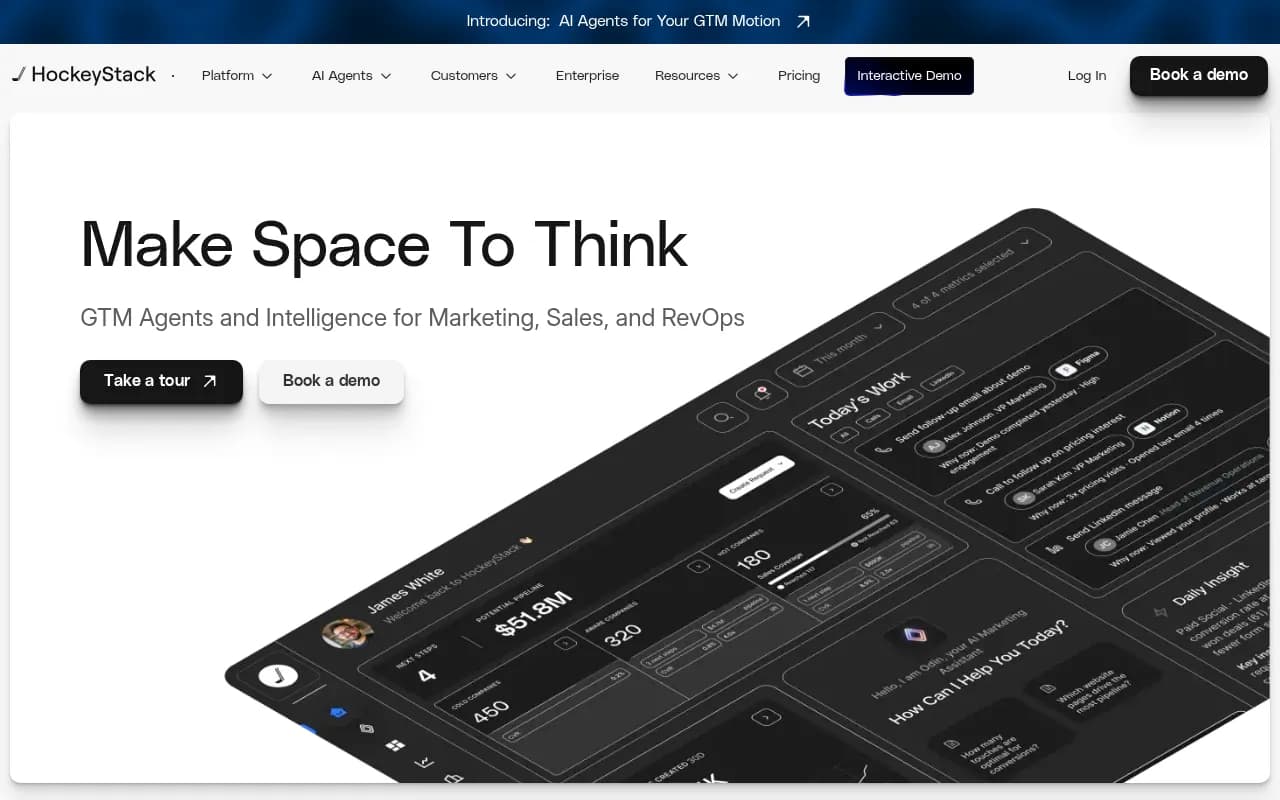
HockeyStack positions itself as a unified marketing and sales intelligence platform that combines attribution, analytics, and revenue insights in a single interface. The platform is designed for marketing and RevOps teams that want powerful attribution without needing data engineering resources.
Core Capabilities
Multi-Touch Attribution: HockeyStack supports all standard attribution models (first-touch, last-touch, linear, time-decay, U-shaped, W-shaped) plus custom models. The platform automatically tracks every touchpoint across paid, organic, email, events, and sales interactions — no manual tagging required.
Unified Dashboard: Unlike point solutions that only track marketing or only track sales, HockeyStack unifies both sides of the funnel. You see how marketing campaigns influence pipeline, how sales activities affect close rates, and where handoffs break down.
No-Code Setup: HockeyStack's biggest differentiator is ease of implementation. The platform connects to your existing tools (CRM, ad platforms, analytics, marketing automation) via native integrations. Most customers are live within days, not months.
Real-Time Insights: Data syncs continuously, so you're never looking at stale reports. This matters for fast-moving teams that need to adjust campaigns mid-flight based on what's actually working.
Who It's For
HockeyStack is built for mid-market B2B companies (typically 50-500 employees) that want sophisticated attribution without the complexity of enterprise platforms. The ideal customer:
- Has a marketing team of 5-20 people
- Runs multi-channel campaigns (paid ads, content, events, ABM)
- Needs to prove marketing ROI to leadership
- Wants a tool that marketing ops can manage without constant data engineering support
- Values speed to value over infinite customization
Pricing
HockeyStack's pricing is usage-based and scales with your data volume. The platform doesn't publish exact pricing publicly, but typical contracts start around $1,500-$3,000/month for mid-market companies. Enterprise pricing is custom.
Strengths
- Fastest time to value: Most customers see meaningful insights within the first week
- Intuitive interface: Marketing teams can build reports and dashboards without SQL knowledge
- Unified view: Combines marketing and sales data in one place, eliminating data silos
- Strong support: Known for responsive customer success and implementation help
Limitations
- Less technical flexibility: If you need to build highly custom attribution models or run complex data transformations, HockeyStack's no-code approach has limits
- Not warehouse-native: Data lives in HockeyStack's system, not your data warehouse (though exports are available)
- Pricing opacity: Lack of public pricing makes it harder to budget before talking to sales
Dreamdata: Warehouse-Native B2B Attribution Platform
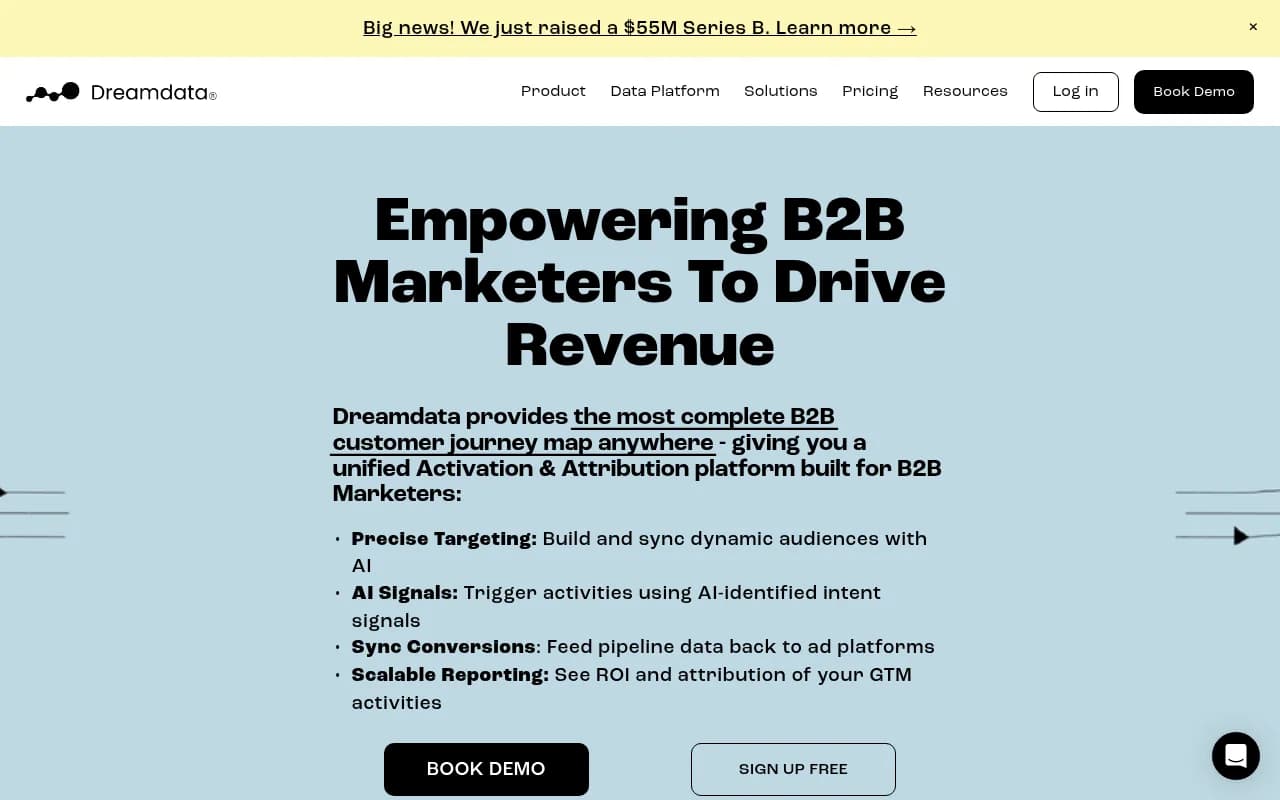
Dreamdata takes a fundamentally different approach: it's a warehouse-native attribution platform that operates directly on top of your existing data infrastructure. Instead of being a standalone SaaS tool, Dreamdata integrates with your data warehouse (Snowflake, BigQuery, Redshift) and builds attribution models using your data.
Core Capabilities
Warehouse-Native Architecture: Dreamdata connects to your data warehouse and runs attribution logic there. This means you maintain full control over your data — it never leaves your infrastructure. For companies with strict data governance requirements, this is a major advantage.
Account-Based Attribution: Dreamdata is purpose-built for B2B, where buying decisions involve multiple stakeholders. The platform tracks attribution at the account level, not just the individual lead level. You see which touchpoints influenced the entire buying committee.
Revenue Attribution: Dreamdata goes beyond pipeline attribution to track closed revenue, expansion revenue, and customer lifetime value. You can attribute not just new deals, but also upsells, cross-sells, and renewals.
Custom Model Builder: For teams with specific attribution requirements, Dreamdata offers a flexible model builder. You can create custom attribution rules, weight touchpoints differently based on your business logic, and adjust models as your go-to-market strategy evolves.
Who It's For
Dreamdata is designed for data-mature B2B companies that already have a data warehouse and want deep control over their attribution methodology. The ideal customer:
- Has a data team (analysts, engineers, or analytics engineers)
- Uses a modern data stack (Snowflake, BigQuery, dbt, etc.)
- Needs account-based attribution, not just lead-based
- Wants to customize attribution models based on their unique buying process
- Values data ownership and governance
Pricing
Dreamdata offers tiered pricing starting at approximately $3,000/month for smaller teams, scaling up based on data volume and feature requirements. Enterprise plans with advanced features and support start around $10,000/month.
Strengths
- Maximum flexibility: Warehouse-native architecture means you can customize everything
- Data ownership: Your data stays in your warehouse, giving you full control
- Account-based focus: Purpose-built for complex B2B sales cycles
- Deep technical capabilities: Supports advanced use cases that no-code tools can't handle
Limitations
- Requires technical resources: You need data engineering or analytics engineering skills to get full value
- Longer implementation: Warehouse-native setup takes weeks to months, not days
- Steeper learning curve: Marketing teams without SQL knowledge will struggle to build custom reports
- Higher total cost: When you factor in data warehouse costs and engineering time, Dreamdata is more expensive than it appears
Improvado: Enterprise Marketing Data Infrastructure
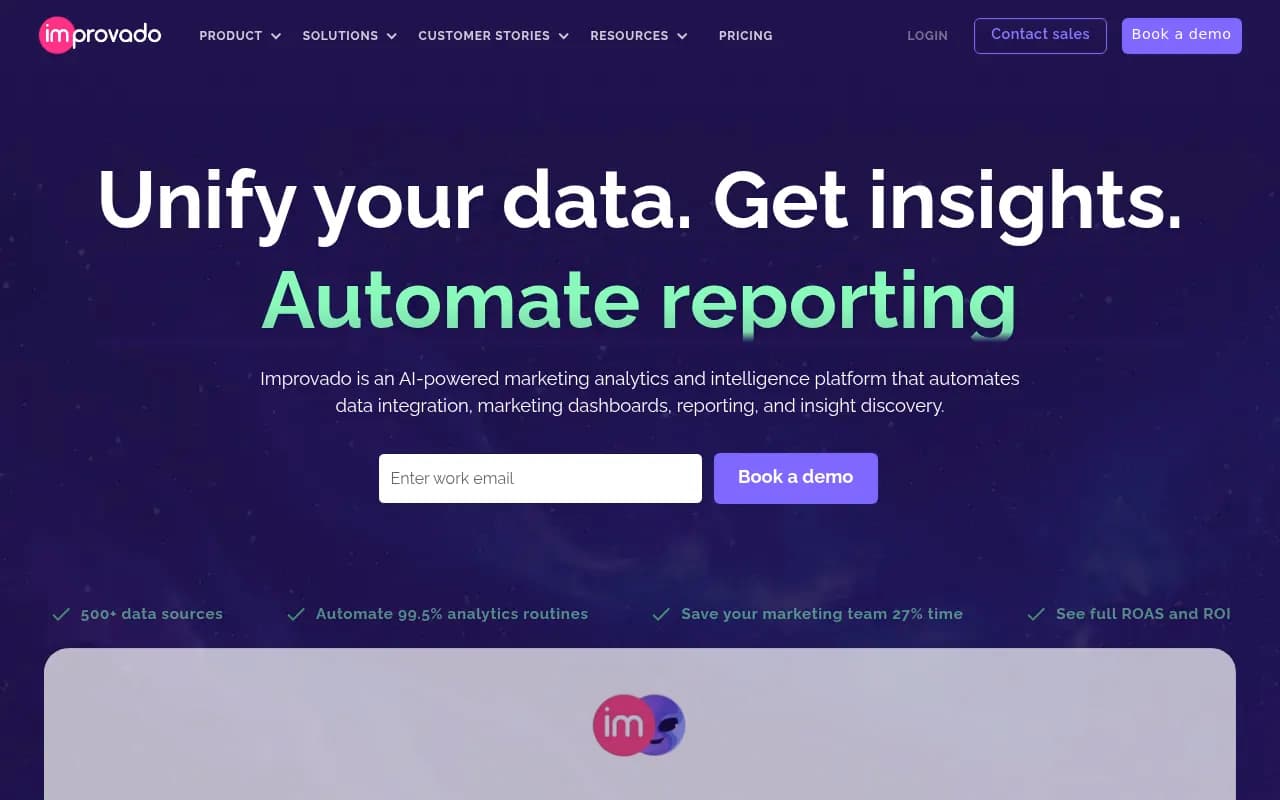
Improvado is fundamentally different from HockeyStack and Dreamdata — it's a marketing data platform that happens to include attribution capabilities, not an attribution platform first. The core value proposition is consolidating data from hundreds of marketing sources into a single source of truth.
Core Capabilities
500+ Data Connectors: Improvado's biggest strength is breadth of integrations. The platform connects to virtually every marketing tool, ad platform, analytics system, and data source. If you're running campaigns across dozens of channels, Improvado can unify them.
Data Transformation Layer: Beyond just moving data, Improvado normalizes and transforms it. Different platforms use different naming conventions, metrics, and data structures — Improvado standardizes everything so you can compare apples to apples.
Attribution as a Feature: Improvado includes multi-touch attribution capabilities, but they're built on top of the data platform. You get standard attribution models (first-touch, last-touch, linear, etc.) plus the ability to build custom models using the unified dataset.
Enterprise-Grade Infrastructure: Improvado is designed for large organizations with complex requirements. The platform handles massive data volumes, supports multiple business units, and includes enterprise features like SSO, audit logs, and SLAs.
Who It's For
Improvado targets enterprise marketing teams (typically 1,000+ employees) with complex, multi-channel operations. The ideal customer:
- Runs campaigns across 20+ marketing platforms
- Has multiple business units or brands
- Needs a single source of truth for all marketing data
- Has budget for enterprise software ($50,000-$200,000+ annually)
- Values vendor support and white-glove service
Pricing
Improvado's pricing starts at approximately $30,000/year for smaller enterprise deployments and scales up based on data sources, volume, and features. Most customers pay $50,000-$150,000+ annually. Custom enterprise pricing is available for large organizations.
Strengths
- Unmatched integration breadth: Connects to more data sources than any competitor
- Enterprise-ready: Built for scale, security, and compliance
- White-glove support: Dedicated customer success and technical account management
- Data transformation: Normalizes messy marketing data into clean, usable datasets
Limitations
- Attribution is secondary: The platform is built for data consolidation first, attribution second — specialized attribution tools are more powerful
- Very expensive: Pricing is 10-20x higher than mid-market alternatives
- Overkill for most companies: Unless you have dozens of data sources and complex requirements, Improvado is more than you need
- Long sales cycles: Enterprise procurement processes mean months from evaluation to implementation
Head-to-Head Comparison
Attribution Models
HockeyStack: Supports all standard models (first-touch, last-touch, linear, time-decay, U-shaped, W-shaped) plus custom models. Models are pre-built and easy to switch between. Best for teams that want proven models without customization.
Dreamdata: Offers standard models plus a flexible custom model builder. Because it's warehouse-native, you can create highly specific attribution logic based on your business rules. Best for teams with unique attribution requirements.
Improvado: Includes standard attribution models as part of the data platform. Attribution capabilities are solid but not as sophisticated as pure-play attribution tools. Best for teams that need data consolidation more than advanced attribution.
Implementation Complexity
HockeyStack: Fastest implementation. Native integrations connect in minutes, and most customers are live within 1-2 weeks. Marketing ops can handle implementation without engineering support.
Dreamdata: Moderate to high complexity. Warehouse-native architecture requires data engineering resources. Typical implementation takes 4-8 weeks, longer for complex environments.
Improvado: High complexity. Enterprise deployments involve discovery, data mapping, custom transformations, and integration work. Typical implementation takes 2-4 months.
Data Ownership
HockeyStack: Data lives in HockeyStack's infrastructure. You can export data, but it's not warehouse-native. Fine for most companies, but may not meet strict data governance requirements.
Dreamdata: Full data ownership. All data stays in your warehouse, and Dreamdata operates on top of it. Best for companies with strict data governance or compliance requirements.
Improvado: Data is centralized in Improvado's platform, then synced to your warehouse or BI tool. You maintain ownership, but data flows through Improvado's infrastructure.
Pricing & ROI
HockeyStack: Mid-market pricing ($1,500-$5,000/month typical). Fast time to value means ROI can be measured in weeks. Best price-to-value ratio for companies under 500 employees.
Dreamdata: Higher pricing ($3,000-$10,000+/month) plus data warehouse costs and engineering time. ROI takes longer but is higher for data-mature organizations that leverage the flexibility.
Improvado: Enterprise pricing ($30,000-$150,000+/year). ROI comes from consolidating dozens of data sources and eliminating manual reporting work. Only makes sense at scale.
User Experience
HockeyStack: Designed for marketers. Intuitive interface, pre-built dashboards, and no-code report builder. Non-technical users can be productive immediately.
Dreamdata: Designed for analysts. Requires SQL knowledge for custom reports. Marketing teams will need support from data teams.
Improvado: Designed for enterprise teams. Interface is functional but not as polished as pure-play analytics tools. Requires training and onboarding.
Which Platform Should You Choose?
Choose HockeyStack if:
- You're a mid-market B2B company (50-500 employees)
- You want attribution insights fast (days, not months)
- Your marketing team needs to self-serve reports without constant data team support
- You value ease of use over infinite customization
- Budget is $2,000-$5,000/month
- You want a unified view of marketing and sales performance
Choose Dreamdata if:
- You have a data warehouse and data team
- You need account-based attribution for complex B2B sales cycles
- You want full control over attribution models and data
- Data governance and ownership are critical requirements
- Budget is $3,000-$10,000+/month plus engineering time
- You're willing to invest in longer implementation for deeper capabilities
Choose Improvado if:
- You're an enterprise with 20+ marketing data sources
- You need a single source of truth for all marketing data
- Attribution is one requirement among many (reporting, analytics, BI)
- You have budget for enterprise software ($50,000-$150,000+/year)
- You want white-glove support and dedicated account management
- You're solving a data consolidation problem, not just attribution
Alternative Approaches to Consider
Before committing to a specialized attribution platform, consider whether you actually need one:
Native CRM Attribution: Modern CRMs like HubSpot and Salesforce include basic multi-touch attribution. If your attribution needs are simple and you're already paying for an enterprise CRM, start there.
BI Tool + Data Warehouse: For highly technical teams, building attribution models directly in your data warehouse (using dbt, SQL, and a BI tool like Looker or Tableau) gives you maximum control at lower cost. This requires significant engineering investment but avoids vendor lock-in.
Marketing Mix Modeling: For companies with large ad budgets ($1M+/year), marketing mix modeling (MMM) provides a complementary view to multi-touch attribution. Tools like Recast or Metamarkets use statistical modeling to measure channel effectiveness, especially for channels that are hard to track digitally (TV, radio, brand campaigns).
Getting Started with Marketing Attribution
Regardless of which platform you choose, follow this implementation framework:
1. Define Your Attribution Goals: What decisions will attribution data inform? Budget allocation? Campaign optimization? Sales and marketing alignment? Be specific about the outcomes you want.
2. Map Your Customer Journey: Document every touchpoint in your buyer's journey — paid ads, organic search, content downloads, webinars, sales calls, product trials. You can't attribute what you don't track.
3. Choose Your Attribution Model: Start with a standard model (W-shaped is popular for B2B) and refine over time. Don't get paralyzed trying to find the perfect model — any multi-touch model is better than last-click.
4. Implement Tracking: Ensure every touchpoint is properly tracked with UTM parameters, CRM integration, and event tracking. Garbage in, garbage out — attribution is only as good as your data.
5. Validate and Iterate: Compare attribution results to what you know intuitively. If the data says something wildly different from reality, dig into why. Attribution models are tools, not truth — they should inform decisions, not make them.
6. Connect to Revenue: The ultimate goal is connecting marketing activity to revenue outcomes. Track not just pipeline influence, but closed revenue, customer acquisition cost, and lifetime value.
The Future of Marketing Attribution
Marketing attribution is evolving rapidly in 2026. Three trends are reshaping the landscape:
AI-Powered Attribution: Machine learning models are replacing rules-based attribution. Instead of manually weighting touchpoints, AI analyzes historical data to predict which interactions actually drive conversions. Early results show AI models are 20-30% more accurate than traditional multi-touch attribution.
Privacy-First Attribution: With third-party cookies gone and privacy regulations tightening, attribution platforms are adapting. Server-side tracking, first-party data strategies, and probabilistic modeling are replacing cookie-based tracking. The platforms that survive will be those that can deliver accurate attribution without invasive tracking.
Revenue Attribution Beyond Marketing: The best attribution platforms now track the entire customer lifecycle — not just acquisition, but expansion, retention, and advocacy. This shift from "marketing attribution" to "revenue attribution" reflects the reality that customer success, product, and sales all influence revenue outcomes.
Final Recommendations
For most B2B companies reading this guide, HockeyStack offers the best balance of capability, ease of use, and price. You'll be live in days, not months, and your marketing team can self-serve insights without constant data team support.
If you're a data-mature organization with a data warehouse and engineering resources, Dreamdata provides deeper flexibility and control. The warehouse-native architecture is the future of attribution, and Dreamdata is the most mature platform in this category.
For enterprises with complex, multi-channel operations and budget for enterprise software, Improvado solves the broader data consolidation problem. Attribution is one capability among many, and the platform excels at unifying disparate data sources.
The worst choice is doing nothing. Multi-touch attribution isn't optional in 2026 — it's table stakes for any B2B marketing team that wants to prove ROI and optimize performance. Start with the platform that matches your current capabilities and budget, then evolve as your attribution maturity grows.