Summary
- Action-first platforms beat monitoring-only tools: The best agency platforms (Promptwatch, Profound, OtterlyAI) combine tracking with content gap analysis and optimization workflows—not just dashboards
- Client management infrastructure matters: Look for white-label reporting, pitch environments, multi-workspace support, and API access for custom integrations
- Standardize your reporting stack: Build repeatable monthly reports around 5 core metrics: visibility score trends, citation share vs competitors, prompt coverage gaps, content performance, and traffic attribution
- Automate the repetitive work: Use workflow automation (Zapier, Make) to sync data between your AI visibility platform, Google Analytics, and client reporting tools
- Price for value, not seat count: Most agencies bill AI visibility as a standalone service ($500-2500/mo per client) or bundle it into existing SEO/content retainers
The Agency AI Visibility Challenge
If you're running SEO or content services for multiple clients, you've already seen the shift: brands that don't appear in ChatGPT, Perplexity, or Google AI Overviews are losing traffic to competitors who do. But managing AI visibility for 5, 10, or 20 clients simultaneously creates operational problems that single-brand tools weren't built to solve.
The core issues agencies face:
Workflow fragmentation: Most AI visibility platforms are built for in-house teams managing one brand. When you're juggling multiple clients, switching between separate dashboards, exporting data manually, and rebuilding reports from scratch each month burns hours.
Inconsistent reporting: Without standardized templates and metrics, every client gets a different report format. This makes it impossible to compare performance across accounts or train new team members on your process.
No action loop: Monitoring-only tools show you where clients are invisible—but then leave you stuck. You still need to figure out what content to create, write it, publish it, and track whether it actually improved visibility. Most platforms stop at step one.
Pricing complexity: When you're paying per brand or per prompt, costs spiral as you add clients. Agency-specific pricing models (flat monthly fee, volume discounts, white-label options) are rare.
This guide walks through how to build a scalable multi-client AI visibility operation: which platforms support agency workflows, how to structure your reporting stack, and what to charge.
Platform Requirements for Multi-Client Management
Before evaluating specific tools, understand what separates agency-grade platforms from single-brand trackers:
Client Management Infrastructure
Multi-workspace support: You need separate dashboards for each client with isolated data, user permissions, and billing. The best platforms let you create unlimited client workspaces under one agency account.
Pitch environments: Before signing a new client, you need to audit their current AI visibility. Look for platforms that offer free or low-cost prospect audits—run a quick scan, generate a report, use it in your sales pitch.
White-label reporting: Client-facing reports should use your agency branding, not the tool's logo. This matters for positioning yourself as the expert (not just a reseller) and for protecting your margins.
Role-based access: Your strategists need full access, junior team members need read-only, and clients should see reports without touching settings. Granular permissions prevent mistakes and keep workflows clean.
Answer Engine Coverage
In 2026, the minimum viable coverage is:
- ChatGPT (OpenAI): Still the dominant AI search engine by volume
- Perplexity: Growing fast in research and shopping queries
- Google AI Overviews: Critical for traditional search visibility
- Claude (Anthropic): Strong in B2B and technical queries
- Gemini (Google): Integrated across Google products
Depending on your clients' industries, you may also need:
- Grok (xAI): For brands targeting X/Twitter audiences
- DeepSeek: For international or developer-focused clients
- Meta AI: For social commerce and Instagram integration
- Copilot (Microsoft): For enterprise B2B brands
Most platforms support 8-12 engines. Verify which ones matter for your client base before committing.
Optimization Capabilities (Not Just Tracking)
The difference between a monitoring tool and an optimization platform:
Content gap analysis: Shows you exactly which prompts competitors rank for but your client doesn't. This tells you what content to create—specific topics, angles, and questions AI models want answers to.
AI content generation: Built-in writing tools that generate articles, listicles, and comparisons grounded in real citation data. This closes the loop from "here's the gap" to "here's the content that fills it."
Crawler logs: Real-time visibility into which AI crawlers (ChatGPT, Claude, Perplexity) are hitting your client's website, which pages they read, and errors they encounter. Critical for diagnosing indexing issues.
Prompt intelligence: Volume estimates and difficulty scores for each prompt. Helps you prioritize high-value, winnable opportunities instead of guessing.
Citation analysis: See exactly which pages, Reddit threads, YouTube videos, and domains AI models cite. Know where to publish and what to optimize.
Most competitors (OtterlyAI, Peec.ai, AthenaHQ, Search Party) stop at tracking. Platforms like Promptwatch and Profound build the full action loop.

Top Platforms for Agency AI Visibility Management
Promptwatch: Action-First Platform for Agencies
Promptwatch is the only platform rated as a "Leader" across all categories in 2026 competitive analysis. The core difference: it's built around taking action, not just monitoring.
The action loop:
- Find the gaps: Answer Gap Analysis shows exactly which prompts competitors are visible for but your client isn't. You see the specific content missing from their website.
- Create content that ranks: Built-in AI writing agent generates articles grounded in 880M+ citations analyzed, prompt volumes, and competitor data. This isn't generic SEO filler—it's content engineered to get cited by ChatGPT, Claude, and Perplexity.
- Track the results: Page-level tracking shows which pages are being cited, how often, and by which models. Traffic attribution (code snippet, GSC integration, or server logs) connects visibility to revenue.
Agency-specific features:
- Multi-site support on Professional ($249/mo for 2 sites) and Business ($579/mo for 5 sites) plans
- AI crawler logs showing real-time activity from ChatGPT, Claude, Perplexity—most competitors lack this entirely
- Reddit & YouTube insights surfacing discussions that influence AI recommendations
- ChatGPT Shopping tracking for e-commerce clients
- Prompt volumes and difficulty scoring to prioritize winnable opportunities
- Looker Studio integration and API for custom reporting
- Multi-language and multi-region monitoring with customizable personas
What agencies like: The content generation capability is the differentiator. Instead of just showing clients where they're invisible, you can generate the content that fixes it—all in one platform.
Pricing: Essential $99/mo (1 site, 50 prompts, 5 articles), Professional $249/mo (2 sites, 150 prompts, 15 articles), Business $579/mo (5 sites, 350 prompts, 30 articles). Agency/Enterprise custom pricing available.
Profound: Enterprise-Grade Agency Tools
Profound positions itself as the premium option for agencies managing large client portfolios. Their Agency mode includes dedicated brand configurations, pitch environments, and volume discounts.
Strengths:
- Robust multi-client workspace management
- Pitch environment for prospecting (audit before you sell)
- Strong prompt volume data and shopping insights
- Answer engine coverage across 11+ models
- White-label reporting options
Limitations:
- Higher price point than Promptwatch
- No Reddit tracking or visitor analytics
- Content generation is limited compared to Promptwatch's AI writing agent
Best for: Agencies with enterprise clients who need comprehensive tracking and can justify premium pricing.
Profound

OtterlyAI: Monitoring-Focused with Clean Reporting
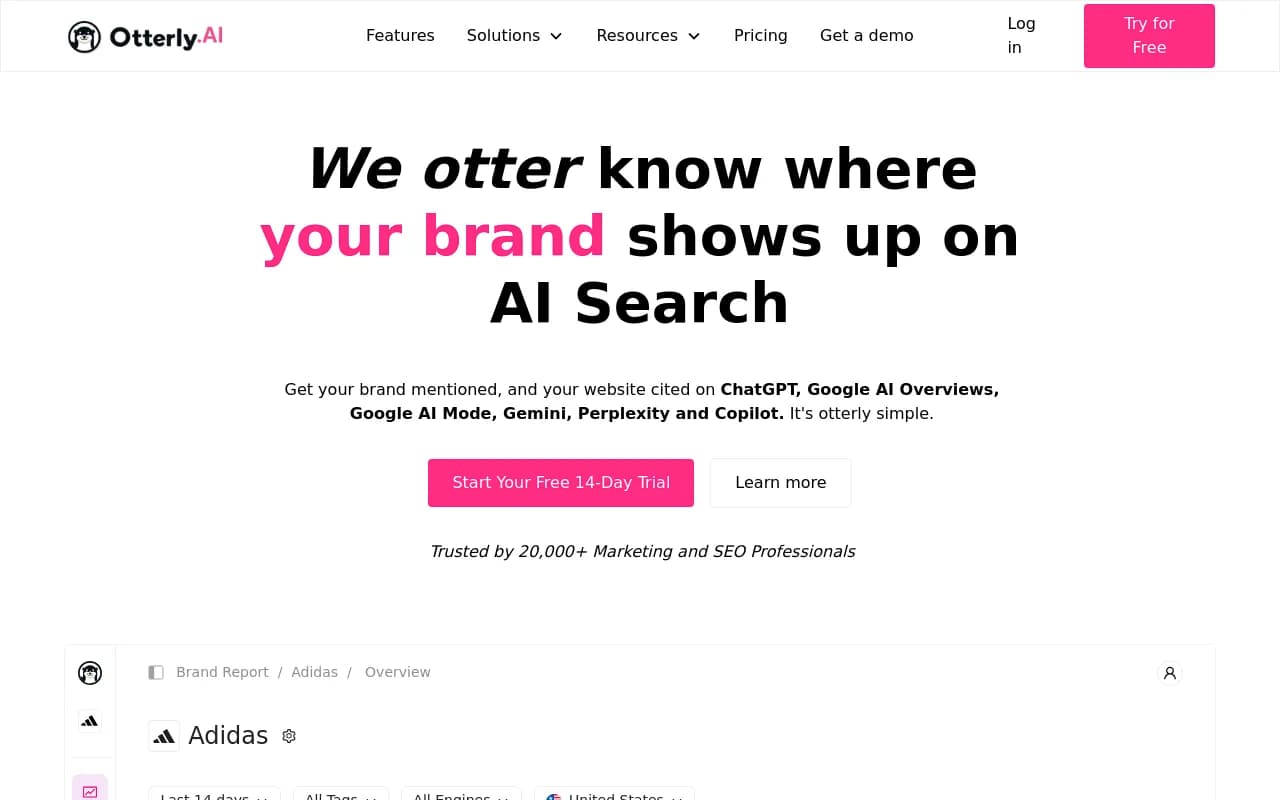
OtterlyAI is a monitoring-first platform with strong reporting UI. Good for agencies that already have content production workflows and just need tracking.
Strengths:
- Clean, client-friendly dashboards
- Reliable tracking across ChatGPT, Perplexity, Google AI Overviews
- Export-friendly data formats
- Competitive pricing
Limitations:
- No crawler logs or visitor analytics
- No content generation or gap analysis
- Limited optimization features beyond tracking
Best for: Agencies that need basic monitoring and already have content teams in place.
Peec AI: Conversational Results Tracking
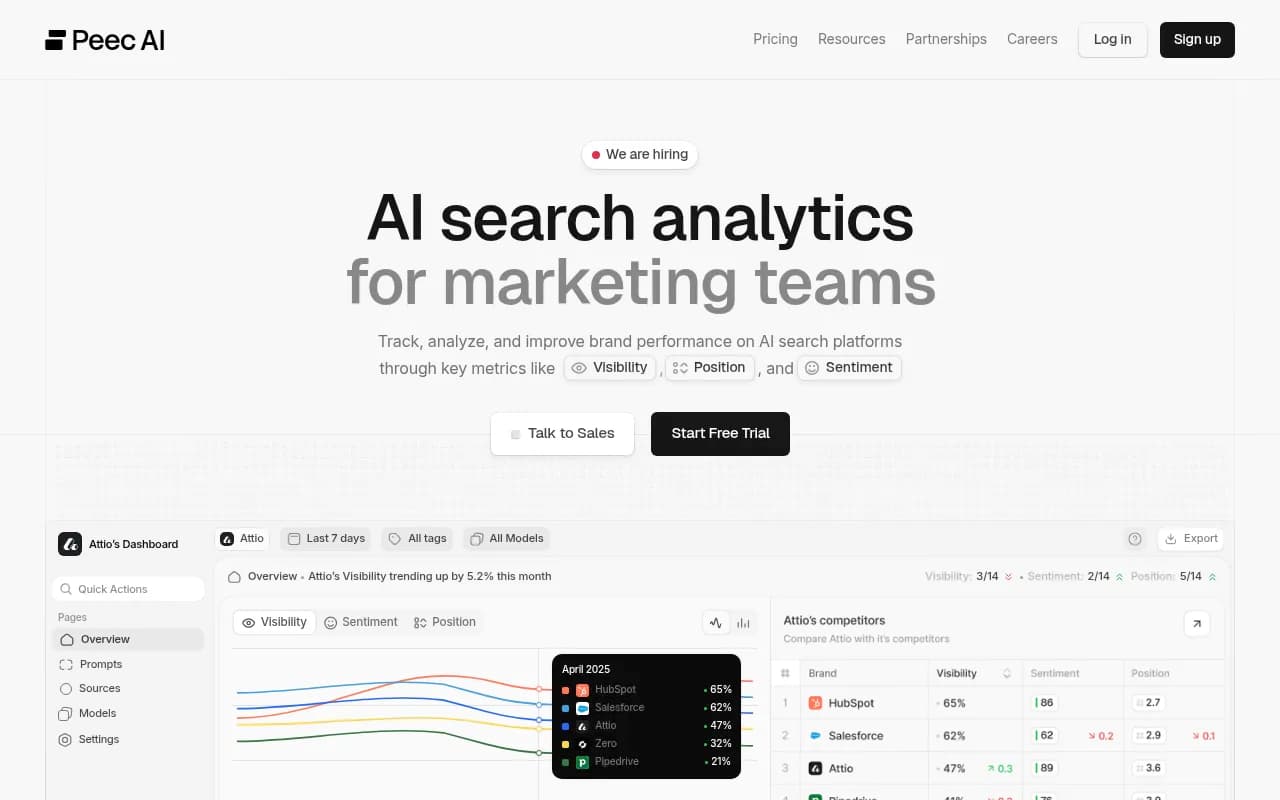
Peec focuses on tracking brand visibility across conversational AI results. Strong for agencies managing B2B clients where ChatGPT and Claude matter most.
Strengths:
- Good coverage of major LLMs
- Simple interface for non-technical clients
- Competitive pricing for small agencies
Limitations:
- Limited to monitoring—no content tools
- Fewer optimization features than Promptwatch or Profound
- No crawler logs or indexing diagnostics
Best for: Small agencies managing 3-5 clients who need straightforward tracking.
Building Your Multi-Client Reporting Stack
Once you've chosen your core AI visibility platform, you need to integrate it into a repeatable reporting workflow.
The 5 Core Metrics Every Client Report Needs
1. Visibility Score Trends
Track overall brand visibility across all monitored prompts month-over-month. This is your headline metric—the number clients look at first.
Present it as:
- Current visibility score (0-100 scale)
- Change vs previous month (+/- percentage)
- Trend line over last 6 months
- Breakdown by AI engine (ChatGPT, Perplexity, Google AI, etc.)
2. Citation Share vs Competitors
Show how often your client is cited compared to their top 3-5 competitors. This contextualizes performance—a 60% visibility score looks different if competitors are at 40% vs 80%.
Present it as:
- Heatmap comparing your client vs competitors across key prompts
- Share of voice percentage
- Prompts where client leads vs lags
3. Prompt Coverage Gaps
Identify high-value prompts where competitors appear but your client doesn't. This is your action list for next month's content.
Present it as:
- Top 10 missed opportunities (prompts with high volume, competitors visible, client absent)
- Recommended content topics to close gaps
- Estimated traffic potential if gaps are filled
4. Content Performance
Track which of your client's pages are being cited by AI models. This shows what's working and what needs optimization.
Present it as:
- Top 10 cited pages with citation counts
- New pages added to citation index this month
- Pages that dropped out of citations (needs attention)
5. Traffic Attribution
Connect AI visibility to actual website traffic and conversions. This is how you prove ROI.
Present it as:
- Traffic from AI referrals (ChatGPT, Perplexity, etc.)
- Conversion rate from AI traffic vs other channels
- Revenue attributed to AI visibility improvements
Not all platforms support traffic attribution natively. Promptwatch offers code snippet, GSC integration, and server log analysis. For others, you'll need to manually tag AI referral traffic in Google Analytics.
Report Structure Template
Executive Summary (1 page)
- Headline visibility score and month-over-month change
- Top 3 wins (new citations, improved rankings, traffic growth)
- Top 3 priorities for next month
Performance Deep Dive (2-3 pages)
- Visibility trends by AI engine
- Citation share vs competitors
- Prompt coverage analysis
- Content performance breakdown
Action Plan (1 page)
- Recommended content topics (from gap analysis)
- Optimization priorities (pages to update, technical fixes)
- Timeline and resource requirements
Appendix (optional)
- Full prompt list with visibility scores
- Crawler log summary
- Traffic attribution data
Automation Workflow
Manual reporting doesn't scale past 5 clients. Automate the repetitive parts:
Step 1: Data extraction
Use your AI visibility platform's API or export feature to pull monthly data. Most platforms (Promptwatch, Profound, OtterlyAI) offer CSV exports or API endpoints.
Step 2: Data transformation
Use Zapier or Make to:
- Pull data from your AI visibility platform
- Merge with Google Analytics data (traffic, conversions)
- Push to Google Sheets or Looker Studio
Step 3: Report generation
Build a template in:
- Looker Studio: Free, integrates with Google Sheets, good for visual dashboards
- Google Slides: For narrative-heavy reports with commentary
- Notion: For interactive reports clients can explore
Set up automated data refresh so reports update automatically each month. You just add commentary and send.
Operational Workflows for Scale
Onboarding New Clients
Week 1: Audit and baseline
- Run initial AI visibility audit across all target prompts
- Document current visibility scores by engine
- Identify top 3 competitors and benchmark against them
- Export crawler logs to check indexing status
Week 2: Gap analysis and strategy
- Run content gap analysis to find missed opportunities
- Prioritize prompts by volume, difficulty, and business value
- Build 90-day content roadmap
- Set up tracking in Google Analytics for AI referral traffic
Week 3: Content production kickoff
- Generate first batch of content using platform's AI writer (if available)
- Brief external writers on priority topics
- Set up editorial calendar
Week 4: First report
- Deliver baseline report with current state and 90-day plan
- Set monthly reporting cadence
Monthly Maintenance Workflow
Week 1: Data collection
- Pull monthly data from AI visibility platform
- Export traffic data from Google Analytics
- Document any major algorithm updates or platform changes
Week 2: Analysis and reporting
- Generate automated report
- Add commentary on trends and anomalies
- Update action plan based on new gap analysis
Week 3: Content production
- Generate or brief new content based on gap analysis
- Optimize underperforming pages
- Fix any crawler errors flagged in logs
Week 4: Client review and planning
- Present monthly report
- Review progress against 90-day plan
- Adjust strategy based on results
Scaling to 10+ Clients
Once you're managing 10+ clients, you need process standardization:
Standardize your prompt lists: Build a core set of 50-100 prompts that work across most clients in each vertical (e-commerce, SaaS, local services, etc.). Customize 20-30% per client, but keep 70% consistent. This makes reporting and analysis faster.
Batch content production: Instead of writing one article at a time, batch similar topics across clients. If three clients need "best [product] alternatives" articles, write all three in one session. Use your platform's AI writer to generate first drafts, then edit for client-specific details.
Hire a dedicated AI visibility specialist: Once you hit 8-10 clients, the work justifies a full-time role. This person owns the entire workflow: audits, reporting, content briefs, optimization. They become your expert.
Build a knowledge base: Document your processes in Notion or Confluence. Include:
- Onboarding checklist
- Monthly workflow steps
- Report templates
- Common troubleshooting issues
- Best practices by vertical
This makes training new team members faster and ensures consistency across accounts.
Pricing Your AI Visibility Services
Most agencies structure AI visibility as either a standalone service or an add-on to existing SEO/content retainers.
Standalone Service Pricing
Basic monitoring: $500-1000/mo
- Monthly visibility tracking across 50-100 prompts
- Competitor benchmarking
- Monthly report
- Best for: Small businesses, local services
Monitoring + optimization: $1500-2500/mo
- Everything in basic
- Content gap analysis
- 2-4 optimized articles per month
- Crawler log monitoring and fixes
- Best for: Mid-market B2B, e-commerce brands
Full-service AI visibility: $3000-5000/mo
- Everything in monitoring + optimization
- 8-12 articles per month
- Reddit/YouTube outreach
- ChatGPT Shopping optimization (for e-commerce)
- Quarterly strategy reviews
- Best for: Enterprise brands, high-growth startups
Bundled Pricing
If you're already providing SEO or content services, add AI visibility as a $300-800/mo add-on. Position it as:
"We're already optimizing your content for Google. For an additional $500/mo, we'll ensure you're also visible in ChatGPT, Perplexity, and Google AI Overviews—where 40% of search traffic is shifting."
This works because:
- Lower friction (they already trust you)
- Incremental revenue on existing accounts
- Shared data and workflows (same content serves both)
Value-Based Pricing
For clients where you can directly attribute revenue to AI visibility improvements, consider performance-based pricing:
- Base fee: $1000/mo (covers platform costs and baseline work)
- Performance bonus: 10-20% of incremental revenue from AI referral traffic
This requires solid tracking (traffic attribution, conversion tracking) but can significantly increase your margins on successful accounts.
Common Pitfalls and How to Avoid Them
Pitfall 1: Over-Promising Immediate Results
AI visibility takes 60-90 days to show meaningful improvement. AI models need to recrawl your content, index new pages, and update their citation databases. If you promise results in 30 days, you'll disappoint clients.
Solution: Set expectations upfront. Frame the first 90 days as "baseline building and content production." Show progress through leading indicators (content published, crawler activity, page indexing) before visibility scores improve.
Pitfall 2: Treating All Prompts Equally
Not all prompts have equal value. A prompt with 10,000 monthly searches and 5% conversion rate is worth 100x more than a prompt with 100 searches and 1% conversion.
Solution: Prioritize prompts by business value, not just volume. Use your platform's prompt intelligence (volume estimates, difficulty scores) combined with your client's conversion data to build a weighted priority list.
Pitfall 3: Ignoring Technical Issues
If AI crawlers can't access your client's content (JavaScript rendering issues, robots.txt blocks, slow page speed), no amount of content optimization will help.
Solution: Start every engagement with a technical audit. Check crawler logs, verify AI bots can access key pages, fix indexing errors before creating new content. Platforms like Promptwatch include crawler log monitoring; for others, check server logs manually.
Pitfall 4: Siloing AI Visibility from SEO
AI visibility and traditional SEO share 80% of the same fundamentals: quality content, authoritative backlinks, clear site structure, fast page speed. Treating them as separate initiatives wastes resources.
Solution: Integrate AI visibility into your existing SEO workflow. The same content that ranks in Google should also get cited by ChatGPT. The same technical fixes that help Googlebot help ChatGPT's crawler. Run one unified strategy, not two parallel tracks.
The Future of Agency AI Visibility Management
As AI search matures, expect these trends:
Consolidation of platforms: The current landscape (20+ AI visibility tools) will consolidate. Platforms that combine tracking with optimization (like Promptwatch) will win. Monitoring-only tools will get acquired or fade.
Deeper integration with existing tools: Expect native integrations between AI visibility platforms and SEO suites (Semrush, Ahrefs), content platforms (WordPress, Contentful), and analytics tools (Google Analytics, Looker Studio). This will reduce workflow fragmentation.
Performance-based pricing models: As attribution improves, more agencies will shift to performance-based pricing. Platforms that offer robust traffic attribution and conversion tracking will enable this.
Vertical-specific solutions: Generic AI visibility tools will give way to vertical-specific platforms optimized for e-commerce, local services, B2B SaaS, etc. These will include pre-built prompt libraries, industry benchmarks, and specialized optimization tactics.
AI agent optimization: As AI agents (ChatGPT plugins, Perplexity shopping, Claude integrations) become more prevalent, optimization will shift from "get cited in answers" to "get recommended by agents." This requires new tactics around structured data, API integrations, and agent-friendly content formats.
Agencies that build scalable AI visibility operations now—standardized workflows, proven platforms, clear pricing—will own this market as it matures.
Getting Started
If you're launching AI visibility services for your agency:
Month 1: Platform selection and testing
- Trial 2-3 platforms (start with Promptwatch, Profound, OtterlyAI)
- Run audits on 2-3 existing clients
- Build your first report template
- Calculate your cost structure and pricing
Month 2: Pilot with 1-2 clients
- Onboard 1-2 friendly clients at discounted rates
- Run full 90-day program
- Document your workflow
- Refine reporting and pricing based on learnings
Month 3: Scale to 5-10 clients
- Productize your service offering
- Build sales materials (case studies, pitch decks)
- Hire or train dedicated specialist if needed
- Set up automation for reporting and data collection
The agencies winning AI visibility work in 2026 aren't the ones with the fanciest dashboards—they're the ones with repeatable systems that deliver results at scale.