Key Takeaways
- BrightLocal is best for agencies and SMBs managing 5-50 locations, offering strong local SEO tools, citation building, and rank tracking at affordable pricing ($39-$249/month)
- Yext excels for enterprises with 100+ locations needing centralized control, real-time updates across 200+ directories, and advanced analytics—but comes with enterprise pricing
- Reputation focuses on review management and customer experience at scale, ideal for brands prioritizing reputation over traditional local SEO
- All three platforms now include AI search visibility features, but none match dedicated GEO platforms for tracking brand mentions in ChatGPT, Perplexity, and other AI engines
- Your choice depends on business size, budget, and whether you prioritize listings management (Yext), local SEO (BrightLocal), or reputation (Reputation)
The Multi-Location Visibility Challenge
If you're managing brand visibility for a franchise, retail chain, healthcare network, or any business with multiple physical locations, you already know the pain: inconsistent NAP (Name, Address, Phone) data across directories, duplicate listings, review management chaos, and the impossibility of manually tracking local search performance for dozens or hundreds of locations.
The right platform doesn't just monitor—it centralizes control, automates updates, and gives you visibility into what's working (and what's broken) across every location. In 2026, that also means understanding how your brand appears in AI search engines like ChatGPT, Perplexity, and Google AI Overviews, where customers increasingly discover local businesses.
This guide compares three platforms built specifically for multi-location businesses: BrightLocal (agency-friendly local SEO), Yext (enterprise listings management), and Reputation (review and customer experience focus). We'll break down features, pricing, ideal use cases, and how each handles the emerging challenge of AI search visibility.
BrightLocal: Agency-Friendly Local SEO at Scale
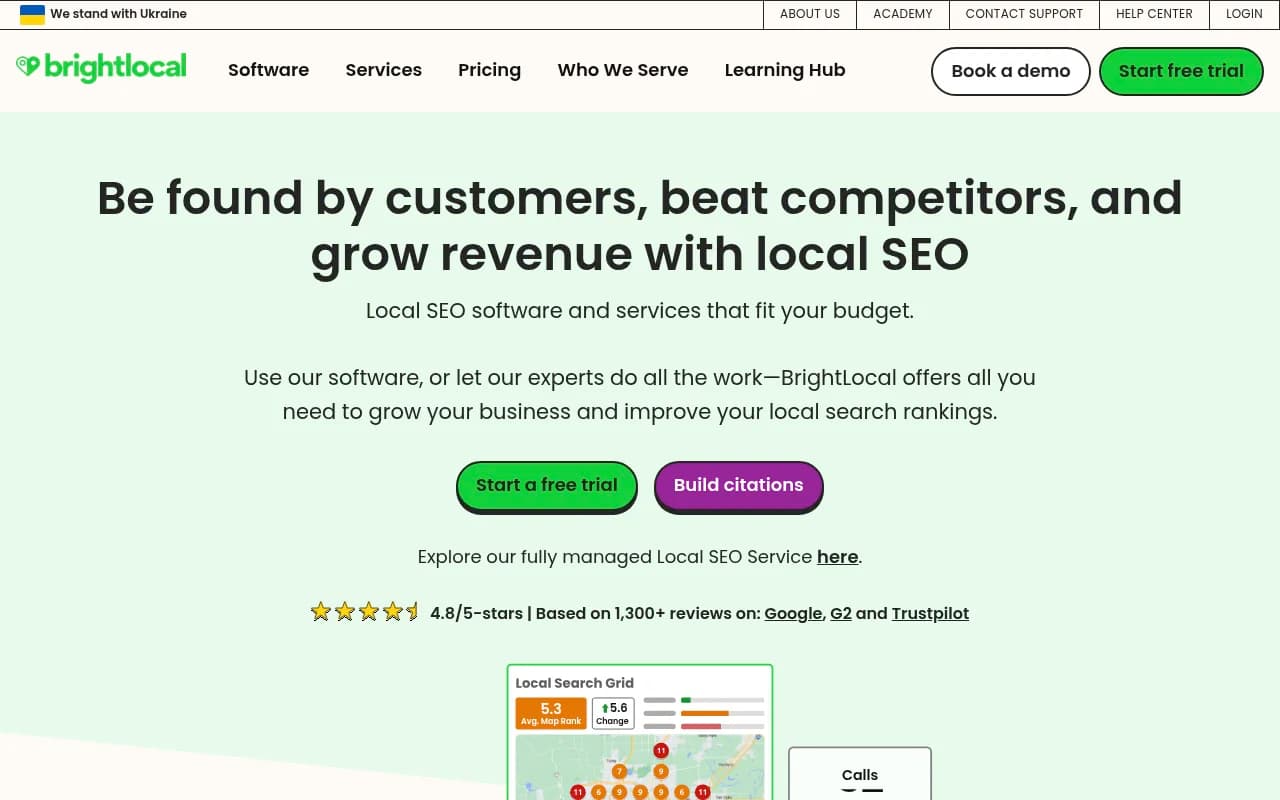
What BrightLocal Does Best
BrightLocal positions itself as the local SEO platform for agencies and businesses managing multiple locations—typically in the 5-50 location range, though it scales higher. The core strength: comprehensive local SEO tools (citation building, rank tracking, audit reports, review monitoring) packaged in a white-label interface agencies can resell to clients.
Core capabilities:
- Citation building and tracking: Submit business listings to 60+ directories, monitor citation consistency, and identify duplicate listings across locations
- Local rank tracking: Track keyword rankings by location, with Google Maps and local pack monitoring
- Reputation management: Aggregate reviews from Google, Facebook, Yelp, and other platforms; respond from a unified inbox
- Local SEO audits: Automated audits checking NAP consistency, schema markup, on-page optimization, and local pack factors
- Reporting: White-label reports for agencies, with customizable branding and automated delivery
Pricing Structure
BrightLocal uses a location-based pricing model:
- Single Business: $39/month (1 location, 25 keywords tracked, 1 user)
- Multi-Business: $79/month (5 locations, 50 keywords, 2 users)
- SEO Pro: $249/month (25 locations, 500 keywords, 5 users, white-label reports)
- Custom Enterprise: For 50+ locations, custom pricing
All plans include citation tracking, review monitoring, and local rank tracking. The SEO Pro tier unlocks white-label reporting and API access—critical for agencies.
Who BrightLocal Is For
BrightLocal shines for:
- Digital marketing agencies managing local SEO for multiple clients
- Small to mid-sized multi-location businesses (5-50 locations) that need hands-on local SEO tools
- Businesses prioritizing traditional local search (Google Maps, local pack rankings) over pure listings distribution
It's less ideal for enterprises with 100+ locations that need real-time updates pushed to hundreds of directories simultaneously—that's where Yext's infrastructure advantage becomes clear.
AI Search Visibility
BrightLocal does not currently offer dedicated AI search tracking. If your multi-location brand needs to monitor how ChatGPT, Perplexity, or Claude answer location-specific queries ("best dentist in Austin"), you'll need a separate GEO platform. Tools like Promptwatch, Otterly.AI, or Profound specialize in tracking AI citations and can complement BrightLocal's traditional local SEO focus.
Yext: Enterprise Listings Management and Knowledge Graph
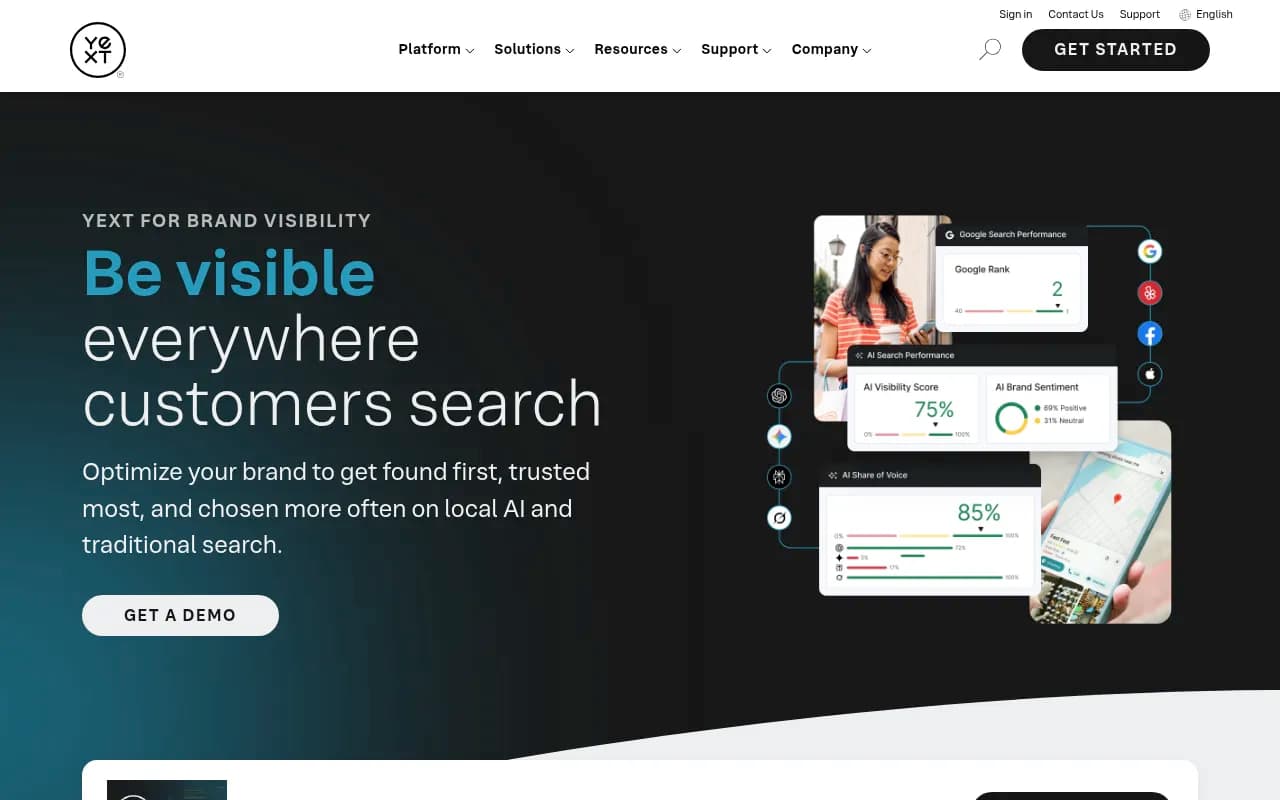
What Yext Does Best
Yext is built for enterprises managing hundreds or thousands of locations. The platform's core innovation: a centralized "Knowledge Graph" that stores all business data (locations, hours, services, products, FAQs) and pushes updates in real-time to 200+ directories, search engines, maps, voice assistants, and apps.
Core capabilities:
- Real-time listings distribution: Update business information once in Yext, and changes propagate to Google, Apple Maps, Bing, Facebook, Yelp, TripAdvisor, Alexa, Siri, and 200+ other endpoints within minutes
- Knowledge Graph: Centralized database of structured business data (locations, products, services, FAQs, events) that powers listings, website search, and chatbots
- Review management: Aggregate reviews from 100+ sites, respond from a unified dashboard, and analyze sentiment trends
- Analytics: Track listing views, clicks, calls, and driving directions across all directories; measure ROI by location
- Pages: Automatically generate location landing pages from Knowledge Graph data, optimized for local search
- Answers: Power website search and chatbots with structured data from the Knowledge Graph
Pricing Structure
Yext does not publish pricing—it's custom enterprise pricing based on number of locations, features, and contract length. Industry estimates suggest:
- Starting price: $1,000-$2,000/month for 10-50 locations
- Mid-market: $5,000-$15,000/month for 100-500 locations
- Enterprise: $20,000+/month for 1,000+ locations
Yext's pricing reflects its enterprise positioning. For smaller businesses (under 50 locations), BrightLocal or Reputation often deliver better value.
Who Yext Is For
Yext is purpose-built for:
- Large franchises and retail chains (100+ locations) that need centralized control and real-time updates
- Brands managing complex data (products, services, FAQs, events) beyond basic NAP information
- Enterprises prioritizing directory accuracy and reducing the manual effort of updating hundreds of listings
It's overkill for small businesses or agencies managing a handful of clients. The platform's complexity and cost make sense at scale, where manual listings management becomes impossible.
AI Search Visibility
Yext has begun integrating AI search features, including monitoring brand mentions in AI-generated answers and optimizing structured data for AI engines. However, these capabilities are still emerging and don't match the depth of dedicated GEO platforms. For comprehensive AI visibility tracking—including prompt-level analysis, citation sources, and competitor comparisons—you'll want a specialized tool alongside Yext.
Reputation: Customer Experience and Review Management at Scale
What Reputation Does Best
Reputation takes a different angle: instead of focusing on listings distribution or local SEO, it prioritizes review management, customer feedback, and reputation intelligence. The platform is designed for multi-location brands that view online reputation as a competitive advantage—healthcare networks, automotive groups, hospitality chains, and retail franchises.
Core capabilities:
- Review aggregation and response: Collect reviews from 100+ sites, respond from a unified inbox, and automate review requests via SMS and email
- Reputation intelligence: AI-powered sentiment analysis, trend detection, and competitive benchmarking across locations
- Customer surveys: Send post-interaction surveys (NPS, CSAT) and route feedback to the right teams
- Social listening: Monitor brand mentions across social media and online forums
- Business listings: Manage NAP data and push updates to major directories (though not as extensive as Yext's network)
- Reputation Score: Proprietary metric tracking overall reputation health across locations
Pricing Structure
Reputation uses custom enterprise pricing based on number of locations and features. Estimates:
- Starting price: $500-$1,500/month for 10-50 locations
- Mid-market: $3,000-$10,000/month for 100-500 locations
- Enterprise: $15,000+/month for 1,000+ locations
Pricing is generally lower than Yext but higher than BrightLocal, reflecting Reputation's mid-market to enterprise positioning.
Who Reputation Is For
Reputation excels for:
- Healthcare networks managing patient reviews and HIPAA-compliant feedback
- Automotive dealerships tracking reviews across sales, service, and parts departments
- Hospitality and restaurant chains prioritizing guest experience and review response
- Any multi-location brand where reputation management is a strategic priority
It's less suited for businesses primarily focused on local SEO (rank tracking, citation building) or those needing extensive listings distribution beyond major directories.
AI Search Visibility
Reputation includes basic AI search monitoring, tracking how brands appear in AI-generated answers. The focus is on reputation-related queries ("best hospital in Denver") rather than comprehensive AI visibility. For deeper AI search optimization—understanding which content gaps prevent AI citations, generating content that ranks in AI engines—you'll need a dedicated GEO platform.
Head-to-Head Comparison
Listings Management
Winner: Yext
Yext's real-time distribution to 200+ directories is unmatched. BrightLocal covers 60+ directories but requires manual submission. Reputation focuses on major directories only.
Use case: If your primary goal is ensuring accurate, consistent business information across every possible directory, map, and voice assistant, Yext is the clear choice.
Local SEO Tools
Winner: BrightLocal
BrightLocal offers the most comprehensive local SEO toolkit: citation audits, local rank tracking, on-page optimization, schema markup checks, and competitive analysis. Yext and Reputation include basic local SEO features but lack the depth agencies and SEO teams need.
Use case: If you're actively optimizing for Google Maps rankings, local pack visibility, and traditional local search, BrightLocal delivers the most actionable tools.
Review Management
Winner: Reputation
Reputation's AI-powered sentiment analysis, automated review requests, and customer survey tools are purpose-built for brands that treat reputation as a strategic asset. Yext and BrightLocal offer review aggregation and response, but Reputation goes deeper with trend detection, competitive benchmarking, and integration with customer experience workflows.
Use case: If managing reviews, responding to feedback, and tracking reputation trends across locations is your top priority, Reputation is the specialist.
Analytics and Reporting
Winner: Yext
Yext's analytics track the full customer journey: listing views, clicks, calls, driving directions, and conversions by location. BrightLocal offers strong local SEO reporting but less granular customer behavior data. Reputation focuses on reputation metrics (review volume, sentiment, response time).
Use case: If you need to prove ROI by connecting directory visibility to actual customer actions (calls, directions, website visits), Yext's analytics are most comprehensive.
Pricing and Value
Winner: BrightLocal (for SMBs), Yext (for enterprises)
BrightLocal delivers the best value for agencies and small to mid-sized businesses managing 5-50 locations. Yext's enterprise pricing makes sense at scale (100+ locations) where manual management becomes impossible. Reputation sits in the middle, offering strong value for brands prioritizing reputation over pure local SEO.
Use case: Budget-conscious agencies and SMBs should start with BrightLocal. Enterprises with hundreds of locations and complex data needs justify Yext's investment. Brands focused on customer experience should evaluate Reputation.
AI Search Visibility
Winner: None (all three are limited)
All three platforms have begun adding AI search features, but none match the depth of dedicated GEO platforms. If tracking how your brand appears in ChatGPT, Perplexity, Claude, and Google AI Overviews is critical, you'll need a specialized tool.
For multi-location businesses, this is increasingly important: AI engines are becoming the first stop for local discovery queries ("best Italian restaurant near me," "urgent care open now"). If your brand isn't cited in AI answers, you're invisible to a growing segment of customers.
Tools like Promptwatch, Otterly.AI, and Profound offer multi-location tracking, showing which locations get cited for which prompts, which competitors dominate AI answers, and what content gaps prevent citations. These platforms complement BrightLocal, Yext, or Reputation by closing the AI visibility gap.
Choosing the Right Platform for Your Business
Choose BrightLocal if:
- You're a digital marketing agency managing local SEO for multiple clients
- You have 5-50 locations and need hands-on local SEO tools (rank tracking, citation building, audits)
- Budget is a constraint and you need comprehensive features at $39-$249/month
- You prioritize traditional local search (Google Maps, local pack) over pure listings distribution
- You want white-label reporting to resell services to clients
Choose Yext if:
- You're an enterprise with 100+ locations needing centralized control
- You manage complex data (products, services, FAQs, events) beyond basic NAP information
- Real-time updates across 200+ directories are critical to your business
- You need advanced analytics connecting directory visibility to customer actions
- You have the budget for enterprise pricing ($1,000+/month)
Choose Reputation if:
- You're a multi-location brand (healthcare, automotive, hospitality) where reputation is a competitive advantage
- Review management and customer feedback are strategic priorities
- You need AI-powered sentiment analysis and reputation intelligence
- You want to integrate reputation data with customer experience workflows
- You're willing to invest in mid-market to enterprise pricing ($500-$15,000+/month)
Add a GEO Platform if:
- Your customers use AI search engines (ChatGPT, Perplexity, Google AI Overviews) to discover local businesses
- You need to track AI citations by location and understand which competitors dominate AI answers
- You want to identify content gaps preventing AI visibility and generate content that ranks in AI engines
- You're serious about future-proofing visibility as AI search adoption grows
For multi-location businesses, the ideal stack often combines a traditional platform (BrightLocal, Yext, or Reputation) with a dedicated GEO tool. The former handles listings, reviews, and traditional local SEO; the latter ensures you're visible in the AI engines reshaping local discovery.
The AI Search Visibility Gap
Here's the reality: in 2026, a growing percentage of local discovery happens in AI chat interfaces, not traditional search engines. When someone asks ChatGPT "best coffee shop in Brooklyn" or Perplexity "urgent care near me open Sunday," the AI engine synthesizes an answer from web sources—and if your brand isn't cited, you're invisible.
BrightLocal, Yext, and Reputation all include basic AI search features, but they're not built for this. They won't show you:
- Which prompts customers use to discover your category, and whether your locations get cited
- Which competitors dominate AI answers, and what content they have that you don't
- What's missing from your website that AI engines want to cite (specific services, FAQs, location details)
- How to fix it: generating content grounded in real citation data that ranks in AI engines
This is where dedicated GEO platforms come in. Tools like Promptwatch track AI citations by location, analyze competitor visibility, identify content gaps, and help you create content that AI engines actually cite. For multi-location businesses, this means understanding which locations are visible in AI search, which are invisible, and what to do about it.
If you're managing 10, 50, or 500 locations, the question isn't whether AI search matters—it's whether you'll be visible when customers ask AI engines for recommendations. The brands that figure this out early will own local discovery in the AI era.
Final Recommendation
For most multi-location businesses, the right platform depends on your size, budget, and strategic priorities:
- Agencies and SMBs (5-50 locations): Start with BrightLocal for comprehensive local SEO tools at an affordable price. Add a GEO platform if AI visibility is a priority.
- Enterprises (100+ locations): Invest in Yext for centralized control, real-time updates, and advanced analytics. Complement with a GEO platform for AI search tracking.
- Reputation-focused brands: Choose Reputation if review management and customer experience are strategic priorities. Add a GEO platform to close the AI visibility gap.
The multi-location visibility challenge isn't getting simpler—it's expanding. Traditional local search, AI-generated answers, review platforms, social media, and voice assistants all shape how customers discover your brand. The platforms that help you manage this complexity, at scale, are the ones worth investing in.
Choose the tool that fits your business today, but don't ignore the AI search shift. The brands that combine traditional local SEO with AI visibility will win the next decade of local discovery.