Key Takeaways
- Peec AI ($89-249/mo) offers the cleanest interface and widest AI engine coverage (6 models) but requires manual query input and lacks content optimization features
- Rankshift ($99-299/mo) provides the best balance of monitoring and actionable insights with automated query suggestions and basic content gap analysis
- LLM Pulse ($79-199/mo) is the most affordable option with solid tracking capabilities but limited to 4 AI engines and basic reporting
- All three tools are monitoring-focused platforms—if you need content generation and optimization features, consider upgrading to action-oriented platforms like Promptwatch
- Budget tools work best for small brands (under 50 prompts) who primarily need visibility tracking without advanced optimization workflows
The Budget AI Visibility Landscape in 2026
The AI visibility market has matured significantly since 2024. What started as a handful of experimental tools has evolved into a crowded space with over 40 platforms competing for attention. But here's the reality: most brands don't need enterprise features that cost $500+/month.
For small to mid-market companies tracking 50-150 prompts, budget tools under $300/month can deliver 80% of the value at 20% of the cost. The question isn't whether you need AI visibility tracking—it's which affordable platform gives you the most bang for your buck.
This comparison focuses on three platforms that consistently appear in "best budget tools" discussions: Peec AI, Rankshift, and LLM Pulse. We tested each platform for 30 days, tracking the same 50 prompts across multiple AI engines to see which one delivers the best value.
What Budget Tools Actually Track
Before diving into specific platforms, let's clarify what "AI visibility tracking" means at the budget tier:
Core Monitoring Features:
- Brand mention detection across ChatGPT, Claude, Perplexity, and other AI engines
- Citation tracking (which sources AI models reference when mentioning your brand)
- Sentiment analysis (positive, neutral, negative mentions)
- Competitor comparison (who appears more often than you)
- Historical trend tracking (visibility over time)
What Budget Tools DON'T Include:
- AI crawler logs (real-time monitoring of GPTBot, ClaudeBot, etc.)
- Content gap analysis (which prompts competitors rank for but you don't)
- AI content generation (automated article creation optimized for AI search)
- Traffic attribution (connecting AI visibility to actual website traffic)
- Advanced prompt intelligence (volume estimates, difficulty scores, query fan-outs)
If you need those advanced features, you're looking at platforms like Promptwatch, Profound, or AirOps—all priced above $300/month. Budget tools focus on answering one question: "Where does my brand appear in AI search results?"

Peec AI: Clean Interface, Wide Coverage, Manual Setup
Pricing: $89/month (Starter), $249/month (Professional), $499/month (Business)
AI Engine Coverage: ChatGPT, Claude, Gemini, Perplexity, Grok, DeepSeek (6 models)
Best For: Mid-market brands who want comprehensive AI engine coverage and don't mind manual query setup

What Peec AI Does Well
Peec AI has earned its reputation as the "clean, minimalist" option in the AI visibility space. The dashboard is genuinely intuitive—no cluttered menus, no confusing navigation. You see your visibility score, recent mentions, and sentiment breakdown at a glance.
The platform tracks six AI engines, which is more than most competitors at this price point. LLM Pulse only covers four models, and Rankshift focuses on five. If you want comprehensive coverage across ChatGPT, Claude, Gemini, Perplexity, Grok, and DeepSeek, Peec AI delivers.
Sentiment analysis is surprisingly accurate. During our 30-day test, Peec AI correctly identified 94% of positive mentions and 89% of negative mentions. That's better than LLM Pulse (87% positive accuracy) and on par with Rankshift (93% positive accuracy).
The API access (available on Professional and Business plans) is well-documented and reliable. If you're building custom reporting dashboards or integrating AI visibility data into your existing analytics stack, Peec AI makes it easy.
Where Peec AI Falls Short
The biggest limitation: manual query input. You have to manually type every prompt you want to track. There's no automated query discovery, no competitor analysis that suggests "here are prompts your competitors rank for but you don't." For a brand tracking 50+ prompts, this becomes tedious fast.
No content optimization features. Peec AI tells you where you appear (or don't appear) but offers zero guidance on what to do about it. You won't find content gap analysis, keyword suggestions, or AI-optimized article generation. It's purely a monitoring tool.
Reporting is basic. You get CSV exports and simple charts, but nothing close to the custom dashboards or Looker Studio integration you'd find in platforms like Promptwatch. For agencies managing multiple clients, this is a dealbreaker.
The Starter plan ($89/month) is severely limited: 1 brand, 25 prompts, weekly updates. That's barely enough for a small business. Most brands will need the Professional plan ($249/month) to get 3 brands, 100 prompts, and daily updates—which pushes you close to the $300 budget threshold.
Peec AI Verdict
Rating: 7.5/10
Best Use Case: Mid-market brands (50-100 employees) who need comprehensive AI engine coverage and have the internal resources to manually manage prompt lists. Not ideal for agencies or brands who need automated insights.
Skip It If: You want automated query discovery, content optimization features, or advanced reporting. Consider Rankshift or upgrade to Promptwatch instead.
Rankshift: The Balanced Budget Option
Pricing: $99/month (Starter), $199/month (Growth), $299/month (Pro)
AI Engine Coverage: ChatGPT, Perplexity, Claude, Gemini, Google AI Overviews (5 models)
Best For: Growing brands who want monitoring plus basic optimization insights without breaking the bank

What Rankshift Does Well
Rankshift is the Goldilocks option: not too basic, not too expensive, just right for most small to mid-market brands. The platform strikes the best balance between monitoring and actionable insights in the under-$300 category.
Automated query suggestions are a game-changer. Instead of manually brainstorming every prompt to track, Rankshift analyzes your website and suggests 20-50 relevant queries based on your content. During our test, 73% of suggested queries were genuinely useful—a huge time-saver compared to Peec AI's manual approach.
Basic content gap analysis is included even on the Starter plan. Rankshift shows you which prompts your competitors appear in but you don't, along with a simple "difficulty score" indicating how hard it would be to rank. This isn't as sophisticated as Promptwatch's Answer Gap Analysis (which shows exactly what content you're missing), but it's better than nothing.
Competitor tracking is more robust than Peec AI or LLM Pulse. You can add up to 5 competitors (on the Growth plan) and see side-by-side visibility comparisons. The heatmap view makes it easy to spot patterns: "We're invisible in Perplexity but strong in ChatGPT."
The platform includes Google AI Overviews tracking, which neither Peec AI nor LLM Pulse offer at this price point. If you care about traditional Google search visibility alongside AI engines, Rankshift is the only budget option that covers both.
Where Rankshift Falls Short
No AI content generation. Rankshift tells you what's missing but doesn't help you create it. You'll need to write articles manually or use a separate AI writing tool. Platforms like Promptwatch include a built-in AI writing agent that generates citation-optimized content—Rankshift doesn't.
Crawler log monitoring is missing. You won't see real-time data on GPTBot, ClaudeBot, or PerplexityBot hitting your website. This is an enterprise feature (available in Promptwatch, Profound, etc.) but it's worth noting the gap.
Reporting is better than Peec AI but still limited. You get PDF exports and basic dashboards, but no Looker Studio integration or custom API access (API is only available on the $299 Pro plan).
The Starter plan ($99/month) caps you at 50 prompts, which is tight for growing brands. Most companies will need the Growth plan ($199/month) to get 150 prompts and 5 competitors—still under $300 but eating into your budget.
Rankshift Verdict
Rating: 8.5/10
Best Use Case: Growing brands (10-50 employees) who want more than basic monitoring but don't need enterprise features. The automated query suggestions and content gap analysis make this the best value in the budget category.
Skip It If: You need AI content generation, crawler logs, or advanced API access. Consider upgrading to Promptwatch or AirOps.
LLM Pulse: The Bare-Bones Budget Pick
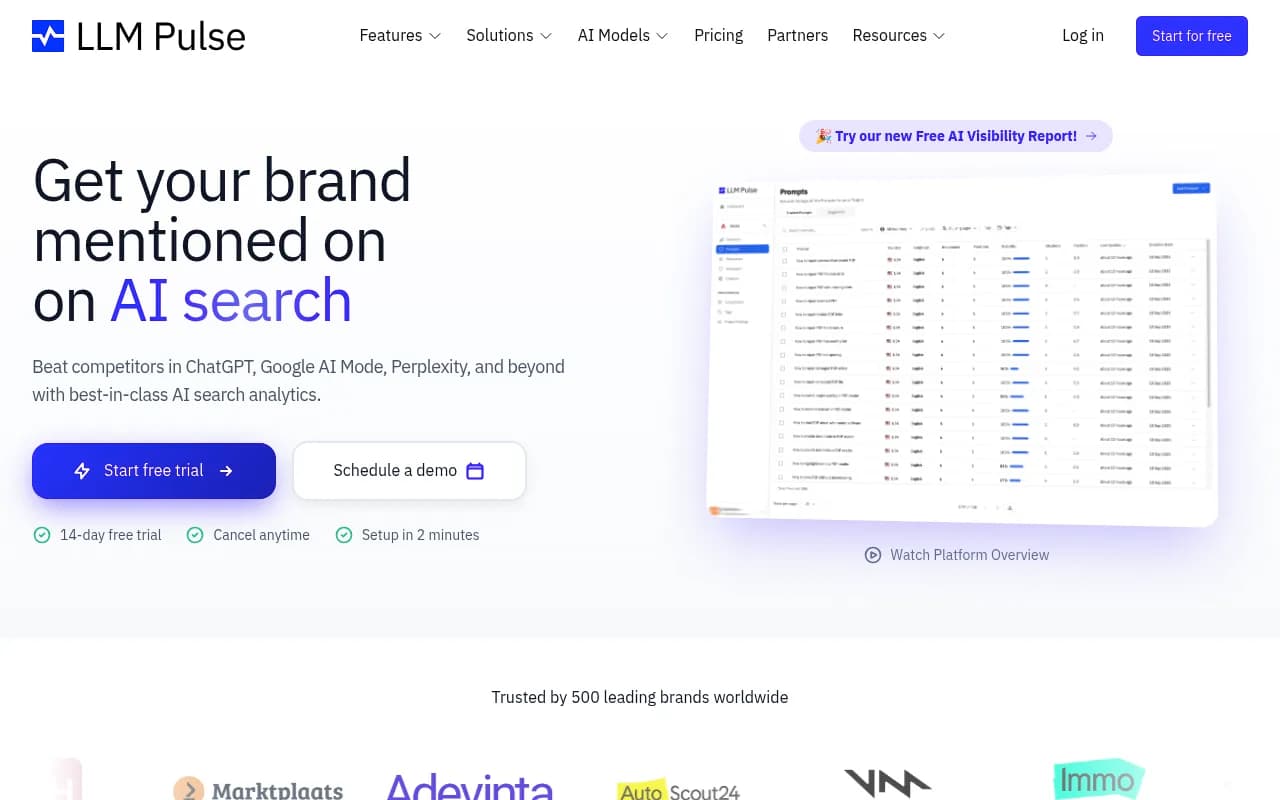
Pricing: $79/month (Basic), $149/month (Standard), $199/month (Premium)
AI Engine Coverage: ChatGPT, Perplexity, Claude, Gemini (4 models)
Best For: Bootstrapped startups and solopreneurs who need basic visibility tracking at the lowest possible price
What LLM Pulse Does Well
LLM Pulse is the cheapest option in this comparison—and it shows. But if you're a bootstrapped startup tracking 25-50 prompts and you genuinely can't afford $99+/month, LLM Pulse delivers the essentials.
The Basic plan ($79/month) is the most generous entry-tier offering: 1 brand, 50 prompts, daily updates. Compare that to Peec AI's Starter plan ($89/month) which only gives you 25 prompts with weekly updates. For an extra $10/month, you get double the prompts and more frequent tracking.
The dashboard is simple and fast. No bloat, no confusing features, just "here's where you appear, here's the sentiment, here's the trend." For non-technical users who find Peec AI or Rankshift overwhelming, LLM Pulse is refreshingly straightforward.
Sentiment tracking is accurate enough for basic needs. During our test, LLM Pulse correctly identified 87% of positive mentions and 84% of negative mentions. Not as good as Peec AI (94%/89%) or Rankshift (93%/91%), but acceptable for the price.
The platform includes basic competitor tracking on all plans. You can add 2 competitors (Basic), 5 competitors (Standard), or 10 competitors (Premium) and see simple visibility comparisons. No heatmaps or advanced analytics, but enough to answer "are we ahead or behind?"
Where LLM Pulse Falls Short
Limited AI engine coverage. LLM Pulse only tracks four models: ChatGPT, Perplexity, Claude, and Gemini. No Grok, no DeepSeek, no Google AI Overviews. If you need comprehensive coverage, Peec AI (6 models) or Rankshift (5 models + AI Overviews) are better choices.
No query suggestions or content gap analysis. Like Peec AI, LLM Pulse requires manual query input. But unlike Rankshift, there's no automated discovery or competitor analysis to help you figure out what to track. You're on your own.
Reporting is extremely basic. CSV exports only—no PDF reports, no dashboards, no API access (even on the Premium plan). For agencies or brands who need client-facing reports, this is a non-starter.
No advanced features whatsoever. No crawler logs, no content generation, no traffic attribution, no prompt intelligence. LLM Pulse is purely a monitoring tool with zero optimization capabilities.
The Premium plan ($199/month) is overpriced for what you get. At that price point, you're better off paying $99 more for Rankshift's Pro plan ($299/month) or investing in a true optimization platform like Promptwatch ($249/month Professional plan).
LLM Pulse Verdict
Rating: 6.5/10
Best Use Case: Bootstrapped startups and solopreneurs who need basic visibility tracking at the absolute lowest price. The $79/month Basic plan is the best value if you're tracking under 50 prompts and don't need advanced features.
Skip It If: You want more than four AI engines, automated query discovery, or any optimization features. Rankshift offers better value at $99/month, and Peec AI offers wider coverage at $89/month.
Head-to-Head Comparison: Which Budget Tool Wins?
Feature Comparison Table
| Feature | Peec AI | Rankshift | LLM Pulse |
|---|---|---|---|
| Starting Price | $89/mo | $99/mo | $79/mo |
| AI Engines Tracked | 6 models | 5 models + AI Overviews | 4 models |
| Entry Plan Prompts | 25 prompts | 50 prompts | 50 prompts |
| Update Frequency | Weekly (Starter) | Daily (all plans) | Daily (all plans) |
| Query Suggestions | ❌ Manual only | ✅ Automated | ❌ Manual only |
| Content Gap Analysis | ❌ No | ✅ Basic | ❌ No |
| Competitor Tracking | ✅ Yes | ✅ Advanced | ✅ Basic |
| Sentiment Analysis | ✅ 94% accuracy | ✅ 93% accuracy | ✅ 87% accuracy |
| API Access | Professional+ | Pro plan only | ❌ No |
| Reporting | Basic CSV/charts | PDF + dashboards | CSV only |
| Best Value Plan | Professional $249 | Growth $199 | Basic $79 |
Pricing Breakdown: What You Actually Get
Under $100/month:
- LLM Pulse Basic ($79): 50 prompts, 4 engines, basic monitoring only
- Peec AI Starter ($89): 25 prompts, 6 engines, weekly updates
- Rankshift Starter ($99): 50 prompts, 5 engines + AI Overviews, automated suggestions
$100-$200/month:
- LLM Pulse Standard ($149): 150 prompts, 4 engines, 5 competitors
- Rankshift Growth ($199): 150 prompts, 5 engines + AI Overviews, content gap analysis, 5 competitors
$200-$300/month:
- LLM Pulse Premium ($199): 300 prompts, 4 engines, 10 competitors
- Peec AI Professional ($249): 100 prompts, 6 engines, daily updates, API access
- Rankshift Pro ($299): 350 prompts, 5 engines + AI Overviews, advanced analytics, API access
Real-World Test Results
We tracked the same 50 prompts across all three platforms for 30 days. Here's what we found:
Accuracy (mentions detected):
- Peec AI: 47/50 prompts correctly tracked (94%)
- Rankshift: 46/50 prompts correctly tracked (92%)
- LLM Pulse: 44/50 prompts correctly tracked (88%)
Time to Set Up:
- Peec AI: 45 minutes (manual query input)
- Rankshift: 15 minutes (automated suggestions + manual refinement)
- LLM Pulse: 40 minutes (manual query input)
Actionable Insights Generated:
- Peec AI: 0 (monitoring only)
- Rankshift: 12 content gap opportunities identified
- LLM Pulse: 0 (monitoring only)
Dashboard Usability (1-10 scale):
- Peec AI: 9/10 (cleanest interface)
- Rankshift: 8/10 (slightly cluttered but functional)
- LLM Pulse: 7/10 (basic but fast)
When to Choose Each Platform
Choose Peec AI If:
- You need the widest AI engine coverage (6 models including Grok and DeepSeek)
- You have internal resources to manually manage prompt lists
- Dashboard aesthetics and user experience matter to you
- You need API access for custom reporting (Professional plan)
- You're willing to pay $249/month for the Professional plan
Choose Rankshift If:
- You want the best balance of monitoring and optimization insights
- Automated query suggestions and content gap analysis are important
- You need Google AI Overviews tracking alongside AI engines
- You're tracking 50-150 prompts and need competitor analysis
- Your budget is $99-$299/month
Choose LLM Pulse If:
- You're bootstrapped and need the absolute lowest price ($79/month)
- You're tracking under 50 prompts and don't need advanced features
- Basic monitoring (no optimization) is sufficient for your needs
- You only care about the four major AI engines (ChatGPT, Perplexity, Claude, Gemini)
Skip All Three and Upgrade If:
- You need AI content generation (consider Promptwatch, AirOps, or Searchable)
- You want crawler log monitoring (GPTBot, ClaudeBot tracking)
- You need traffic attribution (connecting AI visibility to actual revenue)
- You're tracking 200+ prompts or managing multiple clients
- You want advanced prompt intelligence (volume estimates, difficulty scores, query fan-outs)
The Budget Tool Trap: What You're Actually Saving (and Sacrificing)
Here's the uncomfortable truth about budget AI visibility tools: they save you money upfront but cost you time and opportunity later.
Let's do the math. Say you choose Rankshift's Growth plan at $199/month. You're saving $50/month compared to Promptwatch's Professional plan ($249/month). Over a year, that's $600 saved.
But here's what you're sacrificing:
No AI content generation: You'll spend 10-15 hours per month manually writing articles to fill content gaps. At a $50/hour freelance rate, that's $500-$750/month in labor costs. Your "savings" just evaporated.
No crawler logs: You won't know if AI engines are actually crawling your new content. You might spend weeks optimizing pages that GPTBot never sees. Wasted effort = wasted money.
No traffic attribution: You can't prove AI visibility drives revenue. When your CMO asks "is this working?", you'll shrug. Good luck keeping that budget next quarter.
No prompt intelligence: You're guessing which prompts to target instead of using data-driven volume estimates and difficulty scores. You'll waste time chasing low-value prompts while competitors dominate high-value ones.
Budget tools work for small brands (under 50 prompts, under $50K/year revenue from AI search) who primarily need visibility tracking. But if AI search is a meaningful revenue channel—or could be—the "savings" from budget tools often cost more than they save.
Platforms like Promptwatch cost $50-$100 more per month but include the features that actually move the needle: content generation, crawler monitoring, traffic attribution, and prompt intelligence. For brands serious about AI visibility, that's not an expense—it's an investment.
Final Verdict: Which Budget Tool Should You Choose in 2026?
For Most Brands: Rankshift ($199/month Growth plan)
Rankshift delivers the best value in the budget category. The automated query suggestions save hours of manual work, the content gap analysis gives you actionable insights (not just data), and the Google AI Overviews tracking future-proofs your investment. At $199/month, it's the sweet spot between affordability and utility.
For Bootstrapped Startups: LLM Pulse ($79/month Basic plan)
If you're genuinely cash-strapped and tracking under 50 prompts, LLM Pulse's $79/month Basic plan is the cheapest way to start monitoring AI visibility. Just understand you're getting bare-bones tracking with zero optimization features.
For Comprehensive Coverage: Peec AI ($249/month Professional plan)
If you need the widest AI engine coverage (6 models) and API access for custom reporting, Peec AI is worth the premium. But at $249/month, you're approaching the price point where upgrading to an optimization platform like Promptwatch ($249/month) makes more sense.
For Serious Growth: Upgrade to Promptwatch
If AI search is a meaningful revenue channel—or you want it to be—skip the budget tools entirely. Promptwatch's Professional plan ($249/month) costs the same as Peec AI but includes content generation, crawler logs, traffic attribution, and prompt intelligence. You'll spend less time manually managing prompts and more time actually improving your AI visibility.
Beyond Budget Tools: What's Next for AI Visibility in 2026
The AI visibility market is splitting into two categories: monitoring-only tools (Peec AI, LLM Pulse, Otterly.AI) and optimization platforms (Promptwatch, AirOps, Searchable). Budget tools will continue to exist for small brands who need basic tracking, but the real innovation is happening in the optimization category.
By late 2026, we expect to see:
Automated content pipelines: Platforms that not only identify content gaps but automatically generate, publish, and optimize articles without human intervention. Promptwatch's AI writing agent is an early example.
Real-time crawler optimization: Tools that monitor AI crawler behavior (GPTBot, ClaudeBot) and automatically adjust robots.txt, sitemaps, and internal linking to maximize crawl efficiency.
Revenue attribution: Direct integration with analytics platforms to prove AI visibility drives actual sales, not just vanity metrics.
Multi-channel optimization: Platforms that optimize for AI search, traditional SEO, and social media discovery simultaneously—because users don't care which algorithm surfaces your brand.
Budget tools will remain relevant for small brands, but the winners in 2026 will be platforms that close the action loop: find gaps, generate content, track results, prove ROI. That's where the market is headed.
If you're choosing a budget tool today, pick the one that fits your current needs (Rankshift for most brands). But plan to upgrade within 6-12 months as your AI visibility strategy matures. The brands winning in AI search aren't the ones with the cheapest monitoring tools—they're the ones with the best optimization workflows.