Key takeaways
- Profound tracks 9 answer engines on its Enterprise plan but recently killed its self-serve Starter and Growth tiers, meaning multi-engine coverage now requires a custom quote.
- Scrunch's $250/mo Core plan covers 4 engines (ChatGPT, Perplexity, Google AI Overviews, Copilot); Claude, Gemini, Meta AI, Grok, and Google AI Mode are locked behind its custom Enterprise tier too.
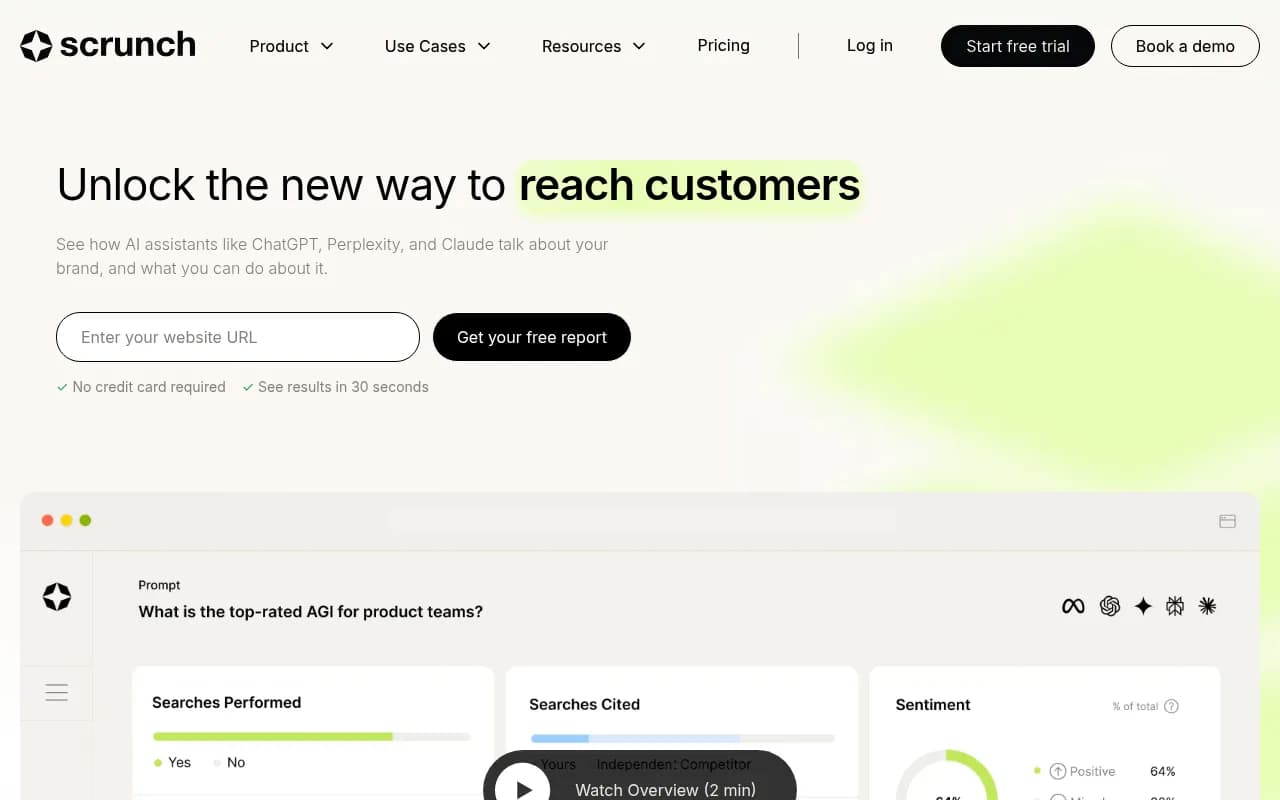
- Scrunch's Agent Experience Platform (AXP) serves optimized HTML to AI crawlers at the CDN layer, something Profound simply doesn't have an equivalent for.
- Scrunch was acquired by Sitecore in June 2026 for a reported $225M, which adds real uncertainty to its standalone roadmap even as both companies insist nothing changes short-term.
- "Coverage" on a pricing page matters less than which engines actually cite your content; ChatGPT cites far fewer sources per answer than Google AI Overviews or Perplexity, so the engines where you're "covered" aren't equally valuable.
Why this question keeps coming up
Every AEO buyer eventually lands on the same spreadsheet row: "engines tracked." It's an easy number to compare, which is probably why both Profound and Scrunch lead with it in their marketing. Profound says 9+. Scrunch says 9 too, once you're on Enterprise. Neither number tells you what you actually need to know, which is whether the engines you're tracked on are the ones where your prompts, your category, and your content actually get cited.
I've gone through both platforms' current pricing pages, the competitive material each vendor publishes about the other (grain of salt warranted on both sides), and third-party reviews from 2026. Here's where they land.
Engine coverage, tier by tier
This is where the gap between marketing copy and what you can actually buy opens up.
| Plan | Profound | Scrunch |
|---|---|---|
| Entry / free | Trial only: 10 prompts, run once, ChatGPT only | No free tier; 7-day trial on Core |
| Self-serve paid tier | None currently (Starter $99/mo and Growth $399/mo were discontinued around the Sept 2026 Series D) | Core: $250/mo, 4 engines (ChatGPT, Perplexity, Google AI Overviews, Copilot), 125 prompts, 5 seats |
| Full multi-engine coverage | Enterprise (custom quote): 9 engines including ChatGPT, Perplexity, Google AI Mode, Gemini, Copilot, DeepSeek, Claude, AI Overviews, Exa Search | Enterprise (custom quote): adds Claude, Gemini, Meta AI, Grok, Google AI Mode on top of Core's 4 |
| Agency option | Agency Growth $99/mo + $399/mo per client workspace (3 engines) | Agency Core, roughly $250-500/mo depending on the source, same 4-engine limit as brand Core |
The practical takeaway: as of late 2026, neither platform lets a mid-market team self-serve its way into full 9-engine coverage. Profound used to offer that path through its old Growth tier; it doesn't anymore. Scrunch never did at the self-serve level. If a sales rep from either company tells you "we cover 9 engines" without specifying the tier, ask which plan that applies to, because it's probably not the one they're about to quote you.
Profound

The real differentiator: what happens after you're covered
Tracking an engine and doing something about what you find there are different jobs, and this is where Profound and Scrunch genuinely diverge rather than just competing on logos.
Scrunch's structuring argument, laid out in its own buyer's guide, is that AEO platforms should be judged on four layers: observe, understand, act, and deliver. By its own scoring, Scrunch and Adobe's LLM tooling hit all four. Profound, in Scrunch's assessment, stops at act, because it has no mechanism to physically hand optimized content to an AI crawler the way Scrunch's Agent Experience Platform (AXP) does.
AXP sits at the CDN/edge layer. When a request comes from a known AI agent or crawler, AXP intercepts it and serves a simplified, technically optimized version of the page, within the existing URL structure, no redirect, no separate mirror site. Human visitors never see a difference. It's a genuinely distinct approach to the "can AI actually read my page" problem, and it's the single feature Conductor's independent comparison also flags as Scrunch's clearest technical lead.
Profound counters that AXP is an "unproven claim" and points to third-party visibility rankings where it ranks #1 at 47.1% and Scrunch ranks #23 at 4.7%. That's a big gap, and worth taking seriously, but it's also vendor-supplied competitive material from Profound's own comparison article, so treat the specific numbers as a data point rather than gospel. What Profound does have, unambiguously, is Profound Agents: a content creation workflow that goes from brief to draft inside the platform, built on AEO-optimized templates trained on millions of the most-cited pages across AI platforms. Scrunch's own roadmap admits general content generation is still "coming soon," not shipped.
So the honest framing is: Scrunch is ahead on delivering content to agents technically; Profound is ahead on generating the content in the first place. Neither does both well yet.
Pricing reality check
| Profound | Scrunch | |
|---|---|---|
| Cheapest working plan | None self-serve; Enterprise custom quote required for real multi-engine use | Core, $250/mo |
| What you get at entry | Trial: 10 prompts, ChatGPT only, one-time run | 125 prompts, 4 engines, 3 personas, 5 site audits/mo, 5 seats |
| Where the "real" product lives | Enterprise: 9 engines, SSO, API, dedicated support | Enterprise: 9 engines, AXP, API, SSO, full audits |
| Funding backing | $180M Series D, Sept 2026, Sequoia + Kleiner Perkins, $1.8B valuation | Acquired by Sitecore, June 2026, ~$225M |
Profound's recent funding ($335M total since its 2024 founding) buys it runway to build fast, and reviewers note its product release pace is genuinely high, GPT-5.2 tracking, Workflows automation, WordPress and GCP integrations for Agent Analytics have all shipped within months of each other. But that same aggressiveness extends to its pricing: dropping the $99 and $399 self-serve tiers pushes everyone who isn't ready to negotiate a custom contract out of the product entirely. That's a real cost for smaller teams evaluating AEO tools for the first time.
Scrunch's acquisition by Sitecore cuts the other way. Both companies say nothing changes for existing customers short term, and Scrunch's own blog post framed it as accelerating its roadmap rather than redirecting it. I'd still factor in that pricing, product priorities, and support quality for a standalone AEO tool tend to shift once it's folded into a larger enterprise DXP. Ask directly in any sales call how Sitecore ownership affects the product roadmap for the next 12 months; if the rep can't give you specifics, that's useful information too.
What "coverage" actually means once you look at citation data
Here's the part most comparison articles skip. Not every engine on a coverage checklist is equally valuable, because engines don't cite the same number of sources, and they don't cite them consistently. Promptwatch's citation data shows ChatGPT typically surfaces around five sources per web-search answer, roughly half of what Google AI Overviews and Perplexity cite (both land near ten sources per response). That means every citation slot in ChatGPT is more contested than a slot in AI Overviews, so being "tracked" on ChatGPT and actually breaking into its five slots is a much harder problem than the same claim for AI Overviews.
Copilot is its own story. The same Promptwatch dataset shows Copilot's source count per response swinging from under 2 to nearly 17 within weeks, evidence Microsoft is still actively re-architecting Copilot's retrieval pipeline. If a platform lists "Copilot coverage" as a selling point, ask how stable that coverage has actually been month to month, because the engine itself hasn't settled.
There's also a growing-but-still-small engine worth watching: Claude. Its citation crawler went from about 0.04% of tracked AI crawler traffic in December 2025 to a 1.73% peak share in April 2026, over 100x growth in four months, even though it's still a small fraction of overall crawler activity compared to ChatGPT. Neither Profound's nor Scrunch's self-serve tiers track Claude by default; both gate it behind Enterprise. If Claude matters to your category, factor that into which tier you'd actually need, not just which platform.
One more data point worth sitting with: mid-authority domains (DR 46-75) earned nearly half of all ChatGPT citations in August 2026, while the very highest-authority domains (DR 91-100) fell to roughly 3% citation share by mid-month, down from about 7% earlier. That's a reminder that no amount of "complete coverage" from an AEO platform substitutes for having content that's actually a good match for what gets cited. Monitoring tells you where you stand; it doesn't fix a content gap by itself.
Where other tools fit if neither is a perfect match
If you want full-stack AEO, meaning visibility monitoring plus crawler-level diagnostics plus content production that actually publishes, it's worth looking beyond just Profound and Scrunch. Promptwatch approaches the "deliver" layer differently: instead of intercepting crawler requests at the edge, its Content Agents plan, draft, and publish AEO-optimized articles directly into Webflow, Framer, or WordPress on a schedule, backed by its own crawler log analytics (Agent Analytics) that show which AI bots hit which pages and whether they error out before ever reaching a citation. It also tracks Reddit and YouTube citations specifically, two channels that barely come up in either Profound's or Scrunch's public materials, despite Reddit alone still representing a meaningful (if shrinking) share of ChatGPT citations.

For teams specifically weighing monitoring-only tools against something with an execution layer, the GEO software directory at bestgeosoftware.com is a reasonable next stop, and the agentic SEO tools directory at agenticseotools.com is worth a look if content automation is the gap you're trying to close.
So which has the more complete answer engine coverage?
On paper, both top out at 9 tracked engines, and both require an Enterprise contract to get there. Neither offers genuinely complete multi-engine coverage at a self-serve price point anymore. If you need Claude, Gemini, or Google AI Mode specifically and can't negotiate custom pricing, you'll hit a wall on both platforms' entry tiers.
The more useful question isn't which platform's pricing page lists more logos. It's whether you need content delivered to agents at the infrastructure level (Scrunch's AXP), or content generated and published at scale (Profound Agents), because that's the actual fork in the road between these two products. Scrunch's acquisition by Sitecore adds a genuine wildcard to its roadmap; Profound's funding and release cadence suggest it'll keep shipping fast, but its removal of self-serve tiers raises the cost of entry for anyone not ready for an enterprise negotiation.
Whichever you pick, treat the "engines covered" number as a starting filter, not a decision criterion. The citation data behind those engines, how many sources they actually cite, how stable that behavior is, and whether your content is the kind that gets cited at all, matters more than the logo count on a comparison page.