
Key takeaways
- Compare tools on your real workload (prompts x engines x frequency), not on the tier price. AthenaHQ's own credit model makes this obvious: 1 credit is 1 AI response.
- Pricing pages move fast. Tenpoint Labs recorded Profound and Scrunch removing tiers between 21 August and 22 September 2026, so any roundup older than a few weeks may list plans you can't buy.
- Ask how each vendor collects data (real interface vs API), how big its prompt panel is, and how much the score wobbles between identical runs.
- Check export, API access, region and language limits before you sign. Several of these are gated or paid add-ons.
- Monitoring alone is rarely the whole job. Decide up front whether you need a tool that also helps fix gaps.
Why a scorecard beats another listicle
Every "best AthenaHQ alternatives" article ranks tools differently, and a good number of them are written by vendors who rank themselves first. One of the pages I read for this guide says as much about its own category: none of the roundups publish a methodology. So instead of another ranking, here is a set of questions you can put to any vendor, including AthenaHQ itself, and score the answers.
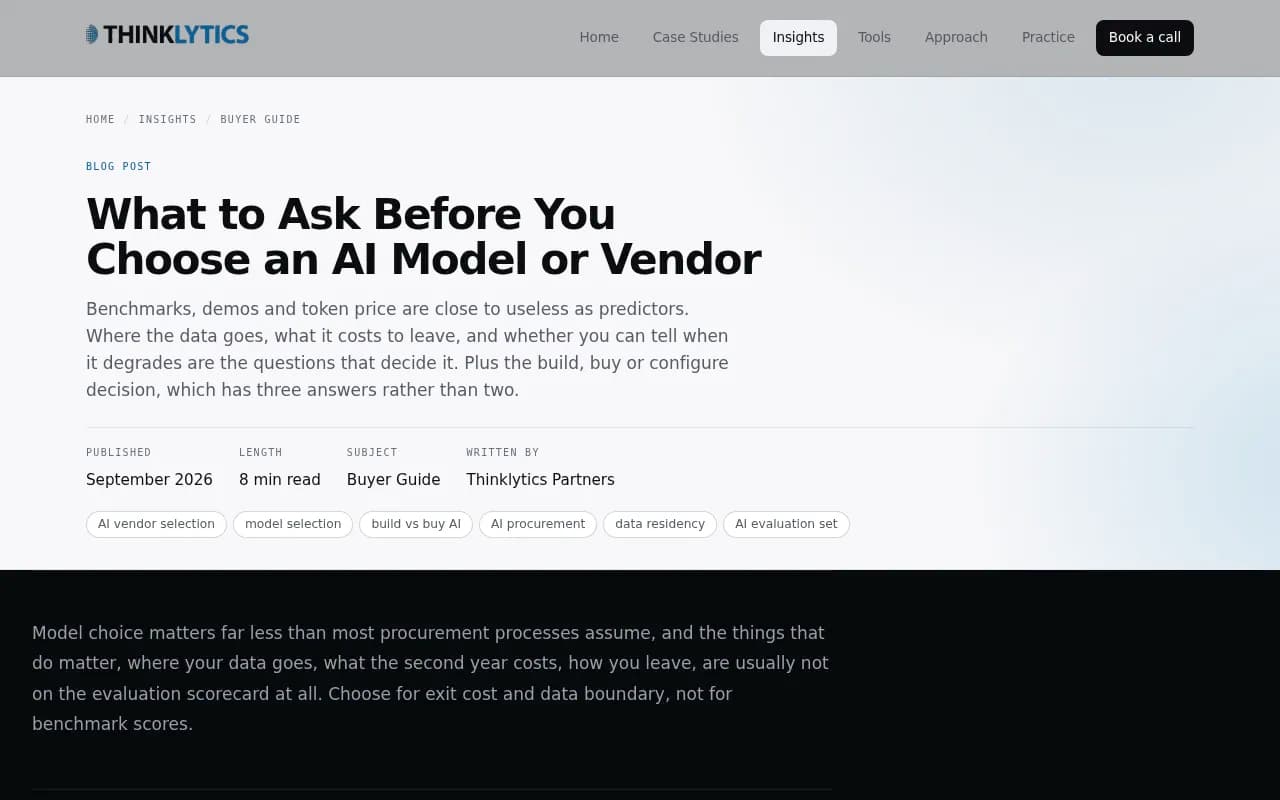
It borrows a structure from a different field. Thinklytics wrote a buyer guide for choosing AI models and vendors that argues demos, benchmarks and headline price are poor predictors, while data boundaries, exit cost and your ability to notice degradation decide the outcome. That translates almost directly to AI visibility tools. A demo on a curated account always looks good. Ask to run it on your own prompts and your own competitors.
First, establish what you are replacing.
Know what you're replacing first
AthenaHQ is the baseline for this comparison.

According to its plans page, the free Essential plan comes with a $25 credit and 300 credits. Starter is $295 a month with 3,600 credits and a one-month rollover. Enterprise is custom. One credit is one AI response. Starter is limited to a single region and language, and multi-country, multi-language support is Enterprise only.
Third-party reviews add detail, and some of it conflicts. Ryze reports 9 models on Starter, with CSV export, integrations and on-page and off-page actions, while Alexandrya and Tenpoint Labs describe 11 models. Alexandrya also quotes $245 a month billed annually. Extra credits and API access are paid add-ons with no published price. Treat engine counts as something to verify on the live page, not something to take from a blog.
The credit math is where teams get surprised. Using the Ryze examples:
| Panel | Credits per month | Fits 3,600 Starter credits? |
|---|---|---|
| 30 prompts x 4 models x daily | 3,600 | Exactly |
| 100 prompts x 9 models x weekly | about 3,870 | Slightly over |
| 40 prompts x 9 models x daily | about 10,800 | No, roughly 3x |
| 200 prompts x 9 models x daily | about 54,000 | No |
Write your own version of this table before you talk to anyone. Every question below depends on it.
The 15-question scorecard
Score each vendor 0 (no answer or deflects), 1 (partial or marketing answer), 2 (clear, documented, demonstrated on your prompts). Anything scoring 0 or 1 deserves a follow-up.
Cost and metering
1. What exactly consumes a credit or a prompt slot? Ask what a prompt, an engine and a refresh each cost. Credit pricing is fine when the metering is clear. It is miserable when it isn't.
2. What does my real monthly panel cost? Bring your prompts x engines x frequency number and have the vendor price it in writing. Compare cost per response across vendors, not the tier sticker. One competitor review puts AthenaHQ at about 8.2 cents per response at full Starter use, but that figure comes from a rival's blog, so recompute it yourself.
3. What is billed on top? API access, extra credits, extra seats, extra markets. AthenaHQ lists extra credits and API access as add-ons without public prices, so ask each vendor for a full price list.
4. What happened to the tier I was quoted last quarter? This sounds odd until you read the Tenpoint Labs notes: Profound's pricing page now shows only a tailored Enterprise plan, Scrunch moved to one $250 self-serve plan plus Enterprise, and Ahrefs repackaged its entry point. Get the quote in writing and ask about price-change notice terms.
Data quality and method
5. How is the data collected: real interfaces or APIs? What users see in ChatGPT, Google AI Overviews or Perplexity can differ from API output. Vendors should say which engines are tracked through the actual user interface and which through an API. Promptwatch's own methodology page describes collecting from the real UIs of the major engines, and that is the sort of disclosure you should demand from everyone.
6. How big and how editable is the prompt panel? Nearly every tool runs its own panel and extrapolates. Ask how many prompts, how often, and whether you can see, edit and add to them. The entry plans in one comparison run from 15 prompts (OtterlyAI Lite) to 500 (LLMrefs), so count your buying situations first.
7. How does the score behave between identical runs? AI answers vary. A movement smaller than the platform's own variance is noise regardless of what color the dashboard turns. Ask for the vendor's variance data or run the same prompt set twice yourself.
8. Does it normalize for different citation volumes per engine? Promptwatch Data on average sources per response shows engines behave very differently: ChatGPT cites about 5 sources per answer, Google AI Overviews about 10, Perplexity almost exactly 10 every day, and Copilot swung from under 2 to nearly 17 within weeks. A blended score that ignores this can mislead you.
9. Does it track query fan-outs, not only the prompts I type? AI engines run their own background searches. Promptwatch's ChatGPT query fanout data tracked averages from 2.15 per response in early December down to about 1.84 in early March, with a single prompt sometimes triggering many more. If a vendor can't show fan-outs, it is showing you only part of the picture.
Coverage and limits
10. Which engines are included on the plan I'd actually buy, without add-ons? Ask specifically about Google AI Mode, Claude, Meta AI and Copilot if they matter to your buyers. Engine lists change quarterly, so this answer expires.
11. Are there region, language or seat limits? AthenaHQ's Starter is single-region. If you sell in more than one country, this alone can decide the evaluation.
Portability and change
12. What leaves with me? Confirm export of prompt history, responses and citations before signing. Reports note AthenaHQ's Starter exports CSV, and others reserve export or API for custom plans. Data portability is the first thing MentionBird tells buyers to demand.
13. What happens to my history when coverage changes? Models get launched, renamed and retired. Ask whether old responses stay in your data and whether trend lines break when an engine is swapped.
Action and proof
14. What does it do after it finds a gap? A dashboard tells you that a competitor is cited and you aren't. The next step is content, crawler access, technical fixes. Ask to see the workflow from finding to fix to re-measurement.
15. Can you demonstrate every answer on my prompts and competitors? Not a prepared demo account. If the vendor balks, score the whole sheet down. A 20-minute manual baseline, running your top prompts by hand in each engine first, tells you whether there is a gap worth paying to close, and gives you a yardstick to check any tool against.
How the main alternatives tend to answer
Pricing below comes from third-party notes gathered in 2026 and was not re-verified on each vendor's site. Use it to build your shortlist, then confirm directly.
| Tool | Typical positioning | Reported entry price | Watch for |
|---|---|---|---|
| AthenaHQ | Broad engine coverage, credits | $295/mo Starter | Credit burn, single region, add-on API |
| Peec AI | Analytics-focused monitoring | From about $95/mo ($80 annual) | Per-model charges for extra engines |
| OtterlyAI | Small monitoring programs | About $29 to $38/mo | Small prompt allowance (15 on Lite) |
| Scrunch | Mid-market citation work | About $250 to $300/mo | Tier changes, add-on engines |
| Profound | Enterprise depth | Tailored Enterprise only per Tenpoint Labs | No self-serve entry reported |
| Ahrefs Brand Radar | Existing Ahrefs customers | Custom Prompts free on paid plans | Separate index, fixed sets |
Peec AI, OtterlyAI, Scrunch, Profound and Ahrefs Brand Radar are the names that come up most.
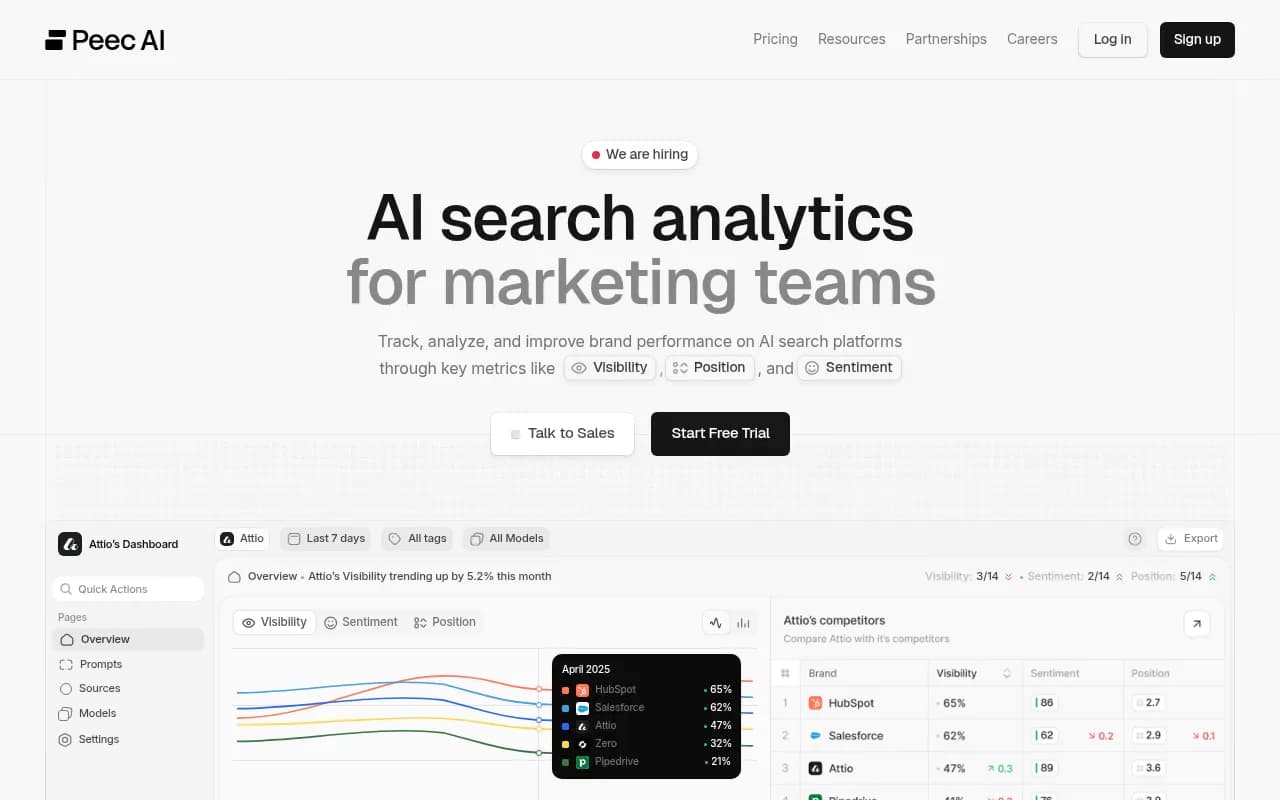
Otterly.AI

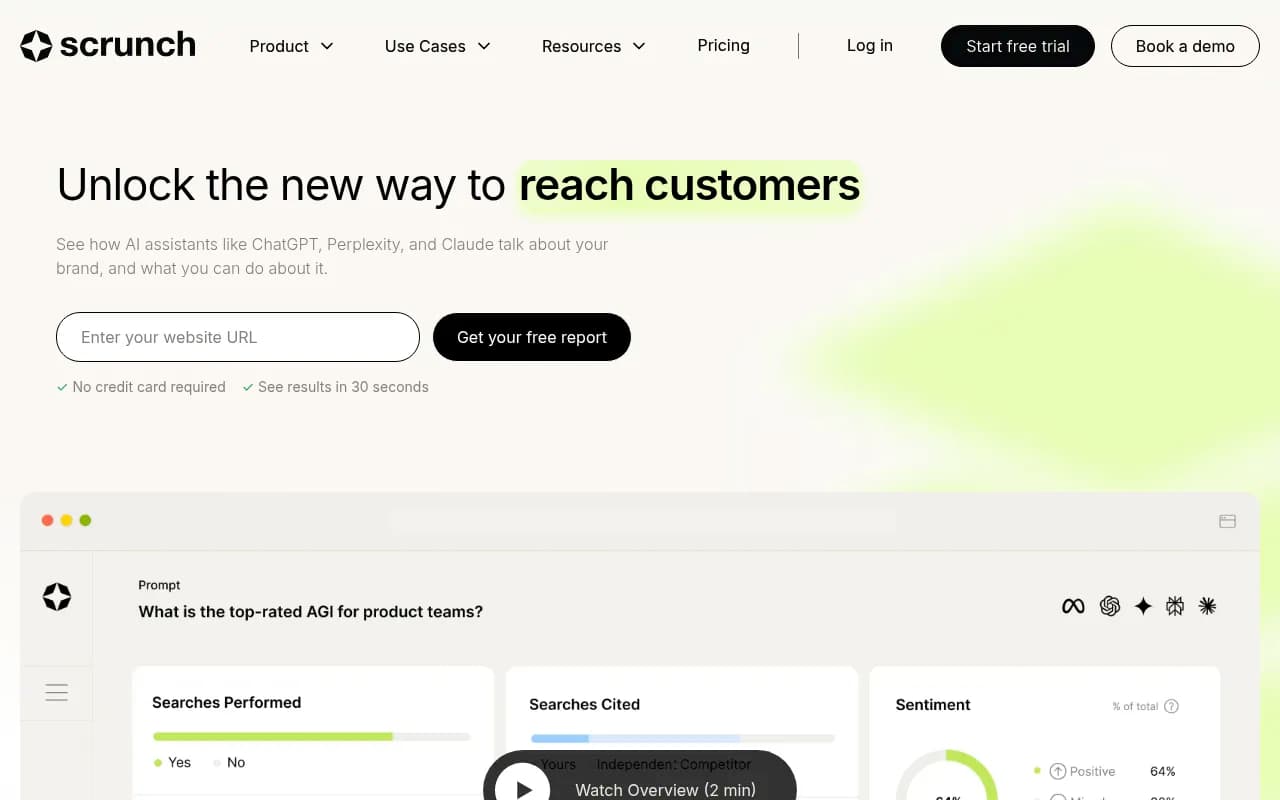
Profound

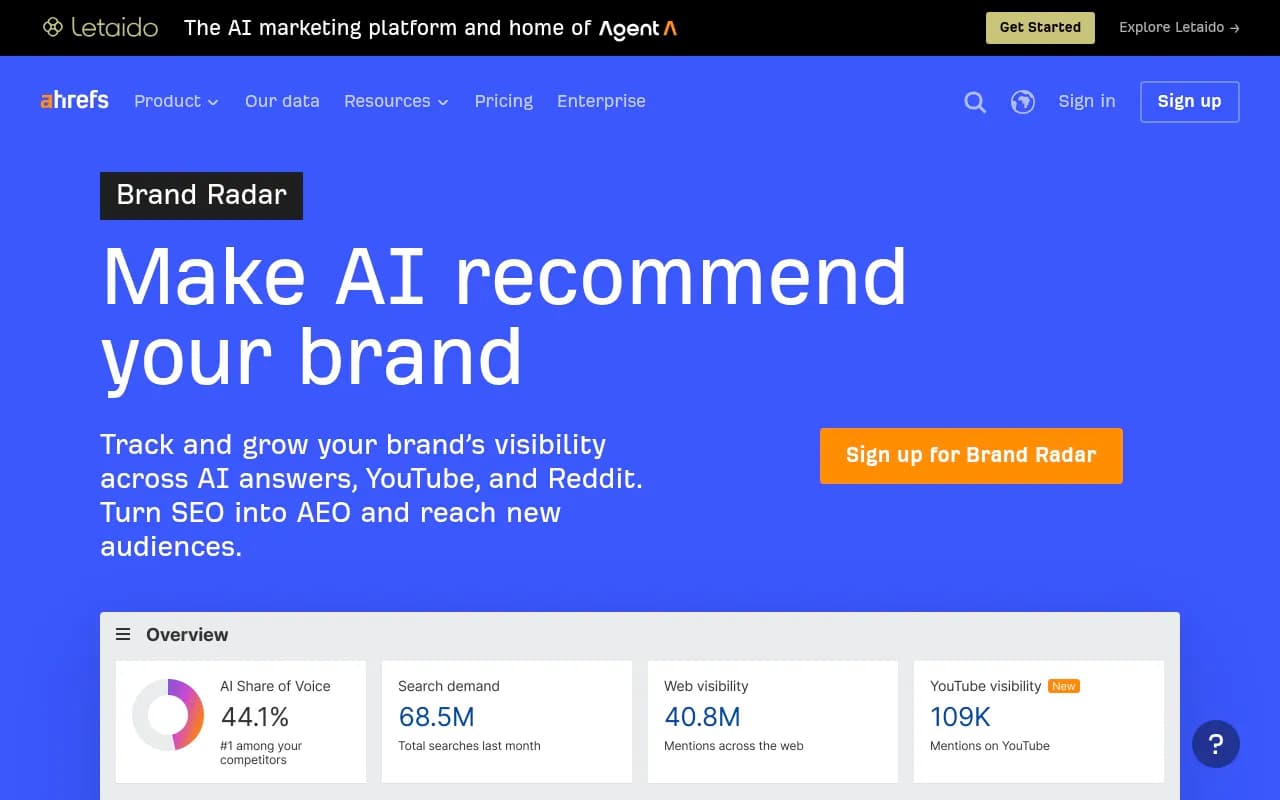
If you already pay for a suite, Semrush also has an AI toolkit worth a look.
For a longer list of options, the GEO software directory at bestgeosoftware.com covers the category.
Where monitoring stops and optimization starts
Question 14 is the one that most often separates tools. Plenty of alternatives are monitors: they report visibility and leave the work to you. If your team already has writers and a content process, that may be enough. If it doesn't, you will pay twice, once for the dashboard and once for whatever turns findings into pages.
Promptwatch is built around that loop. It tracks prompts across ChatGPT, Gemini, Perplexity, Claude, Google AI Overviews and others from the real interfaces, shows which of your pages get cited, and uses IP-verified AI crawler logs to tell an access problem from a content problem. Its Content Agent then drafts and publishes to WordPress, Webflow or Framer, and visitor analytics measure whether the AI traffic arrives. That covers questions 5, 9, 12 and 14 on this scorecard in one product, and there are head-to-head pages if AthenaHQ is on your list: Promptwatch vs AthenaHQ.

Pricing starts at $95 a month for Essential, $245 for Professional and $579 for Business, which is the first plan with the Content Agent, hourly tracking and local targeting. Confirm current numbers at promptwatch.com/pricing. A 7-day free trial on monthly billing lets you run the scorecard on your own prompts, and the free AI visibility report gives you a quick baseline first.
Running the evaluation in a week
- Day 1: List 30 to 50 buyer questions. Run the top ten by hand in each engine and screenshot the answers. That is your manual baseline.
- Day 2: Compute your prompts x engines x frequency number and send it to three to four vendors with the 15 questions.
- Days 3 to 4: Trial the shortlist on your own prompts and competitors. Run the same set twice to see the variance.
- Day 5: Test an export, and ask for the full price list including add-ons.
- Day 6: Score the sheet. Weight cost, data method and action workflow according to your team.
- Day 7: Write down why you chose, which of monitor-only or monitor-and-fix you bought, and what would change the decision. Thinklytics makes the same point about AI vendor choices: eighteen months later, nobody remembers why a tool was bought unless it was written down.
Red flags
- The vendor can't tell you what a credit costs in real responses.
- Export or API access exists only on a custom plan you haven't seen.
- Scores jump without any change on your site, and the vendor can't explain variance.
- The comparison article you found ranks its own publisher first and shows no math.
- A quoted tier disappears between your first call and signing.
If you want outside help building the baseline or interpreting results, 1001 SEO Media runs AI search and GEO engagements and uses Promptwatch for the measurement side.
FAQ
Is AthenaHQ's free plan enough to start?
It covers a handful of engines with 300 credits, and one credit is one response, so it holds 300 answers. That is enough for a small test, not a monthly program.
Is the cheapest alternative the best one?
Only if its prompt allowance holds your buying situations. A $29 plan with 15 prompts can cost more per useful answer than a larger plan.
Do I need a specialist to run one of these?
Not for monitoring. Turning findings into content and technical fixes is where most teams need either a tool that helps with the work or a partner.
Why won't AthenaHQ's numbers match a new tool's?
Every platform runs its own prompt panel and scoring method, so scores don't compare across tools. Compare trends inside one tool, and compare tools on the same manual baseline.
Use the scorecard, write down the answers, and make the vendors show their work on your prompts.