Key takeaways
- The overlap between Google's top 10 organic results and AI Overview citations has collapsed: studies from mid-2024 reported around 76% overlap, while 2026 measurements land between 17% and 38% depending on the methodology.
- AI Overviews retrieve content differently than organic search: a separate server-side pipeline scores individual passages, not whole pages, in roughly 200 milliseconds.
- ChatGPT and Google's AI surfaces increasingly cite product pages and brand-owned content directly, a reward structure that classic SEO never gave you for commercial queries.
- Roughly 68% of Google searches now end without a click, and when an AI Overview appears, position-1 organic CTR drops by more than half. The citation is often the only visibility you get.
- You can play both games with one content strategy: self-contained answer blocks, fanout-aware structure, entity markup, and separate tracking for rankings and citations.
The games split apart, and most teams didn't notice
For twenty years, search had one scoreboard. You ranked #1, you won the click, you won the revenue. Everything in SEO, from backlinks to title tags, existed to move one number: your position on the page.
Then Google bolted an AI answer onto the top of that page, and quietly built a second scoring system underneath it. Your #1 ranking still exists. It just doesn't guarantee you anything anymore.
I've talked to too many SEO teams who treat AI Overviews as a cosmetic change, a summary box that pulls from the same results they already track. That was roughly true in 2024. It is not true now, and the gap between the two games widens every quarter. A Reddit thread on r/AI_SearchOptimization that kicked off this article put it bluntly: same prompt, same week, different answer, different sources. One tester found only about 38% of AI Overview citations still ranked in the top 10.
That number bounces around depending on who's measuring, which is itself the point. But every serious study agrees on the direction: the two games are diverging.
Why ranking #1 no longer guarantees a citation
The technical reason is simple once you see it. Google's organic ranking and AI Overview retrieval are two different pipelines doing two different jobs.
Organic search ranks pages. It takes a URL, weighs its authority, relevance, and a hundred other signals, and slots it into a list. AI Overviews don't rank pages. They extract passages. Network traffic analysis by Discovered Labs shows that AI Overviews run a separate server-side retrieval phase, completed in about 200 milliseconds, that scores individual chunks of text for how well they answer a specific sub-question. A page sitting at position #15 organically can out-cite the #1 result because one of its passages answers the question better than anything on the top page.
This flips a core assumption of SEO on its head. In the organic game, page authority dominates: a weak paragraph on a strong domain beats a great paragraph on a weak domain. In the citation game, the passage itself is the unit of competition. That's why a Shopify help page can get cited in the #1 slot of an AI Overview while ranking somewhere down page two of the traditional results.
There's a second layer too, and it's stranger. AI Overviews generate synthetic sub-queries, dozens of them, to explore the facets of a query before answering. Your page can earn a citation because it ranks well for one of those hidden sub-queries, not the query the user actually typed. ChatGPT does the same thing at a larger scale: Promptwatch's query fanout data shows it fans each prompt out into multiple targeted searches, and those fanout queries have gotten dramatically shorter over 2026, from around 117 characters in December to roughly 53 by April. ChatGPT now searches like someone typing keywords, not sentences. On August 8, 2026 it even started using the site: operator at scale, jumping from about 0.4% to 17% of fanout queries overnight, nearly doubling searches per response.
The retrieval mechanics can change overnight, in ways that have nothing to do with Google's organic algorithm. If you're only watching your rank tracker, you're watching half the game.
The overlap data: shrinking every quarter
Here's the trend in one table. Notice that even the older studies never showed 100% overlap, and the newer ones can't agree on a number because the two systems have genuinely decoupled.
| Study | Period | Sample | Top-10 overlap with AI citations |
|---|---|---|---|
| Ahrefs | Mid-2024 baseline, published July 2025 | 1.9M citations from 1M AI Overviews | ~76% |
| Surfer | 2024–2025 | 405,576 searches | ~52% |
| ALM Corp | March 2026 | AI Overview citations | ~38% |
| BrightEdge | February 2026 | Tracked enterprise queries | ~17% |
| Moz (AI Mode, not AI Overviews) | 2025–2026 | 40,000 queries | Only 12% (88% of citations don't match top 10) |
Two things jump out. First, the direction is unambiguous: every newer study shows less overlap than every older one. Second, AI Mode is a different sport entirely from AI Overviews. Moz found 88% of AI Mode citations don't match the organic top 10 for the same query. If AI Mode becomes the default Google experience, organic rank becomes nearly uncorrelated with what users actually see.
The volatility is its own story. Promptwatch's citation share data shows Reddit's share of ChatGPT citations fell from 6.11% in May 2026 to 3.71% in June, and then collapsed from roughly 4% to 0.5% on a single day in August. Google rankings drift over months. Citation graphs can re-shape overnight because a platform changes one retrieval parameter.
One more pattern worth knowing: AI citation share is far less winner-take-all than Google rankings. In Promptwatch's June 2026 ChatGPT citation data, even the #1 cited domain (Reddit) held under 4% of all citations, and the long tail of smaller, specialized sites absorbed most of the rest. In Google organic, a dominant domain can own entire SERPs. In AI search, the spoils spread out. For smaller brands, that's the best news in years.
What AI actually cites (and what it ignores)
Here's where the two games reward genuinely different content.
Classic SEO wisdom says competitive commercial queries belong to editorial content: listicles, reviews, comparison articles from high-authority publishers. Your product page was supposed to rank for your brand name and nothing else. AI Overviews quietly broke that rule. Promptwatch's citation type data shows product pages overtook listicles as the most cited format in Google AI Overviews in late July 2026, and in ChatGPT Search, product pages hit roughly a third of all citations in July, nearly double their share from March.
| Content type | ChatGPT citations (July 2026) | AI Overviews citations (July 2026) |
|---|---|---|
| Product pages | ~33% | ~16% (and rising, overtook listicles late July) |
| Listicles | ~10% | ~18% (falling from ~26% in Q1) |
| How-tos | ~4% | ~15% |
| News articles | ~5% | ~14% |
| Videos | ~0.1% | ~6% (nearly doubled since January) |
So AI search is shifting toward citing brand-owned commercial pages directly, while classic organic rankings still lean on editorial and informational content for those same queries. The same URL can be wrong for one game and right for the other.
Structure matters too. SparkToro's 2026 analysis found 44.2% of AI citations come from just the first 30% of a page's content. If your answer is buried below the fold behind a 600-word intro, you're handing the citation to whoever answered first. And each engine has a different appetite: Promptwatch's sources-per-response data shows Google AI Overviews and Perplexity each cite roughly 10 sources per answer, while ChatGPT cites around 5, making every ChatGPT slot twice as contested. Copilot swings wildly, from under 2 to nearly 17 sources within weeks, because Microsoft keeps re-architecting its retrieval.
The commercial math has changed
Maybe you're thinking: fine, but my rankings still drive traffic, so who cares about citations?
Here's who cares: your revenue model. SparkToro's 2026 measurement found 68% of Google searches now end without a click, up from 60% in 2024, the fastest two-year acceleration in a decade. Pew Research tracked 68,879 real Google searches and found users click an organic result only 8% of the time when an AI Overview is present, versus 15% without one. Ahrefs puts the position-1 CTR drop at 58% when an AI Overview appears. And in AI Mode, Semrush measured a 93% zero-click rate. Read that again. In AI Mode, if you don't earn a citation inside the answer, you have no reach at all. Your #1 ranking renders in a results page almost nobody scrolls to.
The citation is no longer a nice-to-have next to your ranking. Increasingly, it's the only impression you get.
There's a counterweight worth respecting, though. Google has stated AI Overviews are rooted in its core ranking systems, so a page that doesn't rank anywhere is less likely to get cited either. Ranking is the entry ticket; passage quality wins the seat. The Princeton/KDD study on generative engine optimization found lower-ranked sites saw a +115% visibility boost from citation-focused content optimization, while top-ranked sites sometimes saw slight declines. GEO work narrows the gap, which is exactly why the overlap numbers keep falling.
How to play both games at once
The good news: one well-built page can compete in both games. You just have to build it for two readers, a human skimming a SERP and a retrieval pipeline extracting passages.
1. Write self-contained answer blocks
Structure each section as a 200–400 word block that answers one question completely, without depending on surrounding context. Lead with the direct answer in the user's own phrasing, then support it. This serves the passage extractor and the skimming human equally well. One page with six strong answer blocks can earn citations in six different AI Overviews.
2. Optimize for the fanout, not just the query
Remember those synthetic sub-queries. A prompt like "best CRM for nonprofits" fans out into pricing comparisons, integration questions, alternatives lists, and setup how-tos. Build sections that directly answer the sub-questions, with comparison tables, pricing blocks, and FAQ sections. You can win a citation for a query the user never typed. Tools like AlsoAsked and AnswerThePublic are useful for mapping what those sub-questions actually are.
3. Front-load the facts
With 44% of citations coming from the first third of a page, the old magazine-style intro is a liability. Answer, then elaborate. Never the reverse.
4. Feed the entity layer
Organic ranking leans on backlinks and page speed. Citation retrieval leans on entity clarity: consistent schema markup, unambiguous statements about who you are and what you do, third-party mentions of your brand (even without links), and freshness. AI systems assemble an understanding of your brand from across the web, and offsite mentions on Reddit, YouTube, and review sites feed that understanding even when they don't link back.
5. Track the two games separately
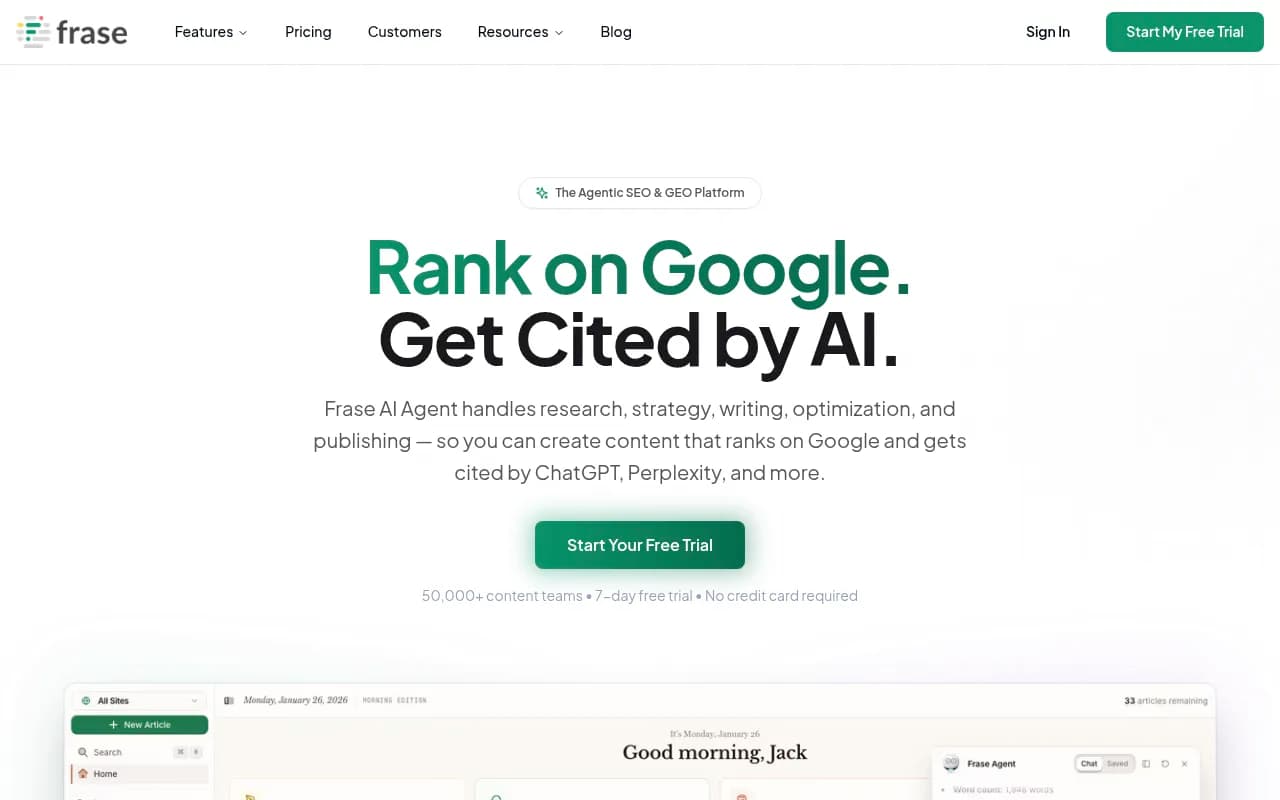
This is the part most teams skip, and it's why they don't know they're losing. Your rank tracker tells you nothing about your citation share. You need to track which prompts you appear in, which pages get cited, and what traffic those citations actually send. A platform like Promptwatch handles this side, showing you which of your pages get cited, when AI crawlers visit your site, and what the gap is between the prompts you should win and the ones you currently do.

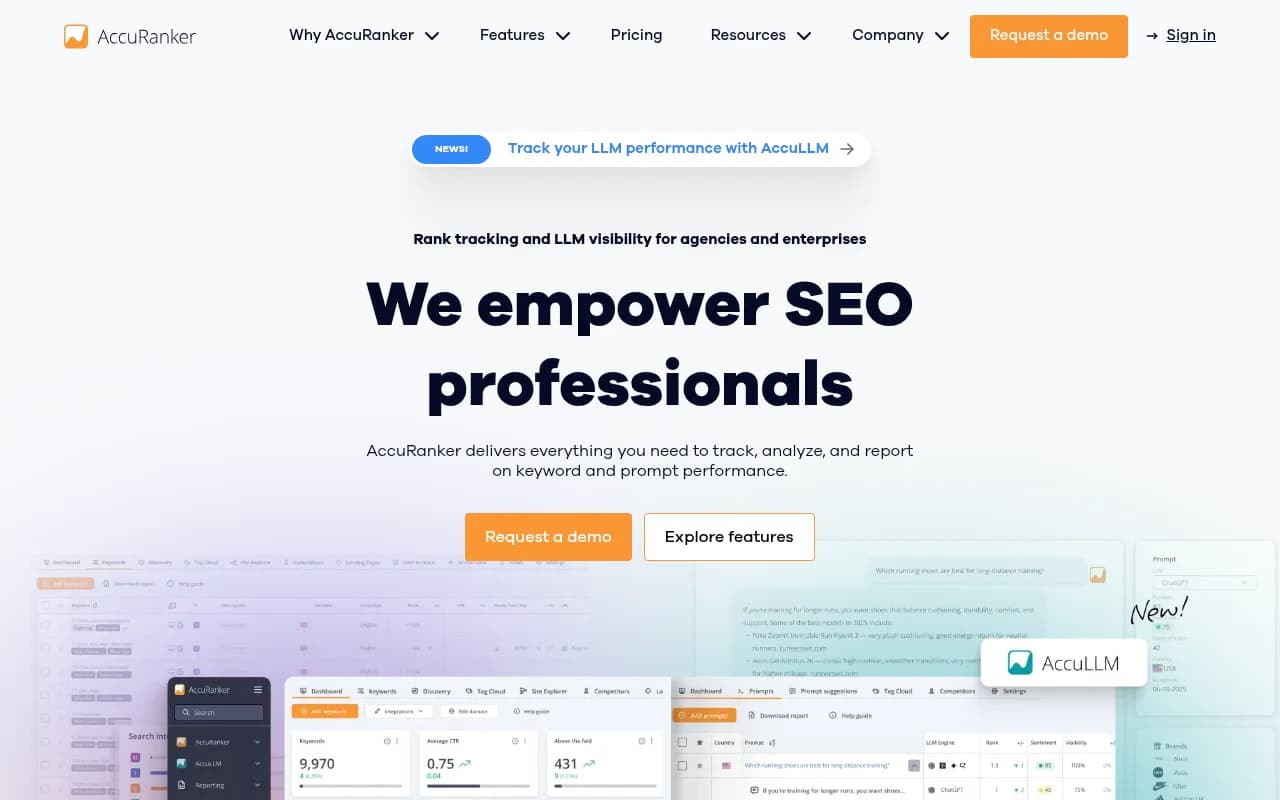
For the traditional side, a real-time rank tracker like AccuRanker or the rank tracking in Semrush still does the job fine. Just don't mistake one dashboard for the whole picture.
The tool stack for both games
Here's how the two stacks differ in practice:
| Dimension | The ranking game | The citation game |
|---|---|---|
| Primary KPI | Position, CTR, organic sessions | Citation frequency, share of voice, AI referral traffic |
| Core signals | Backlinks, on-page keywords, Core Web Vitals | Passage quality, entity authority, offsite mentions, freshness |
| Content unit | The page | The passage / answer block |
| Query model | The literal keyword | The fanout: sub-queries, comparisons, alternatives |
| Typical tools | Rank trackers, site auditors, link tools | AI visibility platforms, crawler log analytics, content gap tools |
A few tools worth knowing on each side of the table:
Otterly.AI

If you want to browse the full category of AI visibility and GEO platforms rather than picking blind, the directories at bestgeosoftware.com and ai-rank-tools.com are good starting points.
Final word
The uncomfortable truth in the 2026 data is that neither game is optional. Drop your SEO and you lose the ranking foundation that AI retrieval still partly depends on. Ignore GEO and you're invisible in the answer layer where the clicks are going, and the zero-click numbers say that's where most of the journey now happens.
Start with the cheapest diagnostic: pick your ten most commercially important prompts, run them through ChatGPT and Google, and count how many cite you. If you rank #1 for the equivalent keywords and get cited in two out of ten, you've found your gap. Then rebuild your key pages around answer blocks, and re-run the test monthly. The teams doing this are watching citation share climb while their competitors keep celebrating rankings that fewer people ever see.
And if you'd rather have a team that plays both games for you, 1001 SEO Media builds combined SEO and GEO programs, from technical foundations to AI citation strategy, with transparent monthly reporting and no long-term contracts.