Key takeaways
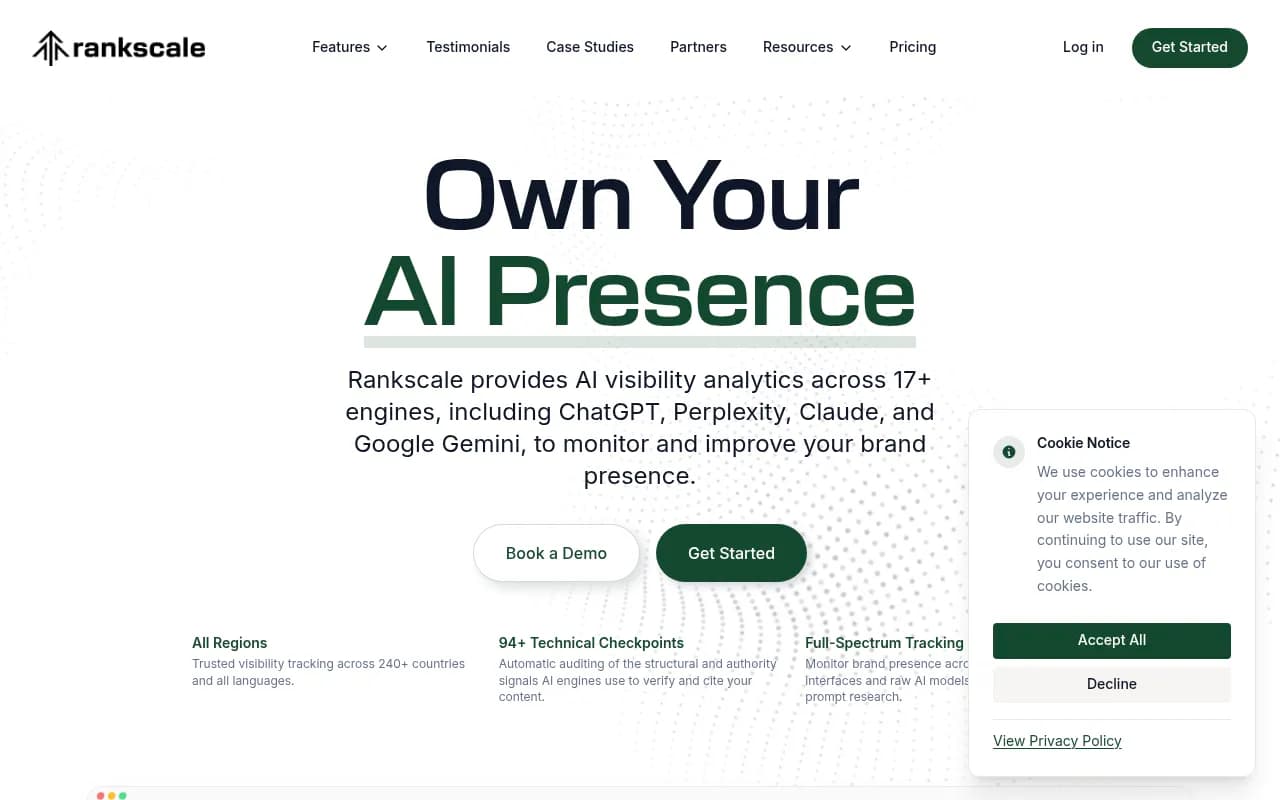
- Rankscale covers 17+ AI engines including ChatGPT, Claude, Perplexity, Gemini, DeepSeek, and Google AI Mode, with 240+ country/language combinations
- Coalition Technologies ran ~2,700 prompts through Rankscale and found near-100% mention and citation detection accuracy
- The platform goes deep on technical auditing (94+ checkpoints) and prompt research, but does not include built-in content generation
- Best suited for agencies, enterprise SEO teams, and brands that want rigorous, evidence-backed AI visibility data
- Pricing and positioning make it a strong fit for teams that need breadth of engine coverage and audit depth over content workflow
What Rankscale actually is
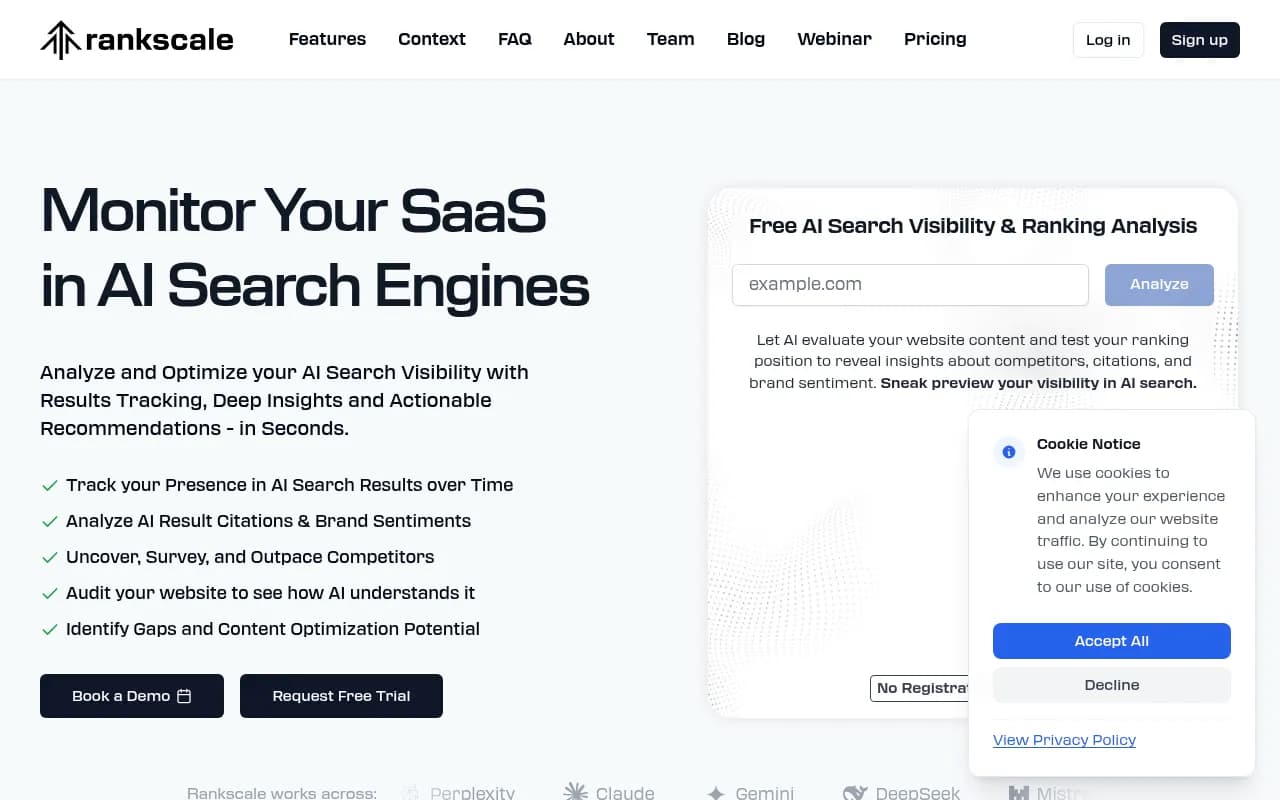
Rankscale is an AI visibility tracking platform built to answer one question: where does your brand show up when people ask AI engines questions? Not Google's blue links. The actual generated answers from ChatGPT, Perplexity, Claude, Gemini, and a dozen other models.
The platform launched into a market that barely existed two years ago. Now it's one of the more mature players in the space, trusted by brands like Bosch, UBS, REWE, and O2, and agencies including Dentsu, WPP Media, and Publicis Sapient. That's not a random mix of clients -- it's a signal that Rankscale has found traction with teams that take measurement seriously.
How the tracking actually works
Rankscale polls AI engines using prompt libraries you configure, then logs the full response, extracts brand mentions and citations, and stores the evidence. That last part matters more than it sounds.
LLMs are non-deterministic. Ask ChatGPT the same question twice and you might get different answers, different citations, different brand mentions. A tracker that just shows you a "visibility score" without logging the actual responses is giving you a number you can't verify or act on. Rankscale keeps the evidence trail -- the raw responses, the detected mentions, the cited URLs -- so you can see exactly what happened and when.
The prompt research module estimates search volume through semantic reconstruction and maps intent and prompt density. This is Rankscale's answer to the "which prompts should I care about?" problem. Instead of guessing, you can see which questions are being asked at volume in your category and prioritize accordingly.
The 94+ technical checkpoints are worth mentioning separately. Rankscale audits the structural and authority signals that AI engines use to verify and cite content -- things like schema markup, entity clarity, and crawlability. This is closer to a GEO audit than a traditional rank tracker, and it's one of the features that separates Rankscale from simpler monitoring tools.
Accuracy: what the data actually shows
The most credible accuracy test I've seen for Rankscale comes from Coalition Technologies, a digital agency that ran approximately 2,700 prompts across ChatGPT, Perplexity, Google AI Overviews, and Google AI Mode. Their finding: near-100% mention and citation detection accuracy.

That's a meaningful sample size. Most tool reviews are based on a handful of manual spot-checks. Running 2,700 prompts and comparing detected mentions against ground truth is actual methodology.
The Coalition Technologies team also noted that Rankscale's broad engine polling combined with predictable credit modeling makes it possible to scale measurement without costs spiraling. That's a real operational concern for agencies running tracking across multiple clients and hundreds of prompts.
What drives the accuracy? A few things:
- Rankscale scrapes actual search data to identify how people search, then uses that to test queries (noted by users in the r/GenerativeSEOstrategy community)
- The evidence logging means false positives and false negatives can be audited after the fact
- The platform tracks both chat interfaces and raw AI model APIs, which catches discrepancies between what the model "knows" and what the product surface shows users
No tool is perfect, and LLM outputs vary. But near-100% detection accuracy across 2,700 prompts is a strong result.
Engine coverage: 17+ models
This is one of Rankscale's clearest advantages. The platform monitors:
- ChatGPT (OpenAI)
- Perplexity
- Claude (Anthropic)
- Google Gemini
- Google AI Overviews
- Google AI Mode
- DeepSeek
- Grok
- Copilot
- Mistral
Plus additional models, covering 17+ engines in total across 240+ countries and all languages. For teams that operate internationally or in multilingual markets, that geographic and language coverage is hard to match.
Feature breakdown
Here's a quick overview of what's inside the platform:
| Feature | What it does |
|---|---|
| Brand visibility dashboard | Central view of mention rates, citation frequency, and share of voice across engines |
| AI rank tracker | Prompt-level tracking with full response logging and evidence trails |
| Competitor analysis | Benchmark your visibility against named competitors across the same prompt set |
| Citation analysis | See which URLs and domains are being cited in AI responses |
| Sentiment analysis | Detect whether brand mentions are positive, neutral, or negative |
| Page audits | 94+ technical checkpoints for AI crawlability and citation signals |
| Prompt research | Volume estimates, intent mapping, and prompt density analysis |
The competitor analysis module is particularly useful for agencies. You can run the same prompt library against your client and their top three competitors, then show exactly where the client is losing visibility and to whom. That's a much more compelling deliverable than a generic "AI visibility score."
What Rankscale doesn't do
Being honest here: Rankscale is a tracking and auditing platform. It does not include a built-in AI content generation tool. If you want to close the loop from "I found a visibility gap" to "I published content to fix it," you'll need to bring your own content workflow.
This is a genuine gap for some teams. Platforms like Promptwatch include an AI writing agent that generates articles and listicles grounded in citation data, specifically engineered to get cited by AI models. If the content creation side of GEO is important to you, that's worth factoring in.

Rankscale also doesn't appear to offer Reddit or YouTube source tracking -- channels that increasingly influence what AI models cite. And there's no ChatGPT Shopping tracking, which matters for e-commerce brands trying to appear in product recommendation carousels.
Who should use Rankscale
Rankscale is a strong fit for:
Agencies with multiple clients. The evidence trail approach and competitor benchmarking make it easy to build client reports. The credit-based pricing model scales predictably. Clients like Dentsu and WPP Media aren't using this for casual monitoring -- they're using it for systematic measurement.
Enterprise SEO teams at large brands. Bosch and UBS aren't small operations. The 94+ technical checkpoints and multi-region support make Rankscale viable for complex, multi-market deployments.
Teams that need audit depth. If you want to understand why your content isn't being cited -- not just that it isn't -- the technical audit layer is genuinely useful. Most AI visibility trackers show you the symptom. Rankscale tries to show you the cause.
Researchers and data-driven marketers. The prompt research module and evidence logging make Rankscale a good fit for teams that want to do rigorous analysis rather than just check a dashboard.
It's less ideal for:
- Solo operators or small teams who need a simple, cheap monitoring tool
- Teams that want content generation baked into the same platform
- E-commerce brands focused specifically on ChatGPT Shopping visibility
How Rankscale compares to alternatives
There are now dozens of AI visibility tools on the market. Here's how Rankscale stacks up against the ones most commonly mentioned in the same breath:
| Tool | Engine coverage | Technical audits | Content generation | Evidence logging | Best for |
|---|---|---|---|---|---|
| Rankscale | 17+ engines | 94+ checkpoints | No | Yes | Agencies, enterprise |
| Promptwatch | 10+ engines | No | Yes (AI writing agent) | Yes | GEO optimization + content |
| Profound | 9+ engines | Limited | No | Partial | Enterprise monitoring |
| Otterly.AI | ~5 engines | No | No | No | Basic monitoring |
| Peec.ai | ~5 engines | No | No | No | Basic monitoring |
| AthenaHQ | ~6 engines | No | No | Partial | Monitoring-focused |
Profound

Otterly.AI



The pattern here is that most tools in this space are monitoring dashboards. They show you a number. Rankscale goes further with technical auditing and evidence trails, though it still stops short of the full optimization loop that includes content generation.
Pricing
Rankscale offers a free trial and a demo booking option. Specific pricing tiers aren't published on the public site -- you'll need to contact them or sign up to see current plans. Based on the credit-based model described in the Coalition Technologies review, costs scale with the number of prompts, engines, and markets you track.
For agencies and enterprise teams, this kind of usage-based pricing is usually preferable to flat-rate plans that either cap you too early or charge you for capacity you don't use.
The honest verdict
Rankscale is one of the most technically rigorous AI visibility trackers available in 2026. The 2,700-prompt accuracy test from Coalition Technologies is the most credible third-party validation I've seen for any tool in this category, and the results are genuinely impressive.
The 17+ engine coverage, 94+ technical checkpoints, and evidence-trail approach make it a serious tool for serious teams. If you're an agency or enterprise SEO team that needs to measure AI visibility with the same rigor you'd apply to traditional rank tracking, Rankscale belongs on your shortlist.
The gap is on the optimization side. Knowing where you're invisible is step one. Fixing it requires content -- and Rankscale doesn't help you write it. Teams that want a tighter loop between gap identification and content creation will need to pair Rankscale with a content tool, or consider a platform that bundles both.
For most agencies and data-driven marketing teams, though, Rankscale's depth of measurement is the right starting point.