
Key takeaways
- AI visibility tools collect data two ways: calling model APIs, or running prompts through the real consumer interfaces. The two can return very different answers to the same prompt.
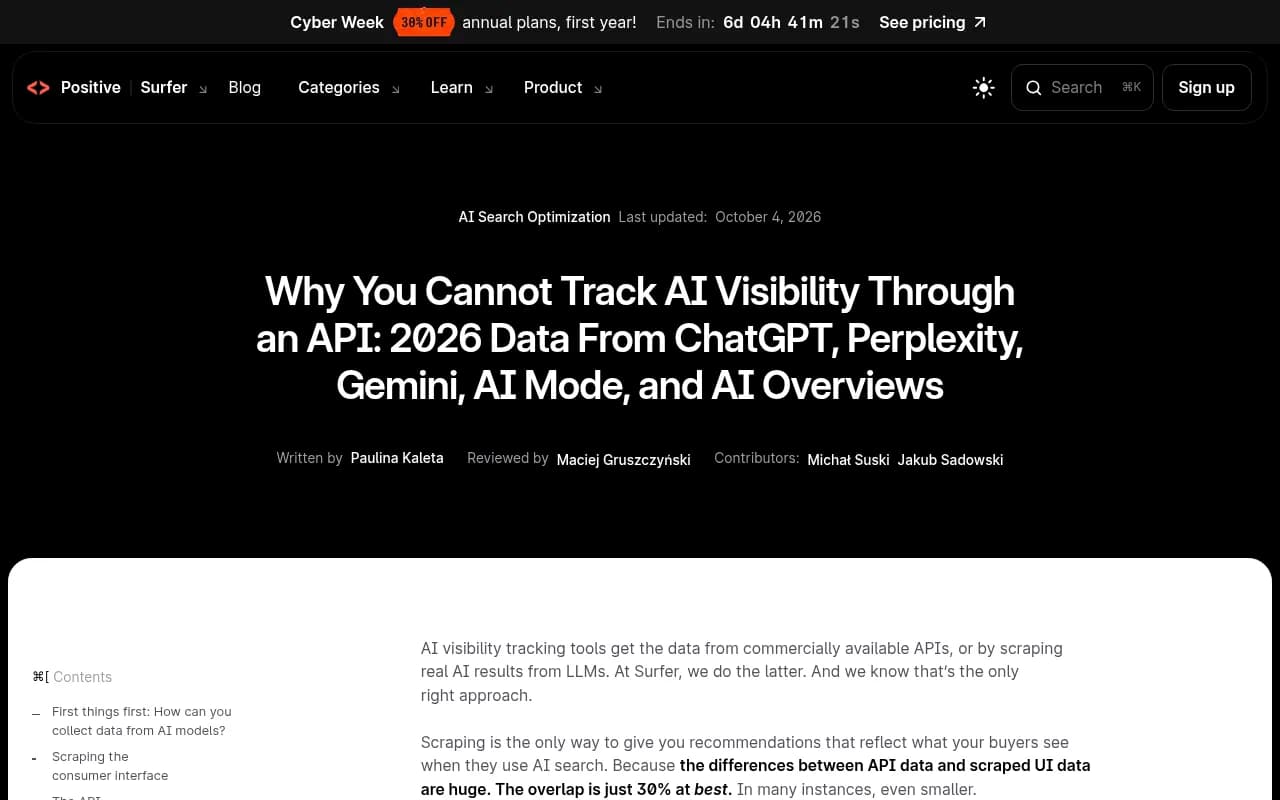
- Surfer's study of 1,000 prompts and 13,779 answers found API and scraped UI results overlapped about 30% at best. Surfer sells scraping, so treat the exact figure with some care, but the direction matches what other sources describe.
- Method is only half the story. Sampling frequency, location, and how a vendor handles non-deterministic answers matter just as much.
- Platform behavior shifted several times in 2026, so any 2027 baseline should be a trend series with annotated platform changes, not a single number.
- Ask vendors five written questions (listed below) before you trust a dashboard for budget decisions.
Why this question matters for 2027 planning
Somewhere in the next few weeks, a lot of marketing teams will build 2027 budgets around an AI visibility number. Share of voice in ChatGPT. Citation rate in AI Overviews. A score that went from 31 to 44 and looks great on a slide.
The problem is that the number depends heavily on how it was collected. If the tool queried a model API with no web search, no personalization, and no interface features, it measured something. It just may not be what your buyers saw.
This guide explains the two collection methods, what the evidence says about the gap, and how to vet a platform before you commit planning money to it.
The two ways tools collect AI visibility data
There is no Search Console for AI answers. ChatGPT, Gemini, Perplexity, AI Overviews and AI Mode do not publish rankings, so every tool generates its own data by running prompts and recording what comes back. How it runs them is the biggest methodological difference between products.
API-based collection
The tool sends your tracked prompts to a provider's developer API, such as the OpenAI or Gemini API, and parses the response.
The upside is real. APIs are stable, cheap at scale, and officially supported, so a vendor can run lots of prompts often without things breaking. The metehan.ai guide on collection methods lists the catches:
- The model behind the consumer chat product is often a different build than the API default, with different system instructions and tuning.
- Web search may be off. A consumer product decides on its own when to search and which sources to retrieve. An API call without a search tool answers from training memory, so citation data can be missing or synthetic.
- Interface behavior is absent. Shopping modules, source carousels, follow-up suggestions and answer formatting only exist in the real UI.
Real UI collection
The tool opens the actual interface, submits the prompt, and parses the rendered answer, brand mentions and citation links. According to Surfer's write-up, that captures the retrieval, ranking, safety filtering, personalization and answer shortening the product applies for real users.
It is harder and more expensive to run. Interfaces change, layouts break, and anti-bot measures get in the way. That cost is why some vendors default to APIs, and why a cheap plan with a huge prompt allowance deserves a follow-up question.
What the evidence says about the gap
Surfer ran 1,000 prompts across five AI products, once by scraping the interfaces and once via API. It collected 13,779 answers across 14 model-and-method combinations and compared cited brands, sources, pages and answer length. Its headline: overlap of about 30% at best, and often lower.
Two caveats, because I think you should read vendor studies skeptically:
- Surfer sells scraping-based tracking, so it has a commercial reason to land where it did.
- Surfer notes that its AI Overviews "API" method is borrowed from AI Mode, because Google runs AI Overviews on a Gemini model that is not sold as an API. So that comparison is the weakest one in the study.
Even so, the mechanism is not controversial. A model without live retrieval cannot cite what retrieval would have found. If a tool tells you which pages ChatGPT cites for a prompt and it never triggered ChatGPT's search behavior, the citation list is a guess.
Omnia's comparison of AI visibility APIs shows a related spread: the share of AI answers naming a given brand ranged from 78% to 35% depending on the data provider. Omnia also ranks its own products, so again, one input among several, not a verdict.
The part people forget: the platforms keep moving
Even perfect collection gives you a snapshot of a moving target. Promptwatch Data, which collects from the actual interfaces of the major AI platforms, documents how fast things changed in 2026:
- When GPT-5.3 rolled out on March 4, 2026, ChatGPT went from about 6.4 cited sources per search-enabled response to roughly 4.7 to 4.9 by late March, about 27% fewer citation slots, and did not recover a month later. See the ChatGPT citation drop report.
- On August 8, 2026, ChatGPT began using the site: operator at scale, jumping from about 0.4% to about 17% of fanout queries overnight (ChatGPT site: operator report).
- reddit.com's share of ChatGPT citations fell from about 4% to 0.5% on August 14, 2026 (Reddit citations report).
- Meta-WebIndexer grew from about 2% to nearly 38% of tracked AI crawler requests between mid-July and August 9, 2026 (Meta-WebIndexer report).
The practical implication: a tool can be perfectly accurate and your trend line can still dip because ChatGPT cites fewer sources across the board. You need a platform that lets you tell "we lost visibility" from "the platform changed." The only way to do that is tracking citations per response over time and annotating the dates.
Method is necessary, not sufficient
UI collection does not automatically make a tool trustworthy. Several other things decide whether the number is usable for planning.
Sampling frequency and volume
As the metehan.ai guide puts it, one run per week is a poll, not a measurement. AI answers are non-deterministic. Run the same prompt five times and you may get five different brand lists. A tool that runs each prompt once and reports a precise percentage is overstating its certainty. Look for daily runs at minimum, and the option to run more often during launches.
Location and language
An answer for a user in Amsterdam is not an answer for a user in Austin. Check whether markets are separated and whether local queries can be pinned to a place. Mixing countries inside one monitor quietly corrupts the average.
Personalization handling
If a scraper reuses a logged-in account with memory, earlier sessions shape later answers. Ask how the vendor controls for that.
Methodology transparency
The metehan.ai article names Peec AI as the clearest positive example in the market: every aggregate metric traces down to the stored chats and sources it was computed from, and collection setup per channel is documented. That is the bar. If you can click from a score to the raw answers behind it, you can audit it.
Five questions to ask any vendor
Put these in writing and keep the answers with your planning documents.
- For each AI platform, do you collect from the real interface or an API? Per channel, not in general.
- Which model version and which mode (search on or off) do you query?
- How often do you run each prompt, and how do you handle answers that vary between runs?
- Can I click from any metric to the stored responses and citations behind it?
- How do you separate countries, languages, and personalization state?
If a vendor cannot or will not answer, as metehan.ai says, that is the answer.
How the platforms compare
The table below summarizes what I could verify from vendor documentation and the sources above. Details change fast, so confirm each point on the vendor's own site before buying.
| Platform | Collection approach | Notable for planning use |
|---|---|---|
| Promptwatch | Real interfaces of ChatGPT, Google AI Overviews, AI Mode, Gemini, Perplexity, Copilot and others, plus API models tracked separately | Crawler logs, visitor analytics and content tools in one product |
| Peec AI | UI scraping, with documented methodology | Click-through from metrics to stored answers |
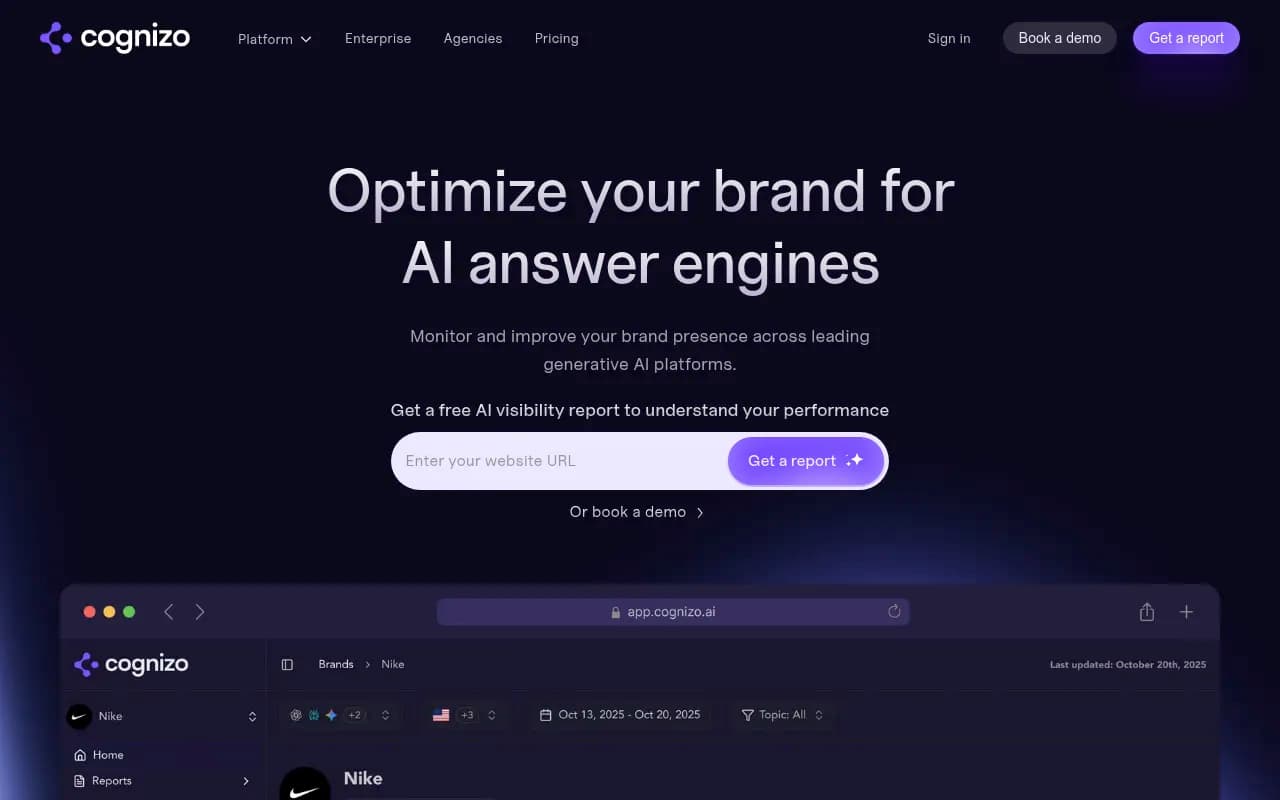
| Cognizo | UI scraping, 10+ platforms, from $499/mo | Pairs tracking with ChatGPT Ads management |
| AIclicks | UI scraping, 10+ platforms, from $59/mo | Low entry price, unlimited seats |
| Profound | Enterprise monitoring across 10+ engines | Strong on monitoring |
| Otterly.AI | Prompt tracking | Basic monitoring |
| Ahrefs Brand Radar / Semrush | SEO suites adding AI tracking | Convenient if you already use the suite |
Where I would start
Promptwatch is the one I would put on a shortlist first, mostly because it collects from the real interfaces of ChatGPT, Google AI Overviews, Google AI Mode, Gemini, Perplexity, Copilot and others in each country and language, and tracks API models alongside to show what models believe from training data. That split is useful: you see both what users see and what the model remembers. It also covers what API-only trackers cannot, such as IP-verified AI crawler logs and visitor analytics that show whether AI visibility sends traffic. Plans start at $95/mo for Essential; confirm current pricing at promptwatch.com/pricing. There is a 7-day free trial on monthly billing.

For a head-to-head, see Promptwatch vs Profound and Promptwatch vs Peec.
Peec AI earns its credit for transparency.

Cognizo combines UI-based tracking with ChatGPT Ads management, which matters if paid placements are in your 2027 plan.
Cognizo
Profound is the enterprise name you will hear most.
Profound

Otterly.AI is a lighter option for basic monitoring.
Otterly.AI

For a wider scan of the category, the GEO software directory at bestgeosoftware.com lists more options.
When API data is fine
I do not want to oversell this. API collection is not worthless.
- It shows what a model believes from training data, which matters for brand perception and for what the model says when it does not search.
- It is useful for cheap, high-volume checks on facts and claims.
- It is a reasonable first pass when budget is tight.
The mistake is using it as a stand-in for what buyers see, and then planning spend on citation-share targets it cannot measure. Use API data for the "what does the model know" question and UI data for the "what does the buyer see" question. The best setup reports both separately.
Building a 2027 plan on defensible numbers
A few habits make the data far more usable, whichever platform you pick.
Treat the baseline as a range
Because answers vary run to run, report a visibility figure with a band, or at least a four-week average, instead of one decimal-point number. Promptwatch's own advice from the GPT-5.3 data is to track over time so you can separate your changes from platform-wide ones.
Annotate platform changes
Keep a dated log of model rollouts and retrieval behavior changes. When a metric moves, check the log first. The 2026 examples above show that big swings can come from the platform, not your content.
Pair visibility with outcomes
Visibility is not revenue. Most AI answers carry no clickable link, so a visibility score will always be larger than AI-referred sessions in GA4, as the Cognizo comparison notes. Track both: mentions and citations on one side, crawler activity and referred visits on the other. Promptwatch's guide to attributing AI traffic covers the mechanics, including the fact that ChatGPT stopped sending a referrer on October 8, 2026.
Weight by where your buyers actually are
The sources AI cites differ a lot by engine. Promptwatch's domain rank distribution report found DR 100 sites earn 13.7% of AI Overviews citations but 0.3% of ChatGPT's (Nov 3 to Nov 16, 2026). A plan that treats all engines as one blob will misallocate effort.
Audit the tool yourself
Before signing, take ten prompts you know well. Run them in the real ChatGPT or Perplexity interface by hand, then compare with the tool's recorded answers. If the brand lists and sources differ wildly, you have learned something free.
A short decision guide
| Your situation | What to prioritize |
|---|---|
| Reporting to a CFO or board | UI collection, drill-down to stored answers, trend with annotations |
| Agency pitching clients | Multi-project plans, quick visibility reports, white-label options |
| Local or multi-location brand | Location-pinned monitors, country and city separation |
| E-commerce | Shopping module tracking, which only exists in the real UI |
| Tight budget | API-based tool for model perception, plus manual UI spot checks |
Bottom line
If a number will drive 2027 budget, it should come from the interface your buyers use, be sampled often enough to be more than a poll, and be traceable to stored answers. The gap between API and UI results is large enough that the method belongs in your vendor scorecard next to price. Ask the five questions, run the ten-prompt spot check, and keep a dated log of platform changes. If a vendor cannot show you the raw answers behind a score, do not plan around it.
FAQ
Is UI data always more accurate than API data?
Not automatically. UI collection is closer to what users see, but a tool that samples once a week or mixes countries can still mislead. Method, frequency, and transparency all count.
How big is the gap between API and UI results?
Surfer's study of 1,000 prompts found about 30% overlap at best. Surfer sells scraping, so verify with your own spot check.
Why do my visibility numbers jump around?
Two reasons: answers are non-deterministic, and platforms change behavior. ChatGPT cited about 27% fewer sources per response after the GPT-5.3 rollout in March 2026, according to Promptwatch Data.
Can I still use API-based tools?
Yes, for measuring what a model believes from training data or for low-cost checks. Do not use them alone to estimate citation share or what buyers see.
Where can I compare more tools?
The directories at bestgeosoftware.com and ai-rank-tools.com list GEO and AI rank tracking tools side by side.