Key takeaways
- SE Ranking's AI visibility features (the AI Results Tracker and SE Visible) let you monitor brand mentions across several AI search engines, but the toolkit is primarily monitoring-focused.
- The platform works well for SEO teams who want a single subscription that covers traditional rank tracking and basic AI visibility in one place.
- For deeper GEO work -- content gap analysis, AI crawler logs, prompt volume data, or content generation grounded in citation data -- SE Ranking's built-in tools don't go far enough.
- Dedicated GEO platforms like Promptwatch close the gap between monitoring and actually fixing your AI visibility.
- If you're serious about ranking in AI search, you'll likely need to pair SE Ranking with a purpose-built tool or switch to one entirely.
SE Ranking has been a reliable all-in-one SEO platform for years. Rank tracking, site audits, backlink analysis, keyword research -- it does the traditional stuff well, and at a price point that makes agencies and in-house teams happy. So when AI search started eating into traditional click traffic, it made sense that SE Ranking would bolt on some AI visibility features.
The question is whether "bolted on" is the right description, or whether the GEO toolkit is genuinely integrated and useful. That's what this guide is about.
Let me be direct: SE Ranking's AI visibility features are real, they work, and they're a reasonable starting point. But they're monitoring tools. They tell you where you stand. What they don't do is help you change where you stand. For a lot of teams, that gap matters.
What SE Ranking's AI visibility toolkit actually includes
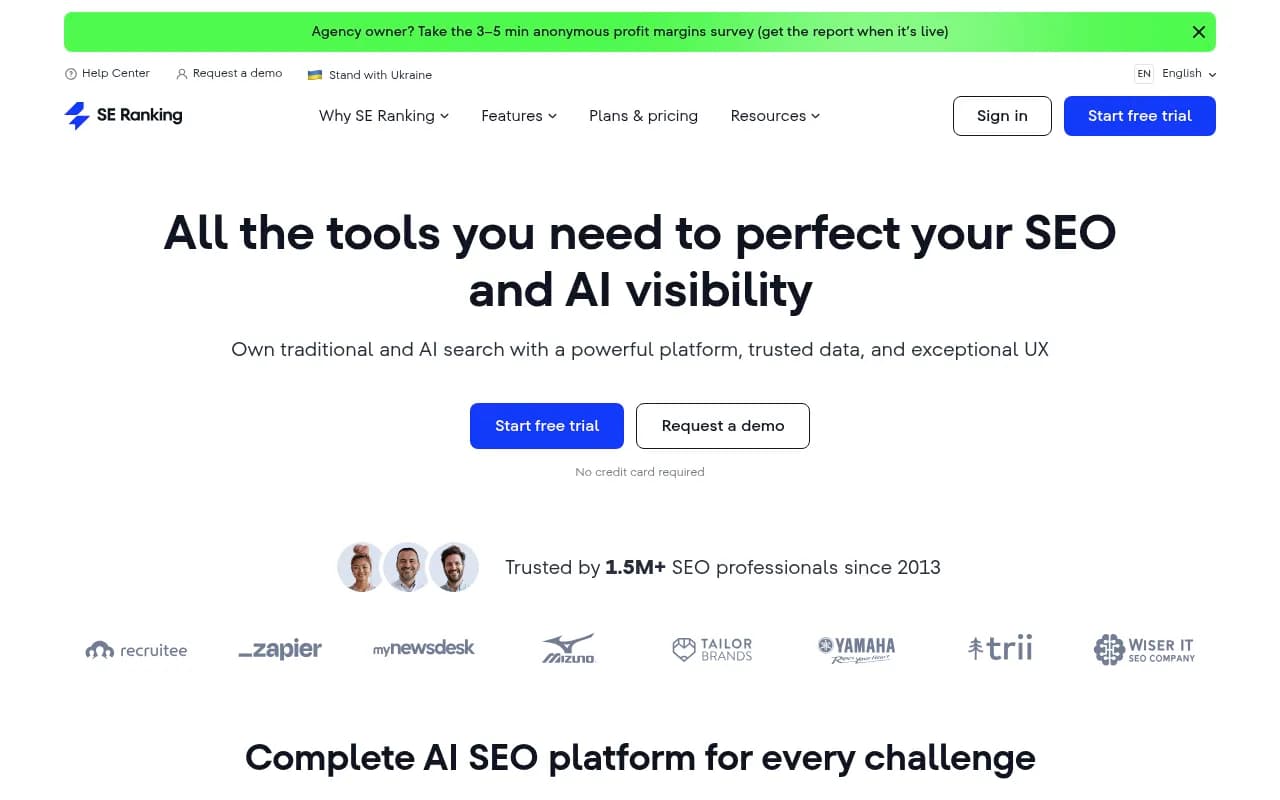
SE Ranking has two main AI-facing products: the AI Results Tracker (built into the core platform) and SE Visible, which is a standalone companion product.
AI Results Tracker
The AI Results Tracker lets you monitor how your brand appears in AI-generated search responses. You set up prompts -- questions or queries relevant to your business -- and the tool checks whether your brand is mentioned in the AI's answer, which position it appears in, and whether a link to your site is included.
It covers several AI engines, including ChatGPT, Google AI Overviews, Perplexity, and Gemini. You can track competitors alongside your own brand, which gives you a basic competitive picture: who's getting cited for the queries you care about.
The interface is clean and familiar if you're already a SE Ranking user. Results are presented in a dashboard format with visibility scores and trend lines. You can see how your mention rate changes over time, which is useful for spotting whether a content update actually moved the needle.
What it doesn't do: it doesn't tell you why you're being cited or not cited. There's no content gap analysis that maps your existing pages against what AI models are pulling from. There's no prompt volume data to help you prioritize which queries are worth targeting. And there's no crawler log data to show you whether AI bots are even visiting your pages.
SE Visible
SE Visible is SE Ranking's dedicated AI search visibility product, available as a separate tool at visible.seranking.com. It's more focused than the AI Results Tracker, designed specifically around tracking brand mentions in AI-generated answers.
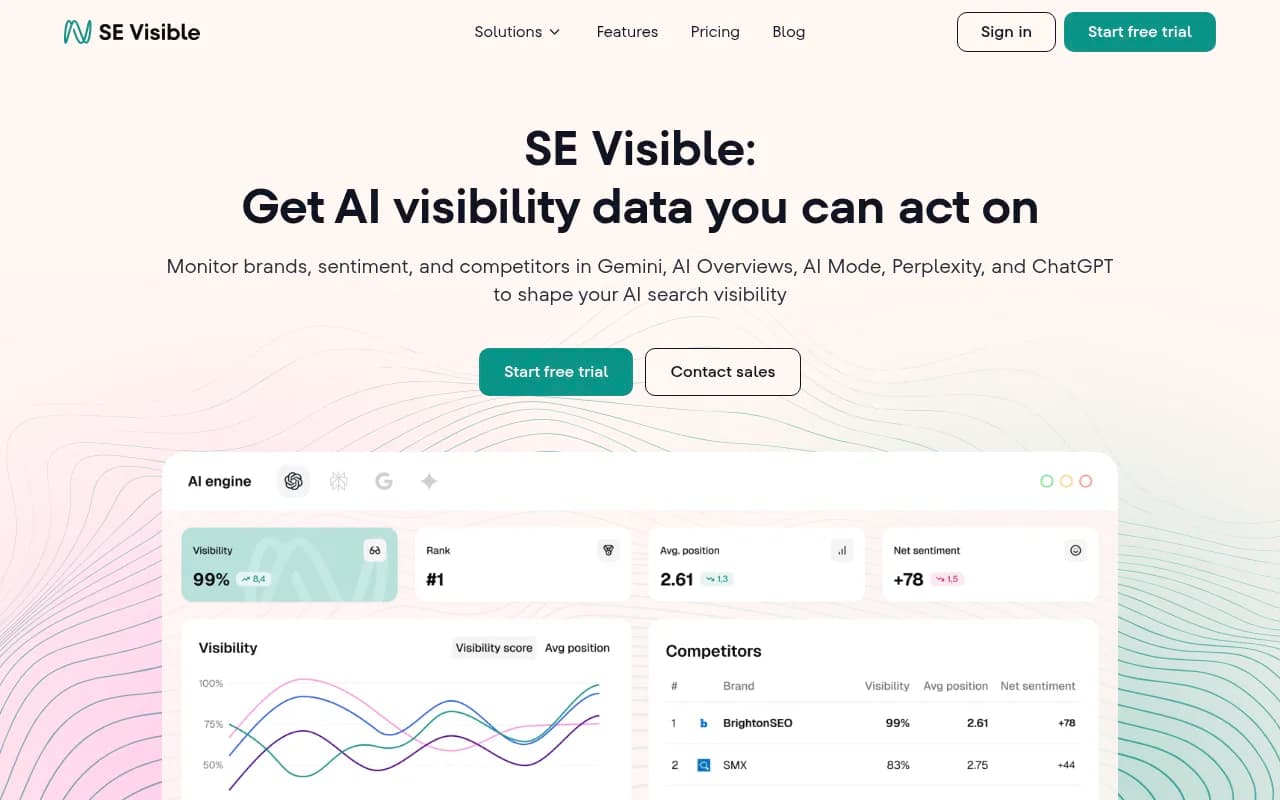
SE Visible gives you a visibility score, mention tracking across AI engines, and competitor comparisons. It's a cleaner interface for teams who want to focus purely on AI visibility without navigating the full SE Ranking platform.
The limitation is the same: it's a monitoring dashboard. The data is useful, but SE Visible doesn't generate content briefs, doesn't show you which external sources (Reddit threads, YouTube videos, third-party listicles) are driving competitor citations, and doesn't connect AI visibility to actual traffic or revenue.
What the SE Ranking GEO toolkit does well
To be fair, SE Ranking's AI features solve real problems for a specific type of user.
For teams already on SE Ranking, the AI Results Tracker is a low-friction way to add basic AI visibility monitoring without paying for another subscription. If you're tracking 50 traditional keywords and want to layer in 20 AI prompts, you can do that inside a tool you already know.
The competitive monitoring is genuinely useful. Seeing which competitors are cited for your target prompts -- and tracking that over time -- gives you a directional sense of where you're losing ground. It's not deep analysis, but it's better than flying blind.
The interface is polished. SE Ranking has always invested in UX, and the AI features follow that pattern. The dashboards are readable, the trend data is easy to interpret, and the setup process is straightforward.
It covers the major AI engines. ChatGPT, Perplexity, Google AI Overviews, and Gemini are the ones that matter most for most businesses, and SE Ranking tracks all of them.
Where SE Ranking's AI features fall short
This is where it gets honest.
No content gap analysis
The most important question in GEO isn't "am I being cited?" -- it's "what content do I need to create so that I will be cited?" SE Ranking doesn't answer that. There's no feature that shows you which prompts competitors rank for that you don't, or which topics your site is missing that AI models are actively looking for.
Without this, you're left knowing you have a problem but not knowing how to fix it.
No AI crawler logs
Understanding whether AI crawlers are visiting your pages -- and which pages they're reading -- is foundational to GEO. If GPTBot isn't crawling your most important pages, or if it's hitting errors, you need to know that. SE Ranking doesn't provide this data.
Some dedicated platforms give you real-time logs of AI crawler activity: which pages were visited, how often, what errors were encountered, and whether a crawl eventually led to a citation. That's the kind of data that lets you diagnose and fix indexing issues. SE Ranking doesn't have it.
No prompt volume or difficulty data
Not all prompts are equal. Some are searched by millions of people; others are niche queries with low volume. Some are dominated by authoritative sources that are nearly impossible to displace; others are genuinely winnable. SE Ranking's AI tracker doesn't give you volume estimates or difficulty scores for prompts, so you're essentially guessing at which ones to prioritize.
No content generation grounded in citation data
Several GEO platforms now let you generate content -- articles, listicles, comparison pages -- that's specifically engineered to fill the gaps AI models expose. SE Ranking doesn't do this. It's an SEO content tool (with AI writing features), but those writing tools aren't connected to AI citation data or prompt intelligence.
No offsite citation tracking
A significant portion of AI citations come from external sources: Reddit threads, YouTube videos, third-party review sites, industry listicles. Knowing which external pages are driving competitor citations -- and where you should be publishing or earning mentions -- is a meaningful part of a GEO strategy. SE Ranking doesn't track this.
No traffic attribution from AI search
If Perplexity starts citing your site more often, does that translate to more traffic? More conversions? SE Ranking doesn't connect AI visibility data to actual site traffic or revenue. You'd need to piece that together manually using Google Analytics or Search Console.
How SE Ranking compares to dedicated GEO platforms
Here's a direct comparison of SE Ranking's AI features against some of the dedicated tools in this space:
| Feature | SE Ranking | SE Visible | Promptwatch | Profound | Otterly.AI |
|---|---|---|---|---|---|
| AI mention tracking | Yes | Yes | Yes | Yes | Yes |
| Competitor comparison | Yes | Yes | Yes | Yes | Limited |
| Prompt volume/difficulty | No | No | Yes | Partial | No |
| Content gap analysis | No | No | Yes | No | No |
| AI crawler logs | No | No | Yes | No | No |
| Content generation | No | No | Yes | No | No |
| Offsite citation tracking | No | No | Yes | Partial | No |
| Traffic attribution | No | No | Yes | No | No |
| Reddit/YouTube insights | No | No | Yes | No | No |
| ChatGPT Shopping tracking | No | No | Yes | No | No |
| Traditional SEO tools | Yes | No | No | No | No |
| Pricing (entry) | Included in plan | Separate | $99/mo | Higher | Lower |
The pattern is clear. SE Ranking and SE Visible are monitoring tools. They show you data. Dedicated GEO platforms -- particularly those built around an action loop -- go further.

Who should use SE Ranking's AI features
SE Ranking's GEO toolkit makes sense for a specific profile:
Small teams with limited budgets who want basic AI visibility monitoring without adding another subscription. If you're already paying for SE Ranking and just want to see whether your brand shows up in ChatGPT answers, the AI Results Tracker is fine.
Teams in early-stage GEO exploration who aren't yet ready to invest in a dedicated platform. SE Ranking gives you enough data to understand the problem before you commit to solving it properly.
Agencies managing many clients who need a quick, dashboard-friendly way to show clients their AI visibility status alongside traditional SEO metrics. The combined reporting is convenient.
What it's not right for: any team that wants to move from monitoring to optimization. If you want to close the gaps you find, you need more than SE Ranking offers.
What a more complete GEO workflow looks like
The teams making real progress on AI visibility in 2026 aren't just tracking mentions -- they're running a cycle: find gaps, create content, track results.
That means starting with prompt intelligence: which queries are AI models answering in your category, which ones have meaningful volume, and which ones you have a realistic shot at winning. Then mapping those prompts against your existing content to find what's missing. Then generating content specifically designed to fill those gaps -- not generic SEO articles, but pages engineered around what AI models are actually looking for. Then tracking whether those pages get crawled, cited, and whether citations translate to traffic.
SE Ranking covers the "track results" part of that cycle, loosely. It doesn't help with the rest.
Platforms like Promptwatch are built around the full loop. The Answer Gap Analysis shows exactly which prompts competitors are visible for that you're not. Content Agents generate articles grounded in real citation data, prompt volumes, and competitor analysis. AI crawler logs show you when pages move from crawl to citation. And traffic attribution connects visibility to revenue.
That's a fundamentally different product than a monitoring dashboard -- and it's the difference between knowing you have a problem and actually fixing it.
Other tools worth considering alongside SE Ranking
If you're using SE Ranking for traditional SEO and want to add dedicated GEO capability, a few tools are worth evaluating:
Profound is one of the stronger enterprise-grade AI visibility monitors. It covers more AI engines than most and has solid reporting. It's more expensive than SE Ranking's add-on and still primarily monitoring-focused, but the data depth is better.
Profound

Otterly.AI is a simpler, cheaper monitoring option. Good for teams that just want to track brand mentions without a lot of complexity. Doesn't do content generation or gap analysis.
Otterly.AI

Peec AI covers the basics of AI search monitoring with a clean interface. Similar limitations to Otterly in terms of depth.

AthenaHQ has a more analytical approach to AI visibility tracking, with better competitive benchmarking than SE Ranking. Still monitoring-focused.

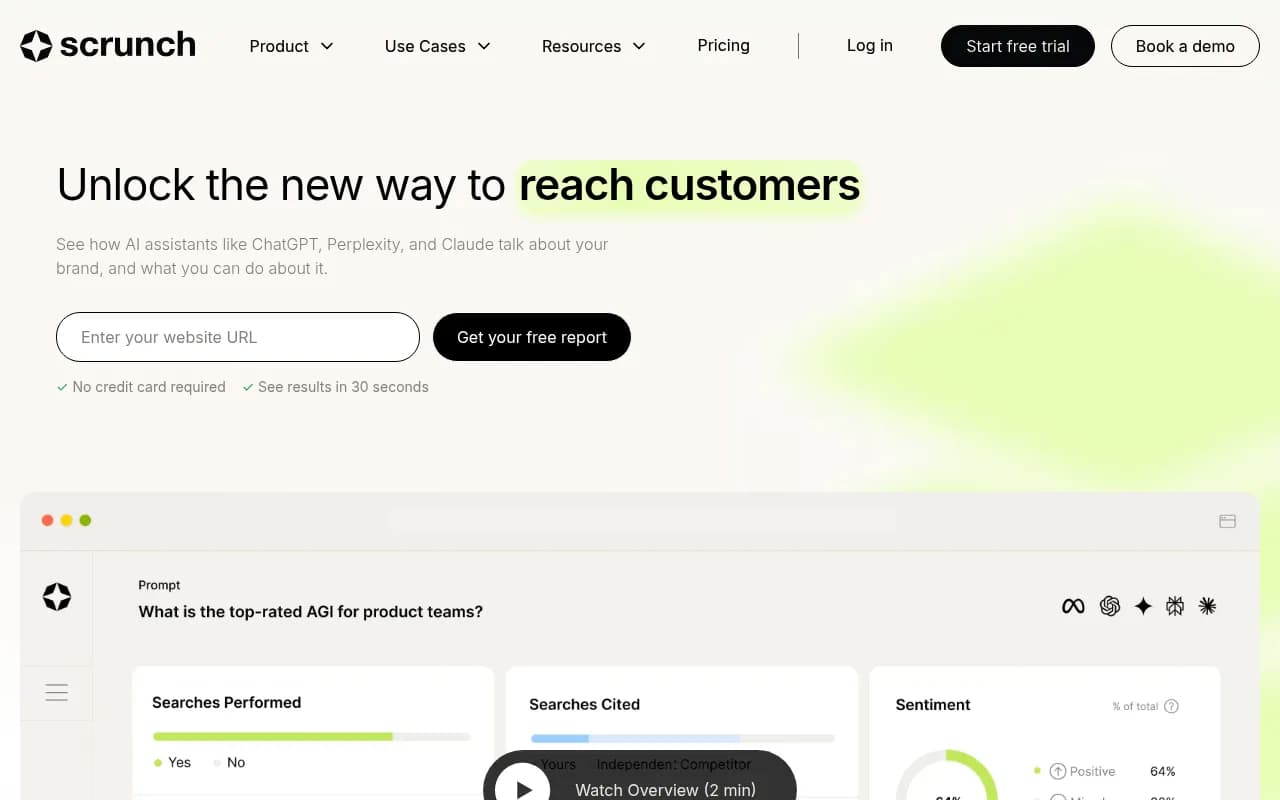
Scrunch AI is worth a look for teams that want a dedicated AI visibility platform with some content optimization features.
The honest verdict
SE Ranking's AI visibility features are a reasonable addition to an already solid SEO platform. If you're an existing SE Ranking customer, turning on the AI Results Tracker costs you nothing extra and gives you a basic read on where your brand stands in AI-generated answers. That's genuinely useful.
But "useful starting point" and "complete GEO solution" are different things. SE Ranking tells you where you are. It doesn't tell you why you're there, what content you need to create to improve, whether AI crawlers are actually visiting your pages, or whether your AI visibility improvements are driving real traffic.
For teams that are serious about AI search -- and given that roughly 68% of Google searches ended without a click in early 2026 (SparkToro's analysis of Similarweb clickstream data), serious is the right word -- SE Ranking's built-in GEO toolkit is a floor, not a ceiling. You'll likely need a dedicated platform to do the actual optimization work.
The good news is that the category has matured enough that you have real options. The question is whether you want a tool that shows you the problem, or one that helps you solve it.