
Key takeaways
- Brand mention tracking is not enough for a store. You need to know which SKUs get recommended, at which retailer, and next to which rivals.
- Profound has the most detailed ChatGPT Shopping module (shopping mode rate, SKU analysis, merchant layer), but one listing says it sits on Enterprise only, and its own page says coverage is focused on ChatGPT.
- AthenaHQ describes SKU-level tracking across several marketplaces, but the strongest claims come from a competitor's page, and credit-based pricing can run out fast.
- Searchable lists AI shopping data on every tier from $125/mo, which makes it the cheapest route to shopping data of the three, with a thinner engine list by default.
- Shopping cards show up in a small share of ChatGPT responses, so product page quality and feed hygiene matter as much as the tool you pick.
Why ecommerce needs a different kind of AI visibility tracking
When a shopper asks ChatGPT for the best stick vacuum for a small flat, the answer can be a product carousel, not a list of links. That changes what you measure. "Was my brand mentioned?" is a SaaS question. For a store the questions are narrower: did my product appear, at what price, from which merchant, and who sat next to it?
All three tools here track brand visibility across AI engines. The split is in how far they go into products. That is what this guide compares.
One caution before the comparison. Much of the public material on these three tools is written by competitors. Profound writes about AthenaHQ, Searchable writes about Profound, and a third-party review of Searchable comes from a vendor with a rival product. I flag those conflicts below instead of smoothing them over.
How often does ChatGPT actually show shopping features?
Less often than the hype suggests. Promptwatch Data's ChatGPT Shopping usage report finds that product cards, shopping recommendations and price comparisons attach to only a low single-digit percentage of web-search responses. The rate also moves in steps: it roughly doubled overnight in late May, then fell back weeks later, which looks like OpenAI tuning when cards appear.
Trigger rates run far higher on commercial and transactional prompts than on the all-prompt average. So the prompts you track matter more than the tool. If you only track informational queries, you will conclude shopping is irrelevant.
Citations tell a related story. In Promptwatch's citation share by content type (Sep 28 to Oct 4, 2026), product pages earned 22.4% of all ChatGPT citations and landing pages 16.8%. For commercial prompts, product pages rose to 26.0%, with listicles at 15.0% and comparisons at 7.9%. For a store, your product pages are the main citation surface, and "best of" lists on other sites decide a lot of shortlists.
What an ecommerce AI visibility tool should track
| Capability | Why it matters for a store |
|---|---|
| Catalog upload or product mapping | Ties AI answers to your actual SKUs |
| SKU-level visibility | Shows which products win and which never appear |
| Merchant or retailer share | Shows whether you, Amazon or a reseller gets the sale |
| Shopping-trigger rate | How often category queries open a shopping interface instead of text |
| Shopping cards and ads in answers | Paid units can push organic products down |
| Cited sources per answer | Review sites, listicles and Reddit threads behind a recommendation |
| Content and listing fixes | Turns a gap into a page, feed or description change |
Keep this list handy. Every tool below gets measured against it.
Profound: the deepest ChatGPT Shopping module
Profound has the most specific shopping story of the three.
Profound

According to Profound's own materials, its Shopping feature does three main things:
- Shopping Mode Rate shows which prompts make ChatGPT surface shopping tiles in your category.
- SKU-level analysis tracks how often your products appear and flags trend changes.
- The Merchant Layer shows which retailers own your checkout options and how share splits by merchant.
You can also see where competitors win placements and how their products are described in the answers that feature them. A Mentionova roundup adds that it tracks how engines describe product attributes and shopper sentiment.
Where Profound is limited
Two caveats. First, Profound's own page says shopping coverage is currently focused on ChatGPT Shopping, with other commerce surfaces still evolving. If your category sells heavily through Amazon or Google, that is a real gap.
Second, access. Mentionova's read of the pricing page (3 Nov 2026) lists ChatGPT Shopping on Enterprise only, not on the free trial. A DeepSmith comparison reports a $99/month Starter plan billed yearly with 50 prompts, ChatGPT only and one seat. That figure is third-party and I could not verify it against Profound's own pricing page, so confirm before you budget. Expect a sales conversation for the shopping module.
The claim that conflicts with Profound's own page
DeepSmith says Profound's Shopping module has "no equivalent" in AthenaHQ. Profound's own article says the opposite: that AthenaHQ has multi-marketplace SKU tracking. Both can be partly right. AthenaHQ may track more surfaces with less documented depth, while Profound goes deeper on one. Test it in a trial, not in a blog post.
AthenaHQ: broad product tracking, murkier methodology
AthenaHQ markets itself to ecommerce directly.

Per Mentionova's read of its ecommerce page, AthenaHQ tracks visibility at product, category or brand level, serves marketplace sellers as well as direct-to-consumer brands, and ties AI recommendations to conversions through your analytics. Profound's comparison page says AthenaHQ tracks SKUs across ChatGPT Shopping, Amazon Rufus, Google Shopping AI and Walmart, but also notes the methodology is undisclosed. That is a competitor's description, and I have not verified the shopping features on AthenaHQ's own site.
Pricing and the credit problem
- Essential: free, 300 credits, covering five engines.
- Starter: $295/month, 3,600 credits, 11 models, Shopify and Webflow integration, GA4 and Search Console integration.
- Enterprise: custom, adding multiple countries, persona targeting and SSO.
One credit equals one AI response. This is where teams get caught. An AEO Action review calculates that 50 prompts across five engines run daily is roughly 7,500 responses a month, more than double what Starter includes. API access and extra credits are paid add-ons with no published price. Geoptie says the Shopify integration includes revenue attribution, which would suit a store, though I only have that from a review.
Before buying, work out how many product prompts times engines times days you need. Then compare it to the credit allowance.
Searchable: the cheapest way into shopping data
Searchable is the least known of the three but has the simplest packaging for stores.
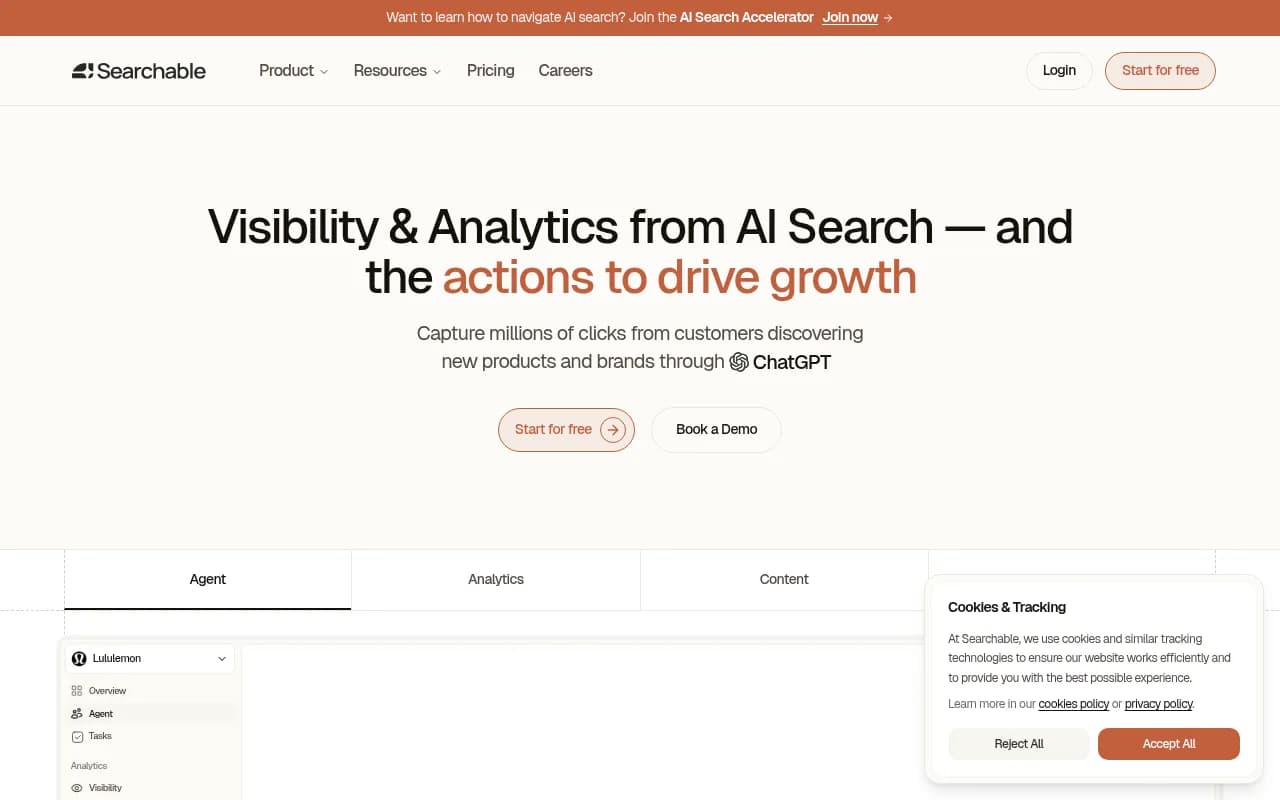
According to its pricing page, AI shopping data is included on every tier, including Pro.
| Plan | Price | Tracked prompts | Articles per month | Site audits per month |
|---|---|---|---|---|
| Pro | $125/mo | 100 | 20 | 200 |
| Scale | $400/mo | 500 | 80 | 1,000 |
| Enterprise | $999+/mo | 1,250 | 200 | 3,000 |
Every tier also lists citation tracking, competitor analysis, Agent Analytics, API, MCP, exports and daily prompt frequency. There is a 14-day free trial. White-label reports start at Scale, and agency plans start at $250/month.
A third-party review from Honeyb describes the AI Shopping module as tracking product visibility and the prompts that trigger shopping results, with traffic measured from AI crawlers, referrals and GA4. Honeyb sells a competing product, so weigh it accordingly. Its main complaint is the engine limit: signup links show ChatGPT, Google AI Overviews and Perplexity by default, with other engines priced separately.
Searchable also offers a free ChatGPT Product Visibility Checker that tests readiness for OpenAI's Agentic Commerce schema. It is a useful free first step before paying anyone.
What I could not verify: how deep Searchable's shopping data goes. SKU-level tracking, a merchant layer and Amazon Rufus coverage are not documented in what I found. "AI shopping data" on a pricing line could mean a lot or a little.
Side-by-side comparison
| Searchable | AthenaHQ | Profound | |
|---|---|---|---|
| Entry price | $125/mo (Pro) | Free; Starter $295/mo | Custom for Shopping; Starter reported at $99/mo (unverified) |
| Shopping on entry plan | Yes, listed on every tier | Not tied to a plan on the pricing page | Listed as Enterprise only |
| SKU-level tracking | Not documented | Described, methodology undisclosed | Yes |
| Merchant or retailer share | Not documented | Not documented | Yes (Merchant Layer) |
| Shopping-trigger rate | Prompts that trigger shopping results | Not documented | Yes (Shopping Mode Rate) |
| Surfaces covered | ChatGPT, AIO, Perplexity by default | Claimed: ChatGPT Shopping, Rufus, Google Shopping AI, Walmart | ChatGPT Shopping focus |
| Engines on entry plan | 3 by default | 5 on Essential, 11 on Starter | ChatGPT only on reported Starter |
| Content production | Articles each month | Content optimization agent | Agents and templates |
| Trial | 14 days | Free tier | Free trial |
Which one should you pick?
A small store watching its budget
Searchable is the easiest place to start because shopping data is on the entry plan and you do not need a sales call. Run the free ChatGPT Product Visibility Checker first, then use the 14-day trial to see whether the shopping data resolves to your products or just to category-level trends.
A mid-size brand selling across marketplaces
AthenaHQ is worth a trial if Amazon and Walmart matter as much as ChatGPT. Check the credit math before you commit, and ask directly how SKU tracking works on each marketplace, since the methodology is not public.
A large retailer or multi-channel brand
Profound is the strongest fit if merchant share is the question: who owns the checkout, you, Amazon or a reseller. Accept that the module is likely Enterprise-gated and ChatGPT-focused.
Other tools to consider
These three are not the only options. Mentionova's roundup says Peec AI lists SKU-level tracking from $95/month with a Shopify or CSV catalog upload, and Otterly lists ChatGPT Shopping Cards and ads tracking from $29/month. Both are in our catalog.

Otterly.AI

Promptwatch is also worth a look, in particular for stores that want tracking connected to action. Its ChatGPT Shopping feature alerts you when competitors appear in shopping results instead of you, and Ads Radar shows which advertisers bid on your prompts. Both sit on the Business plan at $579/mo, and the platform adds IP-verified AI crawler logs and a Content Agent that writes and publishes the pages AI cites. You can see how it works on the ChatGPT Shopping page or compare it directly with the Promptwatch vs Profound page.

For a wider view of the category, the GEO software directory at bestgeosoftware.com lists more options.
What to do before you buy anything
A tool will not fix weak product data. Promptwatch Data recommends getting product data AI-ready first: complete Product schema, accurate price and availability, and a clean merchant feed. A growbydata.com article says ChatGPT's inputs include feed access through Shopify Catalog or a direct application, plus third-party review and retail coverage. I did not verify that against OpenAI's documentation, so check OpenAI's own feed requirements.
Then run the commercial and transactional prompts your buyers actually use, and record whether shopping cards appear and which brands fill them. Check across several days. The rate moves in steps, and a step change may mean OpenAI opened or closed a window for your category.
Finally, watch ads. Promptwatch's ChatGPT ads data (May 20 to Aug 17, 2026) shows ChatGPT served no ads until May 27, then reached a 90-day average of 20.1% of web-search responses with citations, with the last 7 days averaging 32.4%. If paid units sit above organic product results in your category, your organic rank matters less than it appears.
Questions to ask each vendor on a demo
- Is tracking at SKU level, or category level dressed up as product data?
- Which shopping surfaces are tracked today, and which are on a roadmap?
- Is shopping data on the plan I am buying, or on a higher tier?
- How is a "response" or "credit" counted, and how many will my product prompts use per month?
- Can I upload my catalog, and does it map to my own SKUs?
- Do you show merchant share, or only whether my brand appeared?
The vendor that answers these specifically, with a live demo on your own catalog, is usually the one to trust.