
Key takeaways
- I could not find an independent test of Searchable, AthenaHQ and Profound on the same 60 prompts. Nearly every comparison online is written by one of the vendors or a rival, so treat them as marketing.
- Identical prompts return different answers and sources from week to week. Promptwatch Data shows ChatGPT's fanouts per response moving from 2.15 in early December to about 1.84 by early March. Without fixed run dates, any accuracy comparison is noise.
- Engines also differ in how many sources they cite, so citation counts can't be compared across engines.
- The practical answer is a small, repeatable test: 60 prompts, three tools, same dates, same engines, with a manually verified ground truth.
- Profound is positioned as the deeper enterprise tool, AthenaHQ as the more guided one, and Searchable as the action-and-content option. None of that tells you whose numbers are right.
Why there is no clean answer yet
I went looking for a head-to-head accuracy test of these three platforms. I didn't find one. What exists is a pile of comparison pages, and almost all of them are written by a party with a stake in the outcome.
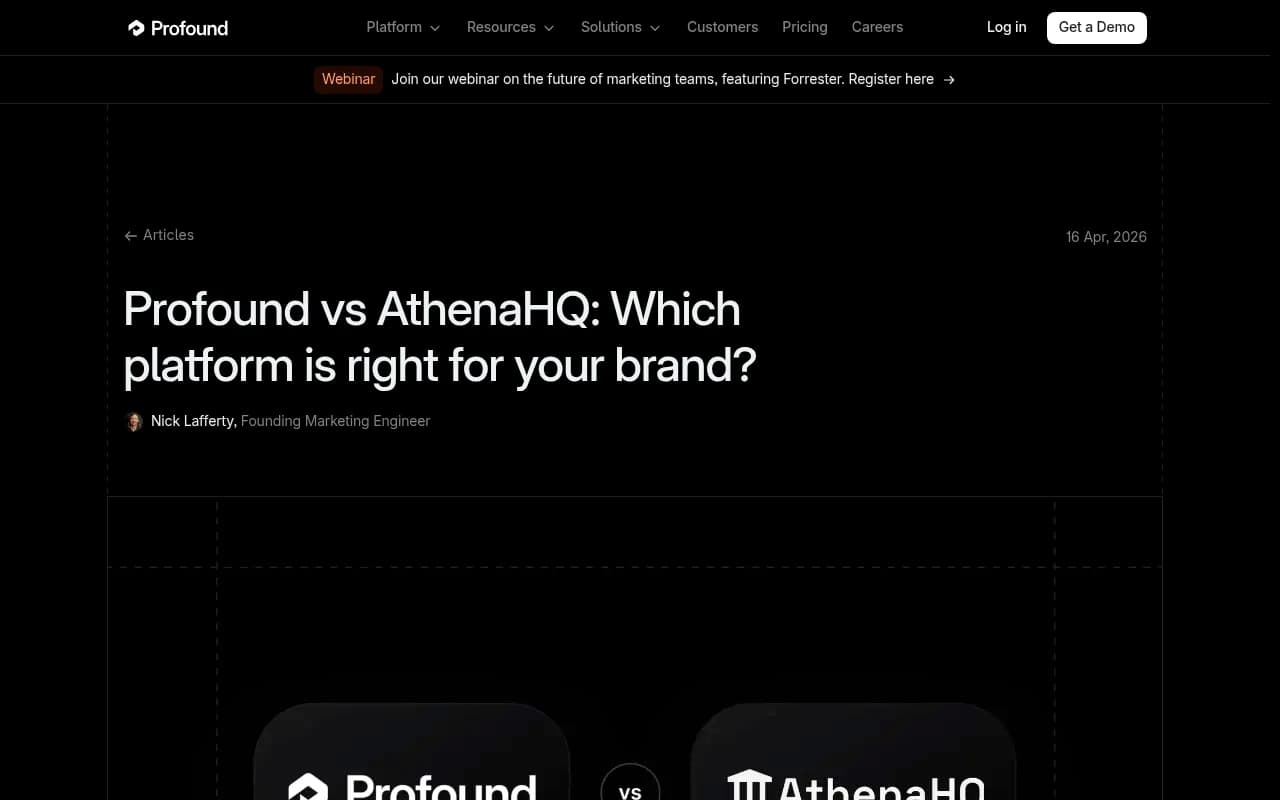
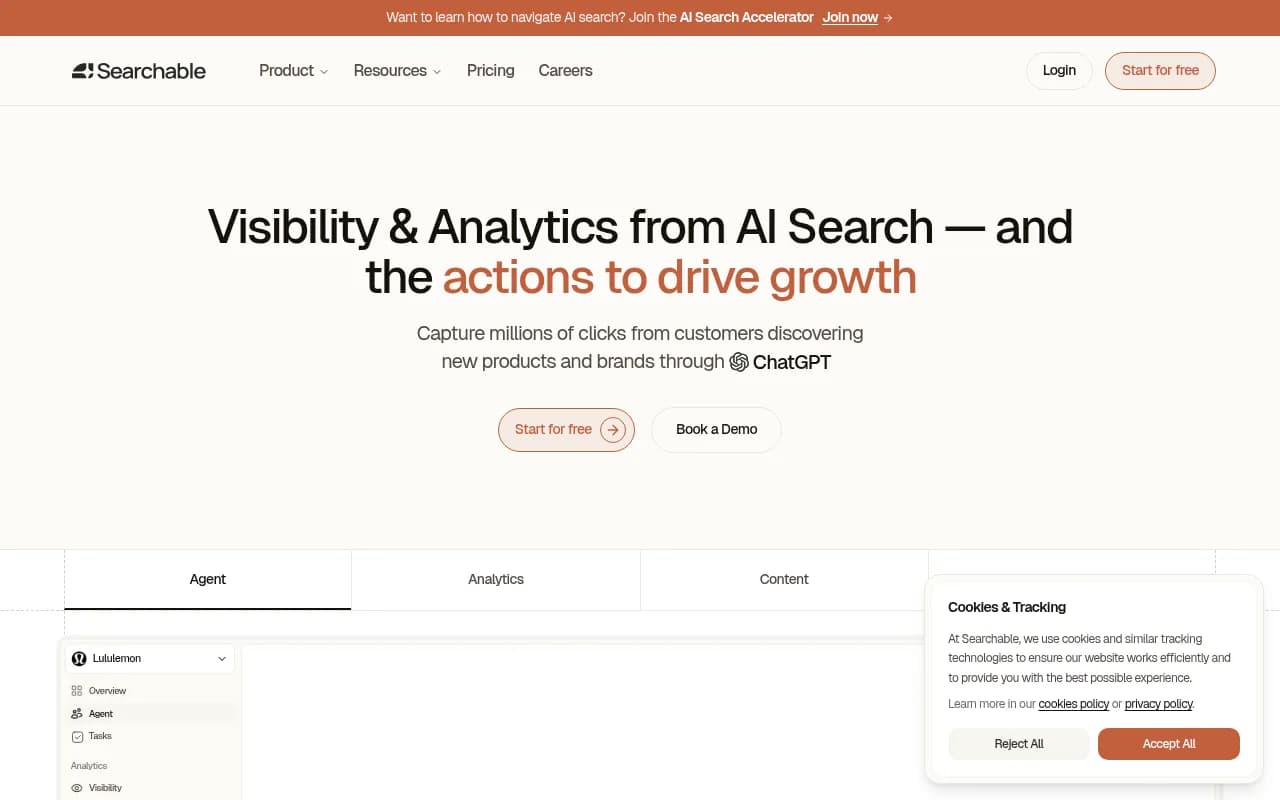
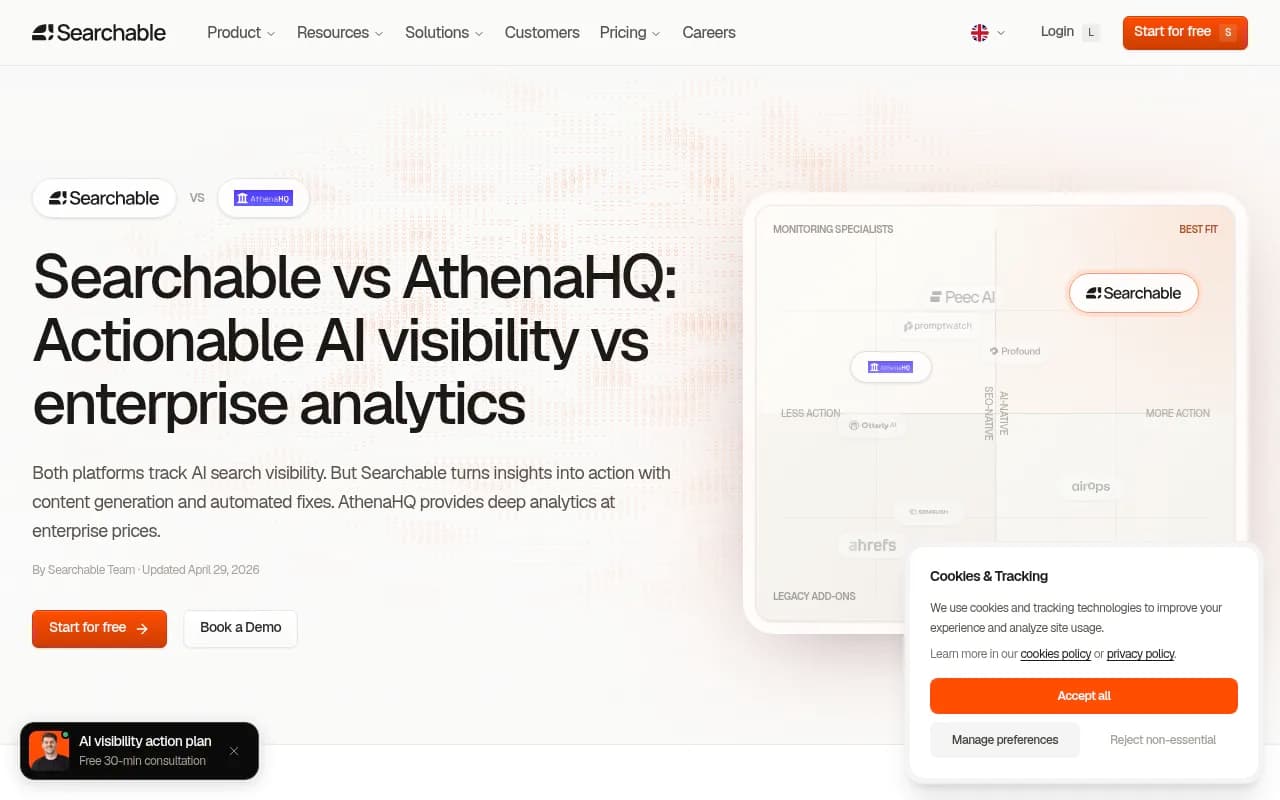
Profound published its own Profound vs AthenaHQ article on 16 April 2026. Searchable publishes its own Searchable vs AthenaHQ page, updated April 29, 2026. Raccoon AI and WorkDuo publish theirs, and WorkDuo is a competitor that wins its own comparison. Reading them is useful for understanding positioning. It is not evidence about accuracy.
So this guide does two things. It lays out what each vendor claims, and it gives you a method to measure accuracy on your own 60 prompts instead of trusting anyone's slide.
What each platform claims
Profound


| Tool | Positioning | Claim worth checking | Source type |
|---|---|---|---|
| Profound | Enterprise AEO, deep AI search intelligence, agentic workflows | 2B+ real user prompts, refreshed weekly, broken down by intent and demographics | Profound's own article |
| AthenaHQ | Guided monitoring and recommendations, Shopify-centered e-commerce attribution | Prompt volume from a proprietary Query Volume Estimation Model | Described by Profound and Raccoon AI |
| Searchable | Visibility plus built-in content generation and fixes | Starts at $125/month vs AthenaHQ's $295/month | Searchable's own page |
A few notes on that table. Profound says AthenaHQ gives no public detail on dataset size or validation for its volume model. That may be true, but it comes from a competitor. Searchable's pricing claim also comes from Searchable, and a snippet on its comparison page shows "$1.25 (Pro) / $0.80 (Scale)" with no clear unit. Verify pricing on each vendor's site before you budget. HubSpot's write-up notes that Profound's only self-serve option is a time-boxed free trial and everything else goes through sales, which matters if you want to run a test quickly.
Why the same 60 prompts give different results
Before you blame a tool for being wrong, rule out the reasons that two correct tools disagree.
The searches behind a prompt keep changing
Promptwatch's ChatGPT query fanouts report tracks how many web searches ChatGPT runs per response. Average fanouts were 2.15 in early December and about 1.84 by early March. Fanouts then returned in April at exactly 1.0 per response after a gap in the data. Average fanout query length fell from about 117 characters to the high 80s, then to about 53 characters.
The page's intro says one prompt can trigger "3-8+" searches, which conflicts with those averages. I'd trust the averages. Either way, the lesson is the same: a prompt run in December and the same prompt run in April are not the same experiment. A comparison needs fixed run dates, and all three tools need to be queried in the same window.
Engines cite different numbers of sources
Promptwatch's average sources per response report (first published September 23, 2025) found ChatGPT cites about 5 sources per web-search answer, AI Overviews about 10, and Perplexity almost exactly 10 every day. Copilot swung from under 2 to nearly 17 within a few weeks. If one tool reports 40 citations for a prompt and another reports 22, check which engines and which days before concluding anything.
Promptwatch suggests Perplexity as a test bench precisely because its citation count barely moves. That is a good tip for this exercise.
Real interface versus API
Some platforms collect answers from the actual consumer interface, others from APIs. User-facing answers and citations can differ from API output. Ask each vendor which one it uses per engine, and whether location and personalization are controlled. This alone can explain a large gap in mention rates.
A 60-prompt accuracy protocol
Here is the setup I'd use. It takes a couple of days of work, not a quarter.
Build the prompt set
Split the 60 prompts into fixed buckets so you can see where each tool breaks:
- 20 branded prompts (your brand name appears in the question)
- 20 category prompts ("best X for Y", no brand named)
- 10 competitor comparison prompts
- 10 long-tail or local prompts
Write them down in a spreadsheet and don't edit them mid-test. Use the same country and language across all three tools.
Fix the conditions
| Variable | What to lock |
|---|---|
| Run window | Same 3 to 5 days for all tools |
| Engines | Same set, for example ChatGPT, Perplexity, Google AI Overviews |
| Location and language | Identical per monitor |
| Prompt text | Exactly as written, no vendor-suggested rewrites |
| Repetitions | Run each prompt at least 3 times to see variance |
Create your ground truth
This is the step people skip. Pick one engine, run each of the 60 prompts yourself in a clean browser session, and record three things: whether your brand is mentioned, which competitors appear, and which domains are cited. That is your reference set. A tool is accurate to the extent that its reported data matches what a real user sees.
Score each tool
For each tool and each engine, compute:
- Mention agreement: how often the tool's mention flag matches your manual check.
- Citation overlap: share of manually observed cited domains the tool also captured.
- Position agreement: does the brand order within the answer match?
- Variance: how much the tool's own result moves across your 3 repeat runs.
A tool with high variance isn't necessarily wrong, since the engines themselves are nondeterministic. But a tool that reports a steady 100% mention rate on prompts where you only see the brand half the time is a red flag.
Check the claims, not just the mentions
Accuracy is also about what AI says about you. Pick 10 responses and verify the factual claims against your own site. Profound markets a FactCheck feature, and Promptwatch has a Fact Check feature that checks claims against your pages and cited third-party sources. Whatever you use, the useful question is whether the tool correctly flags a wrong claim you planted a check for, such as an outdated price.
Questions to ask each vendor
| Question | Why it matters |
|---|---|
| Real UI scraping or API calls, per engine? | Answers and citations can differ between the two |
| How is prompt volume calculated and validated? | Profound and AthenaHQ describe very different approaches |
| How often do prompts run, and can you pin dates? | You need fixed windows for a fair test |
| Can you export raw responses? | You can't audit a score you can't see |
| How are mentions detected? | Brand names that are common words cause false positives |
| What is the self-serve path? | Profound routes most buyers through sales |
If a vendor won't give raw responses for your 60 prompts during a trial, that tells you something.
Which one fits which team, with caveats
Take these as positioning, not verdicts, because the sources are vendors and affiliated reviewers.
Profound reads as the heavy option: prompt data, citation tracking, AI crawler analysis, shopping visibility and agentic workflows, according to Raccoon AI's May 28, 2026 write-up. It suits enterprise teams that can go through a sales process.
AthenaHQ is described as more guided, with lower adoption friction, clearer reporting and Shopify-centered attribution. Small and mid-size teams who want something easy to adopt will likely start here.
Searchable leans toward execution, pairing visibility data with content generation and fixes. Its own page argues for action over analysis, and that is a claim to test in a trial rather than accept.
Add a fourth tool to your test
If you're running a bake-off anyway, it is worth including one platform that collects data from the real interfaces of AI engines and also connects to what happens on your site. Promptwatch does that: it tracks ChatGPT, Gemini, Perplexity, Google AI Overviews and others from their real UIs, and its AI crawler logs show whether bots actually read your pages. That gives you a second reference point beyond the reported mention rate, because you can compare a tool's claim that a page is cited against crawler and traffic data from your own server.

You can start with the 7-day free trial and check pricing at promptwatch.com/pricing. For a broader view of the category, the GEO software directory lists dozens of other trackers, and Promptwatch's 2026 platform comparison and head-to-head pages like Promptwatch vs Profound cover the same ground from its side, with the usual caveat that Promptwatch is a vendor too.
Reporting your results honestly
If you publish or share the outcome internally, include:
- The exact run dates and engines.
- The number of repeats per prompt.
- Which tool plans and tiers you used, since lower tiers may limit engines or frequency.
- Where your ground truth came from, and that it is a sample of 60, not the market.
- Any prompt where tools disagreed and you couldn't tell who was right.
That last item is the most honest part. On a handful of prompts, nobody will be provably correct, because the engines themselves returned different things on each run.
FAQ
Is there a published accuracy benchmark for Searchable, AthenaHQ and Profound?
Not one I could find. The comparisons available are vendor-authored or affiliated, so none can be treated as independent.
Why do two tools report different visibility for the same prompt?
Common causes: different collection methods (UI versus API), different run dates, different locations, personalization, and the natural variance in AI answers. Promptwatch Data shows even citation counts vary widely by engine, from about 5 in ChatGPT to about 10 in AI Overviews and Perplexity.
How many prompts do I need?
Sixty is enough to spot big disagreements and gross errors. It is not enough to rank tools to the decimal. Treat differences of a few percentage points as noise.
Should I trust vendor pricing comparisons?
No. Confirm prices on each vendor's own pricing page or in a sales call, particularly because snippets like Searchable's per-unit figures lack clear units.
Which engine is the best test bench?
Perplexity, since its citation count is steady at about 10 per response. Copilot is the worst, because its average swung from under 2 to nearly 17 sources within weeks.