Key takeaways
- Searchable offers solid AI visibility monitoring with built-in content generation, but its feature set is narrower than it first appears.
- Promptwatch covers the full optimization loop: prompt tracking, citation analytics, AI crawler logs, content agents, and traffic attribution in one platform.
- If your team needs to act on data (not just read it), Promptwatch has a clear structural advantage.
- Searchable suits teams that want a simpler, lighter tool and don't need deep attribution or crawler-level diagnostics.
- Both tools offer free trials. The right choice depends on whether you're monitoring or optimizing.
Most AI visibility tools launched in 2024 and 2025 with the same pitch: "See where your brand appears in ChatGPT and Perplexity." That was enough to be interesting back then. In 2026, it's barely table stakes.
The real question teams are asking now is: once I know I'm invisible, what do I do about it? That's where Searchable and Promptwatch diverge in ways that actually matter.
This comparison goes feature by feature. No fluff, no vague "both are great in their own way" hedging. Just what each platform does, where each falls short, and which one makes more sense depending on what your team actually needs.
What each platform is trying to do
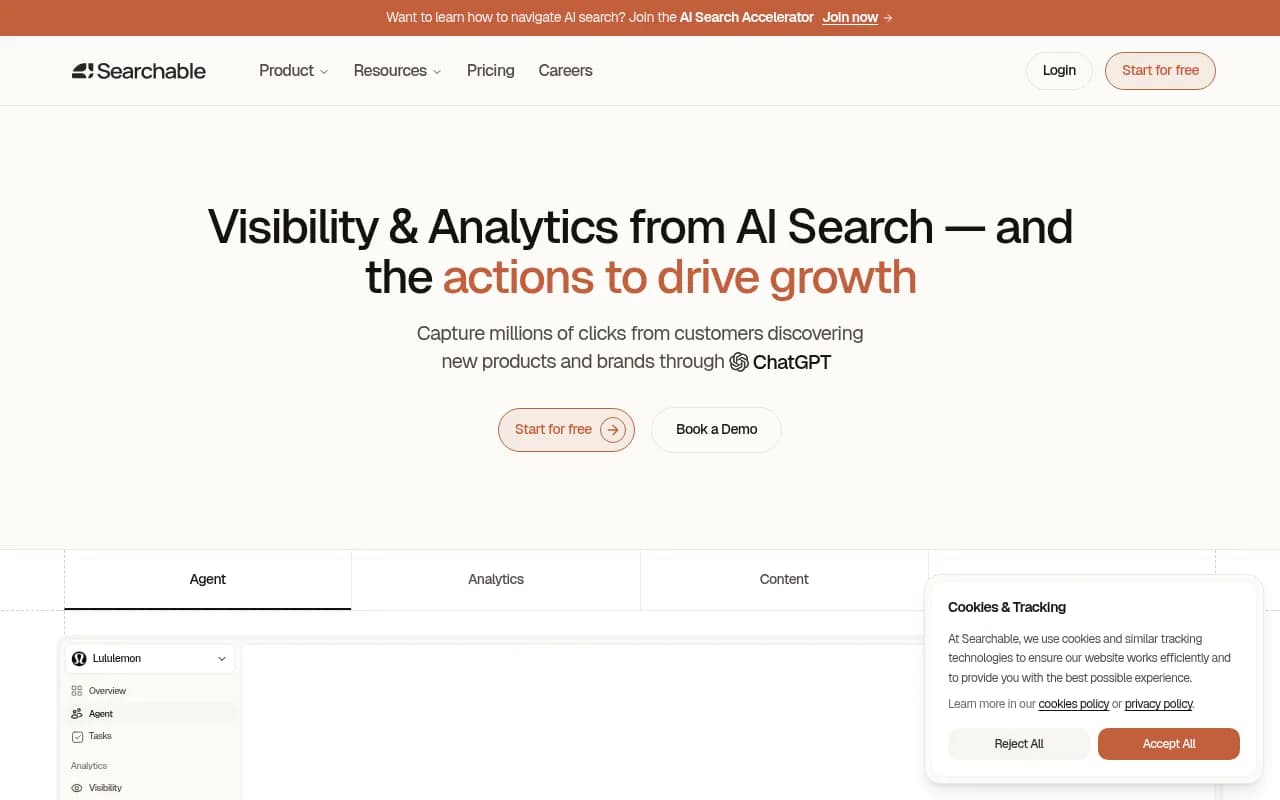
Searchable positions itself as an AI Search Visibility Platform with built-in content generation. The idea is that you track your brand across AI engines and then use the platform's content tools to improve your visibility. It's a reasonable concept, and it's more complete than pure monitoring tools like Otterly.AI or Peec.ai.
Promptwatch is built around what it calls the "action loop": find gaps, generate content, track results. It's been used by 1,480+ brands including Booking.com and Center Parcs, and its data (4.5 billion+ citations, clicks, and prompts processed) has been cited in the Wall Street Journal and Axios. It monitors 10 AI models and pairs that monitoring with crawler logs, content agents, and revenue attribution.

The difference in philosophy shows up immediately in how each platform is structured. Searchable is primarily a monitoring tool with content features bolted on. Promptwatch is built around the optimization cycle, with monitoring as the foundation rather than the ceiling.
AI model coverage
This is where both platforms are reasonably competitive, but Promptwatch has a wider net.
| Platform | Models covered |
|---|---|
| Searchable | ChatGPT, Perplexity, Google AI Overviews, Gemini (varies by plan) |
| Promptwatch | ChatGPT, Perplexity, Google AI Overviews, Google AI Mode, Claude, Gemini, Meta/Llama, DeepSeek, Grok, Mistral, Copilot |
Promptwatch tracks 10 models, including DeepSeek, Grok, and Mistral, which most competitors still don't cover. If your audience uses Claude or Copilot, you'd be flying blind with a narrower tool.
There's also a methodological difference worth flagging. Promptwatch tracks how AI engines behave in real user interfaces, not just through API calls. This matters because what a user sees in ChatGPT's browsing interface can differ from what the API returns. Most tools, including many Searchable competitors, rely on API outputs alone.
Prompt tracking and intelligence
Both platforms let you set up prompts to monitor. But what you get back is different.
Searchable gives you visibility scores and mention tracking for the prompts you configure. It's clean and readable. What it doesn't give you is much context about the prompts themselves: how often real users are asking them, how hard they are to rank for, or how one prompt branches into related sub-queries.
Promptwatch adds volume estimates and difficulty scores for each prompt, plus query fan-outs that show how a single prompt expands into sub-queries. That last feature is genuinely useful. If you're tracking "best project management software," you probably also want to know that AI models are branching that into "best project management software for remote teams" or "best project management software for agencies" -- and whether you're visible for those too.
The practical effect: Promptwatch helps you prioritize which prompts to target. Searchable tells you how you're doing on the prompts you already chose.
Answer gap analysis and content gap detection
This is one of the most important features in the category, and it's where the platforms diverge most sharply.
Promptwatch's Answer Gap Analysis shows you exactly which prompts your competitors are visible for that you're not. You see the specific content your site is missing -- the topics, angles, and questions AI models are already answering from competitor pages. It's not a vague "you should write more content" suggestion. It's a specific list of gaps with evidence.
Searchable has content gap features, but they're less granular. You get a sense of where you're underperforming, but the diagnostic depth isn't the same. You're less likely to walk away with a clear action item.
For teams that want to go from "we're not showing up" to "here's exactly what to write," Promptwatch's gap analysis is more actionable.
Content generation
Both platforms include AI content generation, which puts them ahead of monitoring-only tools like Otterly.AI or Peec.ai. But the quality of the generation differs.
Searchable's content tools let you create articles and briefs based on your visibility data. It's a useful feature that closes the loop between monitoring and publishing.
Promptwatch's Content Agents generate articles, listicles, comparisons, and briefs grounded in real prompt data, citation data, prompt volumes, persona targeting, search results, screenshots, brand guidance, and competitor analysis. You can upload knowledge-base files and brand instructions. The output is designed to answer the specific gaps AI models are already exposing, not generic SEO content.
The distinction matters if you're producing content at scale or if you need the output to actually get cited. Generic AI content rarely moves the needle in AI search. Content built around real citation patterns and prompt data has a better shot.
AI crawler logs and agent analytics
This is where the gap between the two platforms becomes significant.
Promptwatch's AI Crawler Logs give you real-time logs of AI crawlers (ChatGPT, Claude, Perplexity, etc.) hitting your website: which pages they read, errors they encounter, how often they return, and when pages move from crawl to citation. You can see the full timeline from publish to crawl to citation, and connect crawler behavior to actual visibility changes.
Searchable doesn't offer this. Neither do most competitors.
If you've ever published a page and wondered why it isn't being cited despite covering the right topic, crawler logs are how you diagnose that. Maybe the page has a crawl error. Maybe it's being read but not cited because of a structural issue. Without logs, you're guessing.
Traffic attribution and revenue connection
Promptwatch includes AI visitor analytics that connect visibility to actual traffic and revenue. You can see which pages are being cited, how often, by which models, and what that translates to in terms of site visits and conversions. Website integrations via Cloudflare, Fastly, Vercel, server logs, Google Search Console, or a tracking snippet make this low-friction to set up.
Searchable has some attribution features, but the depth of revenue connection is more limited. You can see visibility trends, but tying them to pipeline or revenue requires more manual work.
For marketing teams that need to justify the budget, this matters. "Our AI visibility score went up 15%" is a harder sell to leadership than "AI search drove 340 visits last month, and 12 of those converted."
Reddit and YouTube insights
Promptwatch surfaces Reddit discussions and YouTube videos that directly influence AI recommendations. This is a channel most platforms ignore entirely, and it's worth paying attention to. AI models frequently cite Reddit threads and YouTube content in their responses. If a Reddit thread is driving negative sentiment about your brand, or a competitor's YouTube video is being cited in product recommendations, you want to know.
Searchable doesn't offer Reddit or YouTube tracking. This isn't a dealbreaker for every team, but if you're in a category where community content shapes AI responses (software, consumer products, B2C services), it's a real gap.
ChatGPT Shopping and entity tracking
Promptwatch tracks when your brand appears in ChatGPT's product recommendations, shopping carousels, and entity mentions. For e-commerce brands or any company selling a product, this is increasingly important as ChatGPT expands its shopping features.
Searchable doesn't cover ChatGPT Shopping. If this is relevant to your business, it's a meaningful differentiator.
Competitor analysis and heatmaps
Both platforms let you track competitors. Promptwatch adds competitor heatmaps that show who's winning for each prompt across different LLMs, and why. You can see at a glance whether a competitor is dominating Perplexity but weak on Claude, or vice versa.
Searchable's competitor tracking is more basic: you see where competitors appear, but the cross-model comparison isn't as visual or granular.
Multi-language and multi-region support
Promptwatch supports monitoring in any language, from any country, with customizable personas that match how your actual customers prompt. This matters for international brands and agencies managing clients across markets.
Searchable has some multi-region support, but the persona customization and language flexibility is more limited.
Integrations and API
Promptwatch offers a Looker Studio integration and API for custom reporting and workflows. Website integrations cover Cloudflare, Fastly, Vercel, server logs, and Google Search Console.
Searchable has integrations, but the API access and enterprise extensibility are more limited. For teams that want to pipe data into their own dashboards or build custom workflows, Promptwatch has more to offer.
Pricing comparison
| Plan | Searchable | Promptwatch |
|---|---|---|
| Entry | Varies | $99/mo (1 site, 50 prompts, 5 articles) |
| Mid-tier | Varies | $249/mo (2 sites, 150 prompts, 15 articles, crawler logs) |
| Business | Varies | $579/mo (5 sites, 350 prompts, 30 articles) |
| Agency/Enterprise | Custom | Custom |
| Free trial | Yes | Yes |
Searchable's pricing isn't as publicly detailed, which makes direct comparison harder. Promptwatch's pricing is transparent and tiered clearly by site count, prompt volume, and content output. Crawler logs unlock at the Professional tier ($249/mo), which is worth noting if that feature is a priority.
Full feature comparison
| Feature | Searchable | Promptwatch |
|---|---|---|
| AI model coverage | 4-5 models | 10 models |
| Real UI tracking (not just API) | No | Yes |
| Prompt volume & difficulty scoring | No | Yes |
| Query fan-outs | No | Yes |
| Answer gap analysis | Basic | Detailed |
| Content generation | Yes | Yes (grounded in citation data) |
| AI crawler logs | No | Yes |
| Traffic attribution | Limited | Full (with revenue connection) |
| Reddit & YouTube insights | No | Yes |
| ChatGPT Shopping tracking | No | Yes |
| Competitor heatmaps | Basic | Cross-model heatmaps |
| Multi-language/region | Limited | Full |
| Looker Studio integration | No | Yes |
| API access | Limited | Yes |
| Free trial | Yes | Yes |
Who should use Searchable
Searchable makes sense if you want a lighter tool with a simpler interface, you're early in your AI visibility journey and don't need deep attribution yet, or your team doesn't have the bandwidth to act on detailed crawler diagnostics. It's more accessible than Promptwatch for teams that are just getting started.
Who should use Promptwatch
Promptwatch is the better fit if your team needs to move from monitoring to actually improving visibility. The crawler logs, content agents, answer gap analysis, and revenue attribution make it a genuine optimization platform rather than a dashboard. If you're managing multiple sites, running an agency, or operating in a competitive category where AI search is already driving meaningful traffic, the additional depth is worth it.
The honest summary: Searchable is a monitoring tool with content features. Promptwatch is an optimization platform with monitoring as the foundation. For teams that need more than monitoring, that distinction is the whole ballgame.