Key takeaways
- GEO (Generative Engine Optimization) is no longer optional — AI search engines like ChatGPT, Perplexity, and Google AI Overviews are actively replacing traditional search clicks, and small businesses need to show up in those answers.
- Most GEO tools only monitor your visibility. The best ones help you fix it by identifying content gaps and generating content that earns citations.
- Budget matters: tools range from free tiers to $99/month entry points, making GEO accessible for startups without enterprise budgets.
- The right tool depends on your goal: pure tracking, content optimization, or a full end-to-end workflow.
- Promptwatch is the only platform in 2026 rated as a leader across all GEO categories, combining monitoring, content generation, and crawler analytics in one place.
Why small businesses can't ignore GEO in 2026
Here's the uncomfortable truth: if someone asks ChatGPT or Perplexity for a recommendation in your category, and you're not in the answer, you effectively don't exist for that person. They won't click through to a search results page. They'll just take the AI's suggestion.
This isn't a future problem. It's happening now. Studies tracking AI Overview behavior have found organic click-through rates drop by roughly 61% when an AI-generated answer appears above the results. For small businesses that rely on informational queries to pull in research-stage buyers, that's a material hit.
The good news: AI models cite sources. They pull from websites, Reddit threads, YouTube videos, and third-party listicles. If your content answers the right questions clearly and authoritatively, you can earn those citations — and that's what GEO tools are built to help you do.
The challenge for small businesses is that most GEO platforms were built for enterprise teams with dedicated analysts and $2,000+/month budgets. This guide focuses on tools that are actually accessible to startups and small marketing teams — tools with reasonable pricing, fast onboarding, and features that don't require a data science degree to use.
What to look for in a GEO tool
Before diving into the list, here's what actually matters when evaluating these tools for a small business context:
- Which AI engines are tracked — ChatGPT and Perplexity are table stakes. Google AI Overviews and Gemini matter a lot for local and informational queries.
- Prompt flexibility — Can you define your own prompts, or are you stuck with fixed templates? Custom prompts are far more useful.
- Content gap analysis — Does the tool tell you why you're not showing up, or just that you aren't?
- Content generation — Can it help you create content to fix the gaps, or do you have to figure that out yourself?
- Pricing transparency — Hidden enterprise pricing is a red flag for SMBs.
- Ease of setup — A tool you can't configure in an afternoon isn't practical for a two-person marketing team.
The 7 best GEO tools for small businesses in 2026
1. Promptwatch — best for end-to-end GEO optimization
Promptwatch is the most complete GEO platform available in 2026, and the only one that closes the full loop: find gaps, create content, track results. Most tools stop at step one.

What makes it genuinely different for small businesses is the Content Agents feature. You don't just see that competitors are getting cited for prompts you're missing — you can generate articles, listicles, and comparisons grounded in real prompt data to fill those gaps. The Answer Gap Analysis shows you exactly which questions AI models are answering for your competitors but not for you, with specific content recommendations.
For a small business trying to compete with bigger brands in AI search, this matters. You're not guessing what to write — you're working from actual data on what AI models want to cite.
Other features worth noting: AI Crawler Logs show you which pages ChatGPT, Claude, and Perplexity are actually reading on your site (and which ones they're ignoring), Prompt Intelligence gives you volume estimates and difficulty scores so you can prioritize, and the platform tracks 10 AI models including Google AI Overviews, Grok, DeepSeek, and Mistral.
Pricing starts at $99/month for the Essential plan (1 site, 50 prompts, 5 articles/month), which is genuinely accessible for a startup. The Professional plan at $249/month adds crawler logs, multi-city tracking, and 15 articles/month. A free trial is available.
The one honest caveat: if you only want basic monitoring and have no interest in content creation, Promptwatch may have more capability than you need right now. But for most small businesses that actually want to grow their AI visibility, the action loop is the point.
2. Otterly.AI — best for simple, affordable monitoring
Otterly.AI is a clean, no-fuss monitoring tool that tracks your brand mentions across ChatGPT, Perplexity, Google AI Overviews, and a handful of other engines. It's popular with small teams because the interface is genuinely intuitive — you can get set up in under an hour and start seeing data quickly.
Otterly.AI

The core value is prompt monitoring: you define the prompts you care about, and Otterly tracks whether your brand appears in the AI responses. You get share-of-voice metrics, competitor comparisons, and basic citation tracking.
What it doesn't do: there's no content gap analysis, no content generation, and no crawler log data. It's a monitoring dashboard, full stop. That's fine if you just want to understand your current visibility before deciding what to do about it. But if you're expecting the tool to help you improve your rankings, you'll hit a wall quickly.
Pricing is around €80/month with a trial available, which makes it one of the more affordable entry points in the category.
3. Peec AI — best for budget-conscious visibility tracking
Peec AI has built a reputation as one of the more SMB-friendly options in the GEO space. The interface leans on a clean "Yes/No" visibility dashboard — you can see at a glance whether your brand appears for a given prompt across different AI engines.
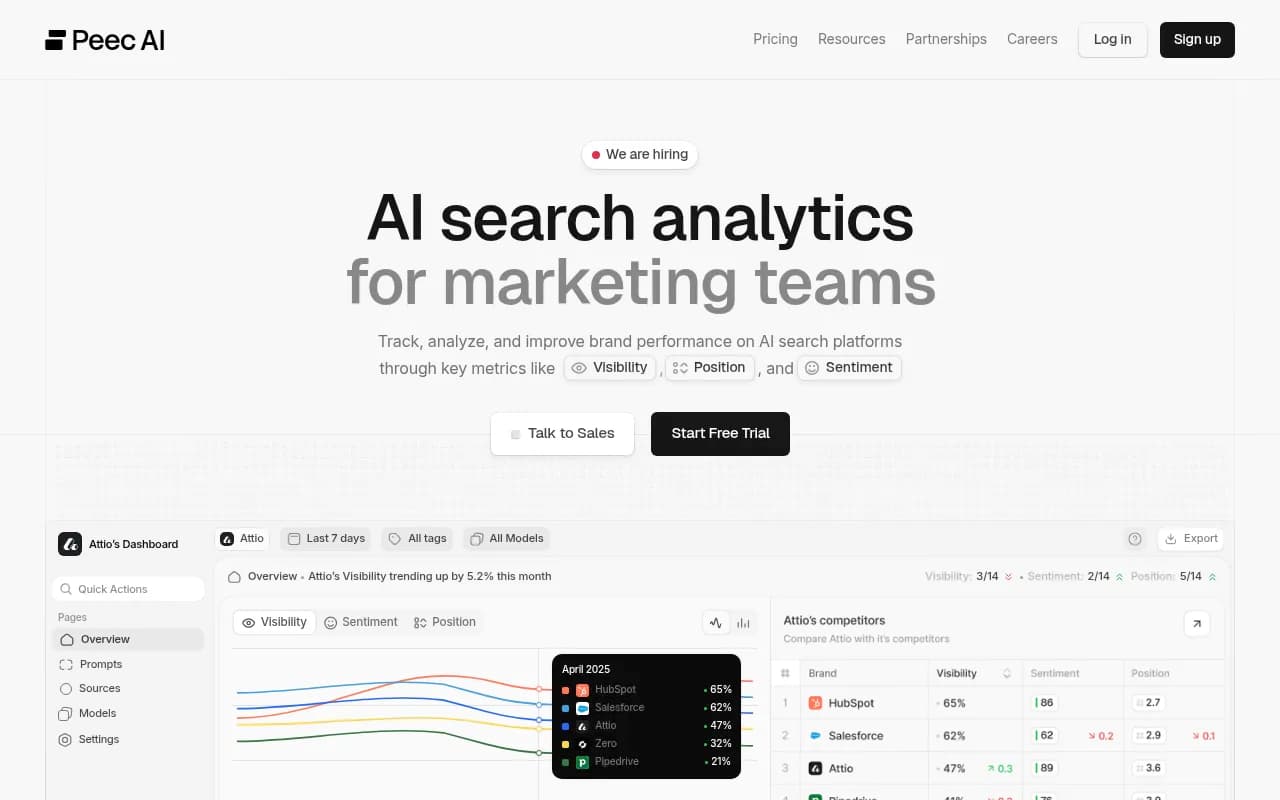
It includes share-of-voice metrics, export options for reporting, and a prompt suggestion engine that helps you figure out which queries to track. For a small business just getting started with GEO, that prompt suggestion feature is genuinely useful — one of the harder parts of GEO is knowing which prompts to care about.
Like Otterly, Peec AI is primarily a monitoring tool. It tells you where you stand but doesn't help you change it. The pricing is tiered with an SMB-focused entry point, making it worth considering if budget is the primary constraint.
4. Semrush — best for teams already invested in traditional SEO
If your small business is already using Semrush for keyword research and rank tracking, their AI visibility features are worth exploring before paying for a separate GEO tool.
Semrush has added AI Overview tracking and some generative search monitoring to their platform. The advantage is consolidation — one tool, one invoice, one dashboard. The disadvantage is that their AI search features use fixed prompt templates rather than custom prompts, which limits how precisely you can track your specific competitive landscape.
For a startup that's still building SEO fundamentals alongside GEO, Semrush makes sense as a starting point. For a business that's specifically trying to win in AI search, the dedicated GEO platforms will give you more depth.
5. Scrunch AI — best for monitoring plus basic optimization insights
Scrunch (now a Sitecore company) positions itself as a more complete AEO/GEO tool, pairing multi-LLM monitoring with auditing and some optimization guidance. It tracks brand mentions across major AI engines and provides insights into what's driving or blocking your visibility.
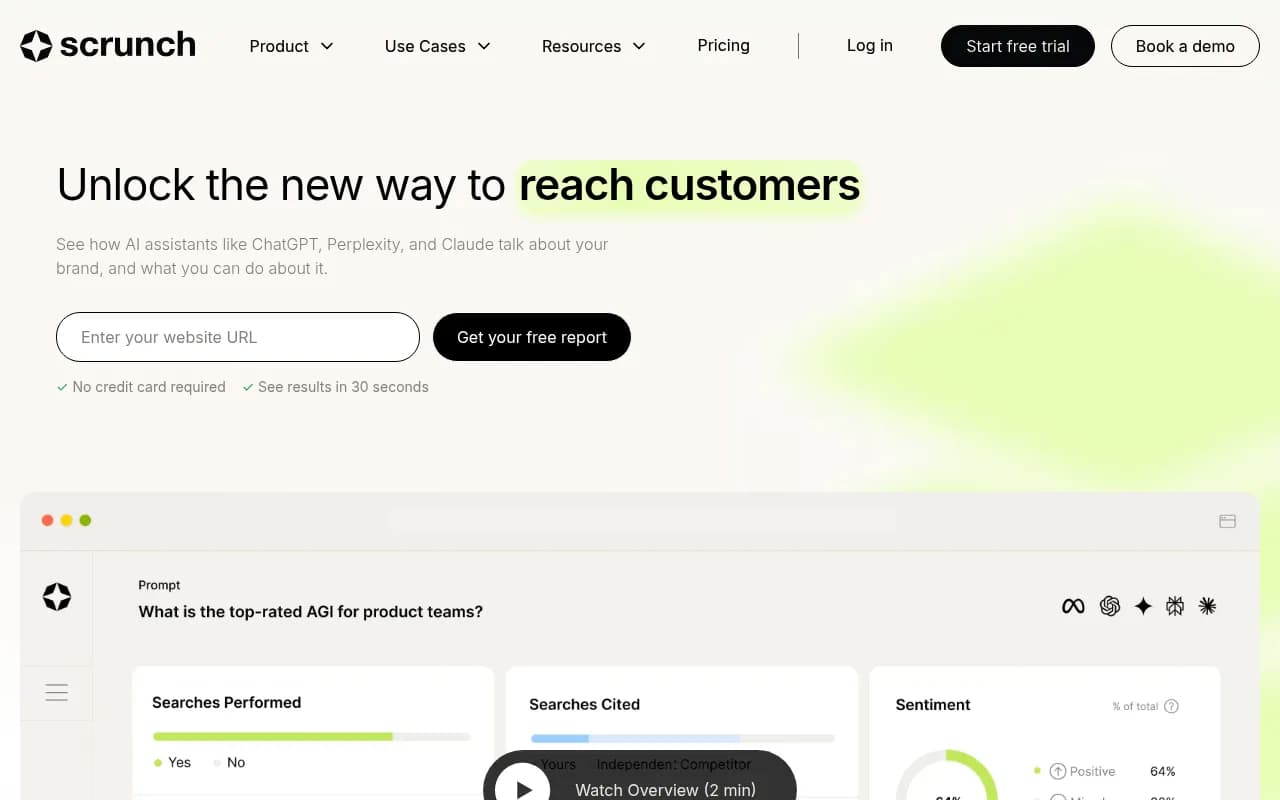
The agent traffic analysis is a notable feature — you can see how AI crawlers are interacting with your site, which pages they're reading, and where there might be technical issues preventing proper indexing. This is closer to what Promptwatch offers with its crawler logs, though the depth varies.
Scrunch is a reasonable middle ground for small businesses that want more than basic monitoring but aren't ready to commit to a full optimization platform. Pricing is more accessible than enterprise tools like Profound, though you'll want to check current tiers directly.
6. Rankshift — best for straightforward multi-engine brand tracking
Rankshift focuses on tracking your brand visibility across ChatGPT, Perplexity, and other AI search engines with a clean, accessible interface. It's built for marketing teams that need to report on AI visibility without a complex setup process.

The tool tracks how often your brand appears in AI responses, which competitors are showing up alongside you, and how your visibility changes over time. It's not trying to be an all-in-one platform — it does brand tracking well and keeps the interface simple.
For a startup that needs to demonstrate AI visibility progress to stakeholders without a lot of technical overhead, Rankshift is worth considering. It won't tell you how to improve your rankings, but it will give you clear data on where you stand.
7. LLM Pulse — best for lightweight monitoring on a tight budget
LLM Pulse is one of the lighter-weight options in the GEO space, focused on tracking your brand's visibility across ChatGPT, Perplexity, and a few other engines. It's designed for teams that want basic AI search monitoring without a significant investment.
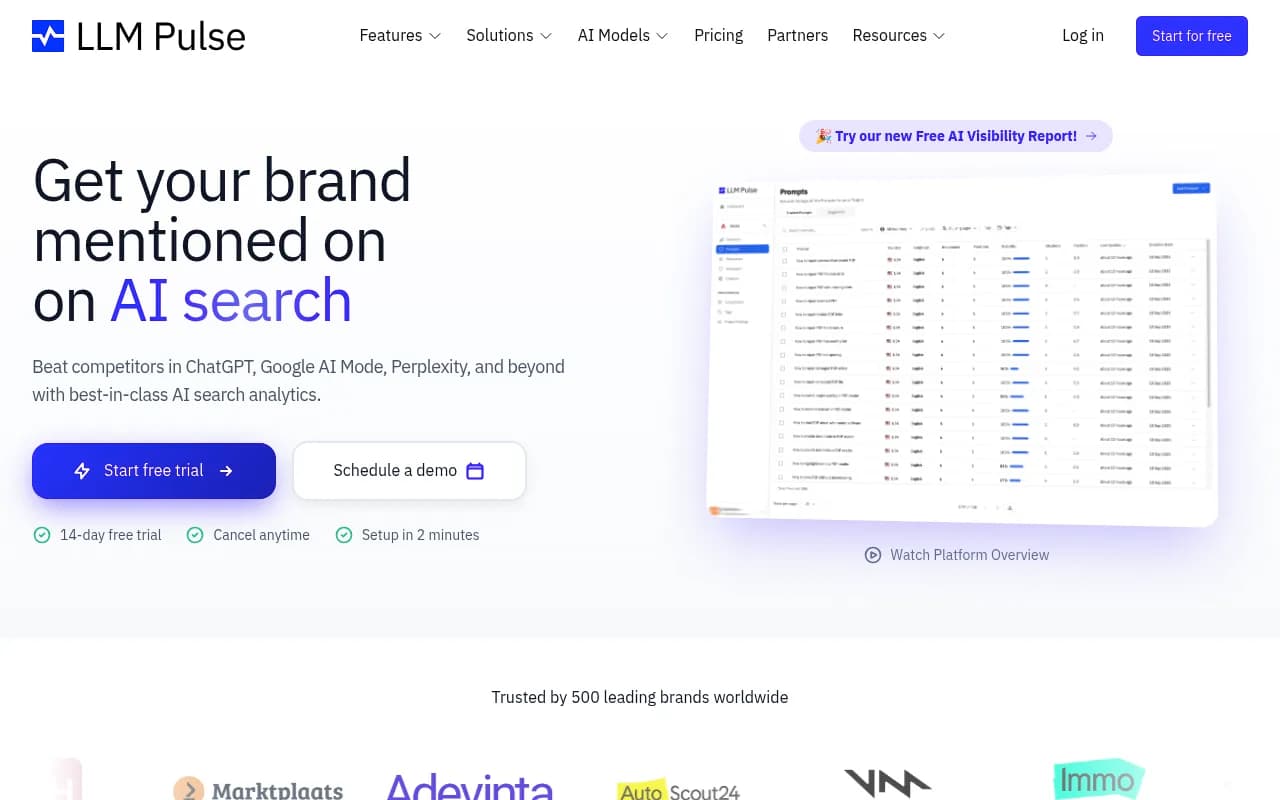
The feature set is intentionally lean: brand mention tracking, basic share-of-voice data, and some competitor comparison. There's no content generation, no crawler data, and no gap analysis. But for a very early-stage startup that just wants to establish a baseline before investing in a more complete platform, it serves that purpose.
Comparison table
| Tool | Monitors AI engines | Custom prompts | Content gap analysis | Content generation | Crawler logs | Starting price |
|---|---|---|---|---|---|---|
| Promptwatch | 10 (ChatGPT, Perplexity, Gemini, Claude, Grok, DeepSeek, Copilot, Mistral, Meta AI, Google AIO) | Yes | Yes | Yes | Yes | $99/mo |
| Otterly.AI | 5+ | Yes | No | No | No | ~€80/mo |
| Peec AI | 5+ | Yes | No | No | No | Tiered |
| Semrush | Limited (fixed prompts) | No | No | No | No | $99/mo (full suite) |
| Scrunch AI | 5+ | Yes | Partial | No | Partial | Custom |
| Rankshift | 3-5 | Yes | No | No | No | Tiered |
| LLM Pulse | 3-5 | Limited | No | No | No | Low/free tier |
How to choose the right tool for your stage
The honest answer is that the right tool depends on what you're actually trying to accomplish.
If you're in the "I just want to understand where I stand" phase, Otterly.AI or Peec AI give you that quickly and cheaply. They're good for establishing a baseline and building internal awareness of AI search visibility.
If you're past that and actively trying to improve your AI visibility, you need a tool that tells you what to fix and helps you fix it. That's where Promptwatch stands apart — the combination of Answer Gap Analysis and Content Agents means you're not just watching your visibility score, you're actually moving it.
If you're already deep in the Semrush ecosystem and want to add AI monitoring without a new tool, their AI features are a reasonable starting point, with the understanding that you'll likely outgrow them.
For startups with very limited budgets, LLM Pulse or the free tiers of some monitoring tools let you get started without commitment. Just know that monitoring alone won't improve your rankings — at some point you'll need to act on the data.
A note on what GEO tools can't do for you
No tool automatically makes you appear in AI search results. What these platforms do is help you understand the gap between where you are and where you need to be, then (in the better ones) help you create content that closes that gap.
The actual work — writing content that answers questions clearly, building credibility through third-party mentions, getting cited on the kinds of sources AI models trust — still requires effort. GEO tools make that effort more targeted and measurable. They're not a shortcut; they're a compass.
For small businesses and startups, that distinction matters. The best ROI comes from picking a tool that matches your current capacity, using it consistently, and building a content strategy around what the data tells you. Start with monitoring to understand your baseline, then invest in optimization as you see what's actually moving the needle.
The AI search landscape is still evolving fast — new models, new citation behaviors, new ranking signals. The businesses that build GEO habits now, even with modest tools, will be better positioned than those waiting for the dust to settle.