Key takeaways
- Both Nimt.ai and Radarkit track brand mentions across AI search engines like ChatGPT, Perplexity, and Gemini — but they differ significantly in depth and actionability
- Radarkit has gained attention in the AI search community for its real-time tracking capabilities, while Nimt.ai focuses on multi-LLM monitoring with a clean interface
- Neither tool offers the full optimization loop (find gaps, create content, track results) that more complete platforms provide
- For growing brands that need more than monitoring, there are stronger alternatives worth considering before committing to either
- Pricing, LLM coverage, and content optimization support are the three biggest differentiators to evaluate
If you've been researching AI visibility tools lately, you've probably come across both Nimt.ai and Radarkit. They're both positioned as trackers for brands that want to know what ChatGPT, Perplexity, and other AI engines are saying about them. But "AI visibility tracker" covers a wide spectrum in 2026 — from basic mention counters to full optimization platforms — and these two tools sit in different places on that spectrum.
This guide breaks down exactly how they compare, where each one falls short, and what growing brands should actually look for when choosing a tool in this category.
What Nimt.ai does
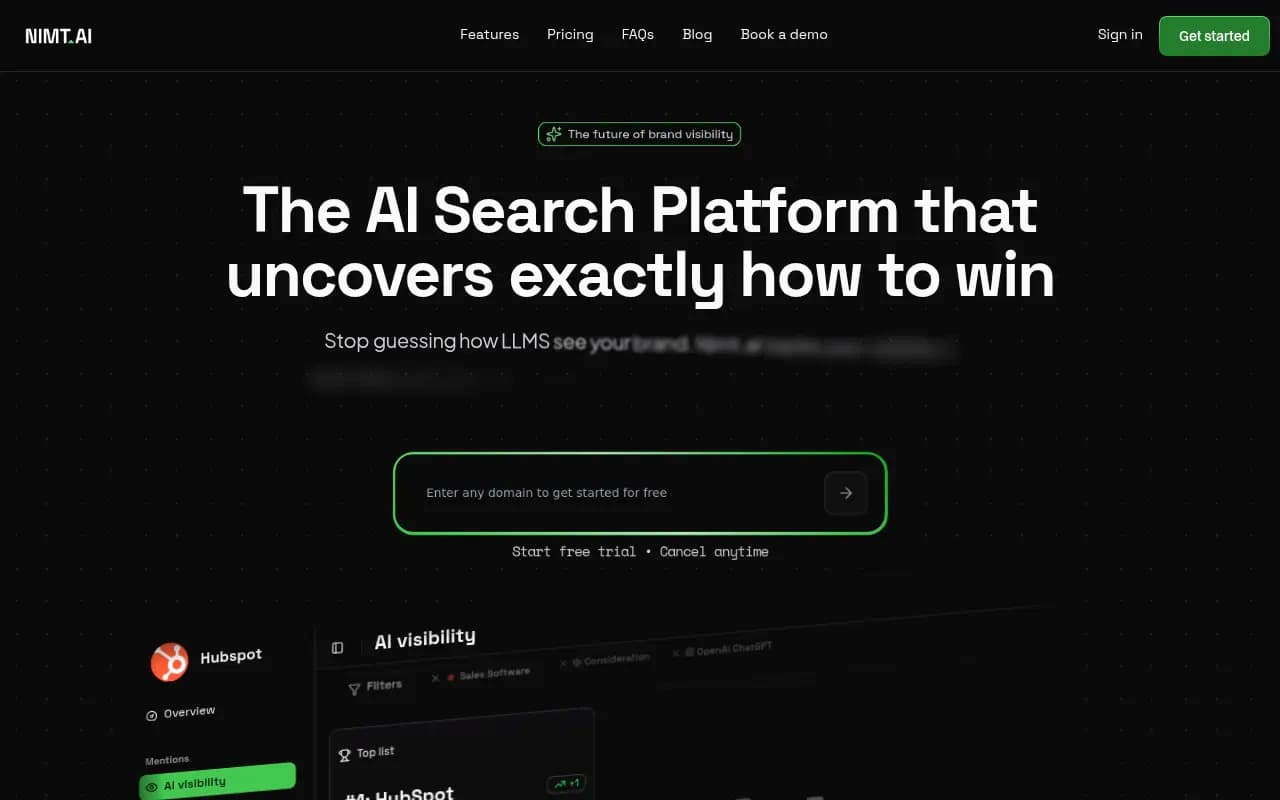
Nimt.ai is an AI search visibility platform focused on tracking brand mentions across large language models. The core use case is straightforward: you set up your brand, define a set of prompts your customers might ask, and the tool monitors whether your brand appears in the AI-generated answers.
Nimt AI sits in the monitoring-first category. It gives you visibility scores, tracks mentions over time, and lets you compare your presence against competitors on the same prompts.
What it does reasonably well:
- Multi-LLM monitoring across major AI engines
- Competitor comparison on shared prompts
- Clean dashboard for tracking mention trends over time
Where it's limited:
- No content generation or gap analysis to help you act on what you find
- Prompt coverage depends heavily on what you manually configure
- No crawler log data to understand how AI bots interact with your site
What Radarkit does
Radarkit (sometimes referenced as Radarkit AI) has picked up attention in the AI search community, with some practitioners calling it one of the more capable real-time AI search trackers available. It came out of the Alpha startup program at Web Summit Qatar, which gave it some early visibility in the marketing and SEO community.
The pitch is similar to Nimt.ai: track where your brand appears in AI answers, see how you compare to competitors, and monitor changes over time. Radarkit leans into real-time tracking as a differentiator, which matters if you're in a fast-moving category where AI recommendations shift frequently.
What it does reasonably well:
- Real-time or near-real-time tracking of AI search responses
- Competitive benchmarking across prompts
- Useful for brands that need to catch visibility drops quickly
Where it's limited:
- Like most monitoring-focused tools, it shows you the problem but doesn't help you fix it
- Limited content optimization features
- Smaller track record compared to more established platforms
Head-to-head comparison
| Feature | Nimt.ai | Radarkit |
|---|---|---|
| AI models tracked | Multiple LLMs | Multiple LLMs |
| Real-time tracking | Standard | Stronger real-time focus |
| Competitor comparison | Yes | Yes |
| Content gap analysis | No | No |
| Content generation | No | No |
| AI crawler logs | No | No |
| Prompt volume data | Limited | Limited |
| Reddit/YouTube tracking | No | No |
| ChatGPT Shopping tracking | No | No |
| Free trial | Check site | Check site |
| Best for | Basic multi-LLM monitoring | Fast-moving categories needing real-time data |
Both tools are fundamentally monitoring dashboards. They answer "are we showing up?" but neither answers "how do we show up more?" That's the gap that matters most for brands trying to grow their AI visibility, not just measure it.
The monitoring-only problem
Here's the honest issue with both tools: knowing you're invisible in AI search is only useful if you can do something about it.
Most AI visibility tools in 2026 have converged on the same core feature set. As Brainlabs Digital put it in their comparison of AI visibility platforms, the table-stakes question most tools answer is "when people ask AI about this topic, do we show up?" Where tools diverge is whether they help you interpret that data, connect it to performance, and turn it into action.
Nimt.ai and Radarkit both stop at the first question. You get a dashboard showing your mention rate, your competitors' mention rate, and trend lines. That's genuinely useful data. But it leaves the hardest work — figuring out what content to create, which prompts to target, and whether your changes are working — entirely up to you.
For a brand just getting started with AI visibility measurement, that might be fine. For a brand that's been tracking for a few months and wants to actually move the needle, it gets frustrating fast.
What growing brands actually need
The AI search landscape has matured enough in 2026 that "monitoring" is no longer a sufficient answer. According to KIME's April 2026 comparison of AI visibility tools, AI-referred visits now convert at 3x to 9x the rate of traditional Google organic traffic. That's not a metric you want to leave on the table because your tool can only show you the problem.
Growing brands need three things from an AI visibility platform:
- Accurate tracking across the AI engines that matter (ChatGPT, Perplexity, Google AI Overviews, Gemini, Claude at minimum)
- Insight into why they're not appearing — which prompts are they losing, what content is missing, what competitors are doing differently
- Tools to actually fix the gaps — content briefs, generation, or at minimum structured guidance on what to create
Neither Nimt.ai nor Radarkit covers all three. They handle the first reasonably well and gesture toward the second, but the third is absent entirely.
Stronger alternatives to consider
If you're evaluating Nimt.ai or Radarkit, it's worth looking at what else is in the market before committing. The category has expanded significantly, and several tools offer meaningfully more capability at comparable or only slightly higher price points.
Otterly.AI
A popular entry-level option with clean UX and solid LLM coverage. Good for teams that want monitoring without complexity. Still monitoring-only, but well-executed.
Otterly.AI

Profound
One of the more established enterprise-focused platforms. Strong on prompt research and multi-model tracking. Better suited to larger teams with dedicated SEO resources.
Profound

SE Visible
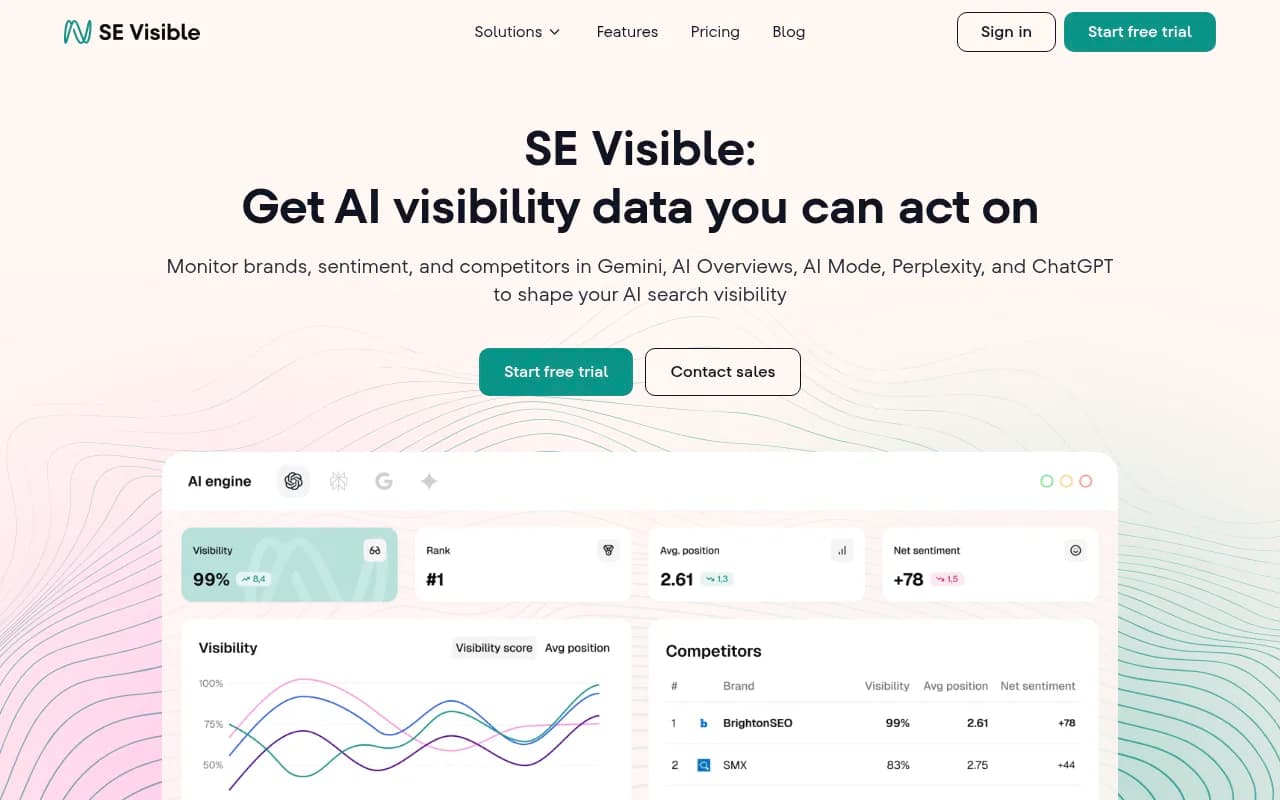
SE Ranking's AI visibility layer. Useful if you're already in the SE Ranking ecosystem. Covers multi-brand and multi-country tracking, though it shares the monitoring-only limitation.
Promptwatch
Promptwatch is the option that goes furthest beyond monitoring. It tracks brand visibility across 10 AI models (ChatGPT, Perplexity, Google AI Overviews, Gemini, Claude, Grok, DeepSeek, Copilot, Meta AI, Mistral), but the real difference is what happens after you see the data.
Its Answer Gap Analysis shows exactly which prompts competitors are visible for that you're not — not just a score, but the specific content gaps your site has. From there, Content Agents generate articles, listicles, and briefs grounded in real prompt data, citation patterns, and competitor analysis. Then page-level tracking shows whether the new content is actually getting cited, and by which models.
It also includes AI crawler logs, which show you when ChatGPT, Claude, Perplexity, and other AI bots are hitting your site, which pages they're reading, and whether those crawls are converting to citations. That's a capability most tools in this category don't have at all.

How to choose between them
If you're specifically deciding between Nimt.ai and Radarkit (rather than the broader category), here's a practical way to think about it:
Choose Nimt.ai if you want a clean, straightforward monitoring dashboard and plan to do your own analysis and content work separately. It's a reasonable starting point for teams that are new to AI visibility tracking and want to establish a baseline.
Choose Radarkit if real-time tracking is genuinely important for your category. If you're in a space where AI recommendations shift quickly (news, finance, fast-moving B2B categories), the real-time emphasis may justify the choice.
But be honest with yourself about whether monitoring alone is enough. If you've been watching your AI visibility numbers for more than a month and haven't been able to act on them, the tool isn't the problem — the missing capability is.
A note on the broader market
The AI visibility tool market has grown fast. A 2026 comparison by Sanbi tested every major platform across ChatGPT, Gemini, and other engines, and found significant variation in both data quality and actionability. Monitoring-only tools are increasingly being squeezed between free or near-free basic trackers at the low end and full optimization platforms at the high end.
For growing brands, the sweet spot is a platform that tracks accurately, surfaces actionable gaps, and gives you something to do with the data. Nimt.ai and Radarkit are reasonable choices for pure monitoring, but they're not the ceiling of what's available.
| Tool | Monitoring | Gap analysis | Content generation | Crawler logs | Starting price |
|---|---|---|---|---|---|
| Nimt.ai | Yes | No | No | No | Check site |
| Radarkit | Yes | No | No | No | Check site |
| Otterly.AI | Yes | No | No | No | $29/mo |
| Profound | Yes | Partial | No | No | $99/mo |
| Promptwatch | Yes | Yes | Yes | Yes | $99/mo |
The right tool depends on where you are in your AI visibility journey. If you're just starting out and want to see what's happening, Nimt.ai or Radarkit will get you there. If you want to actually change what's happening, you'll need something that goes further.