
Key takeaways
- OpenAI does not publish how ChatGPT picks sources, so the only reliable way to learn what works for your site is to run controlled experiments and log the results.
- Change one thing at a time, keep control pages, and write down the date of every test. ChatGPT can change behavior platform-wide overnight, as it did on August 8, 2026.
- Eight tests cover the main levers: crawler access, page type, answer-first structure, freshness, fan-out coverage, third-party mentions, comparison pages and branded prompts.
- You need a prompt set, a sample size above one, and a log. A spreadsheet works. A tracking platform makes it easier.
- Expect noisy results. Treat a single run as an anecdote and a pattern across 20+ runs as evidence.
Why you have to run your own tests
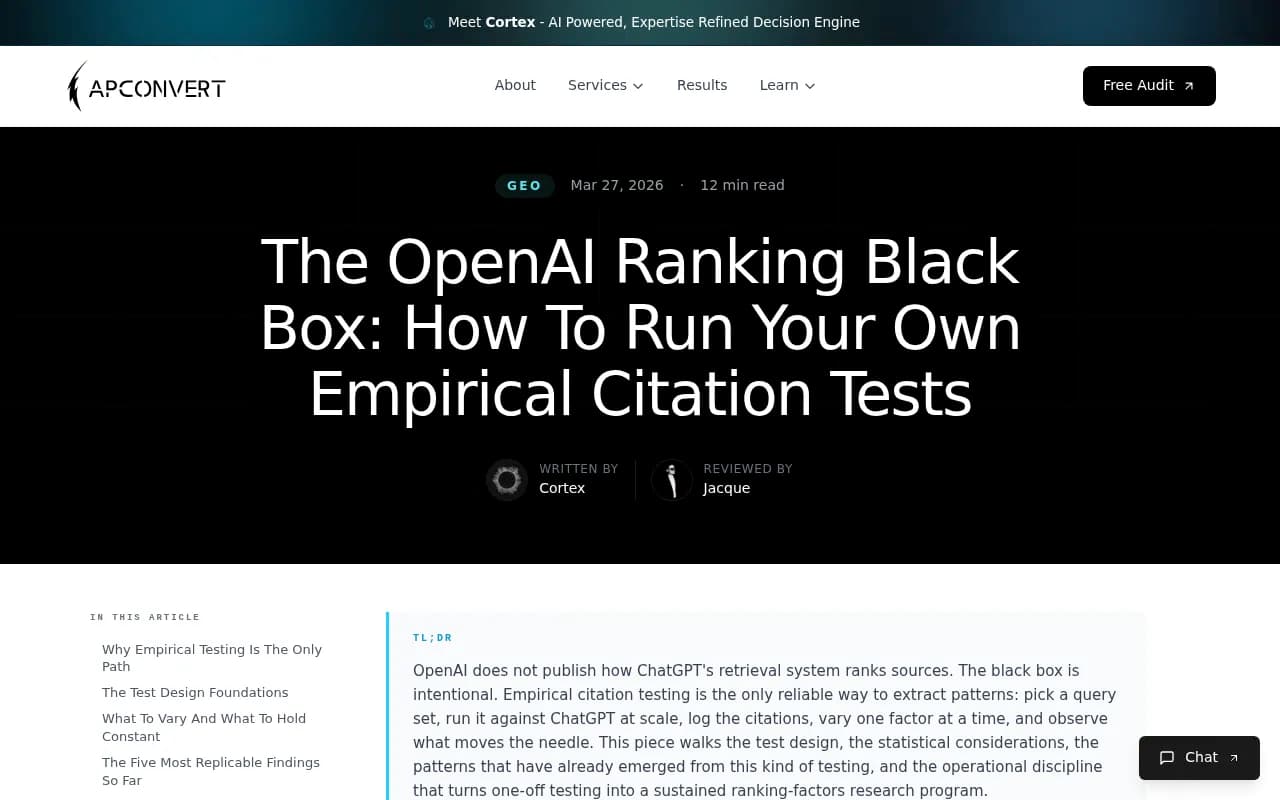
Most advice about ranking in ChatGPT is confident and untested. Vendors say generic things. Commentators extrapolate from thin public information. Conference talks repeat hypotheses as facts. Capconvert's piece on the OpenAI ranking black box makes the same point: OpenAI publishes no ranking-factor documentation, so the practical method is to pick a query set, run it at scale, log citations, vary one factor at a time and see what moves.
That is what this log is. Eight experiments, each small enough to run in a few weeks on a normal site. None of them need a developer team, and several need only a spreadsheet and an hour a day.
One caution before starting. ChatGPT is not a stable system. According to Promptwatch Data's report on the site: operator, on August 8, 2026 the share of fan-out queries using site: jumped from 0.37% to 16.8% overnight, and average fan-outs per response rose from about 1.08 to about 1.83. Earlier, average citations per response dropped around the GPT-5.3 rollout on March 4, 2026. If you had been running a test across either date without a control, you would have credited your change for something OpenAI did.
So every experiment below includes a control, and every log entry gets a date.
Set up your experiment log first
Skip this and the rest is guesswork. You need three things.
1. A fixed prompt set
Write 20 to 40 prompts your buyers actually ask. Mix three types: commercial ("best X for Y"), informational ("how do I do Z"), and branded ("is [your brand] good for..."). Keep the wording identical across runs. Changing a prompt halfway through ruins the comparison.
Tools that suggest prompts from Search Console data, People Also Ask or your own pages save time here. A free option is AnswerThePublic or AlsoAsked for question ideas.
2. A repeatable way to run them
ChatGPT answers vary between sessions, so one run tells you almost nothing. Run each prompt several times, ideally on different days, with web search on. Manual testing works for a pilot. Beyond 20 prompts it gets tedious fast.
If you want automation, tools like Promptwatch collect answers from the real ChatGPT interface by country and language, and log citations, position and the pages cited. Other trackers in this space include Peec AI, Otterly.AI, Profound and Rankshift. Check how each one samples ChatGPT (real UI or API) because the two can differ, which matters when your experiment depends on what a user would actually see.

For a wider look at what exists, the GEO software directory at bestgeosoftware.com lists most of the options.
3. The log itself
Use one row per prompt per run. Columns I would keep:
| Column | Example |
|---|---|
| Date | 2026-12-03 |
| Experiment ID | T4-freshness |
| Prompt | best invoicing tool for freelancers |
| Test or control | Test |
| Your page cited? | Yes / No |
| Citation position | 3 |
| Brand mentioned in text? | Yes |
| Competitors cited | 4 |
| Known platform change that week | None |
| Notes | Fan-out included site: query |
That "known platform change" column feels fussy. It is the one that saves you from false conclusions.
Rules that apply to all eight tests
- One variable per test.
- Hold back at least a third of your pages or prompts as controls.
- Record a baseline for 1 to 2 weeks before you change anything.
- Wait for recrawling. A change ChatGPT has not fetched yet cannot affect anything.
- Run each prompt at least 3 times per measurement window.
Test 1: crawler access and indexability
The cheapest experiment, and the one that most often turns up a real problem.
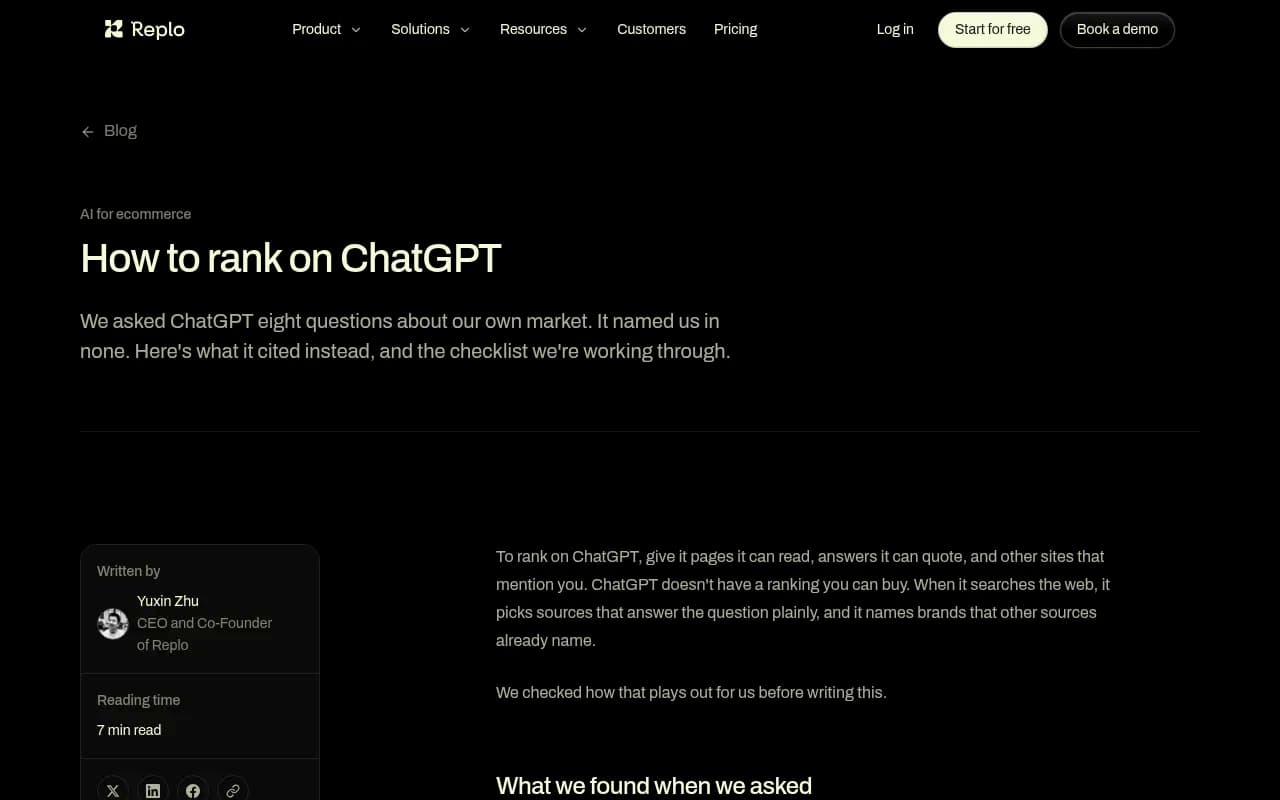
Replo's write-up on ranking in ChatGPT makes a blunt point: if your robots.txt blocks OAI-SearchBot, ChatGPT cannot cite you, however good the page is. Replo also tested its own market with eight store-owner questions and was named in 0 of 8 answers. It then wrote plain pages saying exactly what its product does inside ChatGPT and Claude.
Hypothesis: pages that are blocked, slow, JavaScript-only or not indexed get cited less.
Setup:
- Check robots.txt for GPTBot, OAI-SearchBot and ChatGPT-User rules. The Robots.txt generator for AI and the AI crawler URL inspector help here.
- Pull server or CDN logs and see whether AI bots fetch your key pages and what status codes they get. Promptwatch's AI crawler logs do this with IP verification. Screaming Frog and JetOctopus can analyze raw logs on the SEO side.
- Fix access on a subset of 10 to 20 pages. Leave a matched set untouched.
- Submit changed URLs through IndexNow and recheck in 2 to 4 weeks.
Measure: crawl frequency, errors, and citation rate on fixed versus untouched pages.
Why it matters more now: since the August 2026 shift, ChatGPT uses site: searches against your own domain far more often. Your domain is a retrieval surface. If key pages are not crawlable and indexed, they cannot show up there.
Test 2: page type
Is a landing page a better citation candidate than a blog post on the same topic? The data suggests format matters a lot.
In Promptwatch Data's content type report (Sep 28 to Oct 4, 2026), product pages made up 22.4% of ChatGPT citations, landing pages 16.8%, listicles 13.6%, how-tos 8.7%, docs 7.5%, comparisons 5.9% and news 5.7%. For commercial prompts, product and landing pages together reached almost half of citations.
Hypothesis: for commercial prompts on your site, a dedicated product or landing page beats a blog post covering the same ground.
Setup: pick 6 to 10 commercial prompts where you are currently cited via a blog post or not at all. Build or sharpen a dedicated page for half of them (clear title, one job per page, specs, pricing context, plain language). Leave the other half as they are.
Measure: citation rate and position on test prompts versus controls over 4 weeks.
Honest caveat: these are population averages across all sites. Your niche may differ, which is the whole reason to test.
Test 3: answer-first structure
Replo's conclusion was that ChatGPT picks sources that answer the question plainly. Test whether restructuring pages to lead with the answer changes citation.
Hypothesis: pages that state the answer in the first 2 to 3 lines under each heading get cited more than pages that bury it.
Setup:
- Choose 10 informational pages with similar traffic and age.
- Rewrite 5: add key takeaways at the top, put the answer first under each H2, end with a short FAQ.
- Leave the other 5 alone. Do not change anything else (title, links, publish date).
Measure: citation rate on the prompts each page targets, before and after. Also watch whether the cited snippet is the new opening text.
Tools that show you the snippet an AI model saw for a cited page make this test much more informative. A diff tool like Visualping or Page Modified helps you document exactly what changed and when.
Test 4: freshness and the half-life of your pages
Should you update pages monthly, or leave them alone? The answer depends on content type.
Promptwatch Data's content half-life study tracked every page ChatGPT cited on July 6, 2026 for 90 days:
| Content type | Still cited after 30 days | Still cited after 60 days |
|---|---|---|
| Landing pages | 78% | 69% |
| Docs | 76% | 67% |
| Comparisons | 72% | 63% |
| Listicles | not reported | 60% |
| Product pages | not reported | 55% |
| News | not reported | 41% |
News lost half its pages within 36 days. Landing pages, docs and comparisons barely crossed 50% before the window ended.
Hypothesis: a content refresh on decaying pages restores citation rates, and refreshing evergreen pages makes no measurable difference.
Setup: find pages that were cited and then dropped. Refresh half with real new information (not a bumped date). Leave the rest. Track citation recovery over 4 to 6 weeks.
Measure: days until re-citation, and how many pages recover versus controls. Segment by content type, since a news post and a docs page decay at completely different speeds.
Test 5: fan-out coverage
ChatGPT does not just search your prompt. It generates sub-queries (fan-outs) and retrieves against those. Pages that match the fan-outs, not just the headline prompt, have a better shot.
Hypothesis: adding a section that answers a common fan-out query raises citation for the parent prompt.
Setup:
- For 10 prompts, capture the fan-out queries ChatGPT runs. The ChatGPT query fan-out generator and the GEO Inspector Chrome extension are free ways to see them. The Academy guide on query fan-outs explains the idea.
- Compare your page against those sub-queries. Find the ones you do not answer.
- Add focused sections for the gaps on half the pages.
Measure: citation rate and position for the parent prompt, plus whether the page is now cited for the specific fan-out.
Warning: keyword-to-fan-out mappings built before August 8, 2026 are stale. Rebuild them rather than reusing old research.
Test 6: third-party mentions
Replo's advice was to give ChatGPT other sites that mention you. ChatGPT tends to name brands that other sources already name. Test it.
Hypothesis: earning mentions on pages ChatGPT already cites for your prompts raises your brand mention rate, even without links.
Setup:
- List the domains ChatGPT cites most for your 20 prompts. Sort by how often they appear.
- Pick 5 to 10 realistic targets: listicles, review sites, directories, forums.
- Pitch or contribute to half of them. Track the rest as controls.
- Log brand mention (in text) and citation separately. Read citations vs mentions if the distinction is fuzzy.
Measure: brand mention rate for prompts tied to those third-party pages, 4 to 8 weeks out. This test is slow, so start it early.
The mix of source types differs by industry. In Promptwatch's software citation data, GitHub, Microsoft docs and G2 lead. In travel, booking and search sites earn more than half. Look at your own category before choosing targets.
Social sources are a moving target too. Reddit's share of ChatGPT citations fell from about 4% to 0.5% on August 14, 2026, and in the November 2026 social citation report ChatGPT drew only 0.64% of citations from social platforms. If your plan depends on Reddit for ChatGPT, treat it as a hypothesis, not a strategy.
Test 7: comparison and alternative pages
For "X vs Y" and "best X" prompts, comparison pages made up 5.9% of citations overall and 7.9% of commercial ones, per the content-type report above. Listicles did better, at 13.6% overall.
Hypothesis: a fair, specific comparison page on your own site gets cited for competitor-comparison prompts, and a listicle format gets cited more than a one-sided pitch.
Setup: choose 5 competitor-comparison prompts. Publish a comparison page for 3 of them with a real table, honest tradeoffs and a clear update date. Leave 2 prompts without a page.
Measure: citation of your domain on those prompts, and whether the text of the answer repeats your framing.
Test 8: branded prompts and what AI says about you
Branded prompts ("is [brand] good for...") behave differently. In the same content-type study, reviews were 5.6% of branded citations, more than three times their overall share, and FAQ pages reached 4.8%.
Hypothesis: adding FAQ and review-style content, and correcting factual errors on your own pages, changes what ChatGPT says about you.
Setup:
- Run 10 branded prompts and write down every factual claim ChatGPT makes about you, right or wrong.
- Trace each wrong claim to a source page, yours or a third party's.
- Fix your own pages for half of the wrong claims. Leave the other half.
- Re-run after recrawling.
Measure: share of claims that are accurate, before and after. Platforms with a claim-level view (Promptwatch's Brand Narrative and Fact Check do this on the Business plan) automate the tracing step. Otherwise a spreadsheet and patience will do.
Interpreting results without fooling yourself
A few habits that matter more than any single test:
- Count runs, not impressions. A page cited once in one run is luck. A page cited in 7 of 10 runs is a signal.
- Compare against controls, not against last month. Platform changes hit everything at once.
- Log known events. The GPT-5.3 rollout, the August 8
site:shift and the August 14 Reddit drop all would have contaminated an unlogged test. - Beware of ties. If test and control move together, your change did nothing, even if the numbers went up.
- Do not stack changes. If you fix crawling and restructure content in the same week, you will not know which one worked.
- Check domain strength as a confound. Promptwatch's domain rank data shows the median cited domain is DR 57 in ChatGPT, and DR 100 sites earn only 0.3% of its citations, so authority is not destiny, but it still varies.
A four-week schedule
| Week | What to do |
|---|---|
| 1 | Build prompt set, set up log, run baseline, check robots.txt and crawl logs (Test 1 starts) |
| 2 | Finish baseline, launch Tests 2 and 3 on separate page sets |
| 3 | Launch Test 5, start outreach for Test 6, re-run prompts |
| 4 | Launch Tests 4, 7 and 8 on different pages, review early signals from Tests 1 to 3 |
Do not run all eight on the same pages. Split pages into groups so tests do not overlap. If your site is small, run three or four tests this month and the rest next month. Eight sloppy experiments are worth less than three clean ones.
Tools that make this easier
You can run the whole log in a spreadsheet. As prompts and pages multiply, a dedicated tracker pays for itself.
| Need | Options |
|---|---|
| Tracking citations across ChatGPT and other engines | Promptwatch, Peec AI, Otterly.AI, Profound, Rankshift |
| AI crawler logs and access checks | Promptwatch, Screaming Frog, JetOctopus |
| Google and Bing data next to AI data | Google Search Console, Bing Webmaster Tools |
| Documenting page changes | Visualping, Page Modified |
| SEO split testing for the Google side | SearchPilot, SplitSignal |

Otterly.AI

Profound

If you want one platform that also acts on what the experiments reveal, Promptwatch connects tracking to the fix: its Content Agent writes and publishes pages against visibility gaps, and crawler logs plus visitor analytics show whether those pages got read, cited and clicked. The Action Board turns findings into a prioritized to-do list. Pricing starts at $95 per month for Essential (confirm at promptwatch.com/pricing), with a 7-day free trial on monthly billing. The free AI visibility report is a quick way to get a baseline before you build the log.
Seoclarity's comparison of ChatGPT visibility tools is a useful read on how different platforms sample ChatGPT and whether they show fan-out searches, which is exactly what you want to know before you trust a tool with an experiment.
What to do with the results
When a test works, roll it out slowly: apply the change to the next group of pages and see whether the effect repeats. When it does not, write that down too. A negative result saves you from spending a quarter on something that does nothing.
Keep the log running after the month ends. ChatGPT changes often enough that last quarter's finding may not hold. The sites that do well here are the ones that keep measuring, not the ones that found one trick once.
To read more about AI citation patterns before you plan your own tests, the Promptwatch Data hub publishes regularly updated reports on what ChatGPT, Perplexity and Google AI Overviews cite.
FAQ
How many prompts do I need for a valid test?
Twenty is a workable minimum for a pilot, and 40 is better. What matters more is running each prompt several times, because ChatGPT answers vary between sessions.
How long should each experiment run?
Plan for 4 weeks after the change, with 1 to 2 weeks of baseline before it. Third-party mention tests (Test 6) need 6 to 8 weeks.
Can I run these tests on a small site?
Yes, but you will have fewer pages for controls. Pick prompts with the most business value and run fewer tests at a time.
Should I test with the API or the ChatGPT interface?
The interface, if you can. User-facing answers and citations can differ from API outputs, and the interface is what your buyers see.
What if my test and control both improve?
Then your change probably did nothing, and something platform-wide moved both. Check your log for known changes that week.
Does ChatGPT use Bing or Google data?
OpenAI does not publish its full retrieval stack, which is why testing beats assumption. Make sure your pages are indexable in both Google and Bing, and treat anything else as a hypothesis.