Key takeaways
- Brandlight is a genuine enterprise-tier AI visibility platform with strong brand intelligence dashboards and driver analysis -- but it's built for large in-house teams with dedicated AI strategists and analyst budgets.
- Pricing is opaque and sales-gated; estimates put enterprise contracts between $4,000 and $15,000 per month, with no self-serve option.
- The platform monitors AI brand representation well but does not help you fix what it finds -- there's no content generation, no crawler log access, and no optimization workflow.
- G2 shows a 4.9/5 rating from 110 reviews, which is impressive, but the reviewer base skews heavily toward enterprise marketing leaders who fit the platform's exact target profile.
- Several alternatives cover similar monitoring ground at a fraction of the cost, and some go further by actually helping you improve your AI visibility rather than just measuring it.
Brandlight raised a $30 million Series A and built a product that Fortune 500 brands like Volkswagen, LG, and TD Bank actually use. That's not nothing. When a platform at that funding level earns a 4.9/5 on G2 from 110 reviews, something is working.
But "works for Volkswagen's CMO team" and "works for your marketing team" are different things. This review covers what Brandlight actually does, where it genuinely earns its price, where it falls short, and which alternatives are worth considering if the fit isn't right.
What Brandlight does
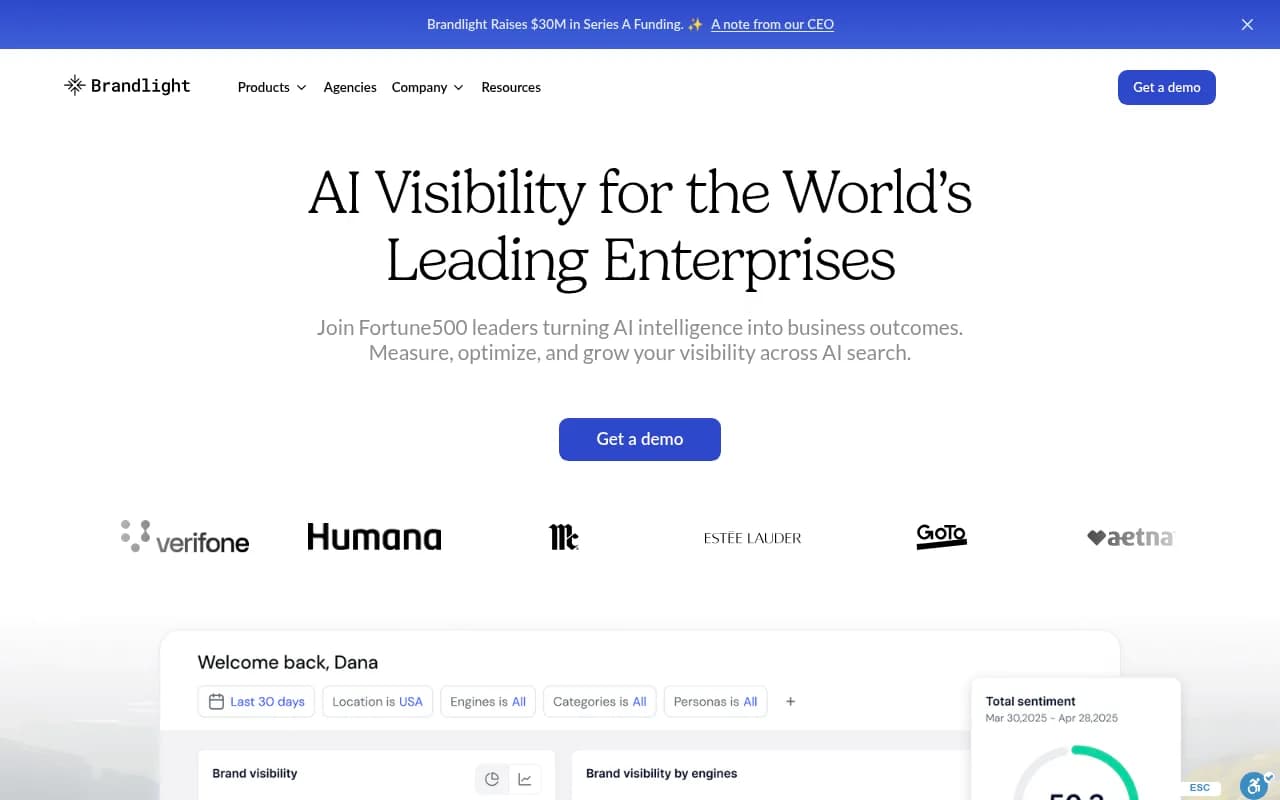
Brandlight is an AI brand intelligence platform. It monitors how your brand appears in answers from ChatGPT, Gemini, Perplexity, Copilot, and Grok -- tracking mentions, sentiment, citations, and competitive positioning inside AI-generated responses.
The core use case: a marketing or brand team wants to know how AI systems represent their company. Are they mentioned? Positively or negatively? What sources are shaping those answers? How does that compare to competitors?
Brandlight answers those questions through a dashboard built for marketing leadership. The UX is polished. The data is presented in a way that works well in CMO presentations. And the driver analysis -- explaining why an AI answer reads the way it does -- goes deeper than most monitoring-only tools.
The platform also includes:
- Sentiment tracking across AI responses
- Citation and source analysis showing what content AI models are drawing from
- Competitive share-of-voice comparisons
- A multi-brand command center for managing multiple properties
- Technical health audits related to AI discoverability
That's a solid feature set for what it is. The question is whether what it is matches what you need.
Pricing: the honest picture
Brandlight does not publish pricing. You go through sales.
Based on publicly available estimates from multiple independent sources, entry-level access starts around $199/month, but enterprise contracts -- which is what most teams end up in -- run between $4,000 and $15,000 per month. G2 lists the time to implement at two months and time to ROI at seven months.
That's a significant commitment before you see results. For a Fortune 500 brand with a dedicated AI strategy team and an analyst budget already allocated, that's manageable. For a growing brand, a mid-market company, or an agency managing multiple clients, the math gets uncomfortable fast.
There's no free trial, no self-serve tier, and no way to test the product without talking to a sales rep first.
Where Brandlight genuinely earns its place
Executive-ready dashboards
If the primary deliverable is a monthly report for marketing leadership, Brandlight's interface is purpose-built for that. The visualizations are clean, the framing is strategic rather than technical, and the data tells a coherent story about brand representation in AI. This matters more than it sounds -- plenty of tools produce data that requires a data analyst to interpret before it's useful in a boardroom.
Driver analysis
Most AI visibility tools tell you your share of voice or whether you were mentioned. Brandlight goes a step further by surfacing the sources and signals that shaped an AI response. Understanding why ChatGPT describes your brand a certain way -- which pages, which third-party sources, which Reddit threads -- is genuinely useful for teams trying to influence those answers.
Enterprise compliance and security
For regulated industries or companies with strict data governance requirements, Brandlight's enterprise positioning comes with the security and compliance infrastructure those teams need. That's a real differentiator against smaller, self-serve tools.
Multi-brand management
For holding companies or large brand portfolios, the multi-brand command center reduces the operational overhead of tracking AI visibility across several properties simultaneously.
Where Brandlight falls short

It monitors but doesn't fix
This is the most significant limitation. Brandlight shows you where your brand stands in AI responses. It does not help you change that standing. There's no content generation, no gap analysis that produces actionable briefs, no workflow for creating the content AI models need to represent you differently.
For teams that want to actually move the needle -- not just measure it -- that's a meaningful gap. Monitoring tells you the score. Optimization changes it.
No crawler log access
Understanding how AI crawlers interact with your website -- which pages they read, how often they return, what errors they encounter -- is increasingly important for AI visibility work. Brandlight doesn't surface this data. You can see how you appear in AI responses, but you can't see how AI systems are (or aren't) discovering your content in the first place.
Sales-gated buying process
The mandatory sales call before you can access anything is a friction point that many teams find frustrating. You can't evaluate the product independently, run a trial, or even see a pricing page. For teams that prefer to research and decide on their own timeline, this is a genuine obstacle.
No Reddit or YouTube tracking
AI models draw heavily from Reddit discussions, YouTube content, and other third-party sources when forming answers. Brandlight tracks citations but doesn't specifically surface Reddit threads or YouTube videos that are influencing AI recommendations about your brand. That's a channel gap that matters more than it used to.
No ChatGPT Shopping or entity tracking
As ChatGPT expands into product recommendations and shopping carousels, tracking whether your brand appears in those surfaces becomes relevant for consumer brands. Brandlight doesn't cover this.
Who Brandlight is actually for
Be honest with yourself about this list before committing:
- You have an enterprise analyst budget (not just a marketing budget)
- Marketing leadership is the primary consumer of the data, not the people doing the work
- You need driver analysis more than you need optimization tools
- You're at a company large enough to have dedicated AI strategy resources
- Compliance and security requirements rule out self-serve tools
If that's you, Brandlight is a credible choice. If it's not, you're paying for features you don't need and missing features you do.
Alternatives worth considering

For teams that want to fix visibility, not just measure it
Promptwatch is the most complete option here. It tracks brand visibility across 10 AI models (ChatGPT, Perplexity, Claude, Gemini, Google AI Overviews, Grok, DeepSeek, Copilot, Meta AI, Mistral), but the real difference is what happens after the monitoring. Answer Gap Analysis shows you which prompts competitors appear for that you don't. Content Agents generate articles and briefs grounded in real prompt data. AI Crawler Logs show exactly how AI systems are discovering (or failing to discover) your content. Pricing starts at $99/month with a free trial -- no sales call required.

For teams that want enterprise-grade monitoring without enterprise pricing
Profound is the most established monitoring product in the category at the enterprise tier. It covers 9+ AI search engines, has strong prompt tracking, and is a credible Brandlight alternative for teams that prioritize monitoring depth. Pricing is still enterprise-oriented, but it's more transparent than Brandlight's process.
Profound

For agencies managing multiple clients
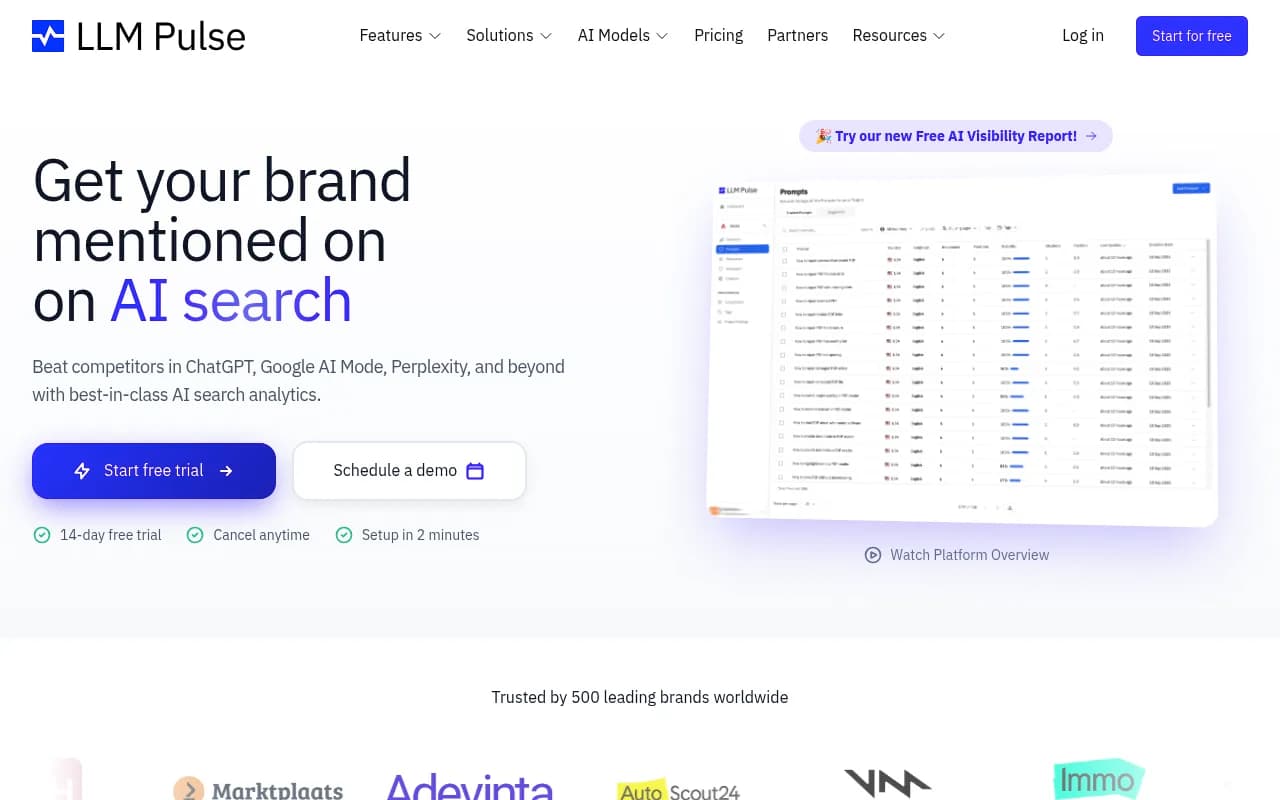
LLM Pulse offers AI visibility tracking at €49/month with a 14-day free trial. It's not as deep as Brandlight on driver analysis, but for agencies running 5 to 50 client portfolios, the self-serve model and accessible pricing make it a practical starting point.
For teams that want monitoring without the enterprise overhead
AthenaHQ is a self-serve monitoring platform with a clean interface. It covers the major AI models and gives marketing teams visibility into brand representation without requiring a sales conversation. It's monitoring-focused like Brandlight, but more accessible.

For teams that want to track AI visibility alongside traditional SEO
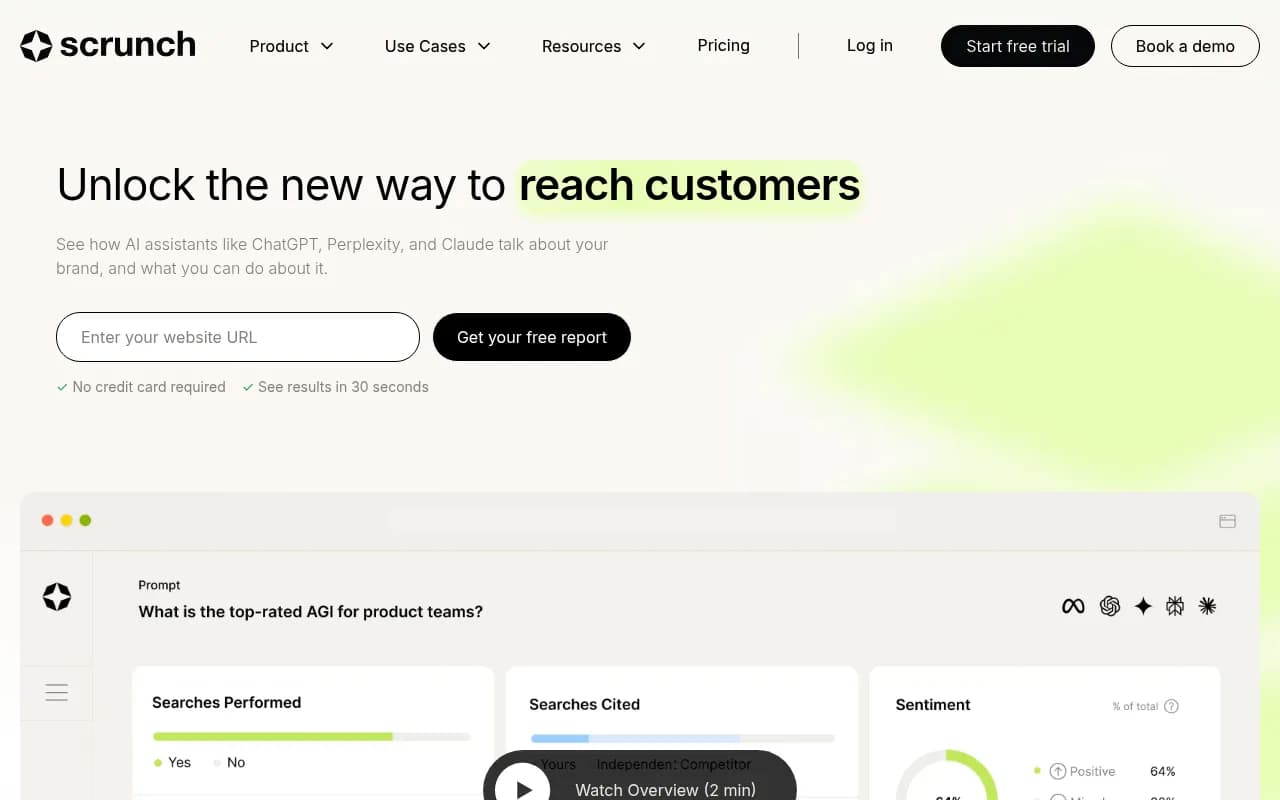
Scrunch AI combines AI search visibility tracking with broader SEO context. If your team is already managing traditional search and wants to add AI visibility without running two separate platforms, it's worth evaluating.
Feature comparison
| Feature | Brandlight | Promptwatch | Profound | LLM Pulse | AthenaHQ |
|---|---|---|---|---|---|
| AI model coverage | ChatGPT, Gemini, Perplexity, Copilot, Grok | 10 models incl. Claude, DeepSeek, Meta AI | 9+ models | ChatGPT, Perplexity, others | Major models |
| Sentiment & driver analysis | Yes | Partial | Yes | Basic | Basic |
| Content gap analysis | No | Yes | No | No | No |
| Content generation | No | Yes | No | No | No |
| AI crawler logs | No | Yes | No | No | No |
| Reddit/YouTube tracking | No | Yes | No | No | No |
| ChatGPT Shopping tracking | No | Yes | No | No | No |
| Free trial / self-serve | No | Yes ($99/mo) | Limited | Yes (€49/mo) | Yes |
| Pricing transparency | Opaque | Published | Partial | Published | Published |
| Best for | Enterprise CMO teams | Teams that want to optimize | Enterprise monitoring | Agencies, SMBs | Self-serve monitoring |
The honest verdict
Brandlight is a well-built product for a specific buyer. If you're a global brand with a dedicated AI strategy team, an analyst budget, and marketing leadership that needs polished reporting, it does that job well. The driver analysis is genuinely useful, the UX is executive-friendly, and the enterprise infrastructure is real.
But if you're outside that profile -- if you want to actually improve your AI visibility rather than just track it, if you need transparent pricing, if you want to understand how AI crawlers interact with your site, or if you're managing a portfolio of clients -- Brandlight's limitations will frustrate you quickly.
The monitoring-only model is the core issue. Knowing your brand appears negatively in Gemini responses is useful. Knowing why and having tools to fix it is what most teams actually need. That's the gap Brandlight leaves open, and it's a meaningful one in 2026 when AI search is no longer a future trend but a current traffic source.
For teams that want the full picture -- monitoring, gap analysis, content creation, crawler logs, and traffic attribution in one place -- the alternatives above are worth a serious look before committing to an enterprise contract that takes seven months to show ROI.