Key takeaways
- Goodie AI is a legitimate AI visibility monitoring platform with genuinely unique coverage of Amazon Rufus and Walmart Sparky, but it requires a sales call before you can see pricing or access the product.
- Third-party estimates put entry-level pricing at $199-$495/month depending on scope, with Claude tracking locked to the custom Enterprise tier.
- The platform focuses on monitoring and competitive benchmarking. It does not generate content, identify content gaps, or help you act on what you find.
- Teams that need to both track and improve AI visibility will likely outgrow Goodie quickly, or find it was never the right fit to begin with.
- Several alternatives publish their prices and offer free trials, making them easier to evaluate before committing.
What is Goodie AI?
Goodie AI (found at higoodie.com) is an Answer Engine Optimization (AEO) platform designed to help brands understand how they appear in AI-generated search results. The core pitch is straightforward: as more users turn to ChatGPT, Perplexity, Google AI Overviews, and other AI engines to find products and services, brands need to know whether they're showing up in those answers.
Goodie tracks brand mentions, citation frequency, and sentiment across a range of AI platforms. Its most distinctive claim is coverage of Amazon Rufus and Walmart Sparky -- the AI shopping assistants embedded in two of the world's largest retail platforms. No other self-serve AEO tool in 2026 matches this, which makes Goodie genuinely interesting for e-commerce brands selling on those marketplaces.
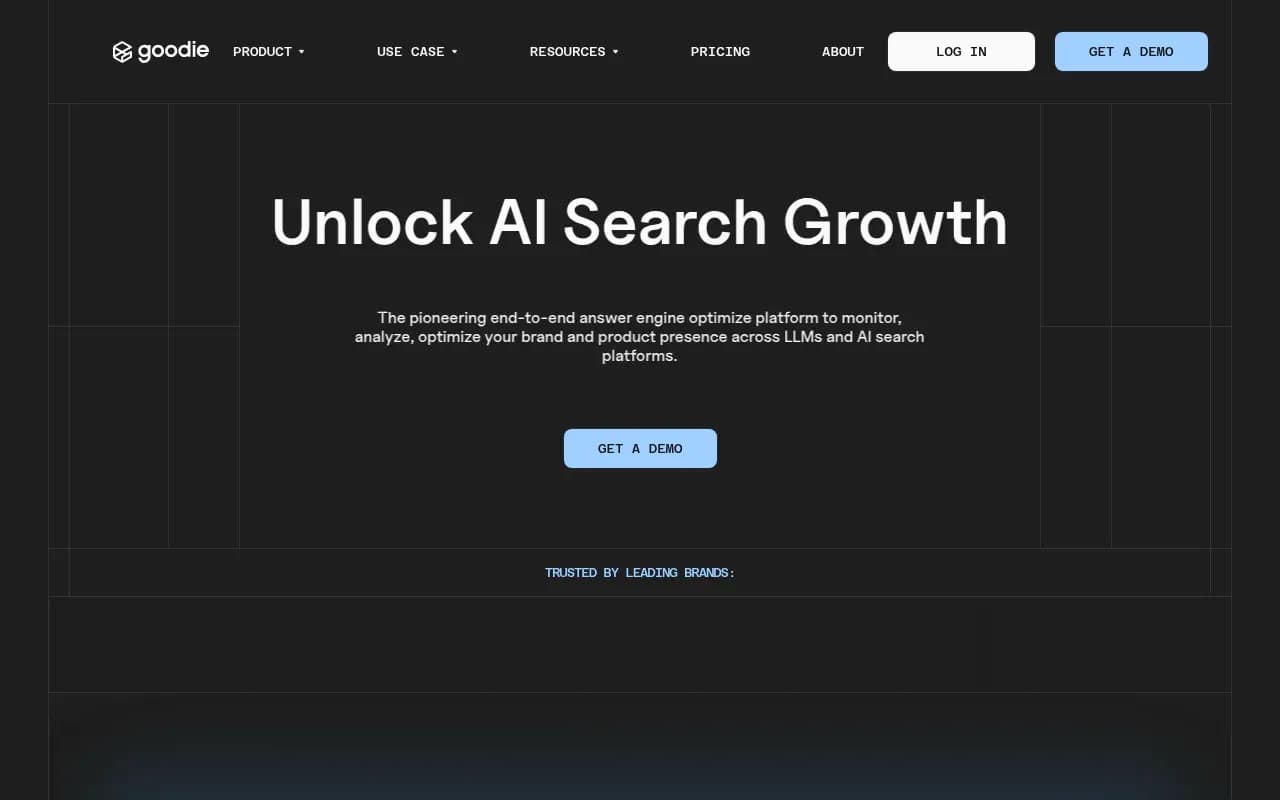
Beyond the Agentic Commerce angle, Goodie offers competitive benchmarking (see how your visibility compares to competitors), sentiment analysis on how AI models describe your brand, and an optimization hub that surfaces recommendations. Case studies from brands like Dermalogica, NoGood, and SteelSeries suggest real-world traction.
So why are so many teams actively searching for alternatives?
Goodie AI's real limitations
No free trial, no self-serve access
This is the friction point that comes up in every evaluation. You cannot sign up for Goodie and start using it. Every tier -- Explorer, Pro, and Enterprise -- is gated behind a "Get a Demo" form. Before you can see the interface, run a test query, or even confirm whether the tool fits your workflow, you need to complete a sales discovery process.
For a marketing team comparing five tools against a fixed monthly budget, that's potentially a week of back-and-forth before the real comparison work starts. Every major alternative covered later in this guide lets you evaluate before paying.
No public pricing
Goodie publishes no pricing on its website. Third-party sources like Capterra estimate entry at $199-$495/month depending on scope, but those numbers can't be verified without going through the demo process. Claude tracking is fully unlocked only on the custom-priced Enterprise tier, which means mid-market teams may find a key engine missing from their plan.
This isn't necessarily a dealbreaker for enterprise procurement teams used to custom contracts, but it creates real friction for anyone trying to do a quick budget check.
Monitoring without optimization
Goodie shows you where you stand. It does not help you change where you stand.
The platform surfaces visibility scores, sentiment data, and competitive benchmarks. What it doesn't do is tell you which specific content gaps are causing you to lose citations to competitors, generate content designed to fill those gaps, or track whether new content you publish actually improves your AI visibility over time.
For teams that want to act on their data -- not just observe it -- this is a significant gap. You end up needing a separate content strategy tool, a separate content production workflow, and a separate way to connect those efforts back to visibility changes.
Engine coverage varies by tier
Claude tracking is Enterprise-only. The exact engine coverage at Explorer and Pro tiers isn't publicly documented, which means you may not know what you're getting until after the demo. For teams that specifically need Claude visibility (increasingly important as Anthropic's market share grows), this creates uncertainty.
What Goodie AI does well
To be fair: Goodie is not a bad product. It's a serious platform with a credible enterprise story.
The Amazon Rufus and Walmart Sparky coverage is genuinely unique. If you're an e-commerce brand selling on Amazon and you want to know whether AI shopping recommendations are surfacing your products, Goodie is the only self-contained platform that tracks this. That's a real differentiator.
The competitive benchmarking is also solid. Seeing your citation share versus specific competitors across multiple AI engines is useful for executive reporting and for understanding where to focus optimization efforts.
Sentiment analysis -- understanding not just whether AI mentions your brand but how it describes you -- is a feature that many cheaper tools skip entirely.
Goodie AI pricing (what we know)
Goodie has three tiers: Explorer, Pro, and Enterprise. None have published prices.
| Tier | What we know | Engine coverage |
|---|---|---|
| Explorer | Entry-level; estimated $199-$495/mo | Partial -- exact engines undisclosed |
| Pro | Mid-tier; custom quote | More engines, likely excludes Claude |
| Enterprise | Full platform; custom contract | All 11 engines including Claude |
For comparison, most alternatives in this space publish flat monthly prices starting at $29-$99/month, with clear engine coverage at each tier.
Who Goodie AI is actually right for
Goodie makes the most sense for:
- E-commerce brands actively selling on Amazon or Walmart who need Agentic Commerce tracking
- Enterprise teams with procurement processes that expect custom contracts and dedicated onboarding
- Organizations where the sales discovery process is a feature, not a bug -- i.e., teams that want a vendor relationship, not a self-serve tool
It's probably not the right fit for:
- Marketing teams that need to evaluate tools quickly against a fixed budget
- Teams that want to move from monitoring to optimization within a single platform
- Smaller brands or agencies where $199+/month requires justification before seeing the product
Better alternatives in 2026
Here's how the main alternatives stack up against Goodie on the dimensions that matter most.
| Tool | Free trial | Public pricing | Starts at | Content optimization | AI engines |
|---|---|---|---|---|---|
| Promptwatch | Yes | Yes | $99/mo | Yes (full content generation) | 10+ |
| Profound | Yes | Yes | $99/mo | No | 10 (Enterprise) |
| Otterly.AI | Yes | Yes | $29/mo | No | 4-6 |
| Peec AI | Yes | Yes | $95/mo | No | 7 (3 on self-serve) |
| Scrunch AI | Yes | Yes | $300/mo | No | 9 (Enterprise) |
| AthenaHQ | Yes | Yes | Custom | No | Multiple |
| Goodie AI | No | No | ~$199/mo est. | No | 11 (Enterprise) |
Promptwatch -- best for teams that want to act, not just monitor
Promptwatch is the platform that most directly addresses Goodie's core limitation. Where Goodie shows you visibility data and leaves you to figure out what to do next, Promptwatch is built around a complete loop: find gaps, create content, track results.
The Answer Gap Analysis identifies exactly which prompts competitors are visible for that you're not -- down to the specific topics and questions AI models want answered but can't find on your site. Content Agents then generate articles, comparisons, and briefs grounded in real prompt data, citation analysis, and competitor research. Page-level tracking shows which new pages start getting cited, by which models, and on what timeline.
It also covers AI crawler logs (real-time data on when ChatGPT, Claude, Perplexity, and others crawl your site), ChatGPT Shopping tracking, Reddit and YouTube citation analysis, and prompt volume/difficulty scoring. Pricing is public: $99/month for Essential, $249 for Professional, $579 for Business.

Profound -- best for enterprise depth without content generation
Profound is the closest enterprise-grade competitor to Goodie in terms of engine coverage and compliance posture (SOC2 certified). It covers 10 AI engines at the Enterprise tier, with published pricing starting at $99/month for Starter.
The limitation is the same as Goodie: it's a monitoring platform. You get visibility data, competitive benchmarks, and trend tracking, but no content gap analysis or content generation. For teams that already have a strong content operation and just need the tracking layer, Profound is worth evaluating.
Profound

Otterly.AI -- best for small teams on a tight budget
At $29/month for the Lite tier, Otterly.AI is the most accessible entry point into AI visibility monitoring. It covers ChatGPT, AI Overviews, Perplexity, and Copilot, with AI Mode and Gemini available as paid add-ons. No sales call required.
The trade-off is depth. Otterly.AI is a monitoring tool without competitive benchmarking, content optimization, or crawler analytics. For solo SEOs or small teams that just want to start tracking before committing to a larger platform, it's a reasonable starting point.
Otterly.AI

Peec AI -- best for brand sentiment tracking
Peec AI focuses specifically on how AI models describe your brand, with sentiment scoring across seven engines. Self-serve plans let you choose three of those seven engines at $95/month, with Claude available only on Enterprise.
The brand-description angle is genuinely useful for PR and brand teams who care less about citation volume and more about whether AI is saying accurate, positive things about them. It doesn't do content optimization either.

AthenaHQ -- monitoring-focused enterprise option
AthenaHQ is a monitoring-focused platform aimed at enterprise teams. It tracks brand visibility across AI search engines with competitive benchmarking, but like most competitors, stops at the data layer. No content generation, no gap analysis.

Scrunch AI -- best for technical SEO teams
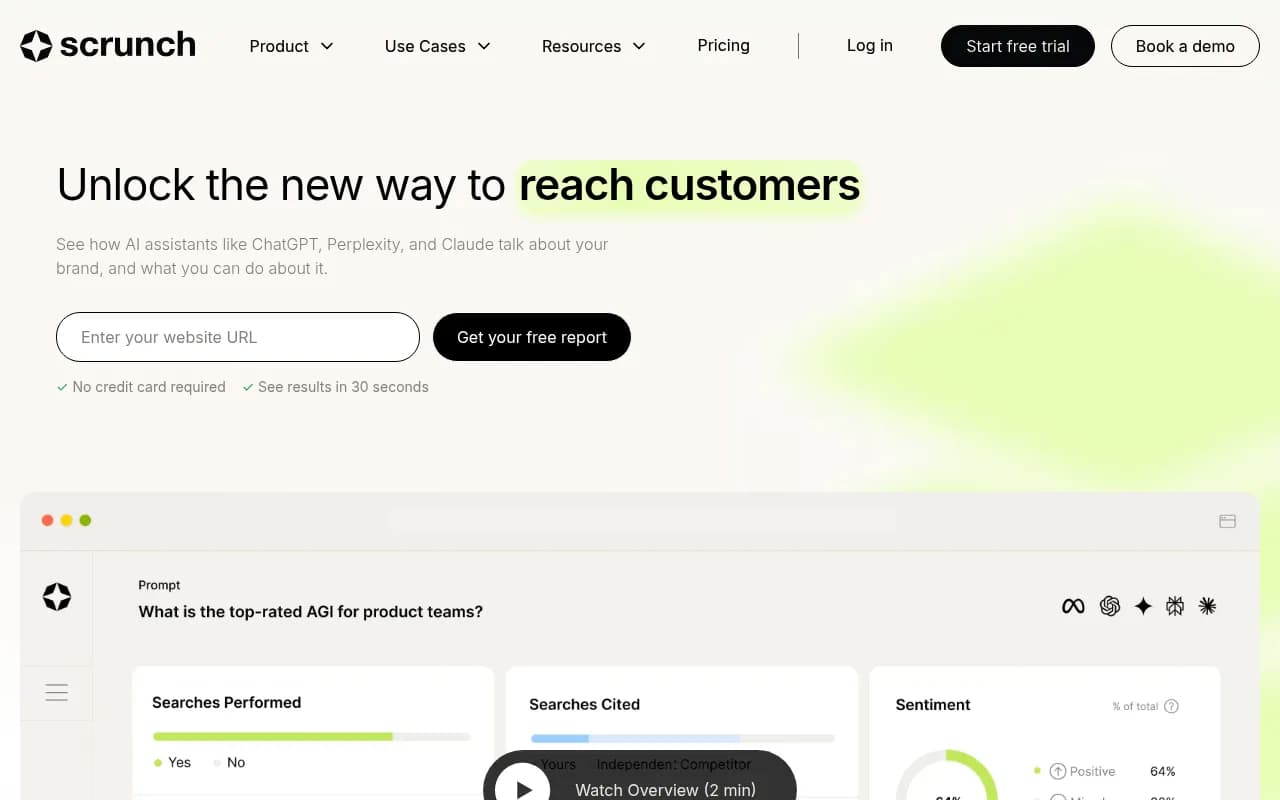
Scrunch AI combines citation tracking with AI crawler analytics, making it useful for technical SEO teams that want to understand how AI engines discover and index their content. The Core plan at $300/month covers ChatGPT, Perplexity, Google AIO, and Copilot, with Claude, Gemini, Meta AI, and others on Enterprise.
The monitoring-only problem
One pattern worth naming directly: most AEO platforms in 2026 -- including Goodie -- are monitoring dashboards. They show you data. They don't help you change the data.
This is fine if you already have a content team that knows how to translate visibility gaps into editorial briefs, a production workflow that can execute those briefs quickly, and a way to connect content publication back to visibility changes over time.
Most teams don't have all three. They see a visibility score, they see that a competitor ranks higher for certain prompts, and then they're stuck. The data is interesting but not actionable.
The platforms that solve this -- Promptwatch being the clearest example -- treat content generation and tracking as part of the same product, not separate workflows. That's a meaningful architectural difference, not just a feature checklist item.
Should you use Goodie AI?
If Amazon Rufus or Walmart Sparky coverage is genuinely important to your business, Goodie is worth going through the demo process. No other platform tracks Agentic Commerce the same way, and for e-commerce brands where AI shopping recommendations drive real revenue, that's a legitimate reason to pay the enterprise premium.
For everyone else, the combination of no public pricing, no free trial, and monitoring-only functionality makes it hard to justify over alternatives that are easier to evaluate and more actionable once you're inside.
The honest summary: Goodie is a capable monitoring platform with a unique e-commerce angle, priced and packaged for enterprise buyers who don't mind a sales-led process. If that's you, it's worth a demo. If it's not, there are better-fit options at every price point.