Key takeaways
- Scrunch AI is a well-built AI visibility monitoring platform with solid multi-engine coverage and an intuitive dashboard, rated 4.7/5 on G2 across 63 reviews.
- Pricing starts at $300/month and climbs fast with per-seat charges ($25/user), making it one of the more expensive options in the GEO space.
- The platform is strong on monitoring but weak on actionability -- it shows you where you're invisible without giving you the tools to fix it.
- No prompt volume data, limited competitor depth, and no built-in content generation are the most consistent user complaints.
- Several alternatives offer comparable or better monitoring at lower prices, and some go further by helping you actually improve your AI visibility.
What is Scrunch AI?
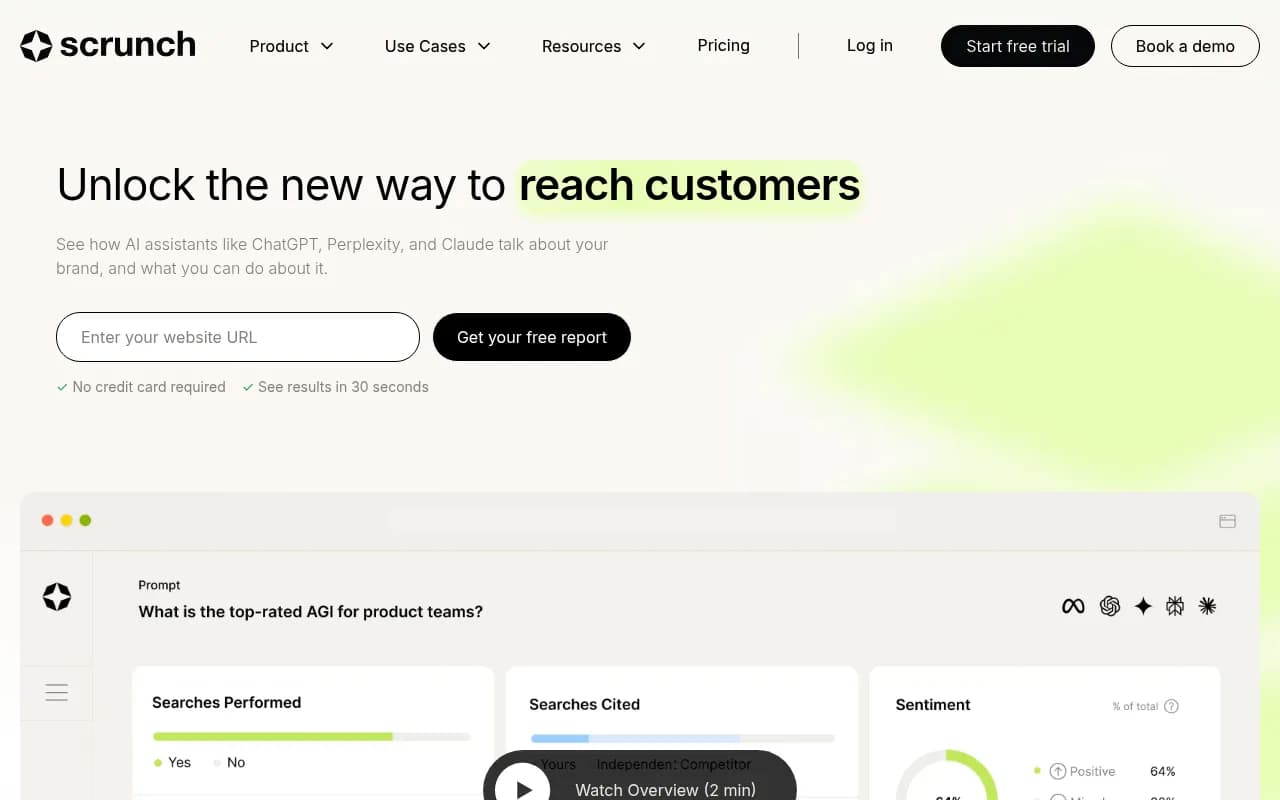
Scrunch AI is a generative engine optimization (GEO) platform built to help brands understand how they appear in AI-generated responses. Instead of tracking Google rankings, it tracks how ChatGPT, Claude, Perplexity, Gemini, and other large language models reference your brand when users ask questions.
The company was founded in 2023, raised a $4M seed round and then a $15M Series A in 2025 (led by Decibel, with Mayfield participating), and has positioned itself as an enterprise-grade "AI Customer Experience" platform. The pitch: AI is now your most important visitor, and Scrunch helps you manage that relationship.
It's a reasonable pitch. AI search is genuinely reshaping how people discover products and services, and brands that don't track their presence in LLM responses are flying blind. The question is whether Scrunch is the right tool to fix that -- or just the most expensive way to see the problem.
Scrunch AI features: what you actually get
Monitoring and brand visibility
This is where Scrunch does its best work. The platform tracks brand mentions across 10+ AI engines, including ChatGPT, Claude, Perplexity, Gemini, DeepSeek, and Grok. You get:
- Visibility scoring that shows how often your brand appears in AI responses
- Citation analysis to see which of your pages LLMs are pulling from
- Competitive benchmarking to compare your share of voice against rivals
- Prompt-level reporting to see which queries trigger your brand mentions
The dashboard is genuinely good. G2 reviewers consistently call it intuitive and easy to navigate -- 76% of reviews are 5-star, which isn't nothing. For teams that are new to AI visibility tracking, the onboarding experience is smooth.
Content and citation gap analysis
Scrunch does surface content gaps -- areas where competitors are getting cited and you're not. This is useful for identifying what's missing. The problem is that it stops there. You can see the gap; you can't close it from within the platform. There's no built-in content generation, no writing agent, no optimization workflow. You get a list of problems and then you're on your own.
Persona segmentation
One feature worth noting: Scrunch lets you segment monitoring by persona, so you can see how AI engines respond differently depending on who's asking. This is more sophisticated than what many competitors offer and is genuinely useful for brands with diverse customer segments.
Competitive intelligence
Scrunch shows competitor visibility scores and share of voice comparisons. Where it falls short -- and this comes up repeatedly in user feedback -- is depth. You can see that a competitor is outranking you for a given prompt. You can't easily see why, or what specific content is driving their citations.
Scrunch AI pricing: the full picture
Scrunch doesn't publish pricing on its website, which is a red flag for any team trying to budget. Based on available data from third-party reviews and comparison sites, here's what the tiers look like in 2026:
| Plan | Price | Prompts | Notes |
|---|---|---|---|
| Core | ~$250-300/mo | ~350 custom prompts | Multi-engine tracking, citation data, persona segmentation |
| Growth | ~$500+/mo | More prompts, more competitors | Additional engines, deeper reporting |
| Enterprise | Custom | Unlimited | Dedicated support, custom integrations |
The per-seat pricing is the real kicker. At $25 per additional user, a team of five adds $100/month on top of the base plan. For agencies or larger marketing teams, costs escalate quickly. One comparison site noted that Scrunch is "one of the most expensive tools in the AI visibility space" at the entry level.
There's no free trial mentioned publicly, and no self-serve sign-up -- you go through a demo process, which adds friction for teams that want to evaluate quickly.
Real user feedback: what G2 reviewers actually say
The 4.7/5 rating on G2 (63 reviews) is strong, and the praise is consistent: the dashboard is clean, the multi-engine coverage is broad, and the onboarding is smooth. Teams that are new to GEO find it accessible.
But the critical feedback is also consistent:
- "Scrunch provides prompt and citation tracking but doesn't share prompt volume data -- and its prompt trend feature is too basic to be actionable." This is a real gap. Without knowing which prompts get the most traffic, you can't prioritize what to fix.
- The optimization guidance is thin. Several users describe it as a monitoring dashboard that shows you problems without helping you solve them.
- Pricing is a recurring complaint, especially for smaller teams or agencies managing multiple brands.
The pattern that emerges: Scrunch is a good tool for enterprises that have a dedicated team to act on the data. For teams that need the platform to do more of the heavy lifting, it falls short.
Where Scrunch AI falls short
No prompt volume data
This is the biggest functional gap. Knowing that you're invisible for a prompt is only half the picture. Knowing whether that prompt gets asked 50 times a month or 50,000 times determines whether it's worth your time. Scrunch doesn't surface this data, which makes prioritization guesswork.
Monitoring without optimization
Scrunch tells you where you're losing. It doesn't help you win. There's no content generation, no AI writing agent, no structured workflow for turning visibility gaps into published content. For a platform at this price point, that's a meaningful limitation.
Per-seat pricing adds up
$25 per user per month sounds modest until you're running a five-person marketing team or an agency with multiple client accounts. The cost structure penalizes collaboration.
Limited competitor depth
Scrunch shows competitive share of voice, but users consistently note that the competitive intelligence doesn't go deep enough to be truly actionable. You know you're losing; you don't know exactly why or what to do about it.
Scrunch AI vs the competition
Here's how Scrunch stacks up against the main alternatives in 2026:
| Tool | Starting price | Prompt volume data | Content generation | AI crawler logs | Free trial |
|---|---|---|---|---|---|
| Scrunch AI | ~$300/mo | No | No | No | No |
| Promptwatch | $99/mo | Yes | Yes (built-in agent) | Yes | Yes |
| Profound | ~$200/mo | Partial | No | No | Demo only |
| Otterly.AI | ~$99/mo | No | No | No | Yes |
| Peec AI | ~$79/mo | No | No | No | Yes |
| AthenaHQ | Custom | No | No | No | Demo only |
The table tells a clear story. Scrunch is priced at the top end of the market but doesn't lead on features. Platforms like Promptwatch come in at a third of the price and go significantly further -- tracking prompt volumes, generating content to fill visibility gaps, and logging AI crawler activity so you can see exactly how models are discovering (or failing to discover) your pages.

The best Scrunch AI alternatives in 2026
Promptwatch
If the core frustration with Scrunch is that it shows you problems without helping you solve them, Promptwatch is the most direct answer. It's built around a closed loop: find the prompts where competitors are visible and you're not, generate content engineered to get cited by AI models, then track whether it works.
The built-in AI writing agent creates articles, listicles, and comparisons grounded in real citation data -- not generic SEO filler. The platform also logs AI crawler activity (which pages ChatGPT, Claude, and Perplexity are reading, how often, and what errors they hit), which is something most competitors don't offer at all. Pricing starts at $99/month with a free trial available.
Profound
Profound is the other enterprise-grade option worth considering. It has strong monitoring capabilities and a cleaner competitive intelligence layer than Scrunch. One comparison found Profound ranking #1 in AI search visibility at 47.1% vs Scrunch's #23 at 4.7% -- though that's a self-reported metric from Profound's own blog, so take it with appropriate skepticism. Pricing is similar to Scrunch, and it also lacks content generation. Good for enterprise teams that want depth of monitoring over breadth of optimization.
Profound

Otterly.AI
A more affordable monitoring option. Otterly covers ChatGPT, Perplexity, and Google AI Overviews, and the interface is clean. It's monitoring-only -- no content generation, no crawler logs -- but at roughly a third of Scrunch's price, it's a reasonable starting point for teams that just want visibility data without the enterprise overhead.
Otterly.AI

Peec AI
Similar positioning to Otterly -- basic monitoring across the main AI engines at a lower price point. Good for smaller teams or those just getting started with GEO. Doesn't have the depth for enterprise use cases, but it doesn't charge enterprise prices either.

AthenaHQ
AthenaHQ is monitoring-focused with a clean interface and solid competitive tracking. It's positioned for enterprise teams and uses a demo-first sales process. Like Scrunch, it doesn't have content generation or optimization tools built in -- it's a visibility dashboard, not an optimization platform.

AirOps
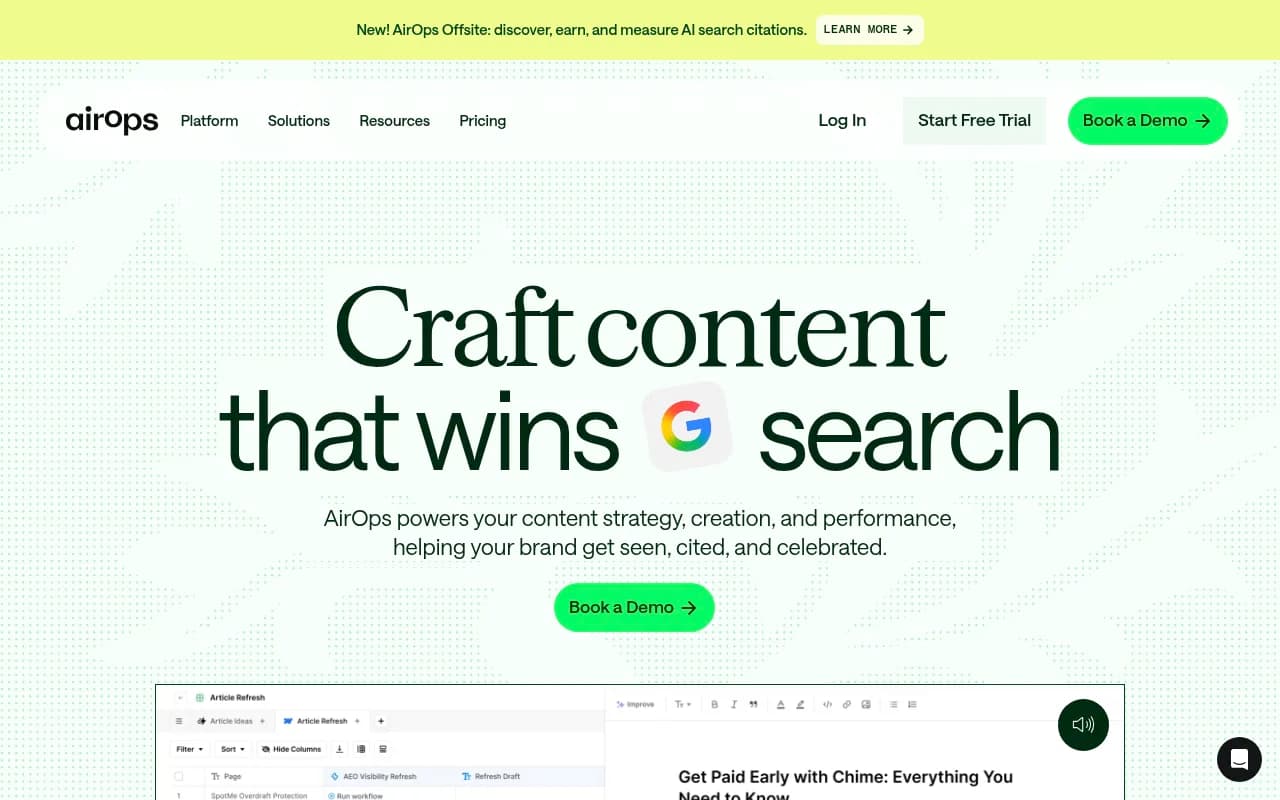
AirOps takes a different angle -- it's more of a content engineering platform than a pure monitoring tool. If your primary need is creating content that ranks in AI search (rather than tracking what's already happening), AirOps is worth evaluating. It's less focused on real-time monitoring and more focused on the production side.
Who should use Scrunch AI?
Scrunch makes the most sense for:
- Enterprise marketing teams with $500+/month budgets who need multi-engine coverage and persona segmentation
- Brands that already have a content team to act on the data and don't need built-in generation
- Organizations that value a polished, easy-to-use interface and are willing to pay for it
It's probably not the right fit for:
- Smaller teams or agencies where per-seat pricing becomes prohibitive
- Teams that need prompt volume data to prioritize their work
- Anyone who wants the platform to help close the gap, not just identify it
Final verdict
Scrunch AI is a genuinely good monitoring platform. The dashboard is clean, the multi-engine coverage is broad, and the G2 reviews reflect real user satisfaction. For an enterprise team with budget to spare and a dedicated content operation to act on the data, it does what it promises.
But "good monitoring" is table stakes in 2026. The GEO tools that are pulling ahead are the ones that close the loop -- that don't just show you where you're invisible, but help you do something about it. Scrunch hasn't gotten there yet, and at $300+/month with per-seat charges on top, the gap between price and capability is hard to ignore.
If you're evaluating Scrunch, spend an hour with Promptwatch before you sign anything. The price difference alone is significant, and the feature gap -- prompt volumes, content generation, crawler logs -- is real.