Key Takeaways
- Brand visibility is volatile: Only 30% of brands maintain visibility from one AI answer to the next, and just 20% remain present across five consecutive queries
- Fresh, structured content wins: Pages not updated quarterly are 3× more likely to lose citations; sequential headings and rich schema correlate with 2.8× higher citation rates
- Off-site credibility drives citations: 48% of citations come from community platforms like Reddit and YouTube, while 85% of brand mentions originate from third-party pages rather than owned domains
- AI Overviews bypass traditional rankings: 60% of AI Overview citations come from URLs not ranking in the top 20 organic results
- Enterprise AI adoption accelerates: Worker access to AI rose 50% in 2025, with companies expecting to double production-scale AI projects within six months
How AI Search Transformed Discovery in 2025
The way people find information fundamentally changed in 2025. Instead of scanning a list of blue links, millions now ask AI assistants for direct answers. ChatGPT Search, Perplexity, Google AI Overviews, Claude, and Gemini became default research tools for a generation that expects answers, not links.
This shift created a new visibility problem: brands that dominated Google's first page found themselves invisible in AI responses. The rules changed. Rankings matter less. Citations matter more. And the signals that determine which brands get mentioned—freshness, structure, community validation—operate on entirely different logic than traditional SEO.
By mid-2025, 75% of people were using AI search more than in 2024, and 43% were using it daily or more. As traffic shifted, clicks decreased. PEW Research reported that AI summaries reduce the likelihood of users clicking on search results links. Gartner predicted that by 2026, a quarter of all search traffic would shift from Google to AI-driven answer engines—and early 2026 data suggests they were right.
The Citation Volatility Crisis
Traditional search rankings are relatively stable. If you rank #3 for a keyword today, you'll likely rank #3 tomorrow. AI search doesn't work that way.
Research from AirOps analyzing millions of AI responses found that only 30% of brands stay visible from one answer to the next. Run the same prompt five times, and just 20% of brands remain present across all five runs. This volatility creates a fundamental challenge: you can't optimize for a fixed position because there is no fixed position.
Why does this happen? AI models don't retrieve a static set of results. They synthesize answers from dynamic knowledge bases that update in real time. A brand mentioned today might be replaced tomorrow if:
- A competitor publishes fresher content
- Community discussions shift sentiment
- The model's training data updates
- Query interpretation changes based on context
This means brands must earn visibility continuously, not once. The old SEO playbook—rank, then coast—doesn't apply.
What Actually Drives AI Citations
Fresh Content Wins (And Stale Content Loses Fast)
Pages not updated quarterly are 3× more likely to lose citations compared to regularly refreshed content. AI models prioritize recency signals because they're trained to surface current, relevant information.
This doesn't mean you need to rewrite everything every month. Strategic freshness works:
- Update statistics and data points
- Add new examples or case studies
- Refresh dates in titles and headers
- Expand sections with new insights
- Remove outdated references
The goal is to signal that your content reflects the current state of the topic, not just historical knowledge.
Structure and Schema Create 2.8× Higher Citation Rates
AI models parse content differently than humans. They look for clear hierarchies, semantic relationships, and machine-readable signals. Research shows that sequential headings and rich schema correlate with 2.8× higher citation rates.
What this looks like in practice:
- Use proper heading hierarchy (H1 → H2 → H3)
- Implement schema markup (FAQPage, HowTo, Product, Organization)
- Structure content with clear sections and subsections
- Use lists and tables for scannable information
- Include explicit definitions and explanations
AI models reward content that's easy to parse and extract. If your page structure is messy or your schema is missing, you're invisible by default.
Off-Site Credibility Matters More Than Owned Content
Here's the surprising part: 85% of brand mentions originate from third-party pages rather than owned domains. And 48% of citations come from community platforms like Reddit and YouTube.
Yext Research found that 86% of citations in AI-generated answers link to sources brands can control—but "control" doesn't mean "owned." It means places where you can influence the conversation:
- Reddit threads discussing your category
- YouTube reviews and comparisons
- Industry forums and communities
- Third-party review sites
- News articles and press coverage
AI models trust community validation more than brand messaging. A Reddit thread with 500 upvotes carries more weight than a perfectly optimized landing page. This shifts the game from on-page SEO to reputation management and community engagement.
Mentions + Citations = Stability
Brands earning both mentions (name drops without links) and citations (direct source links) show 40% higher likelihood of reappearing across answers. But only 28% of answers include brands with dual visibility.
This suggests a two-tier strategy:
- Earn citations through authoritative, structured content on your owned properties
- Earn mentions through community presence, reviews, and third-party validation
The combination creates resilience. If your citation drops, your mention keeps you visible. If your mention fades, your citation holds the position.
AI Overviews Bypass Traditional Rankings
Google AI Overviews introduced a new wrinkle: 60% of citations come from URLs not ranking in the top 20 organic results. This means traditional SEO performance doesn't predict AI visibility.
Why? AI Overviews pull from Google's broader knowledge graph, not just the current SERP. They prioritize:
- Authoritative domains with strong E-E-A-T signals
- Content with clear, direct answers to the query
- Pages with rich schema and structured data
- Sources with high engagement and user satisfaction metrics
A page ranking #47 can get cited in an AI Overview if it has the clearest answer and strongest schema. Meanwhile, the #1 organic result might be ignored if it's a thin affiliate page or lacks structure.
This creates opportunity: you don't need to outrank competitors to outperform them in AI search. You need to out-structure and out-answer them.
Enterprise AI Adoption Accelerates
While consumer AI search adoption grew, enterprise AI adoption exploded. Deloitte's 2026 State of AI report found that worker access to AI rose 50% in 2025, and companies expect to double the number of AI projects in production within six months.
Key enterprise trends:
- 93% of eCommerce brands see AI as a competitive advantage
- Companies with ≥40% of AI experiments in production will double in six months
- 58% of companies report at least limited use of physical AI today, rising to 80% in two years
- Agentic AI usage is poised to rise sharply, with 23% of companies using it moderately today
But there's a gap: only 34% of companies are truly reimagining their business with AI. Most are using it at surface level or redesigning key processes, not fundamentally transforming operations.
For brands, this means AI search visibility isn't just a marketing problem—it's a business strategy problem. As AI agents begin booking, purchasing, and recommending on behalf of users, being invisible in AI search means being invisible to automated decision-makers.
The Zero-Click Search Reality
AI search accelerated the zero-click trend. Nearly half of all Google searches now end without a click, and AI summaries are a major driver. When ChatGPT, Perplexity, or Google AI Overviews answer a question directly, users don't need to visit websites.
This creates a paradox:
- Traffic declines as AI answers questions inline
- Visibility matters more because being mentioned is the only brand exposure
- Attribution breaks because traditional analytics can't track AI-driven awareness
Brands that relied on click-through traffic for conversions now face a world where awareness happens in AI interfaces, not on websites. The solution isn't to fight AI search—it's to optimize for it.
Tools like Promptwatch help brands track AI visibility, identify content gaps, and measure the impact of AI citations on actual traffic. The platform connects AI search monitoring with traffic attribution, closing the loop between visibility and revenue.

What Brands Should Do in 2026
1. Audit Your AI Visibility
You can't optimize what you don't measure. Start by understanding:
- Which prompts trigger mentions of your brand
- Which competitors appear more often
- Which content types get cited most
- Where your citations come from (owned vs. third-party)
Platforms like Promptwatch, Otterly.AI, and Profound provide AI search monitoring across ChatGPT, Perplexity, Google AI Overviews, and other models. Track your baseline before making changes.
Otterly.AI

Profound

2. Refresh Content Quarterly
Set a calendar reminder to update your top-performing pages every 90 days. Focus on:
- Updating statistics and data points
- Adding new examples or case studies
- Expanding sections with deeper insights
- Removing outdated information
- Refreshing publish dates
This signals to AI models that your content reflects current knowledge, not historical snapshots.
3. Implement Rich Schema
If you haven't already, add schema markup to your key pages:
- FAQPage schema for Q&A content
- HowTo schema for step-by-step guides
- Product schema for product pages
- Organization schema for brand information
- Article schema for blog posts
Use Google's Structured Data Testing Tool to validate your implementation. Schema isn't optional anymore—it's table stakes for AI visibility.
4. Build Community Presence
Since 48% of citations come from Reddit and YouTube, invest in community engagement:
- Participate authentically in relevant subreddits
- Create helpful YouTube content (reviews, tutorials, comparisons)
- Engage in industry forums and discussions
- Encourage customers to share experiences publicly
- Monitor and respond to community conversations
Don't spam. Add value. AI models detect and reward genuine community contributions.
5. Track and Attribute AI Traffic
Implement tracking to connect AI visibility to actual business outcomes:
- Add UTM parameters to links in AI-cited content
- Use server log analysis to identify AI crawler traffic
- Integrate with Google Search Console for AI Overview data
- Monitor brand search volume as a proxy for AI-driven awareness
This helps you prove ROI and prioritize optimization efforts based on what actually drives results.
6. Generate Content That Answers Specific Prompts
AI models cite content that directly answers user queries. Use prompt intelligence tools to identify:
- High-volume prompts in your category
- Questions competitors answer but you don't
- Content gaps where no one has a good answer
- Query fan-outs that show how prompts branch into sub-queries
Then create content specifically designed to answer those prompts. Tools like Promptwatch include AI writing agents that generate articles grounded in real citation data and competitor analysis.
The Future of AI Search
AI search in 2026 is just the beginning. As agentic AI emerges—AI that doesn't just recommend but actually books, purchases, and acts on behalf of users—brand visibility will matter even more.
Google AI Mode already offers agentic booking. OpenAI launched its Atlas browser. ChatGPT Shopping tracks product recommendations. These aren't experiments—they're the new default.
Brands that optimize for AI search now will own the advantage as AI agents become the primary interface between consumers and commerce. Those that wait will find themselves invisible in the only channel that matters.
The rules changed. Fresh, structured, community-validated content wins. Traditional rankings matter less. Citations matter more. And the brands that adapt fastest will dominate the next decade of search.
Resources and Tools
If you're serious about AI search visibility, these tools can help:
- Promptwatch: End-to-end AI visibility platform with content gap analysis, AI writing agents, and traffic attribution
- Otterly.AI: Basic AI search monitoring across ChatGPT, Perplexity, and Google AI Overviews
- Profound: Enterprise AI visibility platform tracking 9+ AI search engines
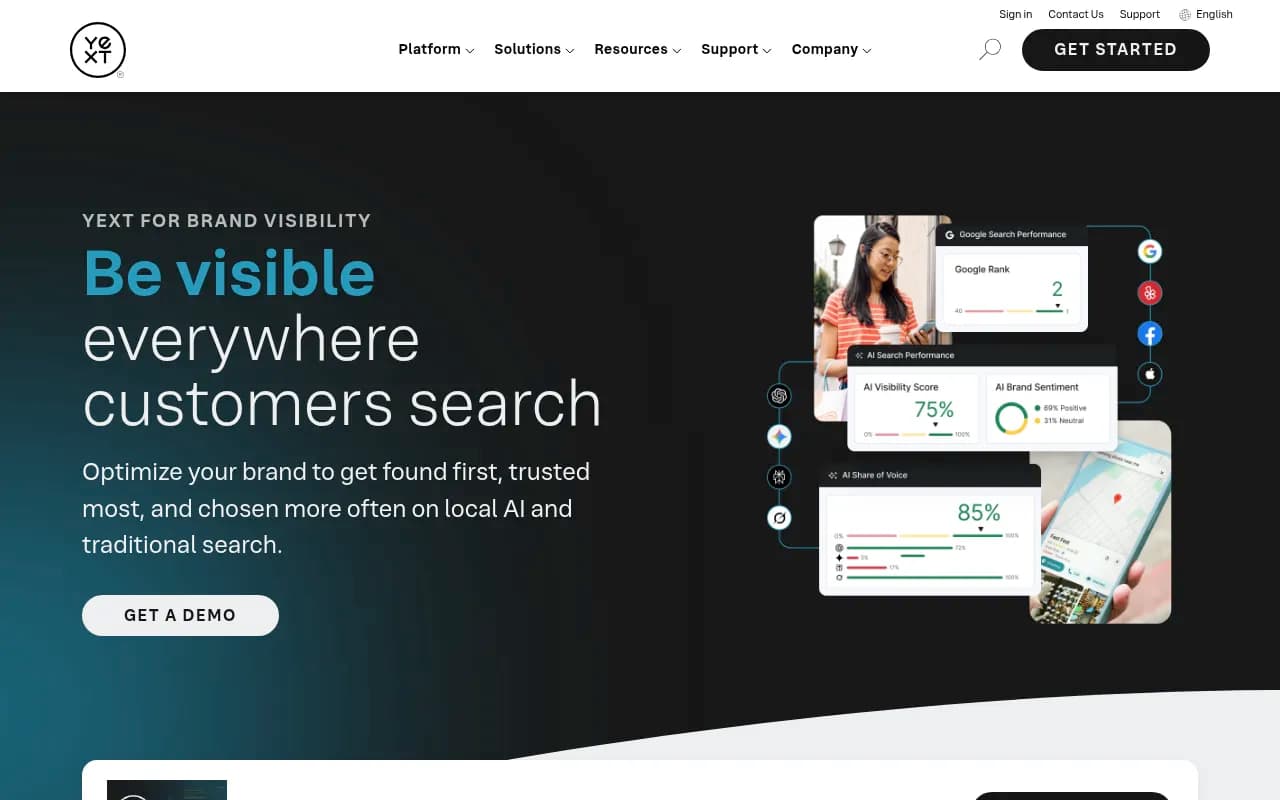
- Yext: Multi-location brand visibility across traditional and AI search
- Semrush: Traditional SEO platform with emerging AI search capabilities
The state of AI search in 2026 is clear: visibility is volatile, citations bypass rankings, and off-site credibility matters more than owned content. Brands that understand these patterns and optimize accordingly will win. Those that don't will fade into irrelevance, invisible to the AI models that now control discovery.