
Key takeaways
- Three GEO vendors were acquired in 2026: Scrunch by Sitecore (June 3), Hall by Tracksuit (July 21), and AthenaHQ by Bloomreach (November 16). Each buyer is an adjacent platform, not a pure-play GEO company.
- Outcomes differ. Hall has effectively stopped taking new sign-ups. Scrunch is being wired into Sitecore's own products. AthenaHQ is described as continuing, but nothing public says for how long or at what price.
- None of the announcements I found state sunset dates, standalone pricing, or migration terms. Those are the questions you have to ask your vendor directly.
- Your best protection is boring: export your data regularly, read your contract for change-of-control language, and know which tool you would switch to.
- If you want a vendor-neutral way to keep AI visibility tracking in one place, compare several platforms before you commit, not after.
Why this is happening now
GEO tools are a young category. Most of them are startups that raised small rounds, built a dashboard that tracks brand mentions in ChatGPT, Perplexity and Gemini, and got noticed by bigger software companies that want an AI search story.
The buyers are not other GEO specialists. They are companies that already sell to marketers and want AI visibility as a feature. That distinction matters, because a feature inside a suite does not have to behave like a standalone product. It can be rebuilt, bundled, repriced or switched off.
I am not saying any of these deals will hurt customers. Acquisitions often give a small product more engineering and a longer runway. But if you pay for one of these tools today, you should know how the three deals actually played out so far, and how little is public.
The three deals at a glance
| Vendor | Acquirer | Announced | Price | What the acquirer does | Public info on standalone future |
|---|---|---|---|---|---|
| Scrunch | Sitecore | June 3, 2026 | Reported at about $225M by Bloomberg; Sitecore declined to confirm | Digital experience platform | Recommendations to be automated inside SitecoreAI products; standalone availability not stated |
| Hall | Tracksuit | July 21, 2026 | Undisclosed | Brand tracking | Hall homepage says it is now part of Tracksuit; new sign-ups are not offered |
| AthenaHQ | Bloomreach | November 16, 2026 | Undisclosed | Commerce and customer engagement | Described as continuing at its own site; no pricing or sunset terms published |
Scrunch and Sitecore
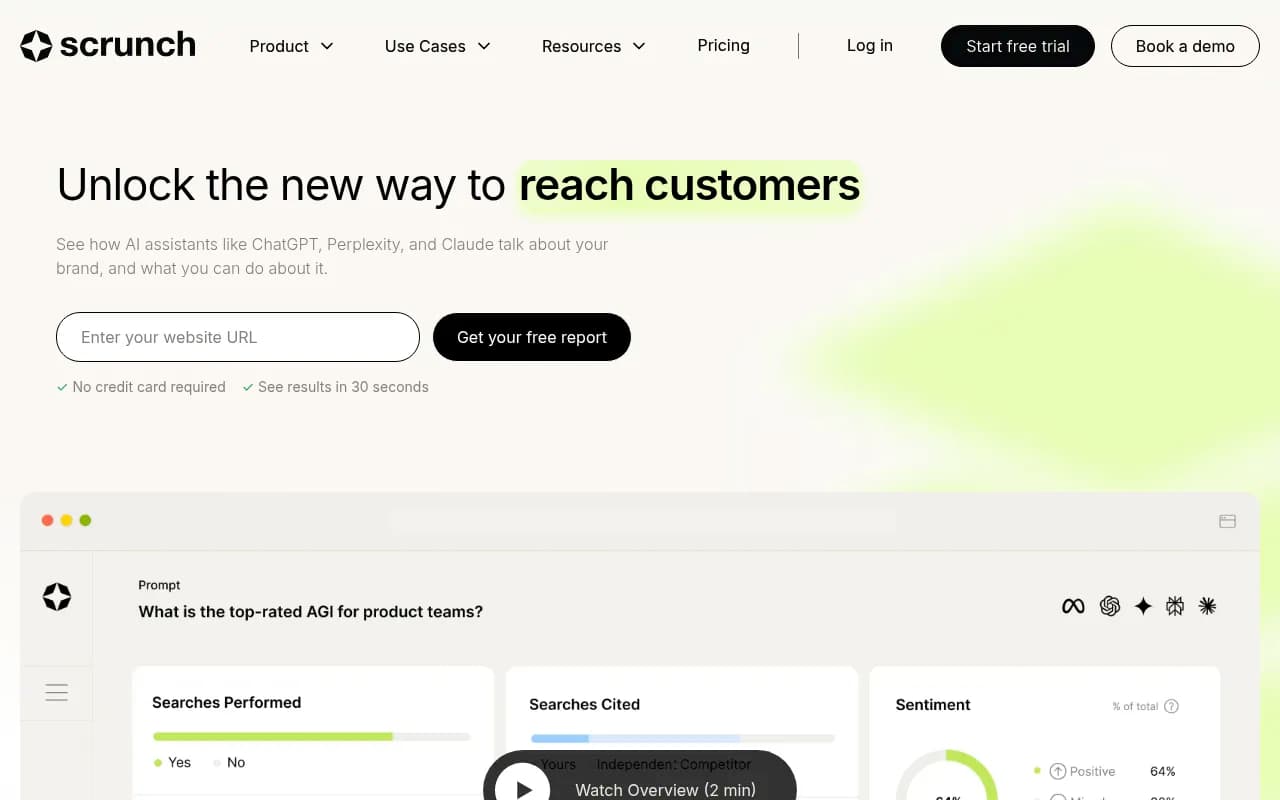
Sitecore announced the Scrunch acquisition on June 3, 2026. Bloomberg reported the price at roughly $225M, which Adweek covered; Sitecore did not confirm the number. Chris Andrew is now described as CEO of Scrunch, a Sitecore company.
The interesting part is the product direction. Sitecore says Scrunch's recommendations will be automated inside SitecoreAI Content Management, Content Marketing and Digital Asset Management. It also draws a contrast with standalone AEO tools. Read that sentence slowly. The acquirer is explicitly positioning the product against the thing many of Scrunch's customers bought it as.
Scrunch's Agent Experience Platform, which serves AI agents a version of your pages they can read, is the piece Sitecore seems most excited about. The press release cites Akamai seeing a 364% increase in appearances in non-branded AI answers, and Runpod reporting a 400% increase in paying customers tied to its AI search work. Those are vendor claims. Nobody has verified them independently, and I would treat them as marketing until a customer tells you the same thing.
The release does not state pricing or whether Scrunch will stay available on its own. Scrunch listed at $250 per month and up before the deal, per Graphite's AEO tools comparison, but I could not find anything current on how that will hold.
Hall and Tracksuit
Hall is the clearest case of a product being absorbed. Tracksuit, the Auckland-based brand tracking company, announced the acquisition on July 21, 2026, for an undisclosed amount. Hall's team, based in Sydney, joined in full. Founder Kai Forsyth becomes product lead of AI visibility at Tracksuit, and SmartCompany reported that Hall had raised a $2M pre-seed from Blackbird in 2025.
The Hall homepage now reads "Hall is now part of Tracksuit" and points visitors to a Tracksuit AI visibility waitlist rather than the Hall product. SmartCompany says Tracksuit will offer AI visibility tools later this year. My read, and it is only a read, is that Hall as a standalone product is being folded into Tracksuit. Verify that with the vendor before you act on it.
Hall's own rationale is worth quoting in spirit: measuring AI visibility alone tells you very little, and a mention score only matters next to what real people think. That is a coherent product thesis. It is also a thesis that changes what you get. If you bought Hall for a clean AI mention tracker, a roadmap that blends it with human brand health is a different product.
Content Monk's AthenaHQ alternatives roundup makes the practical point plainly: a slot that used to go to Hall now can't, because the site no longer offers sign-ups to new customers.
AthenaHQ and Bloomreach
Bloomreach announced the AthenaHQ acquisition on November 16, 2026, with price undisclosed. Forbes covered it. AthenaHQ is Y Combinator-backed, led by CEO Andrew Yan (ex-Google) and Alan Yao (ex-ServiceNow), and names Coinbase, Cozy Earth, Nuvadermis and Datmos as customers.
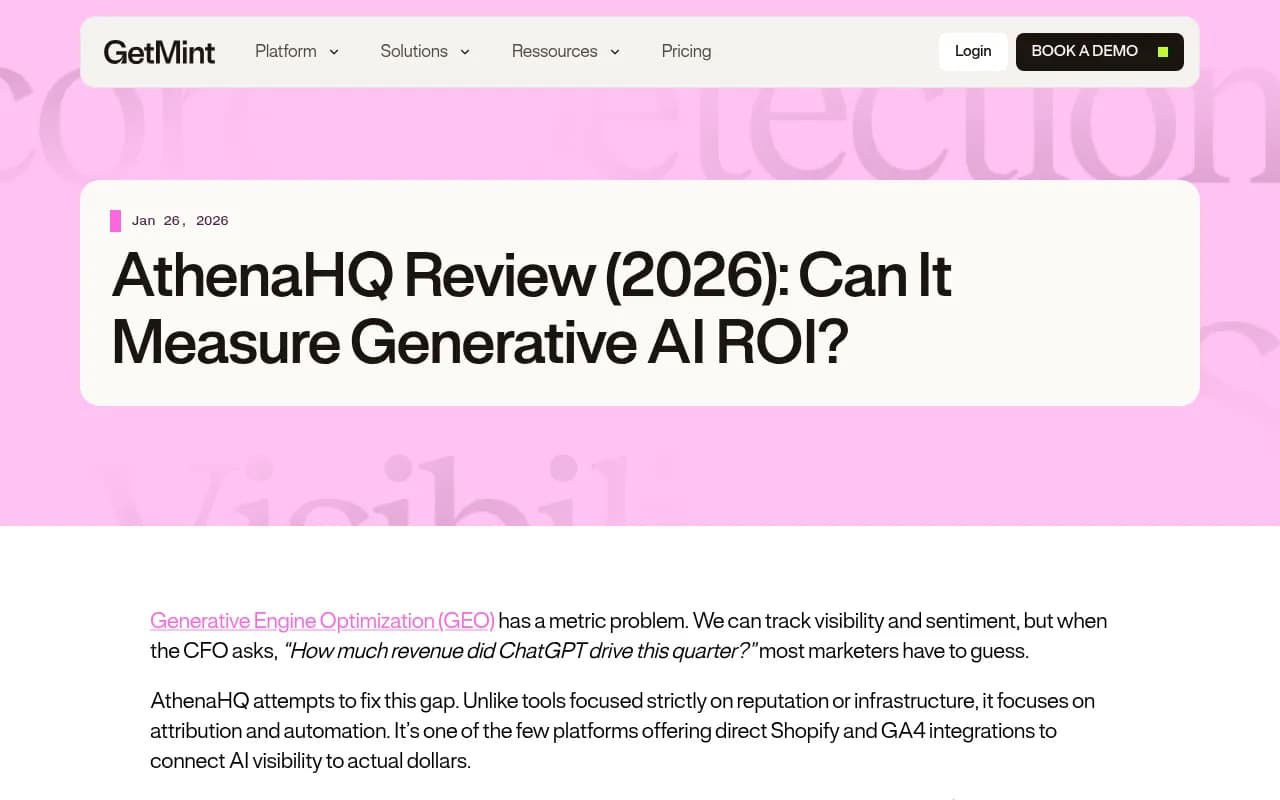
Bloomreach says it serves 1,400+ brands and pitches the deal as tying AI visibility to revenue. It positions the Athena Citation Engine, a model that forecasts how likely content is to be cited by AI, as a complement to Loomi, its customer-engagement AI. AthenaHQ's existing strengths are Shopify and GA4 integrations and MCP connections to Claude and ChatGPT. GetMint's AthenaHQ review lists pricing around $295 per month and calls it unusually focused on attribution.
What the release does not say is the point. No standalone pricing, no sunset, no migration plan. The product is described as continuing. That is reassuring and also not a commitment. This deal is two weeks old as I write this, so most of the real decisions probably have not been made yet.

What the three deals have in common
Every buyer is an adjacent platform. Sitecore sells a digital experience platform. Tracksuit sells brand tracking. Bloomreach sells commerce and customer engagement. None of them is a GEO company that wants more GEO customers. It is a plausible inference that the tool becomes a feature of a bigger suite, though that is inference, not something any of the three announced.
A few patterns follow from that.
- The people who benefit most are customers who already use the acquirer's suite. A Sitecore customer gets Scrunch recommendations in the CMS. A Bloomreach customer gets AI visibility next to commerce data.
- Standalone customers are the group with the least clarity. You may be fine, you may get a price change, you may get a polite email.
- Roadmaps shift toward the acquirer's priorities. Hall's pivot toward brand health is one example. Sitecore's emphasis on its own platform workflows is another.
There is also a competitive-set effect. As a tool gets absorbed, your list of independent options shrinks. If you are choosing now, that is a reason to look at vendors whose entire business is AI visibility, and to ask what their ownership looks like.
What a short sunset window looks like
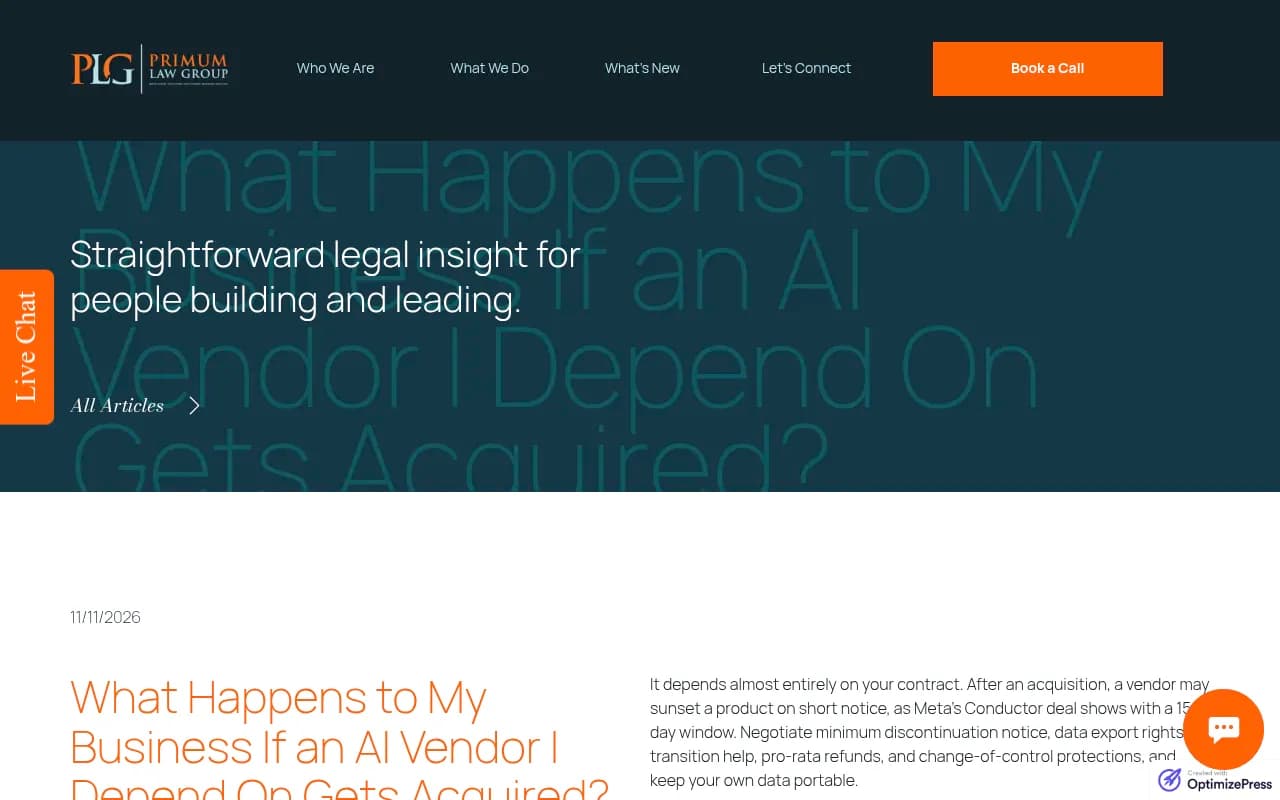
These three GEO deals have not produced a published shutdown date. A different AI deal gives a sense of how fast it can go when a buyer wants the team, not the customers. Primum Law Group wrote that after Meta confirmed it had acquired AI coding startup Conductor on November 5, 2026, Conductor Cloud became read-only on November 13 and shut down on November 20. That is 15 days from announcement to shutdown.
It is a different category of software, so treat it as an analogy and nothing more. The law firm is careful to say that fast transitions are common and that nothing suggests anyone acted badly. Still, it is a useful number to hold in your head when you read your own contract.
A practical checklist before your vendor is next
Here is what I would do this week if I were paying for any GEO tool, including the three above.
Read the contract for five things
Primum Law's list is the right one: minimum discontinuation notice, data export rights, transition help, pro-rata refunds if the product is discontinued, and change-of-control protections. If your plan is monthly and self-serve, you probably agreed to online terms that give the vendor wide latitude. Read them anyway. Annual prepayment is where pro-rata refund language matters most.
Export what you cannot recreate
AI answers change daily, so historical prompt and response data is hard to rebuild. Export prompts, responses, citation lists, sentiment scores and competitor benchmarks on a schedule, monthly at minimum. Keep the prompt list itself in a spreadsheet you own, since that is the part that takes the most thought to rebuild.
Keep attribution outside the tool
If your revenue attribution for AI traffic lives only inside a vendor dashboard, you lose it when the dashboard goes. Make sure GA4 or your own analytics holds the underlying visitor data. Tools like Google Analytics are boring and that is the point.
Name your fallback
For each critical tool, know which alternative you would move to and roughly what migration involves. Trial two or three before you need them. A fallback you have never logged into is not much of a fallback.
Watch for signals
Funding news, leadership changes, acquisition rumors, a sudden quiet on the product blog, a homepage that starts saying "part of". Any of these is a reason to reread your contract.
Questions to email your vendor today
If you use AthenaHQ, Scrunch or any other GEO tool whose ownership recently changed, send a short note. Ask:
- Will the product continue as a standalone offering, and for how long?
- Will pricing change at renewal?
- What is the notice period if the product is discontinued?
- Can I export all historical data in a usable format, and how?
- Does the acquisition change where my data is stored or who can access it?
Whether they answer clearly is information too.
How to choose a GEO tool with this in mind
Acquisition risk should be one criterion alongside coverage, pricing and features. A rough way to think about it:
| Criterion | What to check |
|---|---|
| Ownership | Independent, venture-backed, or part of a suite |
| Export | CSV, API or MCP access to your full history |
| Contract | Notice period, refund terms, change-of-control language |
| Scope | Does it only monitor, or does it also fix and measure |
| Exit cost | How much work to rebuild prompts and reporting elsewhere |
On scope, monitoring-only tools are the easiest to replace, because the data they hold is mostly a history you can export. Tools that also write content, publish to your CMS and track crawler activity are stickier, which is good when the vendor is stable and expensive when it isn't.
One option to put on your shortlist is Promptwatch, an independent AI visibility platform whose whole product is AI search. It tracks ChatGPT, Gemini, Perplexity, Claude, Google AI Overviews and others from the real interfaces, then goes further: AI crawler logs, visitor analytics, a Content Agent that publishes to WordPress, Webflow or Framer, and an Action Board. Every plan, including the free Explore tier, includes MCP and API access, which matters for the export point above. Its Promptwatch vs Profound and side-by-side 2026 comparison pages show how it stacks up, and pricing lives at promptwatch.com/pricing. Because it is also a vendor, apply the same checklist to it.

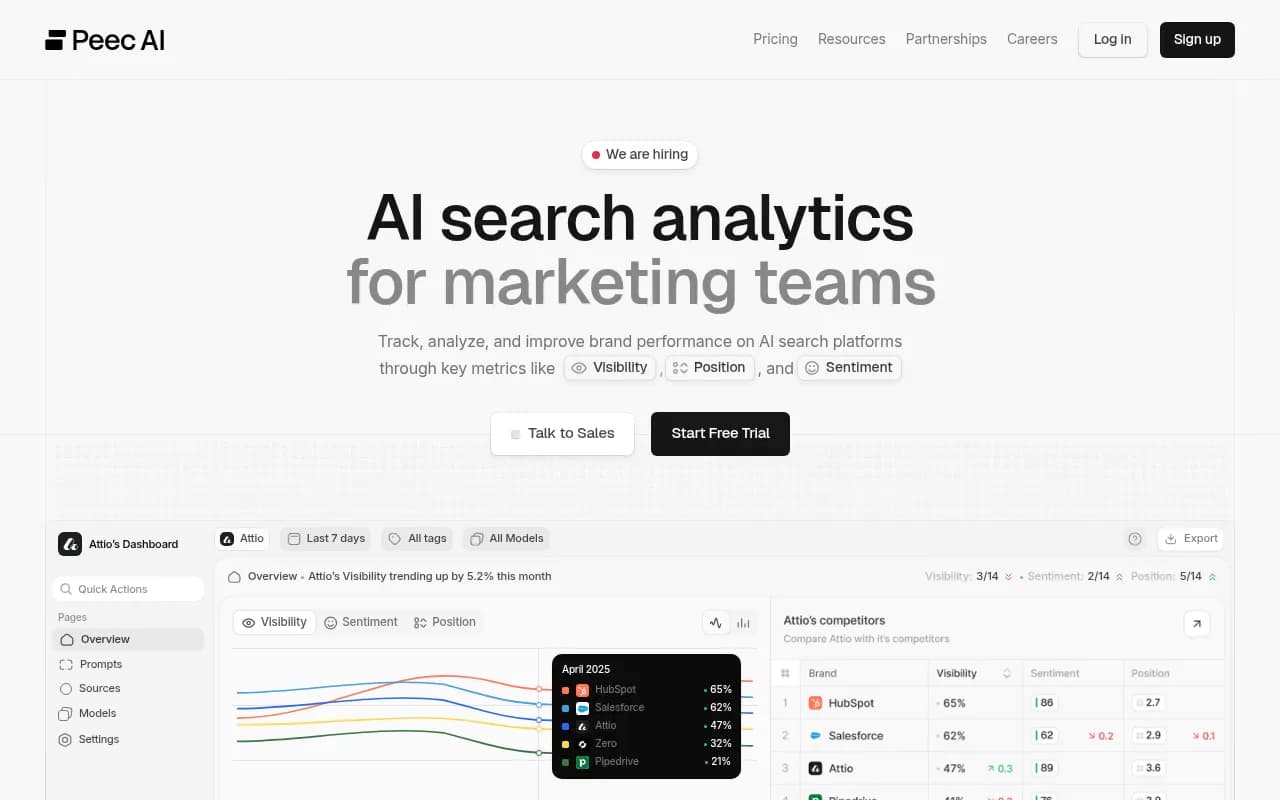
Other options in the same space include Profound, Peec AI and Otterly.AI. For a wider survey, the GEO software directory at bestgeosoftware.com lists many more.
Profound

Otterly.AI

If you are moving off a tool
Migration usually goes better when you plan it as a parallel run rather than a switch.
- Export everything first. Do not wait for the notice email.
- Rebuild your prompt set in the new tool and run both for two to four weeks, so you can compare visibility baselines.
- Expect numbers to differ. Different tools sample different interfaces, locations and personas, so a score of 40 in one is not 40 in another. Compare trends, not absolute values.
- Re-point attribution. Check that analytics, UTM handling and any Shopify or GA4 links still work.
- Record the change date in your reports so nobody misreads a step change in the chart as a real shift in visibility.
For background on what AI visibility metrics mean and how data is collected, Promptwatch's metrics overview and how it collects data guides are useful when you are comparing methodologies.
What we still do not know
The honest answer on all three deals is that the public record is thin. I did not find current pricing, sunset terms, or contract and migration details for any of them. The one hard fact about product status is Hall's: the homepage points to Tracksuit and new sign-ups are not offered. Everything else is either a stated intention in a press release or my own inference.
So here is the stance I would take. Do not panic, and do not wait. Send the questions above, export your data, trial a fallback, and revisit in a quarter. Acquisitions in this category are going to keep happening, and the customers who come out fine are the ones whose data was portable before the announcement.
FAQ
Will AthenaHQ shut down after the Bloomreach acquisition?
Bloomreach's announcement describes AthenaHQ as continuing and says nothing about a sunset, standalone pricing or migration. That is not a promise about the long term. Ask the vendor for written confirmation of what applies to your plan.
Can I still sign up for Hall?
No, based on the vendor's homepage. It says Hall is now part of Tracksuit and sends visitors to a Tracksuit AI visibility waitlist.
Is Scrunch still available on its own?
Sitecore's release does not state standalone availability or pricing. It does say Scrunch's recommendations will be automated inside SitecoreAI products and contrasts its approach with standalone AEO tools, so confirm directly if you are not a Sitecore customer.
What should I do first if my GEO vendor is acquired?
Export your historical data, then read your contract for discontinuation notice, refund terms and change-of-control language. After that, line up a fallback tool and trial it in parallel.