Key takeaways
- Google AI Overviews is far more volatile than traditional SERP rankings — appearing today doesn't mean appearing tomorrow
- Inconsistency is driven by query phrasing, user context, model updates, and Google's own confidence thresholds
- Research from SparkToro confirms AI systems are "highly inconsistent" when recommending brands, even for identical queries
- Tracking AI Overviews like traditional rankings is misleading — you need a different measurement approach
- The fix isn't just monitoring; it's closing the content gaps that cause AI to skip your brand in the first place
If you've been watching your brand pop in and out of Google AI Overviews like a faulty light bulb, you're not imagining things. One week your company appears in a beautifully formatted AI-generated summary. The next week, same query, nothing. A colleague searches from a different device and sees you cited. You search from yours and don't.
This is the AI Overviews instability problem, and it's one of the more frustrating realities of marketing in 2026.
Why AI Overviews behaves differently from traditional rankings
Traditional SEO gave us something relatively stable to work with. A page ranking #3 for a keyword would generally stay around position 3, fluctuating modestly unless something significant changed — a major algorithm update, a competitor publishing a better piece, a technical issue on your site.
AI Overviews doesn't work that way. It's a generative system, not a retrieval ranking. Each time a query fires, Google's AI synthesizes a response by pulling from multiple sources, weighing them against each other, and generating text. The sources it picks, and whether it picks yours, can shift based on dozens of variables.
SEO analyst Daniel Foley Carter documented this directly, noting that AI Overviews are "massively unstable" and significantly more volatile than traditional SERPs. His observation has become a common refrain among practitioners who've tried to track AI Overviews performance the way they track keyword rankings.
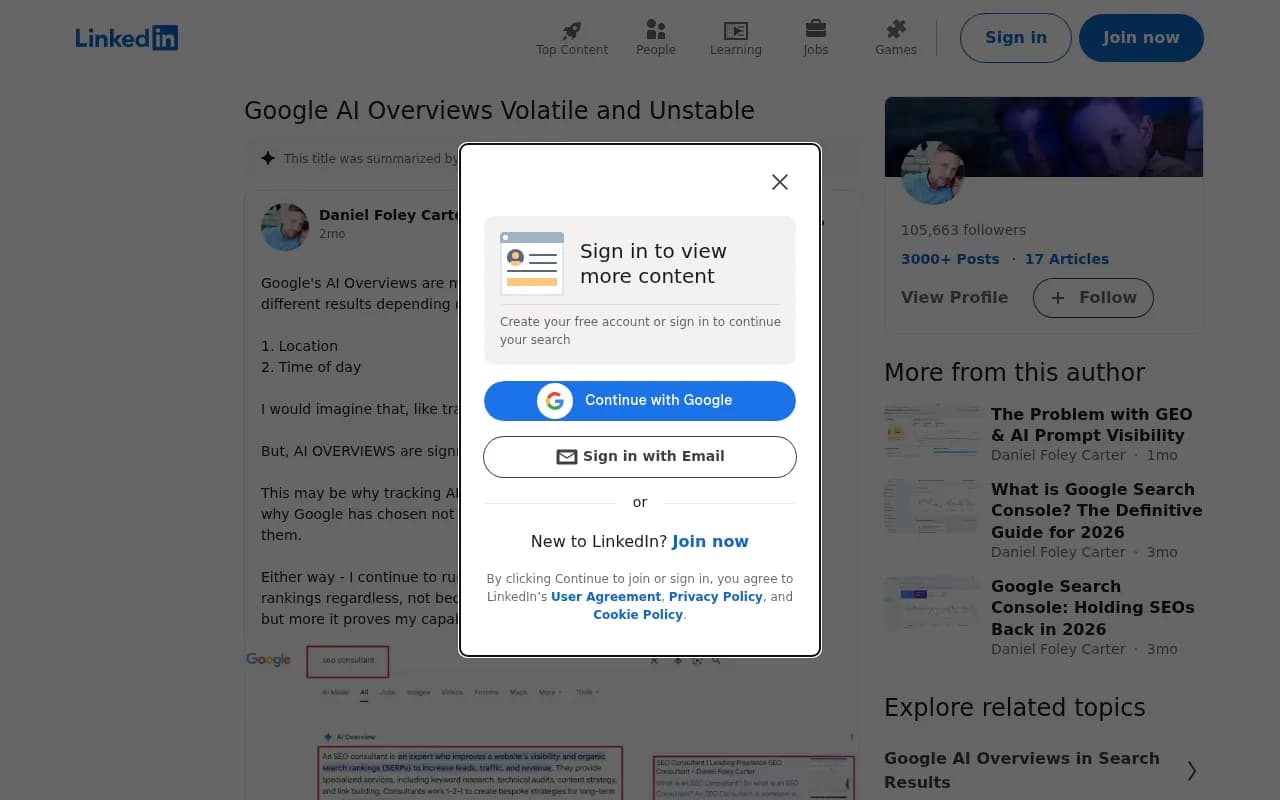
The volatility isn't a bug Google is planning to fix. It's partly structural — generative AI systems produce different outputs based on context, and Google is actively tuning its models, which means the behavior you observe this week may be different next week.
The specific reasons your brand appears inconsistently
Query phrasing changes everything
AI Overviews are highly sensitive to how a question is worded. "Best CRM software for small business" and "CRM tools for small teams" might seem nearly identical, but they can trigger completely different AI responses, citing different brands. Your brand might be authoritative for one phrasing and invisible for another.
This is different from traditional SEO, where a page ranking for one variant often ranks for close variants too. AI systems don't just retrieve — they interpret intent, and small shifts in phrasing can change what the model considers the most relevant answer.
Personalization and context signals
Google's AI Overviews can vary based on the user's search history, location, device, and what Google infers about their intent. A user who has previously searched for enterprise software might see different brand recommendations than someone with no prior context. This means two people searching the exact same query can see completely different AI Overviews — one featuring your brand, one not.
Google's confidence threshold
Google doesn't show an AI Overview for every query. It makes a judgment call about whether the AI can provide a genuinely useful, accurate response. For some queries, it decides the risk of a bad answer is too high and falls back to traditional results. For others, it shows an overview but with different sources depending on how confident the model is in each citation.
Your brand might appear when Google's confidence in your content is above a certain threshold, and disappear when that threshold isn't met — perhaps because a competitor published something more comprehensive, or because Google's model was recently updated and re-evaluated your content's relevance.
Frequent model updates
Google updates its AI systems regularly, and each update can reshuffle which sources get cited. A May 2026 update, for instance, reportedly changed how Google weights certain content types in AI-generated responses. Brands that had stable visibility suddenly saw drops; others that had been invisible started appearing.
This is fundamentally different from a core algorithm update in traditional SEO. Those happen a few times a year and are well-documented. AI model updates can happen more frequently and with less transparency.
The source diversity problem
AI Overviews draw from a wide range of sources — including, as the New York Times noted in April 2026, not just authoritative sites but also social media posts, forums, and other user-generated content. This means your brand might appear when a Reddit thread or YouTube video about you gets cited, and disappear when that content drops out of the model's consideration set.
Why tracking AI Overviews like traditional rankings is misleading
This is worth saying plainly: if you're checking whether your brand appears in AI Overviews by running a few manual searches each week, you're getting a distorted picture.
SparkToro's research on AI brand recommendation consistency found that AI systems are "highly inconsistent" when recommending brands or products — even for identical queries run at different times. The implication for marketers is significant: a single data point (you appeared today) or even a week of data points doesn't tell you much about your actual visibility.
The instability means you need to measure at scale — running the same prompts repeatedly across different times, devices, and contexts to build a statistical picture of your visibility rate, not just a yes/no snapshot.
Tools like Promptwatch are built for exactly this kind of measurement. Rather than giving you a single snapshot, they track how often your brand appears across repeated prompt runs, which gives you a visibility rate that's actually meaningful.

What actually drives consistent AI Overviews visibility
Given all this volatility, what separates brands that appear consistently from those that appear occasionally or not at all?
Comprehensive, authoritative content on specific topics
AI Overviews tend to cite sources that provide clear, direct answers to specific questions. Thin content, content that hedges everything, and content that doesn't actually answer the question the user asked are all poor candidates for citation.
If you want to appear when someone asks "what's the best way to [do X in your category]," you need content that answers that question directly and completely — not a page that mentions the topic in passing.
E-E-A-T signals that AI can actually read
Google's Experience, Expertise, Authoritativeness, and Trustworthiness signals matter for AI Overviews, but the AI reads them differently than traditional ranking algorithms. Author credentials, specific data points, original research, and clear attribution all help signal that your content is worth citing.
Generic content without clear expertise signals is easy for the AI to skip in favor of something that looks more authoritative.
Structured content that's easy to extract
AI systems are better at citing content that's clearly structured. Headers that match question formats, concise definitions, numbered steps, and summary sections all make it easier for the AI to pull a relevant excerpt and attribute it to you.
A long, flowing essay might be excellent writing but a poor citation candidate. A page with clear H2s like "How does X work?" and a direct answer in the first paragraph is much easier for the AI to use.
Being cited in the broader AI ecosystem
Google's AI doesn't just look at your website. It considers the broader information environment — what other sources say about you, whether you're mentioned in authoritative third-party content, and whether your brand appears in the kinds of sources Google's model has learned to trust.
This means your AI Overviews visibility is partly determined by offsite factors: whether you're mentioned in industry publications, whether there are quality YouTube videos about your product, whether Reddit discussions reference you positively.
The content gap problem
Here's the uncomfortable truth for most brands: the reason you appear inconsistently isn't primarily a tracking problem. It's a content problem.
There are specific questions your target customers are asking AI systems where your brand should appear but doesn't — because you don't have content that answers those questions well enough. Competitors who appear more consistently have filled those gaps.
The fix isn't to monitor more carefully. It's to identify which prompts and questions your brand is missing from, understand what content would fill those gaps, and then create it.
This is where the distinction between monitoring tools and optimization platforms matters. Most AI visibility tools will show you that you're not appearing for certain queries. Fewer will tell you exactly what content you'd need to create to fix that, and fewer still will help you create it.
Promptwatch's Answer Gap Analysis does this specifically for AI search — it shows you which prompts competitors are visible for that you're not, and what your site is missing that would let you compete for those citations.
A practical approach to managing AI Overviews instability
Stop treating single data points as signals
One appearance or one disappearance means almost nothing. You need visibility rates across many prompt runs to understand your actual position. Set up systematic tracking rather than manual spot-checks.
Map your content against the questions AI is actually answering
Pull a list of the queries in your category where AI Overviews appear. For each one, look at what sources are being cited and why. What do those pages have that yours doesn't? That gap analysis is your content roadmap.
Prioritize high-volume, high-intent queries
Not all AI Overviews are equal. Focus on the queries where your customers are actually making decisions — comparison queries, "best X for Y" queries, specific how-to questions in your domain. Appearing in AI Overviews for a high-intent query is worth far more than appearing for an informational query with no purchase intent.
Build topical authority, not just individual pages
AI systems reward brands that have comprehensive coverage of a topic. A single great page on a subject is less reliable than a cluster of interconnected content that covers the topic from multiple angles. If you want to be the go-to source for AI when someone asks about your category, you need to cover that category thoroughly.
Track the full picture, not just Google
Google AI Overviews is one channel. ChatGPT, Perplexity, Claude, Gemini, and others are also sending traffic and shaping brand perception. A brand that appears consistently in Perplexity but not in AI Overviews is still getting value — and understanding your visibility across all these platforms gives you a more complete picture of where to invest.
Comparison: how AI visibility tools handle the instability problem
| Tool | Tracks AI Overviews | Visibility rate (not just snapshots) | Content gap analysis | Content generation | Crawler logs |
|---|---|---|---|---|---|
| Promptwatch | Yes | Yes | Yes | Yes | Yes |
| Otterly.AI | Yes | Limited | No | No | No |
| Profound | Yes | Yes | Limited | No | No |
| AthenaHQ | Yes | Yes | No | No | No |
| Semrush | Limited | No | No | No | No |
| LLM Pulse | Yes | Limited | No | No | No |
Otterly.AI

Profound

The instability is real, but it's not random
The volatility in Google AI Overviews can feel arbitrary, but there's usually a logic to it. Brands that appear consistently have done the work: comprehensive content, clear authority signals, structured pages that are easy to cite, and a presence in the broader information ecosystem that AI models have learned to trust.
Brands that appear sporadically are usually in a middle zone — good enough to get cited sometimes, not authoritative enough to get cited reliably. The gap between those two states is almost always a content gap.
The instability problem in 2026 isn't going away. Google will keep updating its models, query sensitivity will remain high, and personalization will keep producing different results for different users. The brands that navigate this well won't be the ones who track it most obsessively — they'll be the ones who use that tracking data to build content that makes them genuinely hard to leave out.