Key takeaways
- Peec AI is a solid monitoring tool for tracking brand visibility across AI search engines, but it stops at the dashboard — it won't tell you what content to create or help you fix citation gaps.
- The platform lacks AI crawler logs, content generation, Reddit/YouTube tracking, and traffic attribution, which are features you need to actually improve your numbers.
- For teams that only need to report on AI visibility, Peec AI is a reasonable choice. For teams that want to move the needle, you need a platform with optimization capabilities built in.
- Promptwatch is the clearest alternative if you want an end-to-end loop: find gaps, generate content, track results.
Peec AI raised $29M and hit $4M ARR in ten months. That's a real product with real traction, not vaporware. And if you've been shopping for an AI visibility tool in 2026, you've almost certainly come across it.
But there's a difference between a tool that shows you what's happening and a tool that helps you change it. Peec AI is firmly in the first category. That's not a knock — monitoring has value. The problem is that most marketing teams buying AI visibility software think they're getting optimization when they're actually getting a dashboard.
This guide breaks down exactly what Peec AI does, where it runs out of road, and what you should use instead if your goal is to actually improve how often AI models recommend your brand.
What Peec AI actually does
Peec AI tracks brand visibility across AI search engines — primarily ChatGPT, Perplexity, and Google AI Overviews. It uses UI scraping to simulate real user queries, then measures how often your brand appears in the responses, which sources get cited, and how your share of voice compares to competitors.

The core metrics you get from Peec AI:
- Citation frequency (how often your brand shows up in AI responses)
- Share of voice vs. competitors for specific prompts
- Source URLs that AI models are pulling from when they mention you
- Basic sentiment analysis on how you're being described
For a B2B marketing team that's never measured AI visibility before, this is genuinely useful. You get a clear answer to "are we showing up when buyers ask ChatGPT about our category?" And in 2026, with 87% of B2B software buyers saying AI chatbots are changing how they research solutions, that's a question worth answering.
Pricing starts at $100/month, which is transparent and accessible compared to enterprise-only competitors like Profound.
Where Peec AI stops short
Here's the honest version: Peec AI is a monitoring tool that was built to show you data, not to help you act on it. That's a meaningful limitation once you've gotten past the initial "are we visible?" question.
No content gap analysis
Peec AI can tell you that a competitor appears in AI responses for a prompt you're missing from. What it can't do is tell you why — which specific content on their site is being cited, what angle they're taking, or what you'd need to write to compete for that prompt. You're left to reverse-engineer that yourself.
No content generation
Once you've identified a gap, you're on your own. Peec AI doesn't have a built-in writing tool, content brief generator, or anything that helps you create the content that would close the gap. You'd need to export your findings and bring in a separate tool.
No AI crawler logs
This is a bigger gap than it sounds. AI crawler logs show you which pages ChatGPT, Claude, Perplexity, and others are actually reading on your site — and which ones they're ignoring or hitting errors on. Without this, you can see that you're not being cited, but you can't diagnose whether it's a crawlability issue, a content quality issue, or something else entirely.
No Reddit or YouTube tracking
AI models don't just cite brand websites. They pull heavily from Reddit threads, YouTube videos, and community discussions. Peec AI doesn't surface these sources, which means you're missing a significant part of the picture when you try to understand why competitors are getting cited and you're not.
No traffic attribution
Knowing your AI visibility score is one thing. Knowing whether that visibility is actually driving traffic and revenue is another. Peec AI doesn't connect citation data to actual site visits or conversions, so you can't close the loop between your AI presence and business outcomes.
Limited prompt intelligence
Peec AI tracks prompts, but it doesn't give you volume estimates, difficulty scores, or query fan-outs (the sub-queries that branch off from a single prompt). That means you're flying somewhat blind when deciding which prompts to prioritize.
Zapier's review of AI visibility tools in 2026 put it plainly: Peec AI is "notably lacking actionable insights, trend data, and AI crawler visibility insights."
The monitoring vs. optimization gap
This is the core issue with Peec AI, and honestly with most tools in this category. The market is full of dashboards that tell you where you're invisible. Very few platforms help you become visible.
Think about what actually needs to happen to improve your AI citation rate:
- You need to know which prompts you're losing and why
- You need to create content that addresses those gaps in a way AI models will actually cite
- You need to track whether that content is working
Peec AI handles a partial version of step one. It doesn't touch steps two or three.
That's not a bug — it's a product decision. Peec AI is built as an analytics layer. But if you're a marketing team with a mandate to improve AI visibility (not just report on it), you'll hit the ceiling of what Peec AI can do pretty quickly.
How the alternatives compare
Here's a direct comparison of Peec AI against the platforms most commonly evaluated alongside it:
| Platform | Citation tracking | Content gap analysis | Content generation | AI crawler logs | Reddit/YouTube tracking | Traffic attribution | Starting price |
|---|---|---|---|---|---|---|---|
| Peec AI | Yes | No | No | No | No | No | ~$100/mo |
| Otterly.AI | Yes | No | No | No | No | No | $29/mo |
| Profound | Yes | Partial | No | No | No | No | Enterprise |
| AthenaHQ | Yes | Partial | No | No | No | No | Enterprise |
| Promptwatch | Yes | Yes | Yes | Yes | Yes | Yes | $99/mo |
Otterly.AI

Profound



A few things stand out from that table. Otterly.AI is cheaper than Peec AI and covers similar ground — it's worth considering if budget is the primary constraint and you genuinely only need monitoring. Profound and AthenaHQ have stronger enterprise feature sets but are priced accordingly and still don't close the loop to content creation.
Promptwatch is the only platform in this comparison that covers the full cycle from gap identification to content generation to traffic attribution. It's also the only one with AI crawler logs and Reddit/YouTube source tracking.
Who Peec AI is actually right for
To be fair: there are teams for whom Peec AI makes sense.
If you're a marketing leader who needs to report upward on AI visibility — to show a CMO or board that you're tracking this channel — Peec AI gives you clean, credible data. The share of voice metrics and competitive comparisons are genuinely useful for that kind of reporting.
If you're early in your AI visibility journey and just need to establish a baseline before deciding on a more comprehensive strategy, Peec AI is a reasonable starting point. The pricing is accessible and the setup is straightforward.
If your team has strong content capabilities in-house and just needs the data layer to inform your own writers and strategists, Peec AI can work as a signal source.
But if you're expecting Peec AI to help you improve your AI visibility — to find the gaps, create the content, and track the results — you'll be disappointed. The tool wasn't built for that.
What to use instead in 2026
The honest answer depends on what you're trying to accomplish.
For monitoring only (budget-conscious)
If you genuinely only need tracking and your budget is tight, Otterly.AI at $29/month covers the basics. It monitors citations across ChatGPT, Gemini, Perplexity, Claude, Copilot, and AI Overviews. It's not going to help you fix anything, but it's a clean, affordable way to stay informed.
Otterly.AI
For monitoring with deeper analytics
If you want more sophisticated competitive analysis and are operating at enterprise scale, Profound has the most mature feature set among monitoring-focused platforms. Expect enterprise pricing.
Profound
For end-to-end optimization
This is where Promptwatch is the clearest recommendation. It's the only platform in the 2026 market that covers the full loop: Answer Gap Analysis shows you exactly which prompts competitors rank for that you don't, a built-in AI writing agent generates content grounded in citation data, and page-level tracking shows you whether that content is working. It also includes AI crawler logs, Reddit and YouTube source tracking, ChatGPT Shopping monitoring, and traffic attribution via GSC integration or server log analysis.
The pricing is also more accessible than you'd expect for this feature set: $99/month for the Essential tier (1 site, 50 prompts, 5 articles), $249/month for Professional (2 sites, 150 prompts, 15 articles, crawler logs), and $579/month for Business (5 sites, 350 prompts, 30 articles). That's a meaningful difference from Profound's enterprise-only model.
For teams that want monitoring plus SEO in one place
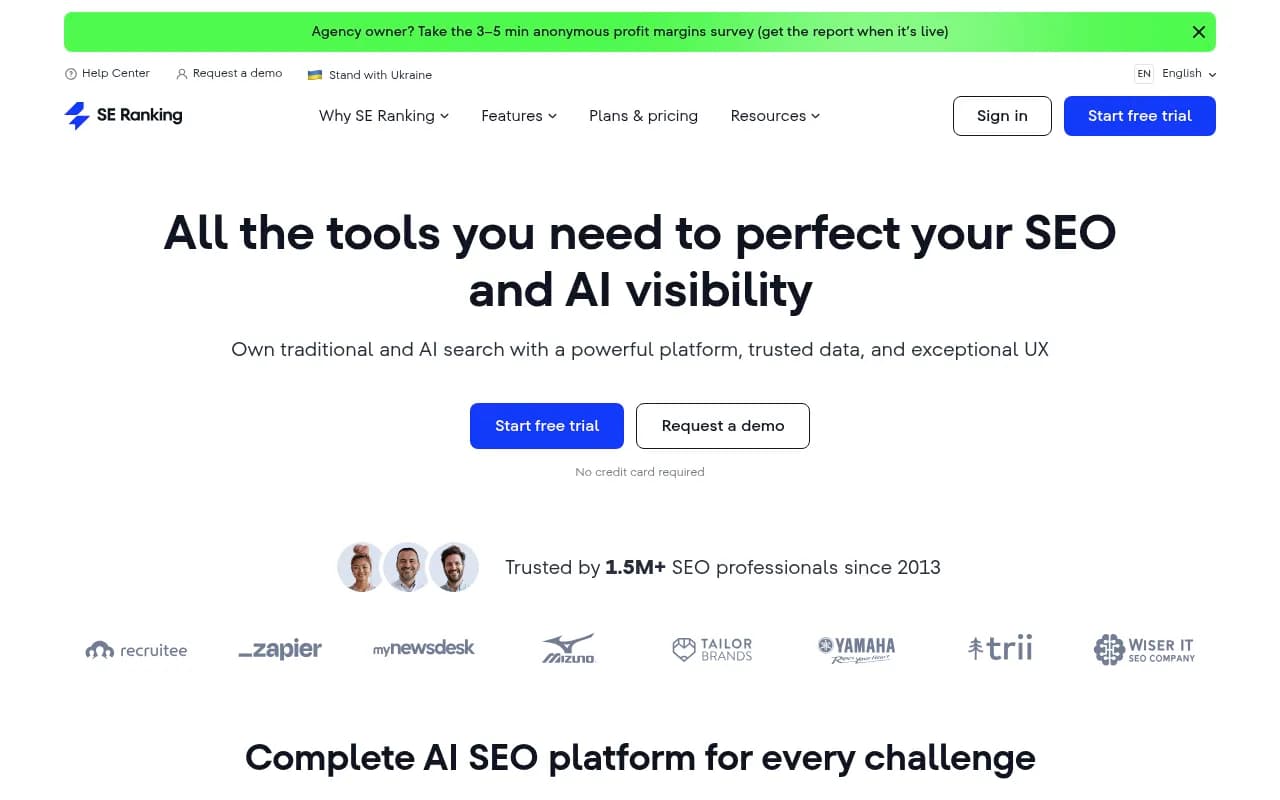
SE Ranking and Semrush both have AI visibility modules bolted onto their traditional SEO platforms. If you're already paying for one of these tools, the AI tracking features are worth exploring. Just know that they use fixed prompt sets and don't offer content generation or traffic attribution for AI search specifically.
The bottom line
Peec AI is a good monitoring tool. It tracks what it says it tracks, the pricing is transparent, and the competitive share of voice data is useful for reporting. If all you need is a dashboard that answers "are we showing up in AI search?", it does that job.
But monitoring is not optimization. Knowing you're invisible in ChatGPT responses doesn't tell you what to do about it. And in 2026, with AI search driving 4-5x higher conversion rates than traditional search according to Conductor's State of AEO/GEO report, "we're tracking it" is not a strategy.
The teams that will win in AI search aren't the ones with the best dashboards. They're the ones that find the gaps, create the content, and close the loop. That requires a platform built around action, not just observation.