Key takeaways
- AthenaHQ tracks AI visibility well but is primarily a monitoring and analytics platform -- it doesn't generate content or close the gaps it finds
- The teams switching away aren't unhappy with the data; they're frustrated that the data doesn't come with a path to action
- Full-stack GEO platforms combine monitoring, content gap analysis, AI content generation, and crawler log insights in one workflow
- Pricing opacity is a recurring complaint -- AthenaHQ's custom enterprise pricing makes it hard to budget, especially for mid-market teams
- Promptwatch is the only platform rated "Leader" across all GEO categories in 2026, specifically because it closes the loop from gap discovery to content creation to citation tracking
The monitoring-only problem
Here's the situation a lot of GEO teams find themselves in: they've got a dashboard full of data. They can see their AI visibility score, their share of voice across ChatGPT and Perplexity, which competitors are getting cited more often. The data is real and it's useful.
And then... nothing happens.
That's the core issue driving the switch away from AthenaHQ in 2026. It's not that the platform is bad at what it does. It's that what it does -- monitoring and analytics -- is only half the job. The other half is fixing the problem, and most monitoring-first platforms leave you to figure that out on your own.
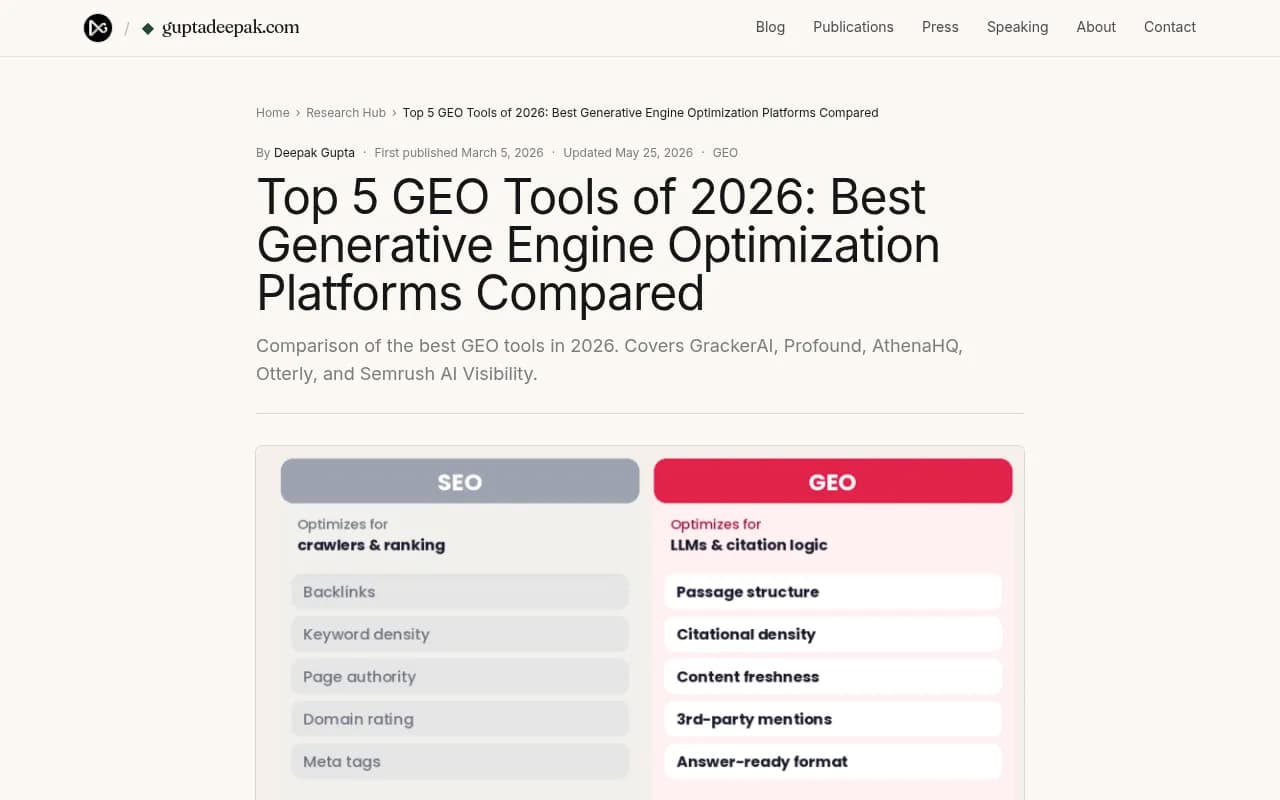
According to a 2026 comparison of GEO platforms by guptadeepak.com, only 12% of URLs that ChatGPT cites currently rank in Google's top 10 search results. That's the business case for GEO in a single number. And it means the content you need to create for AI visibility is almost certainly different from what you've already built for traditional SEO. You need new content, targeted at new prompts, structured in ways AI models actually want to cite.
Knowing you have gaps is step one. Creating the content to fill them is step two. Most teams switching away from AthenaHQ are doing so because they need a platform that does both.
What AthenaHQ actually does well
To be fair about this: AthenaHQ is a genuinely capable platform for what it's designed to do.
It tracks brand mentions and citations across major AI engines -- ChatGPT, Claude, Perplexity, Gemini, and others. It surfaces sentiment analysis, so you can see not just whether you're being mentioned but how AI models are framing your brand. It benchmarks your AI visibility against competitors and identifies which prompts are triggering competitor citations that you're missing.
The content gap analysis is real, too. AthenaHQ can tell you which topics and questions AI models are answering without citing your brand -- which is genuinely useful intelligence.

Where it gets complicated is the "so what." AthenaHQ gives you the diagnosis. The treatment is on you.
The real reasons teams are leaving
1. Gap analysis without content generation
The most common complaint from teams switching away from AthenaHQ isn't about data quality -- it's about workflow. You get a list of content gaps. You export it. You hand it to a writer or an SEO team. They write something. You publish it. You wait. You check back in AthenaHQ to see if anything changed.
That's a lot of manual steps between "we found a gap" and "we closed the gap." In a world where AI search visibility is moving fast and competitors are actively optimizing, that lag matters.
Full-stack platforms have started collapsing this workflow. Instead of gap analysis as a report you act on separately, the gap analysis feeds directly into content generation -- briefs, articles, and structured content built around the exact prompts where you're invisible. The research data, competitor context, and prompt volume data are already baked in.
2. No crawler log visibility
This one is underappreciated. AI models don't just passively read your website -- they crawl it, and the way they crawl it tells you a lot about what they're actually indexing and citing.
AthenaHQ doesn't give you visibility into AI crawler behavior. You can't see which pages GPTBot or ClaudeBot are visiting, how often they return, what errors they're hitting, or whether a page has been crawled but not yet cited. That's a significant blind spot.
If your new content isn't getting cited, you don't know if it's because the AI model hasn't crawled it yet, crawled it and found a technical issue, or crawled it and decided not to cite it. Without crawler logs, you're guessing.
3. Pricing that doesn't scale predictably
AthenaHQ uses custom enterprise pricing, which means you can't look at a pricing page and know what you'll pay. For large enterprise teams with dedicated budgets, that's fine. For mid-market marketing teams, growth-stage SaaS companies, and agencies managing multiple clients, it creates friction.
Several alternatives in the space -- including platforms with transparent monthly pricing -- have picked up customers specifically because teams know what they're getting into before they start a sales conversation.
4. No Reddit or YouTube tracking
This sounds like a niche feature until you understand how AI models actually build their knowledge. Reddit threads, YouTube videos, and third-party review content are heavily cited by AI models -- often more than brand-owned content. If you're not tracking which external sources are driving AI citations in your category, you're missing a significant optimization lever.
AthenaHQ focuses on your owned content and brand mentions. It doesn't surface the Reddit discussions or YouTube videos that are shaping how AI models talk about your space.
5. No traffic attribution
Knowing your AI visibility score went up is satisfying. Knowing it drove a 15% increase in qualified traffic from Perplexity is useful. The difference between those two things is revenue attribution -- connecting AI citations to actual website visits and conversions.
AthenaHQ tracks visibility. It doesn't connect that visibility to traffic or revenue. For teams that need to justify GEO investment to leadership, that's a gap that matters.
What full-stack GEO actually looks like
The platforms teams are moving to in 2026 share a common structure: they treat monitoring as the starting point, not the end point.
The workflow looks like this:
- Track your AI visibility across models and prompts
- Identify specific gaps -- the prompts where competitors are cited and you're not
- Generate content targeted at those gaps, grounded in real prompt data
- Monitor crawler activity to confirm AI models are finding the new content
- Track citations to see which new pages are being referenced and by which models
- Connect citations to traffic and revenue
That's a closed loop. Most monitoring-only tools give you step one and step two. The rest is manual.
How the main alternatives compare
Here's a practical comparison of where AthenaHQ sits relative to the platforms teams are switching to:
| Platform | Monitoring | Content gap analysis | Content generation | Crawler logs | Traffic attribution | Reddit/YouTube tracking | Transparent pricing |
|---|---|---|---|---|---|---|---|
| AthenaHQ | Yes | Yes | No | No | No | No | No (custom) |
| Promptwatch | Yes | Yes | Yes | Yes | Yes | Yes | Yes ($99-$579/mo) |
| Profound | Yes | Partial | No | No | No | No | No (custom) |
| Otterly.AI | Yes | No | No | No | No | No | Yes |
| Peec.ai | Yes | No | No | No | No | No | Yes |
| Search Party | Yes | No | No | No | No | No | Custom |
The pattern is clear. AthenaHQ is stronger than the basic monitoring tools -- it does content gap analysis, which Otterly and Peec don't. But it stops well short of the full-stack platforms that can actually help you create content and track the results.
Promptwatch is the platform that closes the loop most completely, which is why it's the one most teams land on after leaving AthenaHQ. It tracks 10 AI models, surfaces which prompts you're missing, generates content briefs and articles grounded in real prompt data, logs AI crawler activity on your site, and connects citations to traffic attribution.

Specific tools worth evaluating
If you're actively evaluating alternatives, here are the platforms worth a serious look depending on your situation.
For teams that want the full stack
Promptwatch is the obvious starting point. The Essential plan at $99/month covers one site and 50 prompts, which is enough to validate the workflow before committing. The Professional plan at $249/month adds crawler logs, which is where the real technical insight lives.
For teams that need enterprise-grade monitoring with strong analytics
Profound is worth evaluating if your primary need is deep analytics across a large prompt set and you're less focused on content generation.
Profound

For teams on tight budgets that just need basic monitoring
Otterly.AI and Peec.ai both offer transparent pricing and cover the core monitoring use case. They won't help you fix what they find, but if you have a content team that can act on gap data independently, they're a reasonable starting point.
Otterly.AI


For agencies managing multiple clients
Search Party and Rankshift both have agency-oriented features, though neither matches Promptwatch's depth on content generation and crawler visibility.

For teams that want AI visibility alongside traditional SEO
Semrush has added AI search tracking, and Ahrefs has its Brand Radar feature. Neither goes deep on GEO optimization -- they use fixed prompts and don't have AI traffic attribution -- but if you're already paying for one of these platforms, the AI monitoring features are worth exploring before adding a dedicated GEO tool.
Who should stay on AthenaHQ
This isn't a case where everyone should switch. AthenaHQ makes sense if:
- You have a dedicated content team that can act on gap data without needing the platform to generate content
- Your primary need is sentiment analysis and brand framing intelligence across AI models
- You're a large enterprise with a budget that makes custom pricing a non-issue
- You're already deeply embedded in AthenaHQ's workflow and the switching cost outweighs the feature gap
The platform is genuinely good at what it does. The teams leaving aren't leaving because it's broken -- they're leaving because their needs have evolved past monitoring into optimization.
The bottom line
GEO in 2026 is not a monitoring problem. The tools to track AI visibility are mature enough that knowing you have gaps is the easy part. The hard part -- and the part that actually moves the needle -- is closing those gaps with content that AI models want to cite.
AthenaHQ built a strong monitoring product. But the teams winning at AI search right now are the ones using platforms that treat monitoring as the beginning of a workflow, not the end of one. That's the real reason for the switch.
If you're evaluating your options, start by asking one question: does this platform show me what's missing and help me fix it, or does it just show me what's missing? The answer tells you everything about whether it's a monitoring tool or an optimization platform.