Topical Map AI Review 2026
AI-powered topical mapping tool that helps content teams build structured content strategies and generate SEO-friendly topic clusters for better search coverage.
Key takeaways
- Generates 800-1,200 clustered keywords with real search volume data in roughly 60 seconds -- a task that typically takes 10+ hours manually
- Covers five map types: SEO, Social, Product, News, and a general content strategy map, making it more versatile than pure keyword tools
- Starts at $56/month, significantly cheaper than Ahrefs ($129/mo) or Semrush ($139/mo), though it doesn't replace either as a full SEO suite
- White-label PDF export is included on Pro and above -- a genuine differentiator for freelancers delivering client reports
- No AI visibility tracking, no rank monitoring, no backlink data -- this is a content planning tool, not a full SEO platform
Topical Map AI is a focused content strategy tool built by Megan Ragab, a former agency strategist who got tired of spending hours manually clustering keywords for client projects. The pitch is simple: enter a niche, get a complete topical authority map with clustered keywords, search volume data, and content briefs in under two minutes. No spreadsheets, no manual grouping, no waiting on an agency.
The tool sits in a specific gap in the SEO market. Platforms like Ahrefs and Semrush are comprehensive but expensive, and topical mapping is buried inside them as a secondary workflow. Dedicated content planning tools like Surfer SEO or Frase focus on individual article optimization rather than site-wide topic architecture. Topical Map AI does one thing: it builds the structural content map that tells you what to write, in what order, to establish topical authority in a niche.
The target audience is clearly defined on the site -- solo SEOs, freelancers, bloggers, and small agencies who need to deliver content strategies quickly without the overhead of enterprise tooling. It's bootstrapped (no VC funding, per the founder's own note), which means the product roadmap is driven by actual user feedback rather than investor milestones. That's either reassuring or a risk depending on your perspective.
Key features
Topical map generation in 60 seconds
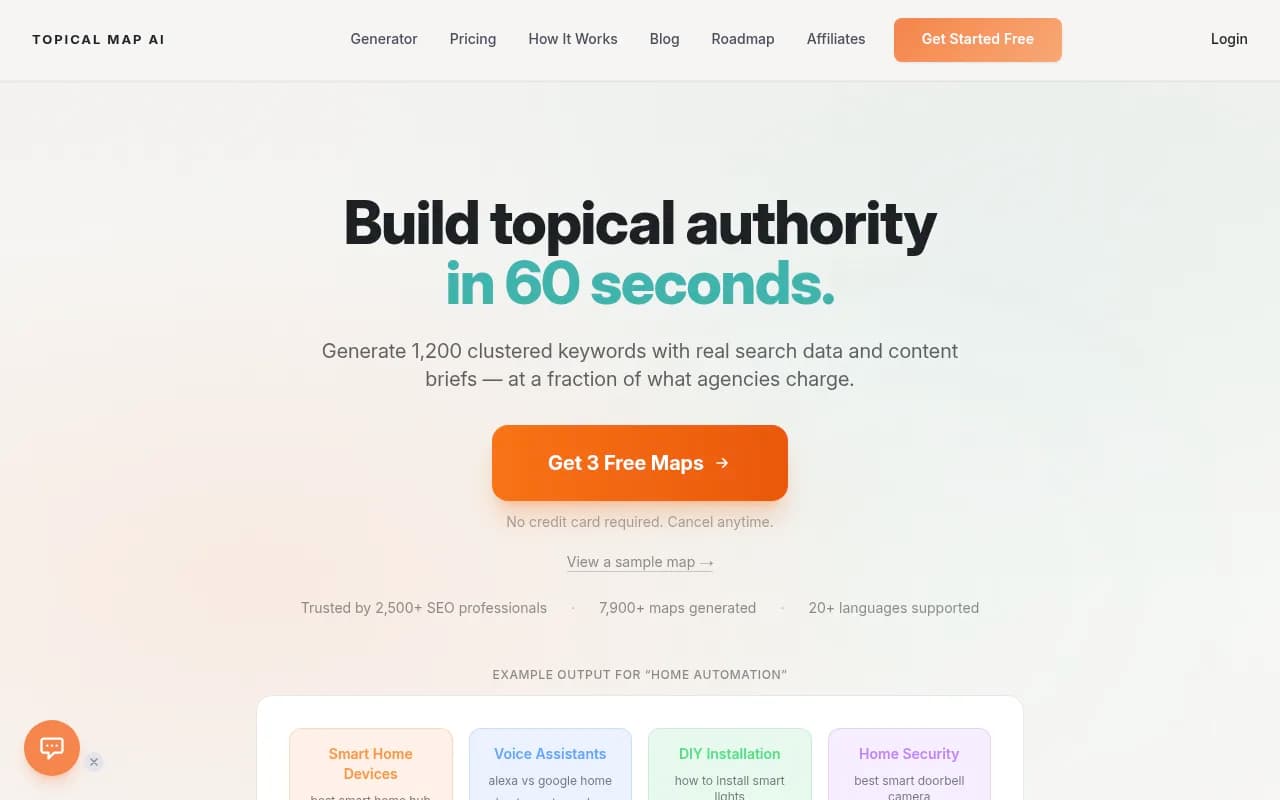
The core feature. You enter a niche or topic, and the AI generates 800-1,200 keywords organized into topical clusters. The example on the homepage shows "Home Automation" producing 1,247 keywords across 16 clusters in 52 seconds -- clusters like Smart Home Devices, Voice Assistants, DIY Installation, and Home Security, each with 50-80+ keywords. In practice, this replaces the manual process of pulling keywords from a tool, exporting to a spreadsheet, and then grouping them by semantic similarity. The AI handles the clustering logic automatically using semantic relationships and search intent signals.
Five map types
Most topical mapping tools assume you're building SEO content. Topical Map AI supports five distinct map types:
- SEO Map: traditional topical authority structure for organic search
- Social Map: viral content planning for social media channels
- Product Map: buyer journey mapping for ecommerce or product launches
- News Map: industry tracking and news content planning
- Content calendar output: 30-day planning structures
This breadth is genuinely useful for content teams that need to plan across channels, not just Google rankings.
Real search volume data via DataForSEO
Keywords come with live search volume, difficulty scores, and competition data sourced from DataForSEO rather than estimates. This matters because some AI content tools generate plausible-sounding keywords that have no actual search demand. Having real metrics attached to each cluster means you can prioritize by volume and difficulty before you start writing.
Content briefs built into every map
For each cluster, you can generate a content brief directly inside the platform without switching to another tool. This is a meaningful workflow improvement -- the brief is contextually aware of the topical map structure, so it can suggest internal linking opportunities and related subtopics that fit the broader architecture.
White-label PDF export
Available on Pro and above, this lets agencies export branded reports with their own logo and branding. The export options include CSV, Excel, and PDF. For freelancers who charge for content strategy audits, this is a direct revenue feature -- the site explicitly positions it as enabling "$2,000 topical audits delivered in 5 minutes."
Bring your own API key
You can connect your own OpenAI API key to reduce costs and maintain control over usage. This is a thoughtful feature for power users who are generating large volumes of maps and want to manage their AI spend independently.
20+ language support across 25+ countries
Maps can be generated in Arabic, Chinese, Portuguese, Spanish, French, German, Italian, Dutch, Russian, Japanese, Korean, and more. Language is selected at map creation time. For agencies running international SEO campaigns, this removes a significant friction point.
Batch generation
Pro plan and above supports generating five maps simultaneously. For agencies onboarding new clients or auditing multiple sites at once, this is a practical time-saver.
Subtopic editing before finalization
Before the full map is generated, you can edit the subtopics the AI proposes. This is a useful quality control step -- if the AI suggests a cluster that's irrelevant to your specific audience, you can remove or modify it before burning a credit on the full generation.
Who is it for
The clearest fit is freelance SEO consultants and content strategists who deliver topical audits and content strategies to clients. If you're charging $1,500-3,000 for a content strategy engagement, being able to produce a professional, white-labeled topical map in under two minutes dramatically changes your margin on that work. The Pro plan at $104/month (monthly) or roughly $87/month (annual) is easy to justify against a single client engagement.
Niche site owners and bloggers are another strong use case. Someone building a content site in a specific vertical -- personal finance, health, travel -- needs to understand the full topical landscape before they start writing. Topical Map AI gives them a structured view of what to cover and in what order, which is exactly the kind of strategic foundation that separates sites that build authority from those that publish randomly and wonder why they don't rank.
Small agencies managing 5-20 client sites are also well-served, particularly on the Business or Agency plans where batch generation and higher map volumes make the economics work. The white-label export means client deliverables look professional without additional design work.
Who should probably look elsewhere: enterprise SEO teams that need deep backlink analysis, rank tracking, technical audits, and content optimization in a single platform. Topical Map AI is explicitly not that. It's a planning tool, not a monitoring or analysis platform. If you need the full stack, you'll still need Ahrefs or Semrush alongside it. The site acknowledges this directly -- "most agencies use TMAI alongside their existing tools, not instead of them."
Integrations and ecosystem
The integration story here is fairly minimal, which is consistent with the tool's focused scope.
Export formats: CSV, Excel, and PDF are the primary output formats. Google Docs export is mentioned in the workflow description on the homepage.
OpenAI API: Bring-your-own-key support for OpenAI means you can route generation through your own account for cost control.
DataForSEO: The underlying keyword data source. Not a user-facing integration, but worth knowing -- it means the search volume data is the same source used by many other SEO tools.
There's no native integration with Ahrefs, Semrush, Google Search Console, or any rank tracking platform. There's no Zapier connection or API documented publicly. For a tool at this price point and stage, that's not surprising, but it does mean the maps live somewhat in isolation from the rest of your SEO stack. You export and then work with the data in whatever tools you already use.
No mobile app is mentioned. The platform appears to be web-based only.
Pricing and value
Topical Map AI uses a tiered subscription model with both monthly and annual billing (annual saves 17%).
The pricing page references a Starter plan starting at $56/month, though the detailed breakdown shown most prominently is the Pro plan at $104/month (monthly billing), described as best for freelancers and growing sites. Pro includes 100 maps per month, all five map types, white-label PDF export, batch generation (5 maps at once), priority support with 24-hour response, 20+ languages, and 25+ countries.
A Business plan and Agency plan are also listed, with the Agency plan presumably covering higher map volumes and additional seats, though specific pricing for those tiers wasn't fully detailed in available information.
The free tier gives you 3 maps with no credit card required, which is enough to evaluate whether the output quality fits your workflow.
The 30-day refund policy applies if you've used fewer than 10 credits, which is a reasonable guarantee for a subscription tool.
Compared to the competition the site benchmarks against: Ahrefs starts at $129/month and Semrush at $139/month, but both are comprehensive platforms where topical mapping is a secondary feature. Surfer SEO starts at $89/month (referenced on the pricing page as "Floyi starts at $99, Surfer starts at $89"). For someone who specifically needs topical mapping and content briefs without the broader SEO suite, Topical Map AI's pricing is genuinely competitive.
The value proposition is clearest for freelancers and small agencies. At $104/month with 100 maps, the per-map cost is about $1. If each map saves 10 hours of manual work, the math is obvious.
Strengths and limitations
What it does well
The speed is real. Generating a structured topical map with 1,000+ keywords in under two minutes is a genuine workflow improvement over manual keyword research and clustering. The output quality -- based on the examples shown and user testimonials from named SEO professionals like Julian Goldie -- appears to be solid for most niches.
The white-label PDF export is a standout feature for freelancers. Most keyword tools don't offer this, and it directly enables client-facing deliverables without additional design work.
The five map types add real versatility. Social and Product maps in particular extend the tool's usefulness beyond pure SEO into broader content strategy, which is increasingly how content teams think about their work.
The bring-your-own-API-key option shows thoughtfulness about cost management for high-volume users.
Limitations
The tool has no rank tracking, no backlink analysis, no technical SEO capabilities, and no AI visibility monitoring. It's a planning tool only -- once you've generated your map and started publishing content, you'll need other tools to measure whether it's working.
There's no keyword import feature yet (listed as "coming soon"). If you have an existing keyword list you want to build a map around, you can only use it as context for the topic input rather than feeding it directly into the system.
The integration ecosystem is thin. No API, no Zapier, no native connections to GSC or rank trackers. For teams that want their content planning data to flow into their broader reporting stack, this requires manual export steps.
The social proof metrics on the homepage show "0+" for SEO professionals and maps generated in some places (likely a display bug or placeholder), while other sections cite 2,500+ users and 7,900+ maps. This inconsistency is a minor credibility issue for a tool positioning itself on trust.
Bottom line
Topical Map AI does a specific job well: it takes a niche topic and produces a structured, keyword-rich content map with real search data in under two minutes. For freelancers delivering content strategy work to clients, or niche site owners who need to plan their content architecture before writing, it's a practical and affordable tool that genuinely saves hours of manual work.
Best use case in one sentence: a freelance SEO consultant who needs to deliver a professional topical authority map to a client in the same day they're briefed on the project.
Tags:
Frequently asked questions
What is Topical Map AI?
How much does Topical Map AI cost?
Is there a free plan?
How does Topical Map AI compare to Ahrefs or Semrush?
Can I use Topical Map AI for client work?
What languages does Topical Map AI support?
Similar and alternative tools to Topical Map AI