Key takeaways
- Surfer SEO is the closest direct competitor to Content Harmony -- similar workflow, stronger AI writing integration, but pricier and heavier on the optimization side vs. brief-building.
- Frase is the best budget-friendly alternative with a genuinely agentic research-to-draft workflow and GEO tracking built in.
- MarketMuse wins on topical authority planning but costs significantly more and is overkill for teams that just need briefs.
- Clearscope is the cleanest, most writer-friendly optimization tool -- great UX, but no brief generation and expensive for small teams.
- Ahrefs and Semrush make sense if you already use them for SEO and want content optimization baked into a broader platform -- not replacements for Content Harmony's brief-focused workflow.
- NeuronWriter is the budget pick for solo operators and small agencies who want solid semantic optimization without paying $100+/mo.
- Search Atlas is worth a look if you want full SEO automation (technical fixes, content, link building) in one place, especially for agencies.
- Promptwatch belongs on this list if your content goal is getting cited by ChatGPT, Claude, and Perplexity -- it goes beyond brief-building into AI search visibility and content gap analysis.
Content Harmony has carved out a specific niche: it's a brief-building machine. The workflow is tight -- keyword report, content brief, content grader -- and teams that have adopted it tend to stick with it because it standardizes a process that used to eat hours of manual research. The content grader alone, which scores drafts against a topic model, is genuinely useful.
So why would someone look for an alternative? A few common reasons:
The pricing model can feel limiting. At $50/mo for 5 workflows or $99/mo for 12, you're paying per brief in a way that doesn't scale well for high-volume content teams. If you're producing 30+ pieces a month, the math gets uncomfortable fast.
Some teams also find the tool narrow. Content Harmony does briefs well, but it doesn't do much else. There's no built-in AI writing, no rank tracking, no backlink data, no AI search visibility monitoring. If you want a more integrated platform, you'll be paying for Content Harmony plus several other tools.
And increasingly, teams are asking a question Content Harmony doesn't really answer: "How do we get cited by ChatGPT and Perplexity?" Traditional SEO brief tools weren't built for that problem.
Here are the best alternatives, broken down honestly.
Surfer SEO
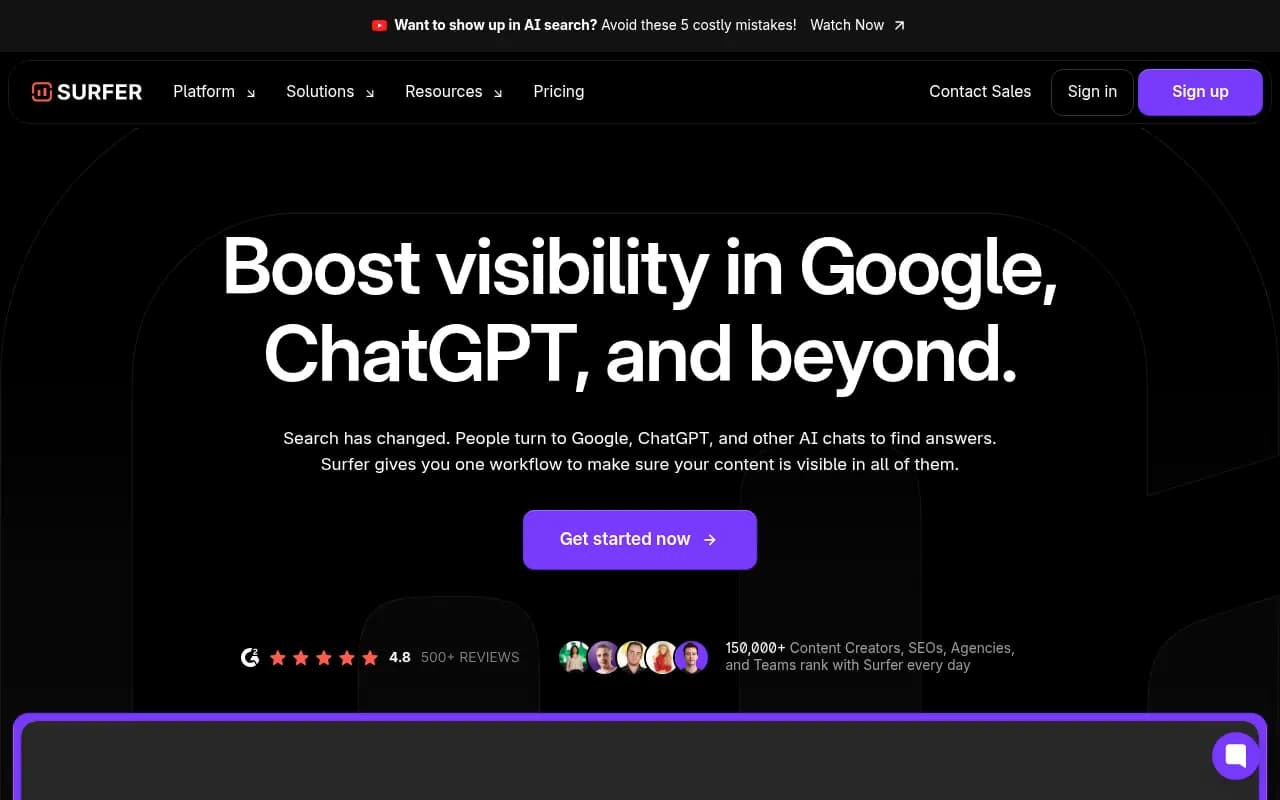
Surfer is probably the most direct competitor to Content Harmony in terms of market positioning. Both tools analyze top-ranking pages, extract keyword and entity data, and help you build content that's optimized for search. But Surfer leans harder into the optimization side -- its Content Editor gives you a real-time score as you write, and the interface is built around the idea that you're writing and optimizing simultaneously rather than building a brief first.
Where Surfer pulls ahead: the AI writing integration is more developed. Surfer AI can generate full drafts, not just outlines, and those drafts are grounded in the same SERP data the optimizer uses. The Topical Map feature also helps with content strategy at a cluster level, which Content Harmony doesn't really offer.
Where Content Harmony holds its own: the brief format